About the Report
Base Year 2024Global Instant Noodles Market Overview
- The Global Instant Noodles Market is valued at approximately USD 58–61 billion, based on a five-year historical analysis, reflecting updated consensus ranges from recent industry trackers . This growth is primarily driven by the increasing demand for convenient and quick meal options, particularly among busy urban populations, and sustained affordability and long shelf life that suit at?home and on?the?go consumption . The rise in disposable income and changing consumer lifestyles have further fueled the market, with innovations such as premium flavors, spicy/K?food trends, and better?for?you variants expanding the consumer base .
- Countries such as China, Japan, and the United States represent key demand markets due to large consumer bases and established production footprints, with Asia-Pacific holding the dominant regional share driven by China’s scale and Japan’s innovation heritage, while the U.S. shows growing interest in premium, international, and health?oriented instant noodle options .
- In 2023, the U.S. government did not enact a new instant?noodle?specific labeling rule; however, ongoing FDA nutrition labeling requirements mandate clear declaration of nutrients such as sodium and fats on packaged foods, and recent nutrition labeling updates continue to drive manufacturers to highlight and reformulate for lower sodium and improved profiles to meet consumer and retailer expectations .
Global Instant Noodles Market Segmentation
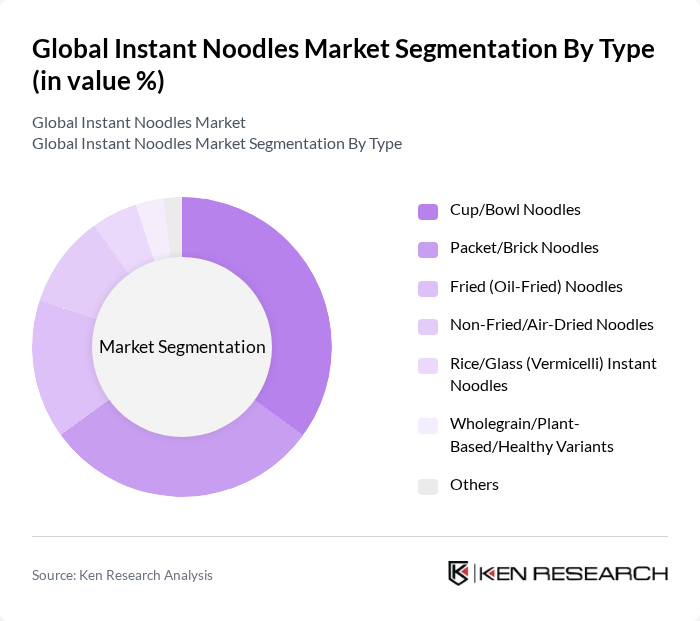
By Type:The market is segmented into various types of instant noodles, including Cup/Bowl Noodles, Packet/Brick Noodles, Fried (Oil-Fried) Noodles, Non-Fried/Air-Dried Noodles, Rice/Glass (Vermicelli) Instant Noodles, Wholegrain/Plant-Based/Healthy Variants, and Others. Among these, Cup/Bowl Noodles have gained significant popularity due to their convenience and variety of flavors, appealing to on-the-go consumers; packet formats also retain strong traction in price?sensitive markets, while non?fried/air?dried and wholegrain/plant?based lines are expanding as health?positioned offerings .
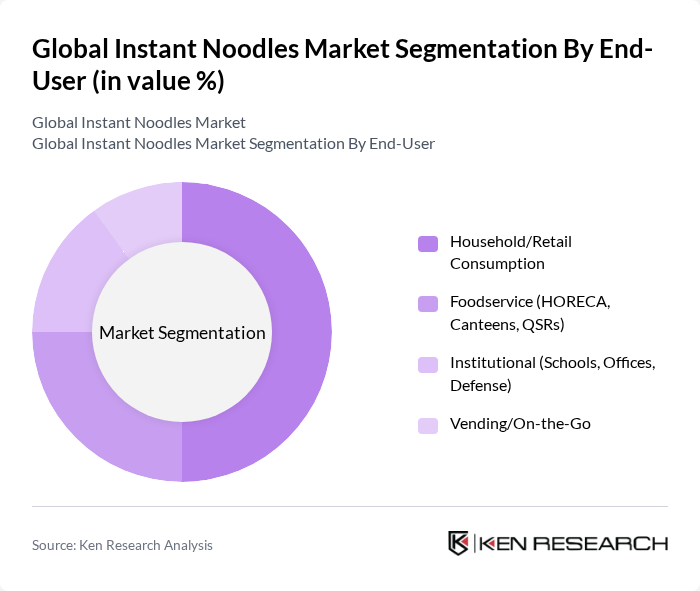
By End-User:The end-user segmentation includes Household/Retail Consumption, Foodservice (HORECA, Canteens, QSRs), Institutional (Schools, Offices, Defense), and Vending/On-the-Go. Household/Retail Consumption is the leading segment, supported by pantry?stocking behavior, convenience?led meals, and the broad retail availability of both cup and packet formats; foodservice channels, including convenience stores and QSRs, are important for ready?to?eat hot cups and impulse consumption .
Global Instant Noodles Market Competitive Landscape
The Global Instant Noodles Market is characterized by a dynamic mix of regional and international players. Leading participants such as Nissin Foods Holdings Co., Ltd., Maruchan, Inc. (Toyo Suisan Group), PT Indofood CBP Sukses Makmur Tbk, Samyang Foods Co., Ltd., Tingyi (Cayman Islands) Holding Corp. (Master Kong), Nestlé S.A. (Maggi), Uni-President Enterprises Corporation, Acecook Vietnam Joint Stock Company, Nongshim Co., Ltd., Sanyo Foods Co., Ltd. (Sapporo Ichiban), Campbell Soup Company (Pacific Foods/Ramen SKUs), Tat Hui Foods Pte Ltd (KOKA), Thai President Foods Public Company Limited (MAMA), Paldo Co., Ltd., Hebei Hualong Food Group, Jinmailang Food Co., Ltd., Baixiang Food Co., Ltd., Uni-Charm/Private Labels (Retail PL Programs) contribute to innovation, geographic expansion, and service delivery in this space.
Global Instant Noodles Market Industry Analysis
Growth Drivers
- Increasing Demand for Convenience Foods:The global demand for convenience foods is projected to reach $1.1 trillion in future, driven by busy lifestyles and the need for quick meal solutions. Instant noodles, being a staple convenience food, are benefiting from this trend. In future, the convenience food sector grew by 6.5%, with instant noodles capturing a significant share due to their affordability and ease of preparation, appealing to time-constrained consumers across various demographics.
- Rising Urbanization and Busy Lifestyles:Urbanization is accelerating, with the UN estimating that 68% of the global population will live in urban areas in future. This shift is leading to increased demand for quick meal options like instant noodles. In metropolitan areas, where the average household size is shrinking, the convenience of instant noodles aligns perfectly with the fast-paced lifestyle of urban dwellers, contributing to a projected increase in consumption by 4.2% annually through future.
- Expansion of Distribution Channels:The expansion of distribution channels, particularly e-commerce, is enhancing the accessibility of instant noodles. In future, online grocery sales surged to $200 billion, with instant noodles being among the top-selling items. Retailers are increasingly adopting omnichannel strategies, allowing consumers to purchase instant noodles conveniently, thus driving sales growth. This trend is expected to continue, with e-commerce projected to account for 25% of total food sales in future.
Market Challenges
- Health Concerns Related to Instant Noodles:Health concerns surrounding instant noodles are significant, with rising awareness about nutrition impacting consumer choices. In future, 45% of consumers expressed concerns over the high sodium content in instant noodles, leading to a decline in consumption in health-conscious demographics. This trend poses a challenge for manufacturers to innovate healthier options while maintaining taste and convenience, as the demand for nutritious food continues to grow.
- Intense Competition Among Key Players:The instant noodles market is characterized by intense competition, with major players like Nissin, Nestlé, and Unilever vying for market share. In future, the top five companies accounted for 60% of the market, leading to price wars and reduced profit margins. This competitive landscape forces companies to continuously innovate and differentiate their products, which can strain resources and impact overall market stability.
Global Instant Noodles Market Future Outlook
The future of the instant noodles market appears promising, driven by evolving consumer preferences and innovative product development. As health-conscious trends continue to rise, manufacturers are likely to focus on creating healthier, plant-based options that cater to diverse dietary needs. Additionally, the growth of e-commerce and online food delivery services will further enhance market accessibility, allowing consumers to explore a wider range of instant noodle products conveniently, thus fostering sustained growth in the sector.
Market Opportunities
- Growth in Emerging Markets:Emerging markets, particularly in Asia and Africa, present significant growth opportunities for instant noodles. With a combined population exceeding 3 billion, these regions are experiencing rising disposable incomes and urbanization, leading to increased demand for convenient food options. This demographic shift is expected to drive a 5% annual growth rate in instant noodle consumption through future.
- Introduction of Healthier Options:The introduction of healthier instant noodle options, such as whole grain and low-sodium varieties, is a key opportunity for market players. As consumer preferences shift towards healthier eating, companies that innovate and offer nutritious alternatives can capture a larger market share. This trend is supported by a 30% increase in demand for health-oriented food products in future, indicating a strong market potential for healthier instant noodles.
Scope of the Report
| Segment | Sub-Segments |
|---|---|
| By Type | Cup/Bowl Noodles Packet/Brick Noodles Fried (Oil-Fried) Noodles Non-Fried/Air-Dried Noodles Rice/Glass (Vermicelli) Instant Noodles Wholegrain/Plant?Based/Healthy Variants Others |
| By End-User | Household/Retail Consumption Foodservice (HORECA, Canteens, QSRs) Institutional (Schools, Offices, Defense) Vending/On?the?Go |
| By Distribution Channel | Supermarkets/Hypermarkets Convenience Stores Specialty/Grocery & Mom?and?Pop Stores Online Retail/E?commerce Foodservice Distributors/Cash & Carry |
| By Flavor | Chicken/Poultry Beef/Pork Seafood Vegetarian/Vegan Spicy/Chili Regional/Localized (e.g., Tom Yum, Curry, Kimchi) Others |
| By Packaging Type | Plastic/Laminated Pouches Cups (Plastic/Paper) Bowls/Trays Multipacks/Family Packs Eco?friendly/Compostable Packaging |
| By Price Range | Economy Mid-Range Premium |
| By Region | Asia-Pacific North America Europe Latin America Middle East & Africa |
Key Target Audience
Investors and Venture Capitalist Firms
Government and Regulatory Bodies (e.g., Food and Drug Administration, Ministry of Health)
Manufacturers and Producers
Distributors and Retailers
Food Safety Authorities (e.g., European Food Safety Authority)
Packaging Suppliers
Market Analysts and Industry Experts
Logistics and Supply Chain Companies
Players Mentioned in the Report:
Nissin Foods Holdings Co., Ltd.
Maruchan, Inc. (Toyo Suisan Group)
PT Indofood CBP Sukses Makmur Tbk
Samyang Foods Co., Ltd.
Tingyi (Cayman Islands) Holding Corp. (Master Kong)
Nestle S.A. (Maggi)
Uni-President Enterprises Corporation
Acecook Vietnam Joint Stock Company
Nongshim Co., Ltd.
Sanyo Foods Co., Ltd. (Sapporo Ichiban)
Campbell Soup Company (Pacific Foods/Ramen SKUs)
Tat Hui Foods Pte Ltd (KOKA)
Thai President Foods Public Company Limited (MAMA)
Paldo Co., Ltd.
Hebei Hualong Food Group
Jinmailang Food Co., Ltd.
Baixiang Food Co., Ltd.
Uni-Charm/Private Labels (Retail PL Programs)
Table of Contents
Market Assessment Phase
1. Executive Summary and Approach
2. Global Instant Noodles Market Overview
2.1 Key Insights and Strategic Recommendations
2.2 Global Instant Noodles Market Overview
2.3 Definition and Scope
2.4 Evolution of Market Ecosystem
2.5 Timeline of Key Regulatory Milestones
2.6 Value Chain & Stakeholder Mapping
2.7 Business Cycle Analysis
2.8 Policy & Incentive Landscape
3. Global Instant Noodles Market Analysis
3.1 Growth Drivers
3.1.1 Increasing Demand for Convenience Foods
3.1.2 Rising Urbanization and Busy Lifestyles
3.1.3 Expansion of Distribution Channels
3.1.4 Innovative Product Offerings
3.2 Market Challenges
3.2.1 Health Concerns Related to Instant Noodles
3.2.2 Intense Competition Among Key Players
3.2.3 Fluctuating Raw Material Prices
3.2.4 Regulatory Compliance Issues
3.3 Market Opportunities
3.3.1 Growth in Emerging Markets
3.3.2 Introduction of Healthier Options
3.3.3 E-commerce Growth
3.3.4 Collaborations and Partnerships
3.4 Market Trends
3.4.1 Increasing Popularity of Plant-Based Noodles
3.4.2 Rise of Gourmet Instant Noodles
3.4.3 Focus on Sustainable Packaging
3.4.4 Growth of Online Food Delivery Services
3.5 Government Regulation
3.5.1 Food Safety Standards
3.5.2 Labeling Requirements
3.5.3 Import Tariffs and Trade Policies
3.5.4 Nutritional Guidelines
4. SWOT Analysis
5. Stakeholder Analysis
6. Porter's Five Forces Analysis
7. Global Instant Noodles Market Market Size, 2019-2024
7.1 By Value
7.2 By Volume
7.3 By Average Selling Price
8. Global Instant Noodles Market Segmentation
8.1 By Type
8.1.1 Cup/Bowl Noodles
8.1.2 Packet/Brick Noodles
8.1.3 Fried (Oil-Fried) Noodles
8.1.4 Non-Fried/Air-Dried Noodles
8.1.5 Rice/Glass (Vermicelli) Instant Noodles
8.1.6 Wholegrain/Plant?Based/Healthy Variants
8.1.7 Others
8.2 By End-User
8.2.1 Household/Retail Consumption
8.2.2 Foodservice (HORECA, Canteens, QSRs)
8.2.3 Institutional (Schools, Offices, Defense)
8.2.4 Vending/On?the?Go
8.3 By Distribution Channel
8.3.1 Supermarkets/Hypermarkets
8.3.2 Convenience Stores
8.3.3 Specialty/Grocery & Mom?and?Pop Stores
8.3.4 Online Retail/E?commerce
8.3.5 Foodservice Distributors/Cash & Carry
8.4 By Flavor
8.4.1 Chicken/Poultry
8.4.2 Beef/Pork
8.4.3 Seafood
8.4.4 Vegetarian/Vegan
8.4.5 Spicy/Chili
8.4.6 Regional/Localized (e.g., Tom Yum, Curry, Kimchi)
8.4.7 Others
8.5 By Packaging Type
8.5.1 Plastic/Laminated Pouches
8.5.2 Cups (Plastic/Paper)
8.5.3 Bowls/Trays
8.5.4 Multipacks/Family Packs
8.5.5 Eco?friendly/Compostable Packaging
8.6 By Price Range
8.6.1 Economy
8.6.2 Mid-Range
8.6.3 Premium
8.7 By Region
8.7.1 Asia-Pacific
8.7.2 North America
8.7.3 Europe
8.7.4 Latin America
8.7.5 Middle East & Africa
9. Global Instant Noodles Market Competitive Analysis
9.1 Market Share of Key Players
9.2 Cross Comparison of Key Players
9.2.1 Company Name
9.2.2 Group Size (Global, Regional, or Local Player)
9.2.3 Global Instant Noodles Revenue (USD) and Growth Rate (YoY/CAGR)
9.2.4 Volume Sold (billion servings) and Market Share (%)
9.2.5 Geographic Footprint (No. of Countries/Key Regions)
9.2.6 Product Portfolio Breadth (Formats, Fried vs. Non?Fried, Flavor Range)
9.2.7 Health & Innovation KPIs (Low?sodium/Sugar, Wholegrain/Protein, Certifications)
9.2.8 Pricing Architecture (Economy/Mid/Premium Mix, ASP)
9.2.9 Distribution Coverage (Modern Trade, Convenience, E?commerce, Foodservice)
9.2.10 Brand Equity/Recognition (Index/Surveys, Social Share of Voice)
9.2.11 Supply Chain Metrics (Manufacturing Sites, Local Sourcing %, Lead Time/OTIF)
9.2.12 Sustainability Metrics (Recyclable Packaging %, GHG/ton, Palm Oil Sourcing)
9.3 SWOT Analysis of Top Players
9.4 Pricing Analysis
9.5 Detailed Profile of Major Companies
9.5.1 Nissin Foods Holdings Co., Ltd.
9.5.2 Maruchan, Inc. (Toyo Suisan Group)
9.5.3 PT Indofood CBP Sukses Makmur Tbk
9.5.4 Samyang Foods Co., Ltd.
9.5.5 Tingyi (Cayman Islands) Holding Corp. (Master Kong)
9.5.6 Nestlé S.A. (Maggi)
9.5.7 Uni-President Enterprises Corporation
9.5.8 Acecook Vietnam Joint Stock Company
9.5.9 Nongshim Co., Ltd.
9.5.10 Sanyo Foods Co., Ltd. (Sapporo Ichiban)
9.5.11 Campbell Soup Company (Pacific Foods/Ramen SKUs)
9.5.12 Tat Hui Foods Pte Ltd (KOKA)
9.5.13 Thai President Foods Public Company Limited (MAMA)
9.5.14 Paldo Co., Ltd.
9.5.15 Hebei Hualong Food Group
9.5.16 Jinmailang Food Co., Ltd.
9.5.17 Baixiang Food Co., Ltd.
9.5.18 Uni-Charm/Private Labels (Retail PL Programs)
10. Global Instant Noodles Market End-User Analysis
10.1 Procurement Behavior of Key Ministries
10.1.1 Bulk Purchasing Trends
10.1.2 Preference for Local Suppliers
10.1.3 Budget Allocation for Food Products
10.1.4 Compliance with Nutritional Standards
10.2 Corporate Spend on Infrastructure & Energy
10.2.1 Investment in Food Processing Facilities
10.2.2 Expenditure on Supply Chain Optimization
10.2.3 Budget for Marketing and Branding
10.3 Pain Point Analysis by End-User Category
10.3.1 Quality Assurance Issues
10.3.2 Supply Chain Disruptions
10.3.3 Price Sensitivity Among Consumers
10.4 User Readiness for Adoption
10.4.1 Awareness of Instant Noodle Varieties
10.4.2 Acceptance of New Flavors
10.4.3 Willingness to Pay for Premium Products
10.5 Post-Deployment ROI and Use Case Expansion
10.5.1 Evaluation of Sales Performance
10.5.2 Customer Feedback Mechanisms
10.5.3 Opportunities for Product Line Extensions
11. Global Instant Noodles Market Future Size, 2025-2030
11.1 By Value
11.2 By Volume
11.3 By Average Selling Price
Go-To-Market Strategy Phase
1. Whitespace Analysis + Business Model Canvas
1.1 Market Gaps Identification
1.2 Value Proposition Development
1.3 Revenue Streams Analysis
1.4 Customer Segmentation
1.5 Key Partnerships
1.6 Cost Structure Analysis
1.7 Channels of Distribution
2. Marketing and Positioning Recommendations
2.1 Branding Strategies
2.2 Product USPs
2.3 Target Audience Identification
2.4 Marketing Channels
2.5 Promotional Activities
3. Distribution Plan
3.1 Urban Retail Strategies
3.2 Rural NGO Tie-ups
3.3 E-commerce Integration
3.4 Logistics Optimization
4. Channel & Pricing Gaps
4.1 Underserved Routes
4.2 Pricing Bands Analysis
4.3 Competitor Pricing Strategies
5. Unmet Demand & Latent Needs
5.1 Category Gaps
5.2 Consumer Segments
5.3 Product Development Opportunities
6. Customer Relationship
6.1 Loyalty Programs
6.2 After-sales Service
6.3 Customer Engagement Strategies
7. Value Proposition
7.1 Sustainability Initiatives
7.2 Integrated Supply Chains
7.3 Customer-Centric Innovations
8. Key Activities
8.1 Regulatory Compliance
8.2 Branding Efforts
8.3 Distribution Setup
9. Entry Strategy Evaluation
9.1 Domestic Market Entry Strategy
9.1.1 Product Mix Considerations
9.1.2 Pricing Band Strategy
9.1.3 Packaging Innovations
9.2 Export Entry Strategy
9.2.1 Target Countries Identification
9.2.2 Compliance Roadmap Development
10. Entry Mode Assessment
10.1 Joint Ventures
10.2 Greenfield Investments
10.3 Mergers & Acquisitions
10.4 Distributor Model Evaluation
11. Capital and Timeline Estimation
11.1 Capital Requirements
11.2 Timelines for Implementation
12. Control vs Risk Trade-Off
12.1 Ownership vs Partnerships
13. Profitability Outlook
13.1 Breakeven Analysis
13.2 Long-term Sustainability Strategies
14. Potential Partner List
14.1 Distributors
14.2 Joint Ventures
14.3 Acquisition Targets
15. Execution Roadmap
15.1 Phased Plan for Market Entry
15.1.1 Market Setup
15.1.2 Market Entry
15.1.3 Growth Acceleration
15.1.4 Scale & Stabilize
15.2 Key Activities and Milestones
15.2.1 Milestone Planning
15.2.2 Activity Tracking
Research Methodology
Phase 1: Approach1
Desk Research
- Analysis of global market reports from industry associations and trade publications
- Review of company annual reports and financial statements of leading instant noodle manufacturers
- Examination of consumer behavior studies and market trends from food research organizations
Primary Research
- Interviews with product development managers at major instant noodle brands
- Surveys with distributors and retailers to understand market dynamics and consumer preferences
- Focus group discussions with consumers to gather insights on flavor preferences and packaging trends
Validation & Triangulation
- Cross-validation of data from multiple sources including trade publications and consumer surveys
- Triangulation of market size estimates using sales data and production statistics
- Sanity checks through expert panel reviews comprising industry veterans and market analysts
Phase 2: Market Size Estimation1
Top-down Assessment
- Estimation of market size based on global food expenditure and instant noodle consumption trends
- Segmentation by region, product type, and distribution channel to identify key growth areas
- Incorporation of macroeconomic factors such as GDP growth and urbanization rates influencing demand
Bottom-up Modeling
- Collection of sales volume data from key players in the instant noodle market
- Estimation of average selling prices across different product categories and regions
- Calculation of market size based on volume x price for each segment
Forecasting & Scenario Analysis
- Multi-variable forecasting using historical sales data and projected consumer trends
- Scenario analysis based on potential impacts of health trends and dietary shifts on instant noodle consumption
- Development of baseline, optimistic, and pessimistic forecasts through 2030
Phase 3: CATI Sample Composition1
| Scope Item/Segment | Sample Size | Target Respondent Profiles |
|---|---|---|
| Retail Market Insights | 120 | Store Managers, Category Buyers |
| Consumer Preferences Survey | 140 | Frequent Instant Noodle Consumers, Food Enthusiasts |
| Distribution Channel Analysis | 100 | Wholesale Distributors, Logistics Coordinators |
| Product Development Feedback | 80 | R&D Managers, Flavor Specialists |
| Market Trend Evaluation | 110 | Market Analysts, Food Industry Experts |
Frequently Asked Questions
What is the current value of the Global Instant Noodles Market?
The Global Instant Noodles Market is valued at approximately USD 5861 billion, reflecting a significant demand for convenient meal options, particularly among busy urban populations. This market growth is supported by innovations in flavors and healthier variants.
Which regions dominate the Global Instant Noodles Market?
What are the main types of instant noodles available in the market?
What are the primary end-user segments for instant noodles?
Other Regional/Country Reports
Indonesia Instant Noodles Market
Malaysia Instant Noodles Market
APAC Instant Noodles Market
Why Buy From Us?

What makes us stand out is that our consultants follow Robust, Refine and Result (RRR) methodology. Robust for clear definitions, approaches and sanity checking, Refine for differentiating respondents' facts and opinions, and Result for presenting data with story.

We have set a benchmark in the industry by offering our clients with syndicated and customized market research reports featuring coverage of entire market as well as meticulous research and analyst insights.

While we don't replace traditional research, we flip the method upside down. Our dual approach of Top Bottom & Bottom Top ensures quality deliverable by not just verifying company fundamentals but also looking at the sector and macroeconomic factors.

With one step in the future, our research team constantly tries to show you the bigger picture. We help with some of the tough questions you may encounter along the way: How is the industry positioned? Best marketing channel? KPI's of competitors? By aligning every element, we help maximize success.

Our report gives you instant access to the answers and sources that other companies might choose to hide. We elaborate each steps of research methodology we have used and showcase you the sample size to earn your trust.

If you need any support, we are here! We pride ourselves on universe strength, data quality, and quick, friendly, and professional service.