Region:Global
Author(s):Dev
Product Code:KRAA3042
Pages:96
Published On:August 2025
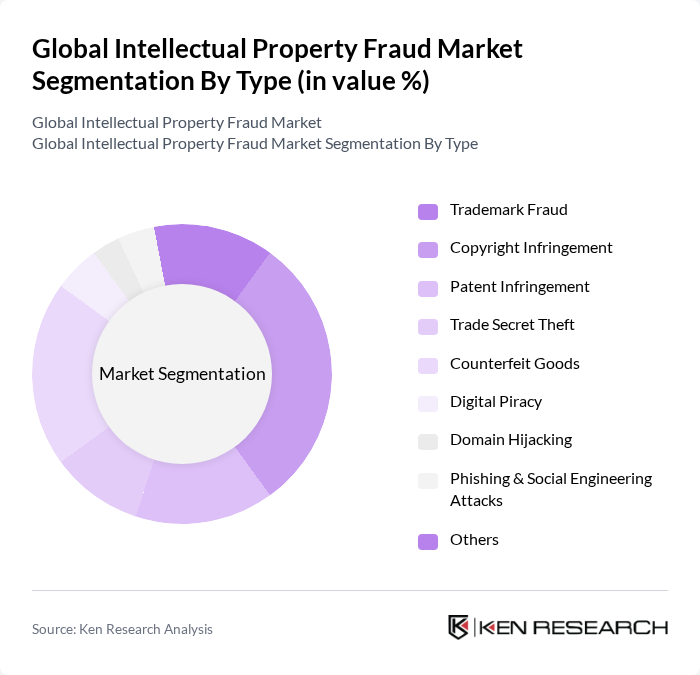
By Type:The market is segmented into various types of intellectual property fraud, including Trademark Fraud, Copyright Infringement, Patent Infringement, Trade Secret Theft, Counterfeit Goods, Digital Piracy, Domain Hijacking, Phishing & Social Engineering Attacks, and Others. Among these, Copyright Infringement and Counterfeit Goods remain the most significant contributors to market growth, driven by the rapid expansion of digital content, online shopping, and the increasing sophistication of fraudulent schemes targeting intellectual property assets.
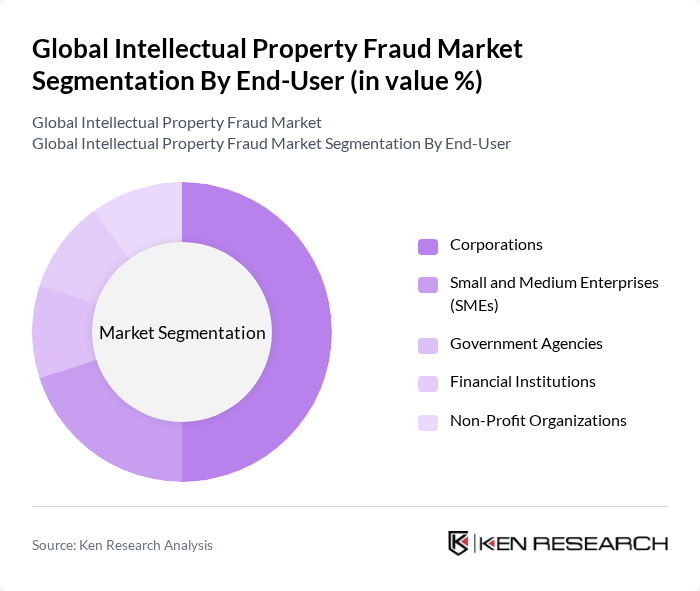
By End-User:The end-user segmentation includes Corporations, Small and Medium Enterprises (SMEs), Government Agencies, Financial Institutions, and Non-Profit Organizations. Corporations are the leading end-users, as they face significant risks from intellectual property fraud and are increasingly investing in advanced protective measures, such as automated monitoring, legal enforcement, and digital rights management, to safeguard their assets in an evolving threat landscape.
The Global Intellectual Property Fraud Market is characterized by a dynamic mix of regional and international players. Leading participants such as Experian Information Solutions, Inc., Clarivate Plc, Mintz Group LLC, LexOrbis, AA Thornton, Deloitte, PwC, KPMG, EY, Baker McKenzie, Hogan Lovells, Finnegan, Fish & Richardson, Jones Day, Sidley Austin, Norton Rose Fulbright, Latham & Watkins, Morrison & Foerster, WilmerHale, Ropes & Gray contribute to innovation, geographic expansion, and service delivery in this space.
The future of the intellectual property fraud market is poised for significant evolution, driven by technological advancements and increasing regulatory scrutiny. As businesses adopt artificial intelligence and machine learning for fraud detection, the efficiency of identifying and mitigating IP fraud will improve. Additionally, the growing collaboration between private sectors and law enforcement agencies will enhance enforcement capabilities, creating a more robust framework for IP protection. This synergy is expected to foster innovation and resilience in combating IP fraud.
| Segment | Sub-Segments |
|---|---|
| By Type | Trademark Fraud Copyright Infringement Patent Infringement Trade Secret Theft Counterfeit Goods Digital Piracy Domain Hijacking Phishing & Social Engineering Attacks Others |
| By End-User | Corporations Small and Medium Enterprises (SMEs) Government Agencies Financial Institutions Non-Profit Organizations |
| By Industry | Technology Pharmaceuticals Entertainment & Media Fashion & Luxury Goods Manufacturing Consumer Goods Others |
| By Geographic Scope | North America Europe Asia-Pacific Latin America Middle East & Africa |
| By Fraud Detection Method | Manual Monitoring Automated Software Solutions AI-Based Detection Systems Blockchain-Based Authentication Third-Party Services |
| By Legal Framework | National Laws International Treaties Industry Standards |
| By Policy Support | Government Subsidies Tax Incentives Public Awareness Campaigns |
| Scope Item/Segment | Sample Size | Target Respondent Profiles |
|---|---|---|
| Pharmaceutical Industry IP Fraud | 100 | Compliance Officers, Legal Advisors |
| Technology Sector IP Infringement | 60 | IP Managers, R&D Directors |
| Consumer Goods Brand Protection | 55 | Brand Managers, Marketing Executives |
| Entertainment Industry Copyright Issues | 45 | Content Creators, Legal Counsel |
| Fashion Industry Counterfeit Challenges | 50 | Product Development Managers, Brand Protection Specialists |
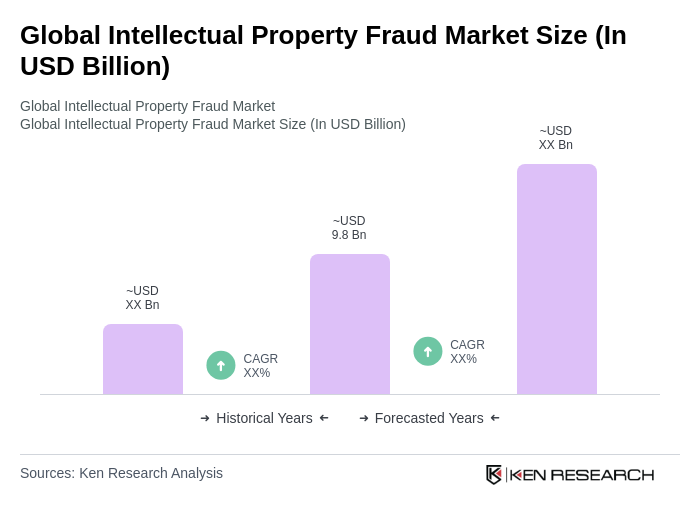
The Global Intellectual Property Fraud Market is valued at approximately USD 9.8 billion, reflecting significant growth driven by the rise of digital content, e-commerce, and increased awareness of intellectual property rights among businesses and consumers.

What makes us stand out is that our consultants follow Robust, Refine and Result (RRR) methodology. Robust for clear definitions, approaches and sanity checking, Refine for differentiating respondents' facts and opinions, and Result for presenting data with story.

We have set a benchmark in the industry by offering our clients with syndicated and customized market research reports featuring coverage of entire market as well as meticulous research and analyst insights.

While we don't replace traditional research, we flip the method upside down. Our dual approach of Top Bottom & Bottom Top ensures quality deliverable by not just verifying company fundamentals but also looking at the sector and macroeconomic factors.

With one step in the future, our research team constantly tries to show you the bigger picture. We help with some of the tough questions you may encounter along the way: How is the industry positioned? Best marketing channel? KPI's of competitors? By aligning every element, we help maximize success.

Our report gives you instant access to the answers and sources that other companies might choose to hide. We elaborate each steps of research methodology we have used and showcase you the sample size to earn your trust.

If you need any support, we are here! We pride ourselves on universe strength, data quality, and quick, friendly, and professional service.













