Global Internet Of Cars Market

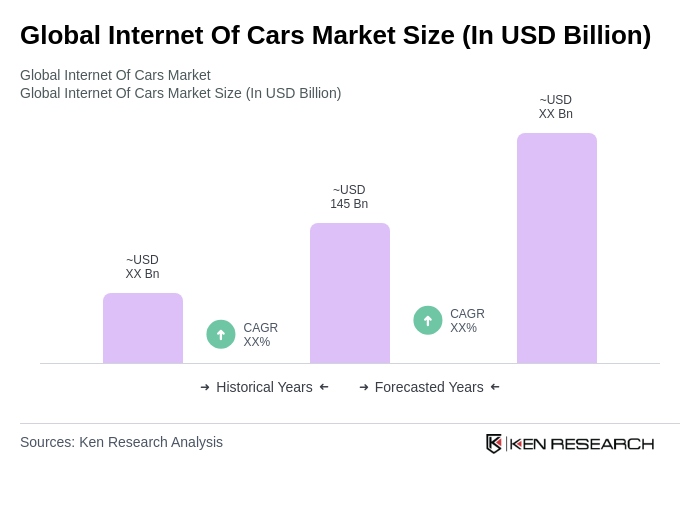
The Global Internet of Cars Market, valued at USD 145 billion, is set for 20% CAGR growth, fueled by telematics, 5G, and EV integration for enhanced safety and infotainment.

Region:Global

Author(s):Dev

Product Code:KRAC0452

Pages:90

Published On:August 2025
About the Report

Base Year 2024

Global Internet Of Cars Market Overview

  • The Global Internet of Cars Market is valued at approximately USD 145 billion, based on a five-year analysis. This reflects consolidation across “automotive IoT,” “connected car,” and “internet of vehicles” taxonomies, with recent benchmarks placing automotive IoT at USD 164 billion and internet of vehicles at USD 145 billion in the latest measured period, while connected car stood near USD 81 billion in the same window .
  • Growth is driven by increasing penetration of factory-installed telematics, 4G/5G connectivity, OTA software capabilities, and integration of sensors and cloud analytics that enable safety, infotainment, diagnostics, and fleet optimization .
  • The United States, Germany, and China lead due to strong automotive manufacturing bases, rapid connected-vehicle adoption, and deep ecosystems spanning OEMs, Tier?1s, telecoms, and chipmakers; Asia Pacific and Europe hold significant shares in internet of vehicles and connected car benchmarks due to high connected-vehicle production and supporting infrastructure .
  • The European Union’s eCall requirement mandating emergency-call capability in all new cars and light vans has been in force since 2018 under Regulation (EU) 2015/758; its ongoing enforcement continues to support connected safety feature adoption across the region .
Global Internet Of Cars Market Size

Global Internet Of Cars Market Segmentation

By Type:The Internet of Cars market is segmented into various types, including Embedded Connectivity, Tethered Connectivity, Integrated Connectivity, Vehicle-to-Everything (V2X), Over-the-Air (OTA) Update–Enabled Vehicles, Advanced Driver Assistance/Autonomous-Ready Vehicles, and Aftermarket Telematics-Equipped Vehicles. Among these, Embedded Connectivity is currently the leading subsegment due to its seamless integration into vehicles, providing constant connectivity and access to real-time data. This trend is driven by consumer demand for enhanced safety features and infotainment systems, and by OEM strategy to ship factory?fitted telematics control units enabling 4G/5G, eCall, OTA, and data services .
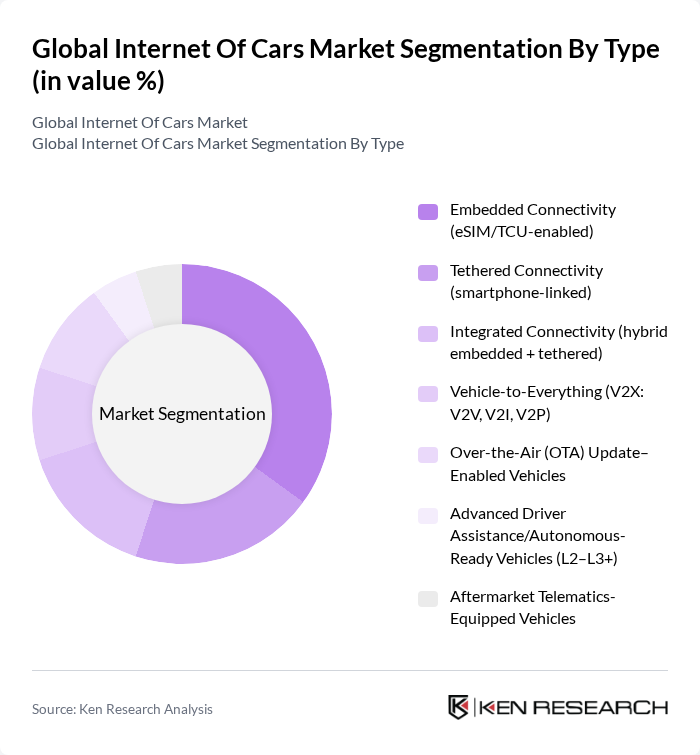
Global Internet Of Cars Market segmentation by Type.

By End-User:The market is segmented by end-users, including Individual Consumers, Fleet and Logistics Operators, Ride-Hailing and Car-Sharing Providers, and Government and Municipal Agencies. The Individual Consumers segment is currently the most dominant, underpinned by rising fitment rates of connected infotainment, safety, navigation, diagnostics, and app ecosystems in passenger vehicles; fleets also accelerate adoption for telematics, route optimization, and OTA-enabled maintenance .
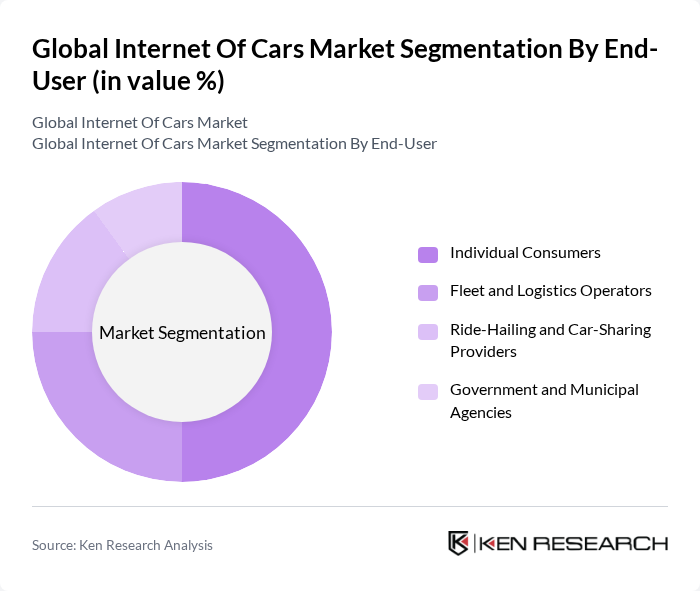
Global Internet Of Cars Market segmentation by End-User.

Global Internet Of Cars Market Competitive Landscape

The Global Internet of Cars Market is characterized by a dynamic mix of regional and international players. Leading participants such as Tesla, Inc., Ford Motor Company, General Motors Company, BMW AG, Audi AG, Toyota Motor Corporation, Honda Motor Co., Ltd., Volkswagen AG, Mercedes?Benz Group AG, Hyundai Motor Company, Nissan Motor Co., Ltd., Cisco Systems, Inc., Qualcomm Technologies, Inc., Intel Corporation, Ericsson AB, Robert Bosch GmbH, Continental AG, Aptiv PLC, Harman International (Samsung Electronics), NVIDIA Corporation, TomTom N.V., HERE Technologies, Waymo LLC (Alphabet Inc.), Vodafone Group Plc, China Mobile Limited contribute to innovation, geographic expansion, and service delivery in this space .

Tesla, Inc.

2003

Austin, Texas, USA

Ford Motor Company

1903

Dearborn, Michigan, USA

General Motors Company

1908

Detroit, Michigan, USA

BMW AG

1916

Munich, Germany

Audi AG

1909

Ingolstadt, Germany

Company

Establishment Year

Headquarters

Group Size (OEM, Tier-1, Telecom/Chipset, Software/Cloud)

Connected Vehicle Shipments/Installed Base

Connectivity Revenue (Connectivity, Telematics, and Software/Services)

Average Revenue per Connected Vehicle (ARPCV)

Geographic Footprint (Regions with commercial deployments)

V2X/5G Readiness (DSRC/C?V2X certifications, pilots)

Global Internet Of Cars Market Industry Analysis

Growth Drivers

  • Increasing Demand for Connected Vehicles:The global demand for connected vehicles is projected to reach 50 million units in the future, driven by consumer interest in enhanced connectivity features. According to the International Organization of Motor Vehicle Manufacturers, the number of connected cars is expected to grow significantly, with a compound annual growth rate (CAGR) of 20% in the future. This surge is fueled by the increasing integration of mobile technology and the Internet of Things (IoT) in vehicles, enhancing user experience and safety.
  • Advancements in Automotive Technology:The automotive sector is witnessing rapid technological advancements, with global R&D spending projected to exceed $100 billion in the future. Innovations in artificial intelligence, machine learning, and sensor technologies are transforming vehicle capabilities. For instance, the integration of advanced driver-assistance systems (ADAS) is expected to enhance safety features, with an estimated 30% of new vehicles equipped with such technologies in the future, according to industry reports from McKinsey & Company.
  • Rising Consumer Preference for Smart Features:A significant shift towards smart vehicle features is evident, with 70% of consumers expressing a preference for vehicles equipped with advanced connectivity options. The demand for features such as real-time navigation, remote diagnostics, and in-car entertainment systems is driving manufacturers to innovate. The global market for smart automotive technologies is expected to reach $200 billion in the future, reflecting a growing consumer inclination towards enhanced vehicle functionalities, as reported by Statista.

Market Challenges

  • High Costs of Technology Integration:The integration of advanced technologies in vehicles poses significant financial challenges, with estimates suggesting that manufacturers may incur costs exceeding $5,000 per vehicle for full connectivity features. This high cost can deter smaller manufacturers from adopting these technologies, limiting market growth. Additionally, the need for continuous updates and maintenance further escalates expenses, impacting overall profitability in the automotive sector, as highlighted by Deloitte's automotive industry outlook.
  • Data Privacy and Security Concerns:As vehicles become increasingly connected, data privacy and security issues are paramount. A report by the World Economic Forum indicates that 60% of consumers are concerned about data breaches in connected vehicles. The potential for cyberattacks on vehicle systems poses a significant risk, leading to regulatory scrutiny and potential legal liabilities for manufacturers. This challenge necessitates robust cybersecurity measures, which can further increase operational costs and complexity.

Global Internet Of Cars Market Future Outlook

The future of the Internet of Cars market is poised for transformative growth, driven by technological advancements and evolving consumer preferences. The expansion of 5G networks is expected to enhance vehicle connectivity, enabling real-time data exchange and improved user experiences. Additionally, the rise of electric vehicles will further integrate smart technologies, creating a seamless driving experience. As manufacturers increasingly collaborate with tech companies, innovative solutions will emerge, reshaping the automotive landscape and addressing consumer demands for safety and convenience.

Market Opportunities

  • Expansion of 5G Networks:The rollout of 5G networks is anticipated to revolutionize vehicle connectivity, with over 1.5 billion 5G subscriptions expected in the future. This technology will facilitate faster data transmission, enabling advanced features such as real-time traffic updates and enhanced vehicle-to-everything (V2X) communication. The improved connectivity will significantly enhance the user experience and safety, creating substantial opportunities for automotive manufacturers and tech companies alike.
  • Growth in Electric Vehicle Adoption:The global electric vehicle market is projected to reach 30 million units in the future, driven by increasing environmental awareness and government incentives. This growth presents opportunities for integrating smart technologies in electric vehicles, enhancing their appeal. As consumers seek sustainable transportation options, manufacturers can leverage this trend to innovate and differentiate their offerings, tapping into a rapidly expanding market segment.

Scope of the Report

SegmentSub-Segments
By Type

Embedded Connectivity (eSIM/TCU-enabled)

Tethered Connectivity (smartphone-linked)

Integrated Connectivity (hybrid embedded + tethered)

Vehicle-to-Everything (V2X: V2V, V2I, V2P)

Over-the-Air (OTA) Update–Enabled Vehicles

Advanced Driver Assistance/Autonomous-Ready Vehicles (L2–L3+)

Aftermarket Telematics-Equipped Vehicles

By End-User

Individual Consumers

Fleet and Logistics Operators

Ride-Hailing and Car-Sharing Providers

Government and Municipal Agencies

By Application

Infotainment, Navigation, and In-Car Commerce

Remote Vehicle Diagnostics and Prognostics

Safety, ADAS, and Emergency Services (eCall)

Vehicle Management: Fleet, Usage-Based Insurance (UBI), and Telematics

V2X for Traffic Management and Smart Infrastructure

By Component

Hardware (TCU, eSIM, Telematics Sensors, Gateways)

Software/Platforms (OS, Middleware, Data Platforms, Cybersecurity)

Services (Connectivity, Cloud, Analytics, OTA, Managed Services)

By Sales Channel

OEM-Installed

Aftermarket

By Connectivity Technology

G/LTE

G

Dedicated Short-Range Communications (DSRC)

Cellular V2X (C-V2X)

By Region

North America

Europe

Asia Pacific

Latin America

Middle East & Africa

Key Target Audience

Investors and Venture Capitalist Firms

Government and Regulatory Bodies (e.g., National Highway Traffic Safety Administration, European Commission)

Automobile Manufacturers

Telecommunications Companies

Insurance Companies

Fleet Management Companies

Automotive Technology Developers

Smart City Planners and Developers

Players Mentioned in the Report:

Tesla, Inc.

Ford Motor Company

General Motors Company

BMW AG

Audi AG

Toyota Motor Corporation

Honda Motor Co., Ltd.

Volkswagen AG

MercedesBenz Group AG

Hyundai Motor Company

Nissan Motor Co., Ltd.

Cisco Systems, Inc.

Qualcomm Technologies, Inc.

Intel Corporation

Ericsson AB

Robert Bosch GmbH

Continental AG

Aptiv PLC

Harman International (Samsung Electronics)

NVIDIA Corporation

TomTom N.V.

HERE Technologies

Waymo LLC (Alphabet Inc.)

Vodafone Group Plc

China Mobile Limited

Table of Contents

Market Assessment Phase

1. Executive Summary and Approach


2. Global Internet Of Cars Market Overview

2.1 Key Insights and Strategic Recommendations

2.2 Global Internet Of Cars Market Overview

2.3 Definition and Scope

2.4 Evolution of Market Ecosystem

2.5 Timeline of Key Regulatory Milestones

2.6 Value Chain & Stakeholder Mapping

2.7 Business Cycle Analysis

2.8 Policy & Incentive Landscape


3. Global Internet Of Cars Market Analysis

3.1 Growth Drivers

3.1.1 Increasing demand for connected vehicles
3.1.2 Advancements in automotive technology
3.1.3 Rising consumer preference for smart features
3.1.4 Government initiatives promoting smart transportation

3.2 Market Challenges

3.2.1 High costs of technology integration
3.2.2 Data privacy and security concerns
3.2.3 Lack of standardization in connectivity protocols
3.2.4 Limited infrastructure for supporting IoT in vehicles

3.3 Market Opportunities

3.3.1 Expansion of 5G networks
3.3.2 Growth in electric vehicle adoption
3.3.3 Development of autonomous driving technologies
3.3.4 Partnerships with tech companies for innovation

3.4 Market Trends

3.4.1 Increasing integration of AI in vehicle systems
3.4.2 Shift towards subscription-based services
3.4.3 Enhanced focus on user experience and personalization
3.4.4 Rise of mobility-as-a-service (MaaS) solutions

3.5 Government Regulation

3.5.1 Regulations on data protection and privacy
3.5.2 Standards for vehicle-to-everything (V2X) communication
3.5.3 Incentives for electric and connected vehicles
3.5.4 Safety regulations for autonomous vehicles

4. SWOT Analysis


5. Stakeholder Analysis


6. Porter's Five Forces Analysis


7. Global Internet Of Cars Market Market Size, 2019-2024

7.1 By Value

7.2 By Volume

7.3 By Average Selling Price


8. Global Internet Of Cars Market Segmentation

8.1 By Type

8.1.1 Embedded Connectivity (eSIM/TCU-enabled)
8.1.2 Tethered Connectivity (smartphone-linked)
8.1.3 Integrated Connectivity (hybrid embedded + tethered)
8.1.4 Vehicle-to-Everything (V2X: V2V, V2I, V2P)
8.1.5 Over-the-Air (OTA) Update–Enabled Vehicles
8.1.6 Advanced Driver Assistance/Autonomous-Ready Vehicles (L2–L3+)
8.1.7 Aftermarket Telematics-Equipped Vehicles

8.2 By End-User

8.2.1 Individual Consumers
8.2.2 Fleet and Logistics Operators
8.2.3 Ride-Hailing and Car-Sharing Providers
8.2.4 Government and Municipal Agencies

8.3 By Application

8.3.1 Infotainment, Navigation, and In-Car Commerce
8.3.2 Remote Vehicle Diagnostics and Prognostics
8.3.3 Safety, ADAS, and Emergency Services (eCall)
8.3.4 Vehicle Management: Fleet, Usage-Based Insurance (UBI), and Telematics
8.3.5 V2X for Traffic Management and Smart Infrastructure

8.4 By Component

8.4.1 Hardware (TCU, eSIM, Telematics Sensors, Gateways)
8.4.2 Software/Platforms (OS, Middleware, Data Platforms, Cybersecurity)
8.4.3 Services (Connectivity, Cloud, Analytics, OTA, Managed Services)

8.5 By Sales Channel

8.5.1 OEM-Installed
8.5.2 Aftermarket

8.6 By Connectivity Technology

8.6.1 4G/LTE
8.6.2 5G
8.6.3 Dedicated Short-Range Communications (DSRC)
8.6.4 Cellular V2X (C-V2X)

8.7 By Region

8.7.1 North America
8.7.2 Europe
8.7.3 Asia Pacific
8.7.4 Latin America
8.7.5 Middle East & Africa

9. Global Internet Of Cars Market Competitive Analysis

9.1 Market Share of Key Players

9.2 Cross Comparison of Key Players

9.2.1 Company Name
9.2.2 Group Size (OEM, Tier-1, Telecom/Chipset, Software/Cloud)
9.2.3 Connected Vehicle Shipments/Installed Base
9.2.4 Connectivity Revenue (Connectivity, Telematics, and Software/Services)
9.2.5 Average Revenue per Connected Vehicle (ARPCV)
9.2.6 Geographic Footprint (Regions with commercial deployments)
9.2.7 V2X/5G Readiness (DSRC/C?V2X certifications, pilots)
9.2.8 OTA Capability and Update Frequency
9.2.9 Strategic Partnerships Ecosystem (operators, cloud, maps)
9.2.10 Cybersecurity Posture (certifications, incident record)
9.2.11 Product Innovation Velocity (features/releases per year)
9.2.12 Monetization Model Mix (one-time, subscription, data services)

9.3 SWOT Analysis of Top Players

9.4 Pricing Analysis

9.5 Detailed Profile of Major Companies

9.5.1 Tesla, Inc.
9.5.2 Ford Motor Company
9.5.3 General Motors Company
9.5.4 BMW AG
9.5.5 Audi AG
9.5.6 Toyota Motor Corporation
9.5.7 Honda Motor Co., Ltd.
9.5.8 Volkswagen AG
9.5.9 Mercedes?Benz Group AG
9.5.10 Hyundai Motor Company
9.5.11 Nissan Motor Co., Ltd.
9.5.12 Cisco Systems, Inc.
9.5.13 Qualcomm Technologies, Inc.
9.5.14 Intel Corporation
9.5.15 Ericsson AB
9.5.16 Robert Bosch GmbH
9.5.17 Continental AG
9.5.18 Aptiv PLC
9.5.19 Harman International (Samsung Electronics)
9.5.20 NVIDIA Corporation
9.5.21 TomTom N.V.
9.5.22 HERE Technologies
9.5.23 Waymo LLC (Alphabet Inc.)
9.5.24 Vodafone Group Plc
9.5.25 China Mobile Limited

10. Global Internet Of Cars Market End-User Analysis

10.1 Procurement Behavior of Key Ministries

10.1.1 Government procurement policies
10.1.2 Budget allocation for smart transportation
10.1.3 Collaboration with private sector

10.2 Corporate Spend on Infrastructure & Energy

10.2.1 Investment in smart infrastructure
10.2.2 Funding for electric vehicle charging stations
10.2.3 Expenditure on connected vehicle technologies

10.3 Pain Point Analysis by End-User Category

10.3.1 Cost of technology adoption
10.3.2 Integration challenges with existing systems
10.3.3 User training and support needs

10.4 User Readiness for Adoption

10.4.1 Awareness of connected vehicle benefits
10.4.2 Willingness to pay for advanced features
10.4.3 Perceived reliability of technology

10.5 Post-Deployment ROI and Use Case Expansion

10.5.1 Measurement of operational efficiency gains
10.5.2 Expansion of service offerings
10.5.3 Long-term cost savings analysis

11. Global Internet Of Cars Market Future Size, 2025-2030

11.1 By Value

11.2 By Volume

11.3 By Average Selling Price


Go-To-Market Strategy Phase

1. Whitespace Analysis + Business Model Canvas

1.1 Market gaps identification

1.2 Value proposition development

1.3 Revenue model exploration

1.4 Customer segmentation analysis

1.5 Key partnerships identification

1.6 Cost structure assessment

1.7 Competitive landscape overview


2. Marketing and Positioning Recommendations

2.1 Branding strategies

2.2 Product USPs

2.3 Target audience identification

2.4 Communication strategy

2.5 Digital marketing tactics

2.6 Customer engagement initiatives


3. Distribution Plan

3.1 Urban retail strategies

3.2 Rural NGO tie-ups

3.3 Online distribution channels

3.4 Partnerships with automotive dealers

3.5 Logistics and supply chain management


4. Channel & Pricing Gaps

4.1 Underserved routes

4.2 Pricing bands analysis

4.3 Competitor pricing strategies

4.4 Customer willingness to pay

4.5 Value-based pricing models


5. Unmet Demand & Latent Needs

5.1 Category gaps identification

5.2 Consumer segments analysis

5.3 Emerging trends and needs

5.4 Feedback from potential users


6. Customer Relationship

6.1 Loyalty programs

6.2 After-sales service

6.3 Customer feedback mechanisms

6.4 Community engagement initiatives


7. Value Proposition

7.1 Sustainability initiatives

7.2 Integrated supply chains

7.3 Unique selling points

7.4 Customer-centric approach


8. Key Activities

8.1 Regulatory compliance

8.2 Branding efforts

8.3 Distribution setup

8.4 Technology development


9. Entry Strategy Evaluation

9.1 Domestic Market Entry Strategy

9.1.1 Product mix considerations
9.1.2 Pricing band analysis
9.1.3 Packaging strategies

9.2 Export Entry Strategy

9.2.1 Target countries selection
9.2.2 Compliance roadmap development

10. Entry Mode Assessment

10.1 Joint Ventures

10.2 Greenfield investments

10.3 Mergers and Acquisitions

10.4 Distributor Model


11. Capital and Timeline Estimation

11.1 Capital requirements analysis

11.2 Timelines for market entry


12. Control vs Risk Trade-Off

12.1 Ownership considerations

12.2 Partnerships evaluation


13. Profitability Outlook

13.1 Breakeven analysis

13.2 Long-term sustainability strategies


14. Potential Partner List

14.1 Distributors identification

14.2 Joint Ventures opportunities

14.3 Acquisition targets


15. Execution Roadmap

15.1 Phased Plan for Market Entry

15.1.1 Market Setup
15.1.2 Market Entry
15.1.3 Growth Acceleration
15.1.4 Scale & Stabilize

15.2 Key Activities and Milestones

15.2.1 Activity timelines
15.2.2 Milestone tracking

Research Methodology

ApproachModellingSample

Phase 1: Approach1

Desk Research

  • Industry reports from automotive and technology associations
  • Market analysis publications from research firms focusing on IoT and automotive sectors
  • Government and regulatory documents related to vehicle connectivity and smart transportation

Primary Research

  • Interviews with automotive OEMs and Tier 1 suppliers involved in IoT integration
  • Surveys with fleet management companies utilizing connected vehicle technologies
  • Focus groups with consumers to understand preferences for connected car features

Validation & Triangulation

  • Cross-validation of data from multiple industry reports and expert opinions
  • Triangulation of market trends with sales data from automotive manufacturers
  • Sanity checks through expert panel discussions with industry veterans

Phase 2: Market Size Estimation1

Top-down Assessment

  • Analysis of global automotive sales data to estimate IoT penetration rates
  • Segmentation of the market by vehicle type, region, and technology adoption
  • Incorporation of trends in smart city initiatives and connected infrastructure

Bottom-up Modeling

  • Estimation of IoT device installations per vehicle based on current adoption rates
  • Cost analysis of IoT solutions including hardware, software, and connectivity
  • Volume x pricing model for subscription services related to connected vehicles

Forecasting & Scenario Analysis

  • Multi-variable forecasting using growth rates in automotive IoT and consumer adoption
  • Scenario analysis based on regulatory changes and technological advancements
  • Development of baseline, optimistic, and pessimistic market projections through 2030

Phase 3: CATI Sample Composition1

Scope Item/SegmentSample SizeTarget Respondent Profiles
Connected Vehicle Technology Adoption150Automotive Engineers, Product Managers
Consumer Preferences for IoT Features140Car Owners, Tech Enthusiasts
Fleet Management Solutions100Fleet Managers, Operations Directors
Regulatory Impact on IoT in Automotive80Policy Makers, Compliance Officers
Market Trends in Smart Transportation120Urban Planners, Transportation Analysts

Frequently Asked Questions

What is the current value of the Global Internet of Cars Market?

The Global Internet of Cars Market is valued at approximately USD 145 billion, reflecting the consolidation of automotive IoT, connected cars, and the internet of vehicles. This market is expected to grow significantly in the coming years due to increasing demand for connected vehicle technologies.

What factors are driving the growth of the Internet of Cars Market?

Which regions are leading in the Internet of Cars Market?

What are the main types of connectivity in the Internet of Cars Market?

Other Regional/Country Reports

Indonesia Global Internet Of Cars Market

Malaysia Global Internet Of Cars Market

KSA Global Internet Of Cars Market

APAC Global Internet Of Cars Market

SEA Global Internet Of Cars Market

Vietnam Global Internet Of Cars Market

Why Buy From Us?

Refine Robust Result (RRR) Framework

What makes us stand out is that our consultants follow Robust, Refine and Result (RRR) methodology. Robust for clear definitions, approaches and sanity checking, Refine for differentiating respondents' facts and opinions, and Result for presenting data with story.

Our Reach Is Unmatched

We have set a benchmark in the industry by offering our clients with syndicated and customized market research reports featuring coverage of entire market as well as meticulous research and analyst insights.

Shifting the Research Paradigm

While we don't replace traditional research, we flip the method upside down. Our dual approach of Top Bottom & Bottom Top ensures quality deliverable by not just verifying company fundamentals but also looking at the sector and macroeconomic factors.

More Insights-Better Decisions

With one step in the future, our research team constantly tries to show you the bigger picture. We help with some of the tough questions you may encounter along the way: How is the industry positioned? Best marketing channel? KPI's of competitors? By aligning every element, we help maximize success.

Transparency and Trust

Our report gives you instant access to the answers and sources that other companies might choose to hide. We elaborate each steps of research methodology we have used and showcase you the sample size to earn your trust.

Round the Clock Support

If you need any support, we are here! We pride ourselves on universe strength, data quality, and quick, friendly, and professional service.

Why Clients Choose Us?

400000+
Reports in repository
150+
Consulting projects a year
100+
Analysts
8000+
Client Queries in 2022








