About the Report
Base Year 2024Global Internet Protocol Television Iptv Market Overview
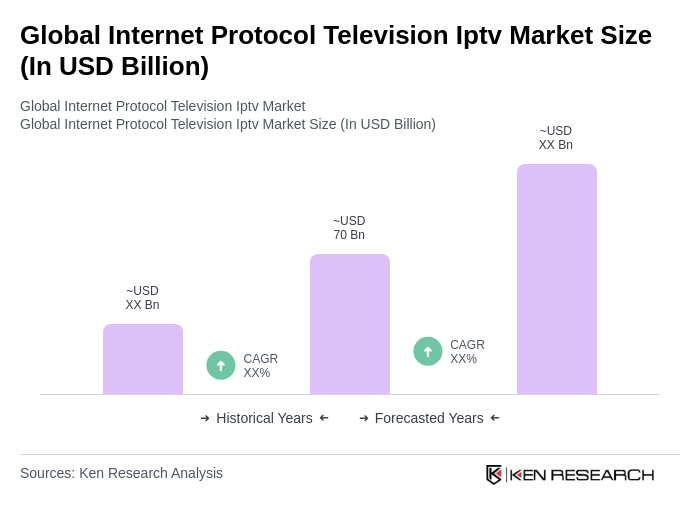
- The Global Internet Protocol Television (IPTV) market is valued at USD 70 billion, based on a five-year historical analysis. This growth is primarily driven by the increasing demand for high-quality video content, the proliferation of smart devices, and the expansion of high-speed internet connectivity. The shift from traditional cable services to internet-based streaming solutions has significantly contributed to the market's expansion.
- Key players in this market include the United States, China, and Germany. The United States dominates due to its advanced technological infrastructure and high consumer spending on entertainment. China follows closely, driven by its vast population and rapid digital transformation. Germany's strong regulatory framework and high broadband penetration also contribute to its significant market presence.
- In 2023, the European Union implemented the Audiovisual Media Services Directive (AVMSD), which aims to enhance consumer protection and promote European content in the IPTV sector. This regulation mandates that a minimum percentage of content offered by IPTV providers must be European works, thereby encouraging local production and ensuring a diverse media landscape.
Global Internet Protocol Television Iptv Market Segmentation
By Type:The IPTV market can be segmented into various types, including Live/Linear IPTV, Time-Shifted/Replay TV, Video on Demand (VoD), Subscription-Based (SVoD), Pay-Per-View (PPV)/Transactional (TVoD), Advertising-Supported (AVoD/FAST), and Hybrid (Multicast + Unicast/OTT Bundles). Among these, Video on Demand (VoD) is currently the leading sub-segment, driven by consumer preferences for on-demand content and the flexibility it offers. The rise of binge-watching culture and the availability of diverse content libraries have further solidified VoD's dominance in the market.

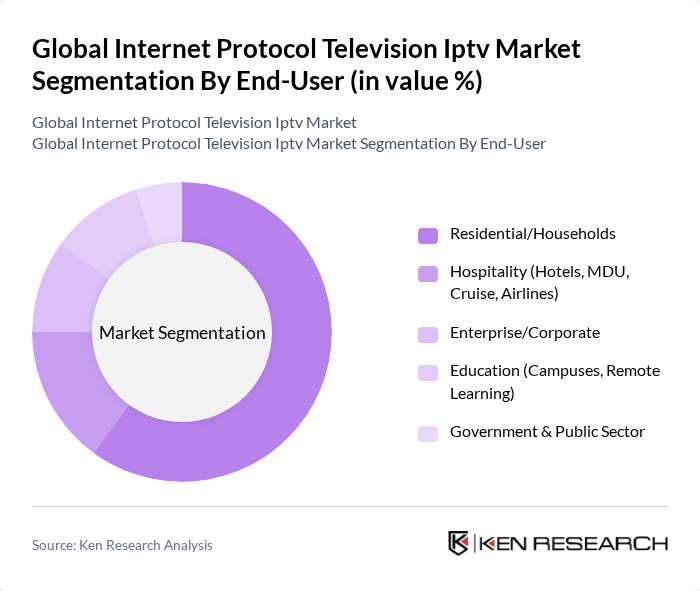
By End-User:The IPTV market is segmented by end-user into Residential/Households, Hospitality (Hotels, MDU, Cruise, Airlines), Enterprise/Corporate, Education (Campuses, Remote Learning), and Government & Public Sector. The Residential/Households segment is the most significant, as the majority of IPTV subscriptions are driven by individual consumers seeking diverse entertainment options. The increasing trend of cord-cutting and the demand for personalized viewing experiences have further propelled this segment's growth.
Global Internet Protocol Television Iptv Market Competitive Landscape
The Global Internet Protocol Television Iptv Market is characterized by a dynamic mix of regional and international players. Leading participants such as China Telecom Corporation Limited (Tianyi IPTV), China Unicom (Hong Kong) Limited, China Mobile Limited (Migu/OTT-Integrated IPTV), Orange S.A. (Orange TV), Deutsche Telekom AG (MagentaTV), BT Group plc (BT TV/EE TV), Sky Group (Sky Glass/Stream; NOW in select markets), Telefónica S.A. (Movistar Plus+), Vodafone Group plc (GigaTV/Vodafone TV), Altice France (SFR TV) and Altice USA (Optimum TV), Swisscom AG (blue TV), KPN N.V. (KPN iTV), Telus Corporation (Optik TV), Bell Canada (Bell Fibe TV), AT&T Inc. (AT&T U-verse TV legacy/IPTV footprint), Verizon Communications Inc. (Fios TV), Comcast Corporation (Xfinity Stream/IP video), DISH Network Corporation (Sling TV IP-delivered live TV), Roku, Inc. (The Roku Channel/OS-enabled IPTV distribution), Hulu, LLC (Live TV; IP-delivered linear bundle), fuboTV Inc., Amazon (Prime Video Channels/Live sports rights), Netflix, Inc. (IP content distribution; ad tier), NTT Docomo, Inc. (dTV/LEONET partnerships), PCCW Limited (Now TV, Hong Kong) contribute to innovation, geographic expansion, and service delivery in this space.
Global Internet Protocol Television Iptv Market Industry Analysis
Growth Drivers
- Increasing Demand for On-Demand Content:The global demand for on-demand content is projected to reach 1.5 billion users in future, driven by changing consumer preferences. According to the International Telecommunication Union, 70% of internet users prefer streaming services that allow them to watch content at their convenience. This shift is further supported by the rise of binge-watching culture, with 60% of viewers engaging in this behavior, indicating a strong market for IPTV services that cater to these needs.
- Advancements in Streaming Technology:The IPTV market is benefiting from significant advancements in streaming technology, with global internet speeds expected to average 50 Mbps in future, according to Akamai. This improvement facilitates high-quality streaming experiences, including 4K and 8K content. Additionally, the adoption of adaptive bitrate streaming technology has increased, allowing seamless viewing experiences across various devices, which is crucial for attracting and retaining subscribers in a competitive landscape.
- Rising Internet Penetration Rates:Internet penetration is projected to reach 60% globally in future, according to the World Bank. This increase is particularly notable in developing regions, where access to high-speed internet is expanding rapidly. As more households gain internet access, the potential subscriber base for IPTV services grows. In regions like Africa and Asia, where internet access is surging, IPTV providers can tap into new markets, driving overall industry growth.
Market Challenges
- High Competition from OTT Platforms:The IPTV market faces intense competition from over-the-top (OTT) platforms, which are projected to reach 1.1 billion subscribers in future. Major players like Netflix and Amazon Prime Video dominate the market, offering extensive libraries of content at competitive prices. This competition pressures IPTV providers to innovate and differentiate their offerings, often leading to increased marketing and content acquisition costs, which can impact profitability.
- Regulatory Compliance Issues:IPTV providers must navigate complex regulatory environments, which can vary significantly by region. In future, it is estimated that compliance costs could account for up to 10% of operational expenses for IPTV companies. Issues such as data privacy regulations and content licensing requirements can create barriers to entry and complicate service delivery, particularly in regions with stringent laws, hindering market growth and expansion efforts.
Global Internet Protocol Television Iptv Market Future Outlook
The future of the IPTV market appears promising, driven by technological advancements and evolving consumer preferences. As internet speeds continue to improve and more users embrace streaming services, IPTV providers are likely to enhance their offerings with interactive features and personalized content. Additionally, the integration of artificial intelligence and machine learning will enable better content recommendations, further engaging subscribers. The focus on user experience will be crucial for retaining customers in an increasingly competitive landscape.
Market Opportunities
- Expansion into Emerging Markets:Emerging markets present significant growth opportunities for IPTV providers, with internet penetration expected to increase by 15% in regions like Southeast Asia in future. This growth can lead to millions of new subscribers, allowing providers to tailor content to local preferences and capitalize on the increasing demand for affordable entertainment options.
- Partnerships with Content Providers:Forming strategic partnerships with content providers can enhance IPTV offerings and attract new subscribers. In future, collaborations with local and international content creators could increase content libraries by up to 25%, providing diverse programming that appeals to various demographics, thus driving subscriber growth and retention.
Scope of the Report
| Segment | Sub-Segments |
|---|---|
| By Type | Live/Linear IPTV Time-Shifted/Replay TV Video on Demand (VoD) Subscription-Based (SVoD) Pay-Per-View (PPV)/Transactional (TVoD) Advertising-Supported (AVoD/FAST) Hybrid (Multicast + Unicast/OTT Bundles) |
| By End-User | Residential/Households Hospitality (Hotels, MDU, Cruise, Airlines) Enterprise/Corporate Education (Campuses, Remote Learning) Government & Public Sector |
| By Region | North America Europe Asia-Pacific Latin America Middle East & Africa |
| By Technology | xDSL Fiber/Fiber-to-the-Home (FTTH) Cable (HFC/DOCSIS) Satellite/IP Hybrid Wireless/5G Fixed Wireless Access |
| By Application | Entertainment & Media Education & Training Sports & Live Events News & Public Broadcasting Advertising/Commerce-Enabled Streams |
| By Revenue Model | Subscription Pay-Per-View/Transactional Advertising-Supported (AVoD/FAST) Hybrid (Subscription + Ads/PPV) |
| By Delivery Method | Multicast IPTV (Managed Networks) Unicast IPTV (OTT/On-Demand) CDN-Optimized/Edge Delivery |
Key Target Audience
Investors and Venture Capitalist Firms
Government and Regulatory Bodies (e.g., Federal Communications Commission, European Commission)
Content Providers and Media Companies
Telecommunications Service Providers
Broadcasting Networks
Advertising Agencies
Technology Providers and Software Developers
Infrastructure and Equipment Manufacturers
Players Mentioned in the Report:
China Telecom Corporation Limited (Tianyi IPTV)
China Unicom (Hong Kong) Limited
China Mobile Limited (Migu/OTT-Integrated IPTV)
Orange S.A. (Orange TV)
Deutsche Telekom AG (MagentaTV)
BT Group plc (BT TV/EE TV)
Sky Group (Sky Glass/Stream; NOW in select markets)
Telefonica S.A. (Movistar Plus+)
Vodafone Group plc (GigaTV/Vodafone TV)
Altice France (SFR TV) and Altice USA (Optimum TV)
Swisscom AG (blue TV)
KPN N.V. (KPN iTV)
Telus Corporation (Optik TV)
Bell Canada (Bell Fibe TV)
AT&T Inc. (AT&T U-verse TV legacy/IPTV footprint)
Verizon Communications Inc. (Fios TV)
Comcast Corporation (Xfinity Stream/IP video)
DISH Network Corporation (Sling TV IP-delivered live TV)
Roku, Inc. (The Roku Channel/OS-enabled IPTV distribution)
Hulu, LLC (Live TV; IP-delivered linear bundle)
fuboTV Inc.
Amazon (Prime Video Channels/Live sports rights)
Netflix, Inc. (IP content distribution; ad tier)
NTT Docomo, Inc. (dTV/LEONET partnerships)
PCCW Limited (Now TV, Hong Kong)
Table of Contents
Market Assessment Phase
1. Executive Summary and Approach
2. Global Internet Protocol Television Iptv Market Overview
2.1 Key Insights and Strategic Recommendations
2.2 Global Internet Protocol Television Iptv Market Overview
2.3 Definition and Scope
2.4 Evolution of Market Ecosystem
2.5 Timeline of Key Regulatory Milestones
2.6 Value Chain & Stakeholder Mapping
2.7 Business Cycle Analysis
2.8 Policy & Incentive Landscape
3. Global Internet Protocol Television Iptv Market Analysis
3.1 Growth Drivers
3.1.1 Increasing Demand for On-Demand Content
3.1.2 Advancements in Streaming Technology
3.1.3 Rising Internet Penetration Rates
3.1.4 Shift from Traditional Cable to IPTV Services
3.2 Market Challenges
3.2.1 High Competition from OTT Platforms
3.2.2 Regulatory Compliance Issues
3.2.3 Network Infrastructure Limitations
3.2.4 Content Licensing and Rights Management
3.3 Market Opportunities
3.3.1 Expansion into Emerging Markets
3.3.2 Partnerships with Content Providers
3.3.3 Development of Interactive Services
3.3.4 Integration of AI and Machine Learning
3.4 Market Trends
3.4.1 Growth of 4K and 8K Streaming
3.4.2 Increasing Use of Mobile Devices for Streaming
3.4.3 Rise of Personalized Content Recommendations
3.4.4 Adoption of Subscription-Based Models
3.5 Government Regulation
3.5.1 Data Privacy Regulations
3.5.2 Content Regulation Policies
3.5.3 Licensing Requirements for IPTV Providers
3.5.4 Net Neutrality Laws
4. SWOT Analysis
5. Stakeholder Analysis
6. Porter's Five Forces Analysis
7. Global Internet Protocol Television Iptv Market Market Size, 2019-2024
7.1 By Value
7.2 By Volume
7.3 By Average Selling Price
8. Global Internet Protocol Television Iptv Market Segmentation
8.1 By Type
8.1.1 Live/Linear IPTV
8.1.2 Time-Shifted/Replay TV
8.1.3 Video on Demand (VoD)
8.1.4 Subscription-Based (SVoD)
8.1.5 Pay-Per-View (PPV)/Transactional (TVoD)
8.1.6 Advertising-Supported (AVoD/FAST)
8.1.7 Hybrid (Multicast + Unicast/OTT Bundles)
8.2 By End-User
8.2.1 Residential/Households
8.2.2 Hospitality (Hotels, MDU, Cruise, Airlines)
8.2.3 Enterprise/Corporate
8.2.4 Education (Campuses, Remote Learning)
8.2.5 Government & Public Sector
8.3 By Region
8.3.1 North America
8.3.2 Europe
8.3.3 Asia-Pacific
8.3.4 Latin America
8.3.5 Middle East & Africa
8.4 By Technology
8.4.1 xDSL
8.4.2 Fiber/Fiber-to-the-Home (FTTH)
8.4.3 Cable (HFC/DOCSIS)
8.4.4 Satellite/IP Hybrid
8.4.5 Wireless/5G Fixed Wireless Access
8.5 By Application
8.5.1 Entertainment & Media
8.5.2 Education & Training
8.5.3 Sports & Live Events
8.5.4 News & Public Broadcasting
8.5.5 Advertising/Commerce-Enabled Streams
8.6 By Revenue Model
8.6.1 Subscription
8.6.2 Pay-Per-View/Transactional
8.6.3 Advertising-Supported (AVoD/FAST)
8.6.4 Hybrid (Subscription + Ads/PPV)
8.7 By Delivery Method
8.7.1 Multicast IPTV (Managed Networks)
8.7.2 Unicast IPTV (OTT/On-Demand)
8.7.3 CDN-Optimized/Edge Delivery
9. Global Internet Protocol Television Iptv Market Competitive Analysis
9.1 Market Share of Key Players
9.2 Cross Comparison of Key Players
9.2.1 Company Name
9.2.2 Scale (Subscribers/Video Homes Passed)
9.2.3 Subscriber Net Adds YoY (%)
9.2.4 Average Revenue Per User (ARPU)
9.2.5 Customer Acquisition Cost (CAC)
9.2.6 Monthly Churn Rate (%)
9.2.7 Blended Revenue Mix (Subscription/Ads/PPV %)
9.2.8 Content Portfolio (Channels, Sports Rights, Originals)
9.2.9 QoS/QoE Metrics (Start Failure, Rebuffering %, Latency)
9.2.10 Coverage/Footprint (Countries/FTTH Homes Passed)
9.2.11 Profitability (EBITDA Margin)
9.2.12 Capex Intensity (% of Revenue; Network/CDN)
9.3 SWOT Analysis of Top Players
9.4 Pricing Analysis
9.5 Detailed Profile of Major Companies
9.5.1 China Telecom Corporation Limited (Tianyi IPTV)
9.5.2 China Unicom (Hong Kong) Limited
9.5.3 China Mobile Limited (Migu/OTT-Integrated IPTV)
9.5.4 Orange S.A. (Orange TV)
9.5.5 Deutsche Telekom AG (MagentaTV)
9.5.6 BT Group plc (BT TV/EE TV)
9.5.7 Sky Group (Sky Glass/Stream; NOW in select markets)
9.5.8 Telefónica S.A. (Movistar Plus+)
9.5.9 Vodafone Group plc (GigaTV/Vodafone TV)
9.5.10 Altice France (SFR TV) and Altice USA (Optimum TV)
9.5.11 Swisscom AG (blue TV)
9.5.12 KPN N.V. (KPN iTV)
9.5.13 Telus Corporation (Optik TV)
9.5.14 Bell Canada (Bell Fibe TV)
9.5.15 AT&T Inc. (AT&T U-verse TV legacy/IPTV footprint)
9.5.16 Verizon Communications Inc. (Fios TV)
9.5.17 Comcast Corporation (Xfinity Stream/IP video)
9.5.18 DISH Network Corporation (Sling TV IP-delivered live TV)
9.5.19 Roku, Inc. (The Roku Channel/OS-enabled IPTV distribution)
9.5.20 Hulu, LLC (Live TV; IP-delivered linear bundle)
9.5.21 fuboTV Inc.
9.5.22 Amazon (Prime Video Channels/Live sports rights)
9.5.23 Netflix, Inc. (IP content distribution; ad tier)
9.5.24 NTT Docomo, Inc. (dTV/LEONET partnerships)
9.5.25 PCCW Limited (Now TV, Hong Kong)
10. Global Internet Protocol Television Iptv Market End-User Analysis
10.1 Procurement Behavior of Key Ministries
10.1.1 Budget Allocation for IPTV Services
10.1.2 Decision-Making Processes
10.1.3 Evaluation Criteria for IPTV Providers
10.2 Corporate Spend on Infrastructure & Energy
10.2.1 Investment in IPTV Infrastructure
10.2.2 Spending on Content Acquisition
10.2.3 Budget for Technology Upgrades
10.3 Pain Point Analysis by End-User Category
10.3.1 Content Availability Issues
10.3.2 Technical Support Challenges
10.3.3 Pricing Concerns
10.4 User Readiness for Adoption
10.4.1 Awareness of IPTV Services
10.4.2 Willingness to Switch from Traditional TV
10.4.3 Technological Literacy
10.5 Post-Deployment ROI and Use Case Expansion
10.5.1 Measurement of ROI
10.5.2 Expansion of Service Offerings
10.5.3 User Engagement Metrics
11. Global Internet Protocol Television Iptv Market Future Size, 2025-2030
11.1 By Value
11.2 By Volume
11.3 By Average Selling Price
Go-To-Market Strategy Phase
1. Whitespace Analysis + Business Model Canvas
1.1 Market Gaps Identification
1.2 Value Proposition Development
1.3 Revenue Streams Analysis
1.4 Customer Segmentation
1.5 Key Partnerships
1.6 Cost Structure
1.7 Channels of Distribution
2. Marketing and Positioning Recommendations
2.1 Branding Strategies
2.2 Product USPs
2.3 Target Audience Identification
2.4 Marketing Channels
2.5 Promotional Strategies
3. Distribution Plan
3.1 Urban Retail Strategies
3.2 Rural NGO Tie-Ups
3.3 Online Distribution Channels
3.4 Partnerships with Local Providers
4. Channel & Pricing Gaps
4.1 Underserved Routes
4.2 Pricing Bands Analysis
4.3 Competitor Pricing Comparison
4.4 Customer Feedback on Pricing
5. Unmet Demand & Latent Needs
5.1 Category Gaps
5.2 Consumer Segments Analysis
5.3 Emerging Trends
5.4 Future Demand Projections
6. Customer Relationship
6.1 Loyalty Programs
6.2 After-Sales Service
6.3 Customer Feedback Mechanisms
6.4 Engagement Strategies
7. Value Proposition
7.1 Sustainability Initiatives
7.2 Integrated Supply Chains
7.3 Unique Selling Points
7.4 Customer-Centric Innovations
8. Key Activities
8.1 Regulatory Compliance
8.2 Branding Initiatives
8.3 Distribution Setup
8.4 Training and Development
9. Entry Strategy Evaluation
9.1 Domestic Market Entry Strategy
9.1.1 Product Mix
9.1.2 Pricing Band
9.1.3 Packaging Strategies
9.2 Export Entry Strategy
9.2.1 Target Countries
9.2.2 Compliance Roadmap
10. Entry Mode Assessment
10.1 Joint Ventures
10.2 Greenfield Investments
10.3 Mergers & Acquisitions
10.4 Distributor Model
11. Capital and Timeline Estimation
11.1 Capital Requirements
11.2 Timelines for Implementation
12. Control vs Risk Trade-Off
12.1 Ownership vs Partnerships
13. Profitability Outlook
13.1 Breakeven Analysis
13.2 Long-Term Sustainability
14. Potential Partner List
14.1 Distributors
14.2 Joint Ventures
14.3 Acquisition Targets
15. Execution Roadmap
15.1 Phased Plan for Market Entry
15.1.1 Market Setup
15.1.2 Market Entry
15.1.3 Growth Acceleration
15.1.4 Scale & Stabilize
15.2 Key Activities and Milestones
15.2.1 Milestone Planning
15.2.2 Activity Tracking
Research Methodology
Phase 1: Approach1
Desk Research
- Industry reports from leading market research firms focusing on IPTV trends
- Government publications and regulatory frameworks impacting IPTV services
- Market analysis articles from technology journals and online platforms
Primary Research
- Interviews with executives from major IPTV service providers
- Surveys targeting end-users to understand viewing habits and preferences
- Focus groups with industry experts and analysts to gather insights on market dynamics
Validation & Triangulation
- Cross-validation of data from multiple sources including industry reports and expert interviews
- Triangulation of findings through comparison of user feedback and service provider data
- Sanity checks conducted through expert panel reviews to ensure data accuracy
Phase 2: Market Size Estimation1
Top-down Assessment
- Analysis of global telecommunications and media spending to estimate IPTV market size
- Segmentation of market by geographical regions and service types
- Incorporation of growth rates from related sectors such as broadband and OTT services
Bottom-up Modeling
- Data collection from IPTV providers on subscriber numbers and average revenue per user (ARPU)
- Estimation of market size based on service penetration rates in various demographics
- Volume x revenue calculations for different IPTV service packages
Forecasting & Scenario Analysis
- Multi-variable regression analysis incorporating factors like internet penetration and content availability
- Scenario modeling based on technological advancements and consumer behavior shifts
- Development of baseline, optimistic, and pessimistic forecasts through 2030
Phase 3: CATI Sample Composition1
| Scope Item/Segment | Sample Size | Target Respondent Profiles |
|---|---|---|
| Residential IPTV Users | 150 | Household Decision Makers, Tech-savvy Consumers |
| Commercial IPTV Clients | 120 | Business Owners, IT Managers |
| Content Providers | 90 | Content Acquisition Managers, Licensing Executives |
| Telecom Service Providers | 80 | Network Engineers, Product Development Managers |
| Industry Analysts | 50 | Market Researchers, Technology Analysts |
Frequently Asked Questions
What is the current value of the Global IPTV market?
The Global Internet Protocol Television (IPTV) market is valued at approximately USD 70 billion, reflecting significant growth driven by the demand for high-quality video content and the shift from traditional cable services to internet-based streaming solutions.
Which regions dominate the Global IPTV market?
What are the main types of IPTV services available?
What factors are driving the growth of the IPTV market?
Other Regional/Country Reports
Indonesia Internet Protocol Television Iptv Market
Malaysia Internet Protocol Television Iptv Market
APAC Internet Protocol Television Iptv Market
Why Buy From Us?

What makes us stand out is that our consultants follow Robust, Refine and Result (RRR) methodology. Robust for clear definitions, approaches and sanity checking, Refine for differentiating respondents' facts and opinions, and Result for presenting data with story.

We have set a benchmark in the industry by offering our clients with syndicated and customized market research reports featuring coverage of entire market as well as meticulous research and analyst insights.

While we don't replace traditional research, we flip the method upside down. Our dual approach of Top Bottom & Bottom Top ensures quality deliverable by not just verifying company fundamentals but also looking at the sector and macroeconomic factors.

With one step in the future, our research team constantly tries to show you the bigger picture. We help with some of the tough questions you may encounter along the way: How is the industry positioned? Best marketing channel? KPI's of competitors? By aligning every element, we help maximize success.

Our report gives you instant access to the answers and sources that other companies might choose to hide. We elaborate each steps of research methodology we have used and showcase you the sample size to earn your trust.

If you need any support, we are here! We pride ourselves on universe strength, data quality, and quick, friendly, and professional service.