About the Report
Base Year 2024Global Jet Fuel Market Overview
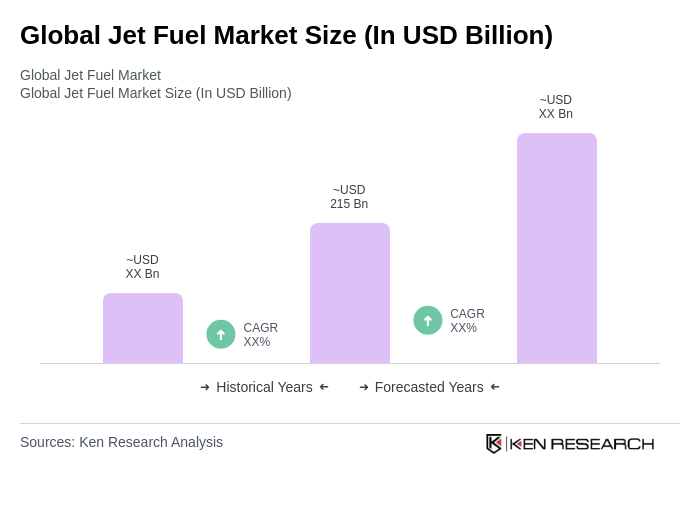
- The Global Jet Fuel Market is valued at USD 215 billion, based on a five-year historical analysis. This growth is primarily driven by the resurgence of air travel post-pandemic, increased cargo transport needs, and the rising demand for sustainable aviation fuels. The market has seen a significant uptick in consumption as airlines expand their fleets and routes to meet growing passenger and freight demands. Key growth drivers also include regulatory emissions standards, renewable aviation fuel initiatives, and ongoing technological advancements in jet engine efficiency .
- Key players in this market include the United States, China, and the European Union. The U.S. leads due to its extensive airline network and high air traffic volumes, while China is rapidly expanding its aviation sector. The European Union is also a significant player, driven by stringent regulations promoting sustainable aviation fuels and a strong commitment to reducing carbon emissions. Asia Pacific, particularly China, is expected to have the largest regional market share, reflecting robust growth in commercial aviation .
- In 2023, the U.S. government introduced regulations encouraging a gradual increase in the use of Sustainable Aviation Fuel (SAF) in commercial aviation, with policy targets aiming for 10% SAF usage by 2025. This initiative is part of a broader strategy to reduce greenhouse gas emissions from the aviation sector and promote the development of alternative fuel sources. Similar regulatory efforts are being observed in the European Union, further accelerating SAF adoption .
Global Jet Fuel Market Segmentation
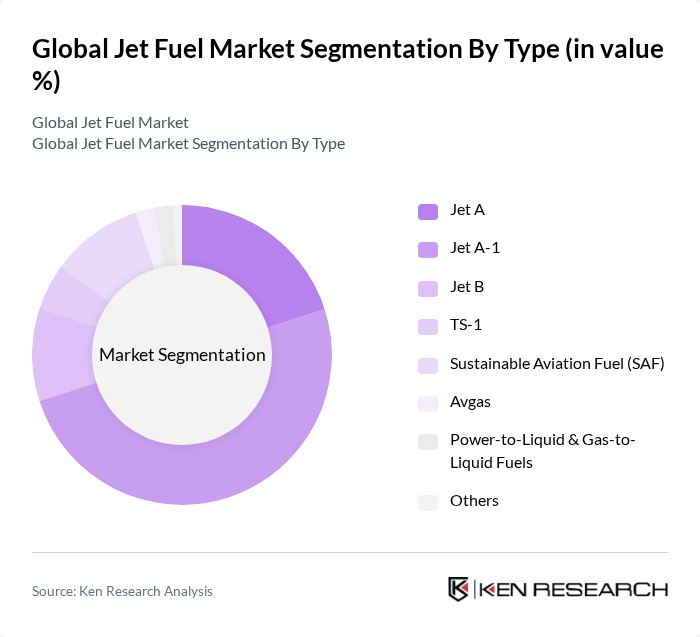
By Type:The jet fuel market is segmented into Jet A, Jet A-1, Jet B, TS-1, Sustainable Aviation Fuel (SAF), Avgas, Power-to-Liquid & Gas-to-Liquid Fuels, and Others. Among these, Jet A-1 remains the most widely used type due to its compatibility with most commercial aircraft and its global availability at airports. The increasing focus on sustainability has led to a rise in the adoption of Sustainable Aviation Fuel (SAF), which is gaining traction as airlines seek to reduce their carbon footprint. Power-to-Liquid and Gas-to-Liquid fuels are emerging segments, reflecting ongoing innovation in alternative fuel technologies .
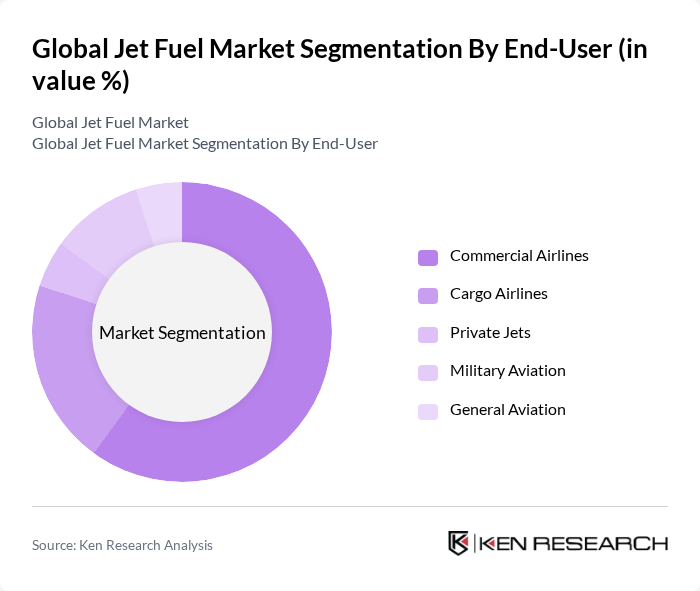
By End-User:The end-user segmentation includes Commercial Airlines, Cargo Airlines, Private Jets, Military Aviation, and General Aviation. Commercial Airlines dominate the market due to the high volume of passenger travel and the need for efficient fuel management. Cargo Airlines are also significant contributors, driven by the growth of e-commerce and global trade. The military sector, while smaller, has specific requirements for fuel types and quality, influencing its market share. General Aviation and Private Jets represent niche segments, with specialized fuel needs .
Global Jet Fuel Market Competitive Landscape
The Global Jet Fuel Market is characterized by a dynamic mix of regional and international players. Leading participants such as ExxonMobil Corporation, Chevron Corporation, Shell plc, BP plc, TotalEnergies SE, Air BP, Phillips 66, Neste Oyj, World Fuel Services Corporation, Avfuel Corporation, Marathon Petroleum Corporation, Valero Energy Corporation, P66 Aviation, SK Energy, Tamoil S.p.A., Gazprom Neft PJSC, Sinopec Group, Indian Oil Corporation Ltd., PetroChina Company Limited, Repsol S.A. contribute to innovation, geographic expansion, and service delivery in this space .
Global Jet Fuel Market Industry Analysis
Growth Drivers
- Increasing Air Travel Demand:The global air travel demand is projected to reach approximately 4.7 billion passengers in future, according to the International Air Transport Association (IATA). This surge is driven by rising disposable incomes and a growing middle class in emerging economies. The increase in passenger numbers directly correlates with higher jet fuel consumption, as airlines require more fuel to operate additional flights and routes, thereby boosting the jet fuel market significantly.
- Expansion of Airline Fleet:The global airline fleet is expected to grow to over 36,000 aircraft in future, as reported by the International Civil Aviation Organization (ICAO). This expansion is fueled by airlines' strategies to enhance capacity and efficiency. Newer aircraft models are designed to be more fuel-efficient, yet the overall increase in fleet size will lead to higher jet fuel demand, further propelling market growth in the coming years.
- Rising Cargo Transportation Needs:The global air cargo market is anticipated to reach approximately 63 million metric tons in future, according to the International Air Transport Association (IATA). This growth is driven by e-commerce and global trade expansion, necessitating increased air freight services. As cargo airlines expand their operations, the demand for jet fuel will rise correspondingly, providing a significant boost to the jet fuel market in the None region.
Market Challenges
- Volatility in Crude Oil Prices:Crude oil prices have fluctuated between USD 70 and USD 90 per barrel in recent periods, according to the U.S. Energy Information Administration (EIA). This volatility poses a significant challenge for the jet fuel market, as airlines face unpredictable fuel costs that can impact profitability. Such fluctuations can lead to increased operational costs, forcing airlines to adjust ticket prices or reduce capacity, ultimately affecting jet fuel demand.
- Environmental Regulations and Compliance:Stricter environmental regulations are being implemented globally, with the International Civil Aviation Organization (ICAO) setting ambitious emission reduction targets. Airlines must comply with new standards that require significant investments in cleaner technologies and sustainable fuels. These compliance costs can strain airline budgets, potentially limiting their operational capacity and affecting jet fuel consumption in the market.
Global Jet Fuel Market Future Outlook
The future of the jet fuel market appears promising, driven by increasing air travel and cargo demands. However, the industry must navigate challenges such as fluctuating crude oil prices and stringent environmental regulations. Innovations in sustainable aviation fuels and advancements in fuel efficiency technologies are expected to play a crucial role in shaping the market landscape. As airlines adapt to these changes, the focus on reducing carbon footprints will likely lead to a more sustainable jet fuel market in the None region.
Market Opportunities
- Growth in Emerging Markets:Emerging markets, particularly in Asia and Africa, are experiencing rapid economic growth, leading to increased air travel. These regions are expected to account for over 50% of global passenger traffic in future, presenting significant opportunities for jet fuel suppliers to expand their market presence and cater to rising demand.
- Development of Sustainable Aviation Fuels:The push for sustainable aviation fuels (SAFs) is gaining momentum, with investments projected to reach approximately USD 1 billion in future. This shift towards greener alternatives presents a lucrative opportunity for companies to innovate and develop SAFs, aligning with global carbon neutrality goals while meeting the increasing demand for environmentally friendly aviation solutions.
Scope of the Report
| Segment | Sub-Segments |
|---|---|
| By Type | Jet A Jet A-1 Jet B TS-1 Sustainable Aviation Fuel (SAF) Avgas Power-to-Liquid & Gas-to-Liquid Fuels Others |
| By End-User | Commercial Airlines Cargo Airlines Private Jets Military Aviation General Aviation |
| By Application | Domestic Flights International Flights Charter Services Unmanned Aerial Vehicles (UAVs) |
| By Distribution Channel | Into-Plane (On-Airport) Bulk Supply to Fixed-Base Operators (FBO) Distributors Online Platforms |
| By Region | North America Europe Asia-Pacific Latin America Middle East & Africa |
| By Pricing Strategy | Premium Pricing Competitive Pricing Discount Pricing |
| By Supply Chain Model | Vertical Integration Outsourced Logistics Hybrid Model |
Key Target Audience
Investors and Venture Capitalist Firms
Government and Regulatory Bodies (e.g., Federal Aviation Administration, International Civil Aviation Organization)
Airline Operators
Jet Fuel Suppliers and Distributors
Aviation Fuel Service Providers
Airport Authorities
Energy and Fuel Research Organizations
Logistics and Transportation Companies
Players Mentioned in the Report:
ExxonMobil Corporation
Chevron Corporation
Shell plc
BP plc
TotalEnergies SE
Air BP
Phillips 66
Neste Oyj
World Fuel Services Corporation
Avfuel Corporation
Marathon Petroleum Corporation
Valero Energy Corporation
P66 Aviation
SK Energy
Tamoil S.p.A.
Gazprom Neft PJSC
Sinopec Group
Indian Oil Corporation Ltd.
PetroChina Company Limited
Repsol S.A.
Table of Contents
Market Assessment Phase
1. Executive Summary and Approach
2. Global Jet Fuel Market Overview
2.1 Key Insights and Strategic Recommendations
2.2 Global Jet Fuel Market Overview
2.3 Definition and Scope
2.4 Evolution of Market Ecosystem
2.5 Timeline of Key Regulatory Milestones
2.6 Value Chain & Stakeholder Mapping
2.7 Business Cycle Analysis
2.8 Policy & Incentive Landscape
3. Global Jet Fuel Market Analysis
3.1 Growth Drivers
3.1.1 Increasing Air Travel Demand
3.1.2 Expansion of Airline Fleet
3.1.3 Rising Cargo Transportation Needs
3.1.4 Technological Advancements in Fuel Efficiency
3.2 Market Challenges
3.2.1 Volatility in Crude Oil Prices
3.2.2 Environmental Regulations and Compliance
3.2.3 Competition from Alternative Fuels
3.2.4 Supply Chain Disruptions
3.3 Market Opportunities
3.3.1 Growth in Emerging Markets
3.3.2 Development of Sustainable Aviation Fuels
3.3.3 Strategic Partnerships and Collaborations
3.3.4 Investment in Infrastructure Development
3.4 Market Trends
3.4.1 Shift Towards Biofuels
3.4.2 Digitalization in Fuel Management
3.4.3 Increasing Focus on Carbon Neutrality
3.4.4 Adoption of Advanced Fuel Management Systems
3.5 Government Regulation
3.5.1 Emission Reduction Targets
3.5.2 Fuel Quality Standards
3.5.3 Subsidies for Sustainable Fuels
3.5.4 International Aviation Regulations
4. SWOT Analysis
5. Stakeholder Analysis
6. Porter's Five Forces Analysis
7. Global Jet Fuel Market Market Size, 2019-2024
7.1 By Value
7.2 By Volume
7.3 By Average Selling Price
8. Global Jet Fuel Market Segmentation
8.1 By Type
8.1.1 Jet A
8.1.2 Jet A-1
8.1.3 Jet B
8.1.4 TS-1
8.1.5 Sustainable Aviation Fuel (SAF)
8.1.6 Avgas
8.1.7 Power-to-Liquid & Gas-to-Liquid Fuels
8.1.8 Others
8.2 By End-User
8.2.1 Commercial Airlines
8.2.2 Cargo Airlines
8.2.3 Private Jets
8.2.4 Military Aviation
8.2.5 General Aviation
8.3 By Application
8.3.1 Domestic Flights
8.3.2 International Flights
8.3.3 Charter Services
8.3.4 Unmanned Aerial Vehicles (UAVs)
8.4 By Distribution Channel
8.4.1 Into-Plane (On-Airport)
8.4.2 Bulk Supply to Fixed-Base Operators (FBO)
8.4.3 Distributors
8.4.4 Online Platforms
8.5 By Region
8.5.1 North America
8.5.2 Europe
8.5.3 Asia-Pacific
8.5.4 Latin America
8.5.5 Middle East & Africa
8.6 By Pricing Strategy
8.6.1 Premium Pricing
8.6.2 Competitive Pricing
8.6.3 Discount Pricing
8.7 By Supply Chain Model
8.7.1 Vertical Integration
8.7.2 Outsourced Logistics
8.7.3 Hybrid Model
9. Global Jet Fuel Market Competitive Analysis
9.1 Market Share of Key Players
9.2 Cross Comparison of Key Players
9.2.1 Company Name
9.2.2 Group Size (Large, Medium, or Small as per industry convention)
9.2.3 Revenue Growth Rate (YoY %)
9.2.4 Market Share (%)
9.2.5 Geographic Reach (Number of Countries/Regions)
9.2.6 Volume of Jet Fuel Supplied (Million Barrels/Year)
9.2.7 Customer Segments Served (Commercial, Cargo, Military, etc.)
9.2.8 Pricing Strategy (Premium, Competitive, Discount)
9.2.9 Operational Efficiency (Cost per Gallon, Supply Reliability)
9.2.10 Fuel Quality Compliance Rate (%)
9.2.11 Innovation Rate (Number of Patents, R&D Spend)
9.2.12 Sustainability Initiatives (SAF Production, Emissions Reduction)
9.2.13 Strategic Partnerships & Alliances
9.3 SWOT Analysis of Top Players
9.4 Pricing Analysis
9.5 Detailed Profile of Major Companies
9.5.1 ExxonMobil Corporation
9.5.2 Chevron Corporation
9.5.3 Shell plc
9.5.4 BP plc
9.5.5 TotalEnergies SE
9.5.6 Air BP
9.5.7 Phillips 66
9.5.8 Neste Oyj
9.5.9 World Fuel Services Corporation
9.5.10 Avfuel Corporation
9.5.11 Marathon Petroleum Corporation
9.5.12 Valero Energy Corporation
9.5.13 P66 Aviation
9.5.14 SK Energy
9.5.15 Tamoil S.p.A.
9.5.16 Gazprom Neft PJSC
9.5.17 Sinopec Group
9.5.18 Indian Oil Corporation Ltd.
9.5.19 PetroChina Company Limited
9.5.20 Repsol S.A.
10. Global Jet Fuel Market End-User Analysis
10.1 Procurement Behavior of Key Ministries
10.1.1 Government Contracts
10.1.2 Budget Allocations
10.1.3 Compliance with Regulations
10.2 Corporate Spend on Infrastructure & Energy
10.2.1 Investment in Fuel Infrastructure
10.2.2 Energy Efficiency Initiatives
10.2.3 Long-term Contracts
10.3 Pain Point Analysis by End-User Category
10.3.1 Cost Management
10.3.2 Supply Reliability
10.3.3 Regulatory Compliance
10.4 User Readiness for Adoption
10.4.1 Training and Development Needs
10.4.2 Technology Adoption Rates
10.4.3 Infrastructure Readiness
10.5 Post-Deployment ROI and Use Case Expansion
10.5.1 Performance Metrics
10.5.2 Scalability of Solutions
10.5.3 Long-term Cost Savings
11. Global Jet Fuel Market Future Size, 2025-2030
11.1 By Value
11.2 By Volume
11.3 By Average Selling Price
Go-To-Market Strategy Phase
1. Whitespace Analysis + Business Model Canvas
1.1 Market Gaps Identification
1.2 Value Proposition Development
1.3 Revenue Streams Analysis
1.4 Cost Structure Evaluation
1.5 Key Partnerships
1.6 Customer Segments
1.7 Channels
2. Marketing and Positioning Recommendations
2.1 Branding Strategies
2.2 Product USPs
2.3 Target Market Identification
2.4 Communication Strategies
3. Distribution Plan
3.1 Urban Retail Strategies
3.2 Rural NGO Tie-ups
3.3 Logistics Optimization
4. Channel & Pricing Gaps
4.1 Underserved Routes
4.2 Pricing Bands Analysis
4.3 Competitive Pricing Strategies
5. Unmet Demand & Latent Needs
5.1 Category Gaps
5.2 Consumer Segments
5.3 Emerging Trends
6. Customer Relationship
6.1 Loyalty Programs
6.2 After-sales Service
6.3 Customer Feedback Mechanisms
7. Value Proposition
7.1 Sustainability Initiatives
7.2 Integrated Supply Chains
7.3 Competitive Advantages
8. Key Activities
8.1 Regulatory Compliance
8.2 Branding Initiatives
8.3 Distribution Setup
9. Entry Strategy Evaluation
9.1 Domestic Market Entry Strategy
9.1.1 Product Mix
9.1.2 Pricing Band
9.1.3 Packaging
9.2 Export Entry Strategy
9.2.1 Target Countries
9.2.2 Compliance Roadmap
10. Entry Mode Assessment
10.1 Joint Ventures
10.2 Greenfield Investments
10.3 Mergers & Acquisitions
10.4 Distributor Model
11. Capital and Timeline Estimation
11.1 Capital Requirements
11.2 Timelines
12. Control vs Risk Trade-Off
12.1 Ownership vs Partnerships
13. Profitability Outlook
13.1 Breakeven Analysis
13.2 Long-term Sustainability
14. Potential Partner List
14.1 Distributors
14.2 Joint Ventures
14.3 Acquisition Targets
15. Execution Roadmap
15.1 Phased Plan for Market Entry
15.1.1 Market Setup
15.1.2 Market Entry
15.1.3 Growth Acceleration
15.1.4 Scale & Stabilize
15.2 Key Activities and Milestones
15.2.1 Milestone Planning
15.2.2 Activity Tracking
Research Methodology
Phase 1: Approach1
Desk Research
- Analysis of global jet fuel consumption statistics from the International Air Transport Association (IATA)
- Review of market reports and publications from the U.S. Energy Information Administration (EIA)
- Examination of industry trends and forecasts from the International Energy Agency (IEA)
Primary Research
- Interviews with airline procurement managers to understand purchasing patterns and preferences
- Surveys with fuel suppliers to gather insights on pricing strategies and supply chain dynamics
- Field interviews with airport fuel management teams to assess operational challenges and innovations
Validation & Triangulation
- Cross-validation of data through multiple sources including government reports and industry publications
- Triangulation of findings from primary interviews with secondary data trends
- Sanity checks conducted through expert panel reviews comprising industry veterans
Phase 2: Market Size Estimation1
Top-down Assessment
- Estimation of total jet fuel demand based on global air travel growth projections
- Segmentation of market size by region, including North America, Europe, Asia-Pacific, and others
- Incorporation of regulatory impacts on fuel standards and emissions targets
Bottom-up Modeling
- Volume estimates derived from fuel consumption data of major airlines
- Cost analysis based on historical pricing trends and current market conditions
- Calculation of market size using a volume x price approach for different fuel grades
Forecasting & Scenario Analysis
- Multi-factor regression analysis incorporating variables such as economic growth, fuel efficiency improvements, and alternative fuel adoption
- Scenario modeling based on potential disruptions like geopolitical tensions and technological advancements in aviation
- Development of baseline, optimistic, and pessimistic forecasts through 2030
Phase 3: CATI Sample Composition1
| Scope Item/Segment | Sample Size | Target Respondent Profiles |
|---|---|---|
| Commercial Airlines Fuel Procurement | 100 | Procurement Managers, Fleet Operations Directors |
| Fuel Suppliers and Distributors | 60 | Sales Managers, Supply Chain Coordinators |
| Airport Fuel Management | 50 | Fuel Operations Managers, Safety Compliance Officers |
| Regulatory Bodies and Policy Makers | 40 | Regulatory Affairs Specialists, Environmental Policy Analysts |
| Alternative Fuel Innovators | 45 | R&D Managers, Sustainability Officers |
Frequently Asked Questions
What is the current value of the Global Jet Fuel Market?
The Global Jet Fuel Market is valued at approximately USD 215 billion, reflecting a significant recovery in air travel demand post-pandemic, alongside increased cargo transport needs and a growing focus on sustainable aviation fuels.
What are the key drivers of growth in the Global Jet Fuel Market?
Which regions are leading in the Global Jet Fuel Market?
What types of jet fuel are available in the market?
Other Regional/Country Reports
Indonesia Jet Fuel Market
Malaysia Jet Fuel Market
APAC Jet Fuel Market
SEA Jet Fuel Market
Why Buy From Us?

What makes us stand out is that our consultants follow Robust, Refine and Result (RRR) methodology. Robust for clear definitions, approaches and sanity checking, Refine for differentiating respondents' facts and opinions, and Result for presenting data with story.

We have set a benchmark in the industry by offering our clients with syndicated and customized market research reports featuring coverage of entire market as well as meticulous research and analyst insights.

While we don't replace traditional research, we flip the method upside down. Our dual approach of Top Bottom & Bottom Top ensures quality deliverable by not just verifying company fundamentals but also looking at the sector and macroeconomic factors.

With one step in the future, our research team constantly tries to show you the bigger picture. We help with some of the tough questions you may encounter along the way: How is the industry positioned? Best marketing channel? KPI's of competitors? By aligning every element, we help maximize success.

Our report gives you instant access to the answers and sources that other companies might choose to hide. We elaborate each steps of research methodology we have used and showcase you the sample size to earn your trust.

If you need any support, we are here! We pride ourselves on universe strength, data quality, and quick, friendly, and professional service.