Region:Global
Author(s):Geetanshi
Product Code:KRAD1232
Pages:87
Published On:November 2025
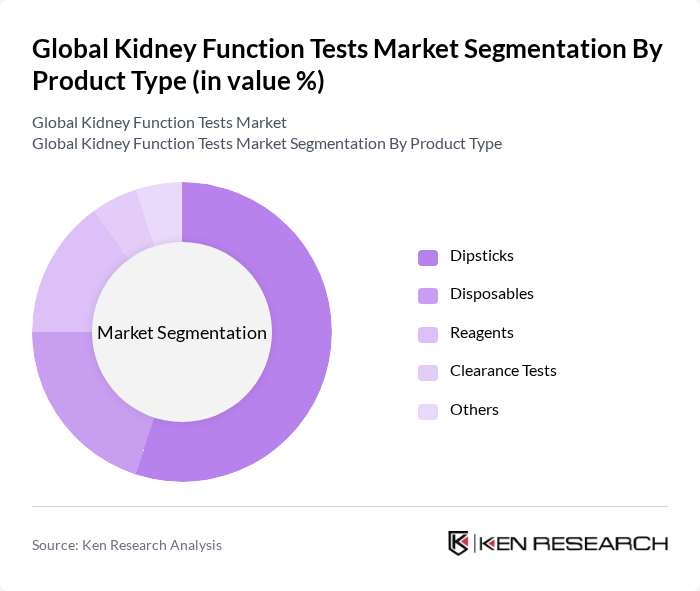
By Product Type:The product type segmentation includes various categories such as dipsticks, disposables, reagents, clearance tests, and others. Among these, dipsticks are particularly popular due to their ease of use and cost-effectiveness, making them a preferred choice in both clinical and home settings. Disposables and reagents also hold significant market shares, driven by the increasing demand for accurate and reliable testing methods. The market is witnessing a trend towards automation, integration of AI-based analysis, and the use of advanced technologies such as high-throughput analyzers, which is further propelling the growth of these segments .
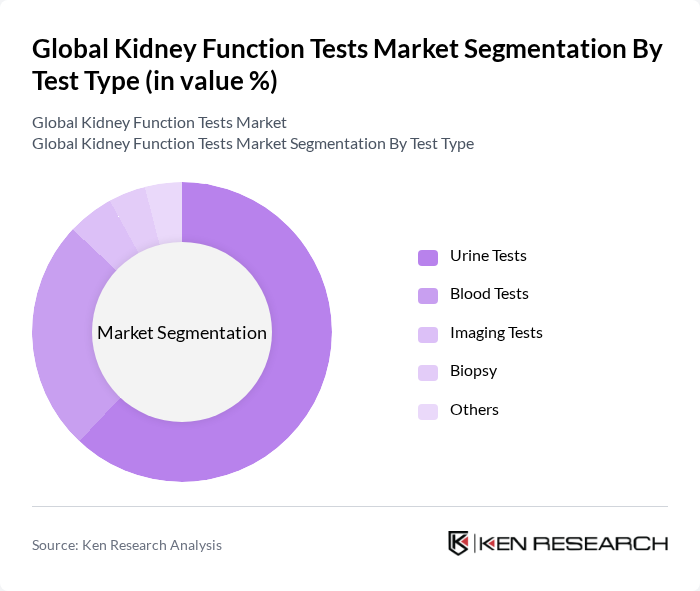
By Test Type:This segmentation encompasses urine tests, blood tests, imaging tests, biopsy, and others. Urine tests, particularly urine protein tests and routine urinalysis, dominate the market due to their non-invasive nature and ability to provide quick results. Blood tests, including serum creatinine and glomerular filtration rate tests, are also crucial for diagnosing kidney function. The increasing focus on preventive healthcare, early diagnosis, and adoption of point-of-care testing is driving the demand for these tests, making them essential in clinical practice .
The Global Kidney Function Tests Market is characterized by a dynamic mix of regional and international players. Leading participants such as Abbott Laboratories, Siemens Healthineers, Roche Diagnostics, Thermo Fisher Scientific, Beckman Coulter (Danaher Corporation), Bio-Rad Laboratories, Ortho Clinical Diagnostics (QuidelOrtho Corporation), QuidelOrtho Corporation, Sysmex Corporation, Fujifilm Holdings Corporation, Hologic, Inc., Agilent Technologies, PerkinElmer, Inc., Mindray Medical International Limited, DiaSorin S.p.A., Randox Laboratories, Quest Diagnostics, Laboratory Corporation of America Holdings (LabCorp), ARKRAY, Inc., Nova Biomedical contribute to innovation, geographic expansion, and service delivery in this space.
The future of the kidney function tests market appears promising, driven by ongoing advancements in technology and increasing healthcare investments. As telemedicine continues to expand, remote monitoring and consultations will enhance patient access to kidney health services. Additionally, the integration of artificial intelligence in diagnostic processes is expected to improve accuracy and efficiency. These trends indicate a shift towards more personalized and preventive healthcare approaches, ultimately fostering a more proactive stance in kidney disease management.
| Segment | Sub-Segments |
|---|---|
| By Product Type | Dipsticks Disposables Reagents Clearance Tests Others |
| By Test Type | Urine Tests Urine Protein Tests Creatinine Clearance Tests Microalbumin Tests Routine Urinalysis Blood Tests Serum Creatinine Tests Glomerular Filtration Rate (GFR) Tests Blood Urea Nitrogen (BUN) Tests Imaging Tests Biopsy Others |
| By End-User | Hospitals and Clinics Diagnostic Laboratories Home and Point-of-Care Settings Research Institutions Others |
| By Region | North America Europe Asia-Pacific Latin America Middle East & Africa |
| By Technology | Immunoassays Chromatography Mass Spectrometry Molecular Diagnostics Others |
| By Application | Clinical Diagnostics Research & Development Drug Development Others |
| By Distribution Channel | Direct Sales Online Sales Distributors Others |
| By Testing Setting | Central Laboratory-Based Point-of-Care |
| By Policy Support | Government Subsidies Tax Incentives Research Grants Others |
| Scope Item/Segment | Sample Size | Target Respondent Profiles |
|---|---|---|
| Nephrology Clinics | 100 | Nephrologists, Clinic Administrators |
| Diagnostic Laboratories | 80 | Laboratory Managers, Technicians |
| Healthcare Providers | 120 | General Practitioners, Family Physicians |
| Patient Advocacy Groups | 60 | Patient Representatives, Health Educators |
| Medical Device Manufacturers | 90 | Product Managers, R&D Specialists |
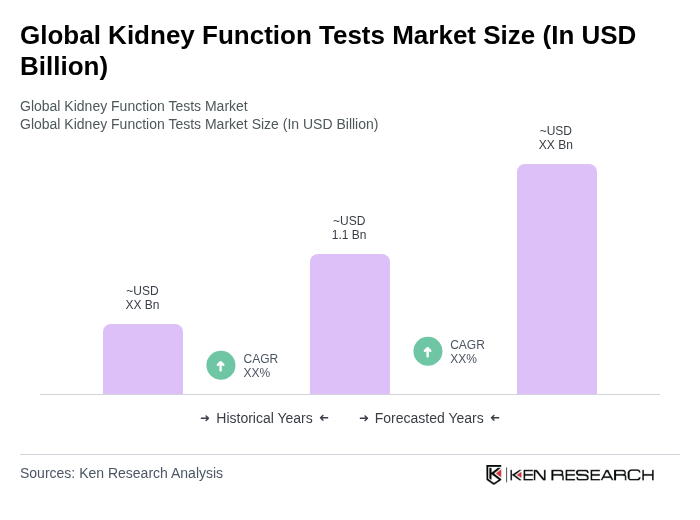
The Global Kidney Function Tests Market is valued at approximately USD 1.1 billion, reflecting a significant growth trend driven by the increasing prevalence of chronic kidney diseases and advancements in diagnostic technologies.

What makes us stand out is that our consultants follow Robust, Refine and Result (RRR) methodology. Robust for clear definitions, approaches and sanity checking, Refine for differentiating respondents' facts and opinions, and Result for presenting data with story.

We have set a benchmark in the industry by offering our clients with syndicated and customized market research reports featuring coverage of entire market as well as meticulous research and analyst insights.

While we don't replace traditional research, we flip the method upside down. Our dual approach of Top Bottom & Bottom Top ensures quality deliverable by not just verifying company fundamentals but also looking at the sector and macroeconomic factors.

With one step in the future, our research team constantly tries to show you the bigger picture. We help with some of the tough questions you may encounter along the way: How is the industry positioned? Best marketing channel? KPI's of competitors? By aligning every element, we help maximize success.

Our report gives you instant access to the answers and sources that other companies might choose to hide. We elaborate each steps of research methodology we have used and showcase you the sample size to earn your trust.

If you need any support, we are here! We pride ourselves on universe strength, data quality, and quick, friendly, and professional service.













