About the Report
Base Year 2024Global Kids Travel Bags Market Overview
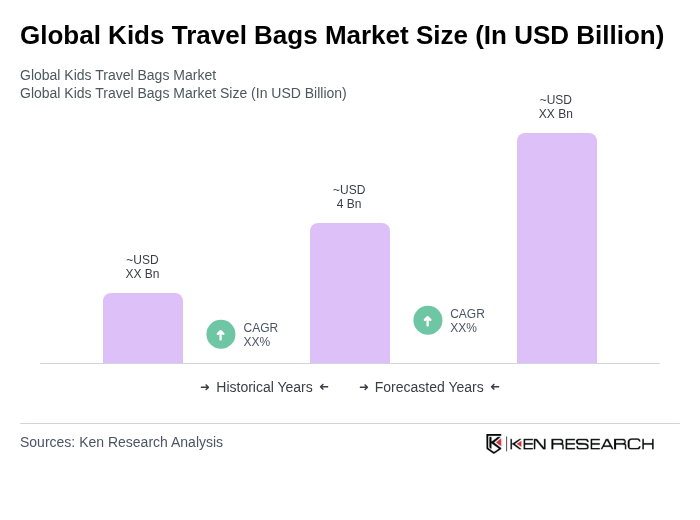
- The Global Kids Travel Bags Market is valued at USD 4 billion, based on recent analysis. Growth is driven by rising demand for eco-friendly and smart-enabled luggage—including ride-on and scooter-integrated designs—and parents’ increasing preference for themes and licensed characters that enhance appeal, along with expanding online retail penetration and evolving educational and travel routines among young families.
- Key regions dominating the market include North America, where strong safety regulations, affluent households, and frequent domestic travel support demand, and the rapidly expanding Asia-Pacific region, fueled by growing middle-class consumption and branded product adoption. These regions are characterized by a high level of consumer spending on children's products, particularly in travel-related categories.
- In the United States, the Consumer Product Safety Improvement Act imposes strict testing, lead and phthalate limits, and certification requirements for children’s products, ensuring higher safety compliance in kids travel bags and reinforcing quality standards that benefit reputable manufacturers and distributors.
Global Kids Travel Bags Market Segmentation
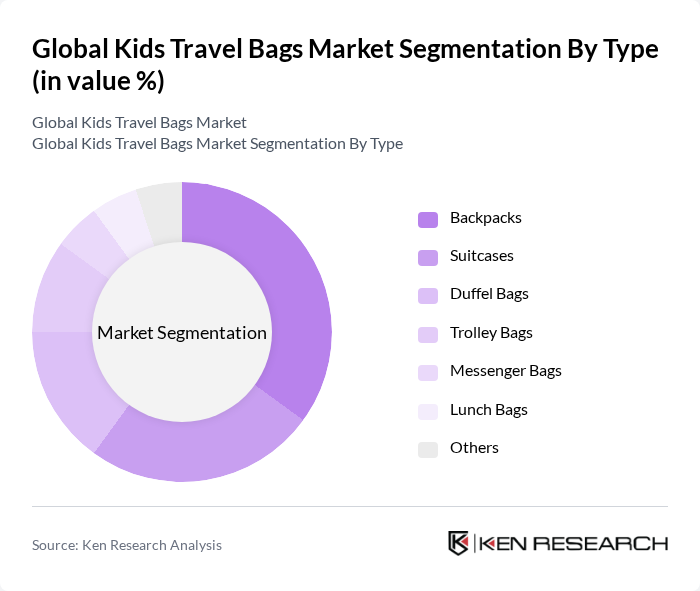
By Type:The market is segmented into various types of travel bags, including backpacks, suitcases, duffel bags, trolley bags, messenger bags, lunch bags, and others. Among these, backpacks are the most popular choice due to their versatility and ease of use for children. They are designed to be lightweight and ergonomic, catering to the needs of young travelers. Suitcases and trolley bags are also gaining traction, especially for family vacations, as they offer more space and organization for longer trips.
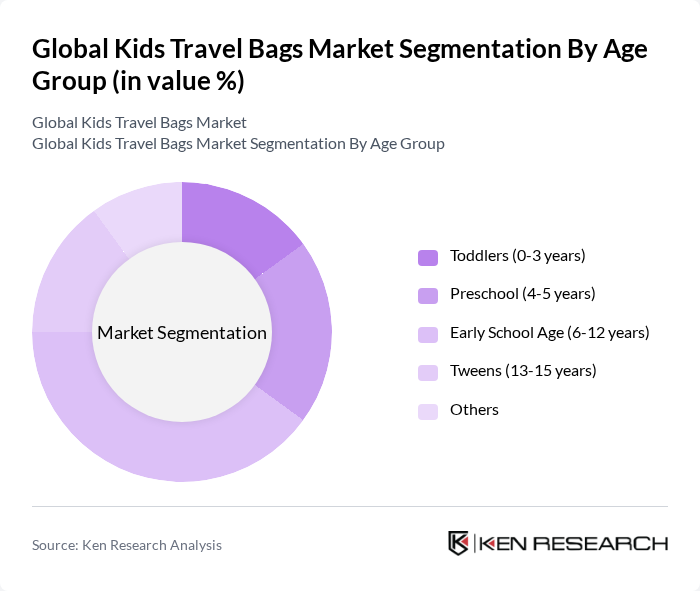
By Age Group:The market is also segmented by age group, including toddlers (0-3 years), preschool (4-5 years), early school age (6-12 years), tweens (13-15 years), and others. The early school age group is the largest segment, as children in this age range are more likely to travel for school-related activities and family vacations. Products designed for this age group often feature popular characters and themes, making them appealing to both children and parents.
Global Kids Travel Bags Market Competitive Landscape
The Global Kids Travel Bags Market is characterized by a dynamic mix of regional and international players. Leading participants such as Disney Consumer Products, Samsonite International S.A., JanSport, Osprey Packs, Inc., North Face, Wildkin, Skip Hop, Pottery Barn Kids, LittleLife, Trunki, Herschel Supply Co., L.L.Bean, Cath Kidston, KidKraft, Targus contribute to innovation, geographic expansion, and service delivery in this space.
Global Kids Travel Bags Market Industry Analysis
Growth Drivers
- Increasing Demand for Family Travel:The nominal GDP of Emerging Markets and Developing Economies (EMDE) is projected to reach USD 49,000 billion in future. This economic growth fosters increased disposable income, enabling families to travel more frequently. As travel becomes a priority for families, the demand for kids' travel bags is expected to rise significantly, particularly in key markets like China and India, where family travel is increasingly popular.
- Rising Disposable Incomes:In future, real household income per capita in the OECD is anticipated to increase by 2.0%. This growth in disposable income allows families to allocate more funds toward non-essential items, including kids' travel bags. As parents prioritize quality and branded products for their children, the market for premium kids' travel bags is likely to expand, driven by enhanced consumer spending capacity.
- Urbanization and E-commerce Expansion:The UN reports that urban areas will house approximately 3.75 billion people in future, representing 46% of the global population. This urban concentration facilitates better access to retail and e-commerce platforms, making it easier for families to purchase kids' travel bags. The expansion of e-commerce in urban regions is expected to drive sales, as parents increasingly turn to online shopping for convenience and variety.
Market Challenges
- Intense Competition Among Manufacturers:The kids' travel bags market is characterized by fierce competition, with numerous manufacturers vying for market share. This competition can lead to price wars, reducing profit margins for companies. As brands strive to differentiate themselves through quality and innovation, the pressure to maintain competitive pricing may hinder profitability, particularly for smaller players in the market.
- Fluctuating Raw Material Prices:In future, global debt is projected to exceed USD 105 trillion, which can lead to economic instability and fluctuations in raw material prices. Manufacturers of kids' travel bags may face increased costs for materials, impacting their ability to maintain competitive pricing. This volatility can create challenges in budgeting and forecasting, ultimately affecting product availability and market stability.
Global Kids Travel Bags Market Future Outlook
The future of the kids' travel bags market appears promising, driven by trends such as the integration of smart technology and a growing emphasis on sustainability. Innovations like GPS tracking and eco-friendly materials are becoming increasingly important to consumers. Additionally, the market is likely to benefit from the rising middle class in the Asia-Pacific region, which is expected to drive demand for quality travel products. As educational travel continues to grow, opportunities for bulk procurement will also emerge, enhancing market dynamics.
Market Opportunities
- Expansion into Emerging Markets:The Asia-Pacific region accounted for 32-37% of the kids' travel bags market share in future. This rapid growth presents significant opportunities for brands to expand their presence and cater to the rising middle class, which is increasingly investing in quality travel products for children.
- Collaborations with Educational Institutions:With 1.4 billion tourist arrivals reported in future, the educational travel segment is growing, with an annual increase of 9% in educational travel programs. This trend offers substantial opportunities for brands to collaborate with schools and educational tour providers, creating bulk demand for kids' travel bags tailored for educational purposes.
Scope of the Report
| Segment | Sub-Segments |
|---|---|
| By Type | Backpacks Suitcases Duffel Bags Trolley Bags Messenger Bags Lunch Bags Others |
| By Age Group | Toddlers (0-3 years) Preschool (4-5 years) Early School Age (6-12 years) Tweens (13-15 years) Others |
| By Material | Polyester Nylon Canvas Leather Eco-friendly Materials Others |
| By Design | Cartoon Characters Sports Themes Fashionable Designs Customizable Designs Others |
| By Distribution Channel | Online Retail Supermarkets/Hypermarkets Specialty Stores Department Stores Others |
| By Price Range | Budget Mid-range Premium Others |
| By Region | North America Europe Asia-Pacific Latin America Middle East & Africa |
Key Target Audience
Investors and Venture Capitalist Firms
Government and Regulatory Bodies (e.g., Consumer Product Safety Commission, Federal Trade Commission)
Manufacturers and Producers
Distributors and Retailers
Travel and Tourism Companies
Logistics and Supply Chain Companies
Industry Associations (e.g., American Apparel & Footwear Association)
Financial Institutions
Players Mentioned in the Report:
Disney Consumer Products
Samsonite International S.A.
JanSport
Osprey Packs, Inc.
North Face
Wildkin
Skip Hop
Pottery Barn Kids
LittleLife
Trunki
Herschel Supply Co.
L.L.Bean
Cath Kidston
KidKraft
Targus
Table of Contents
Market Assessment Phase
1. Executive Summary and Approach
2. Global Kids Travel Bags Market Overview
2.1 Key Insights and Strategic Recommendations
2.2 Global Kids Travel Bags Market Overview
2.3 Definition and Scope
2.4 Evolution of Market Ecosystem
2.5 Timeline of Key Regulatory Milestones
2.6 Value Chain & Stakeholder Mapping
2.7 Business Cycle Analysis
2.8 Policy & Incentive Landscape
3. Global Kids Travel Bags Market Analysis
3.1 Growth Drivers
3.1.1 Increasing demand for travel among families
3.1.2 Rising disposable incomes
3.1.3 Growing trend of personalized and branded kids' products
3.1.4 Expansion of e-commerce platforms
3.2 Market Challenges
3.2.1 Intense competition among manufacturers
3.2.2 Fluctuating raw material prices
3.2.3 Changing consumer preferences
3.2.4 Regulatory compliance issues
3.3 Market Opportunities
3.3.1 Development of eco-friendly travel bags
3.3.2 Expansion into emerging markets
3.3.3 Collaborations with travel agencies and schools
3.3.4 Customization options for consumers
3.4 Market Trends
3.4.1 Increasing focus on sustainability
3.4.2 Rise in online shopping for kids' products
3.4.3 Popularity of multifunctional travel bags
3.4.4 Influence of social media on purchasing decisions
3.5 Government Regulation
3.5.1 Safety standards for children's products
3.5.2 Import/export regulations
3.5.3 Environmental regulations on materials used
3.5.4 Labeling requirements for children's products
4. SWOT Analysis
5. Stakeholder Analysis
6. Porter's Five Forces Analysis
7. Global Kids Travel Bags Market Market Size, 2019-2024
7.1 By Value
7.2 By Volume
7.3 By Average Selling Price
8. Global Kids Travel Bags Market Segmentation
8.1 By Type
8.1.1 Backpacks
8.1.2 Suitcases
8.1.3 Duffel Bags
8.1.4 Trolley Bags
8.1.5 Messenger Bags
8.1.6 Lunch Bags
8.1.7 Others
8.2 By Age Group
8.2.1 Toddlers (0-3 years)
8.2.2 Preschool (4-5 years)
8.2.3 Early School Age (6-12 years)
8.2.4 Tweens (13-15 years)
8.2.5 Others
8.3 By Material
8.3.1 Polyester
8.3.2 Nylon
8.3.3 Canvas
8.3.4 Leather
8.3.5 Eco-friendly Materials
8.3.6 Others
8.4 By Design
8.4.1 Cartoon Characters
8.4.2 Sports Themes
8.4.3 Fashionable Designs
8.4.4 Customizable Designs
8.4.5 Others
8.5 By Distribution Channel
8.5.1 Online Retail
8.5.2 Supermarkets/Hypermarkets
8.5.3 Specialty Stores
8.5.4 Department Stores
8.5.5 Others
8.6 By Price Range
8.6.1 Budget
8.6.2 Mid-range
8.6.3 Premium
8.6.4 Others
8.7 By Region
8.7.1 North America
8.7.2 Europe
8.7.3 Asia-Pacific
8.7.4 Latin America
8.7.5 Middle East & Africa
9. Global Kids Travel Bags Market Competitive Analysis
9.1 Market Share of Key Players
9.2 Cross Comparison of Key Players
9.2.1 Company Name
9.2.2 Group Size (Large, Medium, or Small as per industry convention)
9.2.3 Revenue Growth Rate
9.2.4 Market Penetration Rate
9.2.5 Customer Retention Rate
9.2.6 Pricing Strategy
9.2.7 Product Diversification
9.2.8 Brand Recognition
9.2.9 Distribution Network Efficiency
9.2.10 Customer Satisfaction Score
9.3 SWOT Analysis of Top Players
9.4 Pricing Analysis
9.5 Detailed Profile of Major Companies
9.5.1 Disney Consumer Products
9.5.2 Samsonite International S.A.
9.5.3 JanSport
9.5.4 Osprey Packs, Inc.
9.5.5 North Face
9.5.6 Wildkin
9.5.7 Skip Hop
9.5.8 Pottery Barn Kids
9.5.9 LittleLife
9.5.10 Trunki
9.5.11 Herschel Supply Co.
9.5.12 L.L.Bean
9.5.13 Cath Kidston
9.5.14 KidKraft
9.5.15 Targus
10. Global Kids Travel Bags Market End-User Analysis
10.1 Procurement Behavior of Key Ministries
10.1.1 Government contracts for educational institutions
10.1.2 Budget allocation for children's welfare programs
10.1.3 Partnerships with NGOs for distribution
10.1.4 Compliance with safety standards
10.2 Corporate Spend on Infrastructure & Energy
10.2.1 Investment in child-friendly travel initiatives
10.2.2 Sponsorship of educational trips
10.2.3 Collaborations with travel agencies
10.2.4 Funding for community programs
10.3 Pain Point Analysis by End-User Category
10.3.1 Quality concerns among parents
10.3.2 Price sensitivity in budget-conscious families
10.3.3 Demand for durability and functionality
10.3.4 Need for safety features in kids' bags
10.4 User Readiness for Adoption
10.4.1 Awareness of product benefits
10.4.2 Availability of products in local markets
10.4.3 Influence of peer recommendations
10.4.4 Marketing effectiveness
10.5 Post-Deployment ROI and Use Case Expansion
10.5.1 Customer feedback and satisfaction surveys
10.5.2 Repeat purchase rates
10.5.3 Expansion into new product lines
10.5.4 Long-term brand loyalty
11. Global Kids Travel Bags Market Future Size, 2025-2030
11.1 By Value
11.2 By Volume
11.3 By Average Selling Price
Go-To-Market Strategy Phase
1. Whitespace Analysis + Business Model Canvas
1.1 Market Gaps Identification
1.2 Value Proposition Development
1.3 Revenue Streams
1.4 Key Partnerships
1.5 Cost Structure Analysis
1.6 Customer Segments
1.7 Channels
2. Marketing and Positioning Recommendations
2.1 Branding Strategies
2.2 Product USPs
3. Distribution Plan
3.1 Urban Retail vs Rural NGO Tie-ups
4. Channel & Pricing Gaps
4.1 Underserved Routes
4.2 Pricing Bands
5. Unmet Demand & Latent Needs
5.1 Category Gaps
5.2 Consumer Segments
6. Customer Relationship
6.1 Loyalty Programs
6.2 After-sales Service
7. Value Proposition
7.1 Sustainability
7.2 Integrated Supply Chains
8. Key Activities
8.1 Regulatory Compliance
8.2 Branding
8.3 Distribution Setup
9. Entry Strategy Evaluation
9.1 Domestic Market Entry Strategy
9.1.1 Product Mix
9.1.2 Pricing Band
9.1.3 Packaging
9.2 Export Entry Strategy
9.2.1 Target Countries
9.2.2 Compliance Roadmap
10. Entry Mode Assessment
10.1 JV
10.2 Greenfield
10.3 M&A
10.4 Distributor Model
11. Capital and Timeline Estimation
11.1 Capital Requirements
11.2 Timelines
12. Control vs Risk Trade-Off
12.1 Ownership vs Partnerships
13. Profitability Outlook
13.1 Breakeven Analysis
13.2 Long-term Sustainability
14. Potential Partner List
14.1 Distributors
14.2 JVs
14.3 Acquisition Targets
15. Execution Roadmap
15.1 Phased Plan for Market Entry
15.1.1 Market Setup
15.1.2 Market Entry
15.1.3 Growth Acceleration
15.1.4 Scale & Stabilize
15.2 Key Activities and Milestones
15.2.1 Milestone Planning
15.2.2 Activity Tracking
Research Methodology
Phase 1: Approach1
Desk Research
- Market reports from industry associations focused on children's products
- Analysis of sales data from major retailers and e-commerce platforms
- Consumer behavior studies related to travel and children's accessories
Primary Research
- Interviews with product managers at leading travel bag manufacturers
- Surveys targeting parents and guardians regarding travel bag preferences
- Focus groups with children to understand design and functionality preferences
Validation & Triangulation
- Cross-validation of findings with sales data from multiple distribution channels
- Triangulation of consumer insights with expert opinions from industry analysts
- Sanity checks through feedback from focus group discussions
Phase 2: Market Size Estimation1
Top-down Assessment
- Analysis of overall travel market growth and its impact on travel accessories
- Segmentation of the market by age group, bag type, and geographic region
- Incorporation of trends in family travel and outdoor activities
Bottom-up Modeling
- Volume estimates based on sales data from key retailers and online platforms
- Cost analysis of production and pricing strategies of leading brands
- Estimation of market share based on product offerings and consumer preferences
Forecasting & Scenario Analysis
- Multi-variable forecasting using trends in travel frequency and family demographics
- Scenario analysis based on economic conditions and consumer spending behavior
- Projections for market growth through 2030 under various economic scenarios
Phase 3: CATI Sample Composition1
| Scope Item/Segment | Sample Size | Target Respondent Profiles |
|---|---|---|
| Retail Sales of Kids Travel Bags | 150 | Store Managers, Sales Associates |
| Online Purchase Behavior | 100 | Parents, Online Shoppers |
| Market Trends in Children's Accessories | 80 | Product Designers, Marketing Managers |
| Consumer Preferences in Travel Gear | 120 | Parents, Travel Enthusiasts |
| Feedback on Product Features | 90 | Children, Caregivers |
Frequently Asked Questions
What is the current value of the Global Kids Travel Bags Market?
The Global Kids Travel Bags Market is valued at approximately USD 4 billion, driven by increasing demand for eco-friendly and smart-enabled luggage, as well as parents' preferences for themed and licensed character designs.
What factors are driving the growth of the Kids Travel Bags Market?
Which regions dominate the Kids Travel Bags Market?
What types of travel bags are most popular for kids?
Other Regional/Country Reports
Indonesia Kids Travel Bags Market
Malaysia Kids Travel Bags Market
KSA Kids Travel Bags Market
APAC Kids Travel Bags Market
SEA Kids Travel Bags Market
Vietnam Kids Travel Bags Market
Other Adjacent Reports
Germany Luggage Market
South Korea Backpack Market
Philippines Suitcase Market
UAE Duffel Bag Market
Germany Trolley Bag Market
Thailand Childrens Apparel Market
South Africa Toy Market
Kuwait Licensed Merchandise Market
South Africa E-commerce Retail Market
Mexico Smart Luggage Market
Why Buy From Us?

What makes us stand out is that our consultants follow Robust, Refine and Result (RRR) methodology. Robust for clear definitions, approaches and sanity checking, Refine for differentiating respondents' facts and opinions, and Result for presenting data with story.

We have set a benchmark in the industry by offering our clients with syndicated and customized market research reports featuring coverage of entire market as well as meticulous research and analyst insights.

While we don't replace traditional research, we flip the method upside down. Our dual approach of Top Bottom & Bottom Top ensures quality deliverable by not just verifying company fundamentals but also looking at the sector and macroeconomic factors.

With one step in the future, our research team constantly tries to show you the bigger picture. We help with some of the tough questions you may encounter along the way: How is the industry positioned? Best marketing channel? KPI's of competitors? By aligning every element, we help maximize success.

Our report gives you instant access to the answers and sources that other companies might choose to hide. We elaborate each steps of research methodology we have used and showcase you the sample size to earn your trust.

If you need any support, we are here! We pride ourselves on universe strength, data quality, and quick, friendly, and professional service.