About the Report
Base Year 2024Global Laboratory Chairs Market Overview
- The Global Laboratory Chairs Market is valued at USD 1.5 billion, based on a five-year historical analysis. This growth is primarily driven by the increasing demand for ergonomic seating solutions in laboratories, coupled with the rise in research and development activities across various sectors, including pharmaceuticals and biotechnology. The focus on enhancing workplace safety and comfort has further propelled the market, as organizations seek to improve employee productivity and well-being through purpose-designed laboratory seating.
- Key players in this market are concentrated in regions such as North America and Europe, particularly in countries like the United States, Germany, and the United Kingdom. These regions dominate due to their advanced healthcare infrastructure, significant investments in research and development, and a strong presence of leading laboratory furniture manufacturers, including major lab furniture and equipment brands. The high demand for innovative and specialized laboratory seating solutions in these areas, especially in pharmaceutical, biotechnology, academic, and clinical laboratories, contributes to their market leadership.
- Ergonomic standards relevant to laboratory furniture, including chairs, are shaped by occupational safety and health requirements in the United States. The Occupational Safety and Health Administration (OSHA) enforces the General Duty Clause of the Occupational Safety and Health Act of 1970, which requires employers to provide workplaces free from recognized hazards likely to cause serious harm, including musculoskeletal risks related to seating and workstation design. In parallel, voluntary consensus standards such as ANSI/HFES 100 Human Factors Engineering of Computer Workstations, referenced in many corporate ergonomics programs, guide chair adjustability, posture support, and design criteria used for laboratory and technical seating. Together, these requirements and standards are encouraging laboratories and manufacturers to prioritize ergonomic designs, driving wider adoption of ergonomic laboratory chairs and continuous innovation in features such as adjustability, support, cleanability, and ESD/cleanroom compatibility.

Global Laboratory Chairs Market Segmentation
By Product Type:The product type segmentation includes various categories of laboratory chairs designed for specific functions and environments. The subsegments are as follows:
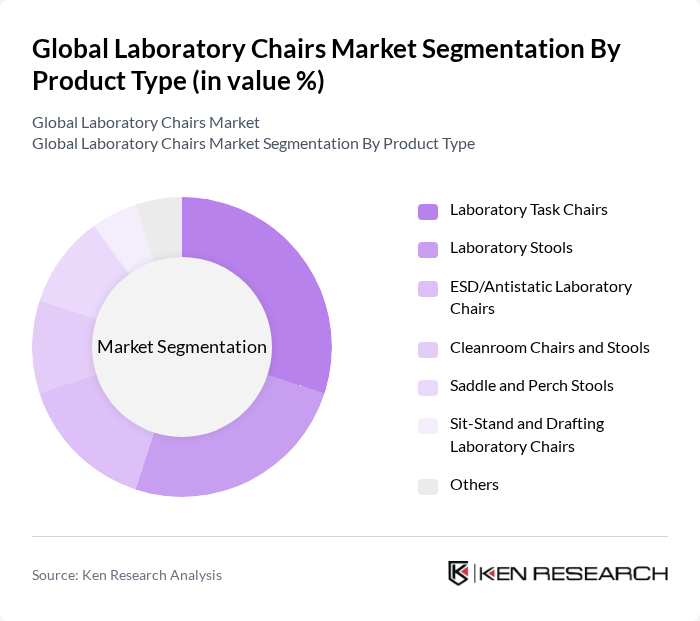
The Laboratory Task Chairs segment is currently dominating the market due to their versatility and ergonomic design, which caters to a wide range of laboratory environments. These chairs are preferred for their adjustability and comfort, allowing users to work efficiently for extended periods in research, quality control, and clinical settings. The increasing focus on workplace ergonomics, laboratory safety, and compliance with occupational health guidelines has led to a surge in demand for these chairs, particularly in academic, pharmaceutical, and biotechnology laboratories. As a result, manufacturers are continuously innovating to enhance the features and functionalities of laboratory task chairs—such as improved lumbar support, material durability, chemical resistance, and ease of cleaning—solidifying their position as market leaders.
By End-User:The end-user segmentation encompasses various sectors that utilize laboratory chairs, reflecting the diverse applications of these products. The subsegments are as follows:
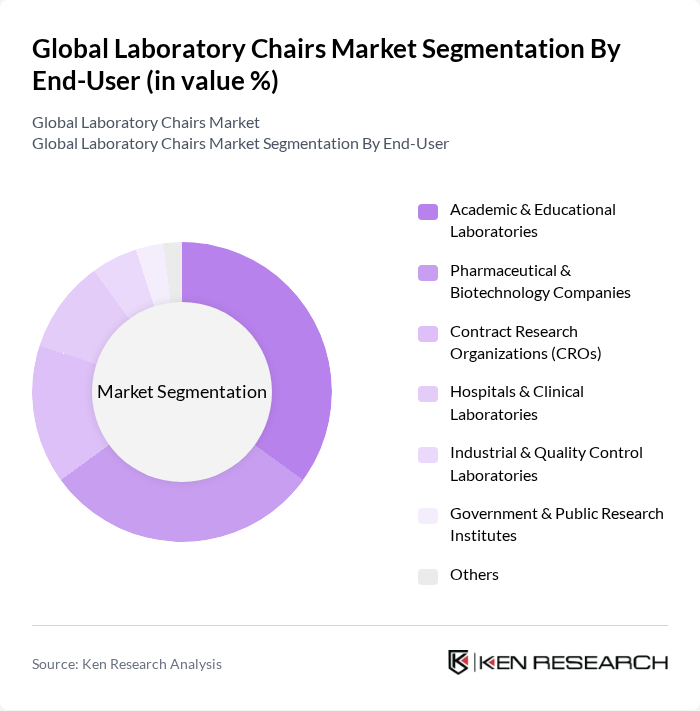
The Academic & Educational Laboratories segment leads the market, driven by the increasing number of educational institutions and research facilities and the expansion of STEM-focused teaching laboratories. These environments require a significant number of laboratory chairs to accommodate students and researchers, emphasizing the need for ergonomic, durable, and easily cleanable seating solutions. The growing emphasis on practical learning, simulation-based training, and collaborative research in academic settings has further fueled the demand for specialized laboratory chairs, making this segment a key driver of market growth.
Global Laboratory Chairs Market Competitive Landscape
The Global Laboratory Chairs Market is characterized by a dynamic mix of regional and international players. Leading participants such as BioFit Engineered Products, Labconco Corporation, Global Industrial (Systemax Inc.), Safco Products Company, National Public Seating Corporation, Interion (Global Industrial Brand), ESD Seating Ltd., VWR International, LLC (Avantor), Fisher Scientific (Thermo Fisher Scientific Inc.), Waldner Laboreinrichtungen SE & Co. KG, Kewaunee Scientific Corporation, LabDesign Corporation, Treston Group, RDM Industrial Products, Inc., IAC Industries contribute to innovation, geographic expansion, and service delivery in this space.
Global Laboratory Chairs Market Industry Analysis
Growth Drivers
- Increasing Demand for Ergonomic Designs:The global ergonomic furniture market is projected to reach $79.4 billion in future, driven by a growing emphasis on workplace comfort. In laboratory settings, ergonomic chairs are essential for enhancing user productivity and reducing fatigue. With over 60% of laboratory professionals reporting discomfort from traditional seating, the demand for ergonomic designs is surging. This trend is supported by the increasing awareness of health benefits associated with ergonomic seating, which is expected to drive sales significantly in the coming years.
- Growth in Laboratory Infrastructure Investments:According to the World Bank, global investments in laboratory infrastructure are expected to exceed $100 billion in future. This growth is fueled by rising healthcare expenditures and the expansion of research facilities. Countries like India and China are significantly increasing their laboratory infrastructure budgets, with India allocating $2.5 billion for research and development in future. This investment directly correlates with the demand for high-quality laboratory chairs, as new facilities require modern, durable seating solutions.
- Rising Awareness of Health and Safety Standards:The global emphasis on health and safety in workplaces is intensifying, with the International Labour Organization reporting that over 2.78 million deaths occur annually due to workplace-related accidents. In laboratories, adherence to safety standards necessitates the use of compliant furniture, including chairs that meet ergonomic and safety regulations. As organizations strive to enhance workplace safety, the demand for compliant laboratory chairs is expected to rise, driving market growth significantly in future and beyond.
Market Challenges
- High Cost of Premium Laboratory Chairs:The average price of premium laboratory chairs can range from $300 to $1,200, which poses a significant barrier for many institutions, especially in developing regions. Budget constraints often limit the ability of laboratories to invest in high-quality seating solutions. As a result, many facilities opt for lower-cost alternatives that may not meet ergonomic or safety standards, potentially compromising user comfort and safety in the long run.
- Limited Availability of Specialized Designs:The market for specialized laboratory chairs is still developing, with many manufacturers focusing on generic designs. This limitation can hinder laboratories that require specific features, such as anti-static properties or chemical resistance. As of future, only 30% of laboratory chair manufacturers offer customizable options, which restricts choices for end-users. This gap in the market presents a challenge for laboratories seeking tailored solutions that meet their unique operational needs.
Global Laboratory Chairs Market Future Outlook
The future of the laboratory chairs market appears promising, driven by ongoing trends in ergonomic design and technological integration. As laboratories increasingly prioritize user comfort and productivity, the demand for innovative seating solutions is expected to rise. Additionally, the integration of smart technology into laboratory chairs, such as adjustable features and health monitoring systems, will likely enhance user experience. Furthermore, the expansion of laboratory infrastructure in emerging markets will create new opportunities for manufacturers to innovate and cater to diverse customer needs.
Market Opportunities
- Customization and Personalization Trends:The growing trend towards customization in laboratory furniture presents a significant opportunity. As laboratories seek to create tailored environments, manufacturers can capitalize on this demand by offering customizable chair designs. This approach not only enhances user satisfaction but also allows manufacturers to differentiate their products in a competitive market, potentially increasing market share and profitability.
- Integration of Smart Technology in Chairs:The incorporation of smart technology into laboratory chairs is an emerging opportunity. Features such as adjustable height, built-in sensors for posture correction, and connectivity to health monitoring systems can enhance user experience. As laboratories increasingly adopt technology-driven solutions, manufacturers that innovate in this area are likely to capture a growing segment of the market, appealing to tech-savvy customers.
Scope of the Report
| Segment | Sub-Segments |
|---|---|
| By Product Type | Laboratory Task Chairs Laboratory Stools ESD/Antistatic Laboratory Chairs Cleanroom Chairs and Stools Saddle and Perch Stools Sit-Stand and Drafting Laboratory Chairs Others |
| By End-User | Academic & Educational Laboratories Pharmaceutical & Biotechnology Companies Contract Research Organizations (CROs) Hospitals & Clinical Laboratories Industrial & Quality Control Laboratories Government & Public Research Institutes Others |
| By Application | Chemical & Analytical Laboratories Microbiology & Biosafety Laboratories Physical & Materials Testing Laboratories Clinical & Diagnostic Laboratories Environmental & Food Testing Laboratories Forensic & Security Laboratories Others |
| By Material | Metal Frame with Polyurethane (PU) Seat Metal Frame with Vinyl/Leatherette Upholstery Plastic/Polymer Fabric-Upholstered Stainless Steel & Cleanroom-Grade Materials Others |
| By Key Design Features | Fully Ergonomic (multi-adjustable) Chairs ESD-Safe and Conductive Chairs Cleanroom-Certified Chairs /7/Heavy-Duty Use Chairs Height-Adjustable (Gas-Lift) Chairs Others |
| By Distribution Channel | Direct Sales (Manufacturers) Laboratory Furniture Distributors Online B2B Platforms Office & Contract Furniture Dealers OEM/Project-Based Sales Others |
| By Price Range | Economy Mid-Range Premium Custom/Project-Based Pricing Others |
Key Target Audience
Investors and Venture Capitalist Firms
Government and Regulatory Bodies (e.g., Food and Drug Administration, Environmental Protection Agency)
Manufacturers and Producers
Distributors and Retailers
Healthcare Providers and Laboratories
Industry Associations
Financial Institutions
Importers and Exporters
Players Mentioned in the Report:
BioFit Engineered Products
Labconco Corporation
Global Industrial (Systemax Inc.)
Safco Products Company
National Public Seating Corporation
Interion (Global Industrial Brand)
ESD Seating Ltd.
VWR International, LLC (Avantor)
Fisher Scientific (Thermo Fisher Scientific Inc.)
Waldner Laboreinrichtungen SE & Co. KG
Kewaunee Scientific Corporation
LabDesign Corporation
Treston Group
RDM Industrial Products, Inc.
IAC Industries
Table of Contents
Market Assessment Phase
1. Executive Summary and Approach
2. Global Laboratory Chairs Market Overview
2.1 Key Insights and Strategic Recommendations
2.2 Global Laboratory Chairs Market Overview
2.3 Definition and Scope
2.4 Evolution of Market Ecosystem
2.5 Timeline of Key Regulatory Milestones
2.6 Value Chain & Stakeholder Mapping
2.7 Business Cycle Analysis
2.8 Policy & Incentive Landscape
3. Global Laboratory Chairs Market Analysis
3.1 Growth Drivers
3.1.1 Increasing demand for ergonomic designs
3.1.2 Growth in laboratory infrastructure investments
3.1.3 Rising awareness of health and safety standards
3.1.4 Technological advancements in materials and design
3.2 Market Challenges
3.2.1 High cost of premium laboratory chairs
3.2.2 Limited availability of specialized designs
3.2.3 Stringent regulatory compliance requirements
3.2.4 Competition from alternative seating solutions
3.3 Market Opportunities
3.3.1 Expansion in emerging markets
3.3.2 Customization and personalization trends
3.3.3 Integration of smart technology in chairs
3.3.4 Collaborations with educational institutions
3.4 Market Trends
3.4.1 Shift towards sustainable materials
3.4.2 Increasing focus on user comfort and productivity
3.4.3 Growth of online sales channels
3.4.4 Rise in demand for multi-functional furniture
3.5 Government Regulation
3.5.1 Compliance with ergonomic standards
3.5.2 Regulations on material safety and toxicity
3.5.3 Guidelines for laboratory safety and equipment
3.5.4 Environmental regulations on manufacturing processes
4. SWOT Analysis
5. Stakeholder Analysis
6. Porter's Five Forces Analysis
7. Global Laboratory Chairs Market Market Size, 2019-2024
7.1 By Value
7.2 By Volume
7.3 By Average Selling Price
8. Global Laboratory Chairs Market Segmentation
8.1 By Product Type
8.1.1 Laboratory Task Chairs
8.1.2 Laboratory Stools
8.1.3 ESD/Antistatic Laboratory Chairs
8.1.4 Cleanroom Chairs and Stools
8.1.5 Saddle and Perch Stools
8.1.6 Sit-Stand and Drafting Laboratory Chairs
8.1.7 Others
8.2 By End-User
8.2.1 Academic & Educational Laboratories
8.2.2 Pharmaceutical & Biotechnology Companies
8.2.3 Contract Research Organizations (CROs)
8.2.4 Hospitals & Clinical Laboratories
8.2.5 Industrial & Quality Control Laboratories
8.2.6 Government & Public Research Institutes
8.2.7 Others
8.3 By Application
8.3.1 Chemical & Analytical Laboratories
8.3.2 Microbiology & Biosafety Laboratories
8.3.3 Physical & Materials Testing Laboratories
8.3.4 Clinical & Diagnostic Laboratories
8.3.5 Environmental & Food Testing Laboratories
8.3.6 Forensic & Security Laboratories
8.3.7 Others
8.4 By Material
8.4.1 Metal Frame with Polyurethane (PU) Seat
8.4.2 Metal Frame with Vinyl/Leatherette Upholstery
8.4.3 Plastic/Polymer
8.4.4 Fabric-Upholstered
8.4.5 Stainless Steel & Cleanroom-Grade Materials
8.4.6 Others
8.5 By Key Design Features
8.5.1 Fully Ergonomic (multi-adjustable) Chairs
8.5.2 ESD-Safe and Conductive Chairs
8.5.3 Cleanroom-Certified Chairs
8.5.4 24/7/Heavy-Duty Use Chairs
8.5.5 Height-Adjustable (Gas-Lift) Chairs
8.5.6 Others
8.6 By Distribution Channel
8.6.1 Direct Sales (Manufacturers)
8.6.2 Laboratory Furniture Distributors
8.6.3 Online B2B Platforms
8.6.4 Office & Contract Furniture Dealers
8.6.5 OEM/Project-Based Sales
8.6.6 Others
8.7 By Price Range
8.7.1 Economy
8.7.2 Mid-Range
8.7.3 Premium
8.7.4 Custom/Project-Based Pricing
8.7.5 Others
9. Global Laboratory Chairs Market Competitive Analysis
9.1 Market Share of Key Players
9.2 Cross Comparison of Key Players
9.2.1 Company Name
9.2.2 Company Size (Global, Regional, or Niche Player)
9.2.3 Laboratory Seating Revenue and 3–5 Year CAGR
9.2.4 Geographic Footprint in Key Laboratory Clusters
9.2.5 Installed Base in Top End-User Segments
9.2.6 Share of Sales from Ergonomic/ESD/Cleanroom Lines
9.2.7 New Product Launches and R&D Intensity
9.2.8 Average Selling Price Positioning
9.2.9 Channel Mix (Direct vs Distributor vs Online)
9.2.10 Customer Satisfaction / After-Sales Service Ratings
9.3 SWOT Analysis of Top Players
9.4 Pricing Analysis
9.5 Detailed Profile of Major Companies
9.5.1 BioFit Engineered Products
9.5.2 Labconco Corporation
9.5.3 Global Industrial (Systemax Inc.)
9.5.4 Safco Products Company
9.5.5 National Public Seating Corporation
9.5.6 Interion (Global Industrial Brand)
9.5.7 ESD Seating Ltd.
9.5.8 VWR International, LLC (Avantor)
9.5.9 Fisher Scientific (Thermo Fisher Scientific Inc.)
9.5.10 Waldner Laboreinrichtungen SE & Co. KG
9.5.11 Kewaunee Scientific Corporation
9.5.12 LabDesign Corporation
9.5.13 Treston Group
9.5.14 RDM Industrial Products, Inc.
9.5.15 IAC Industries
10. Global Laboratory Chairs Market End-User Analysis
10.1 Procurement Behavior of Key Ministries
10.1.1 Budget Allocation Trends
10.1.2 Decision-Making Processes
10.1.3 Preferred Suppliers
10.1.4 Compliance Requirements
10.2 Corporate Spend on Infrastructure & Energy
10.2.1 Investment Trends in Laboratory Infrastructure
10.2.2 Spending on Ergonomic Solutions
10.2.3 Budgeting for Safety Compliance
10.3 Pain Point Analysis by End-User Category
10.3.1 Comfort and Ergonomics
10.3.2 Durability and Maintenance
10.3.3 Cost Constraints
10.3.4 Availability of Custom Solutions
10.4 User Readiness for Adoption
10.4.1 Training and Support Needs
10.4.2 Awareness of Ergonomic Benefits
10.4.3 Adoption Barriers
10.5 Post-Deployment ROI and Use Case Expansion
10.5.1 Measurement of Productivity Gains
10.5.2 Feedback Mechanisms
10.5.3 Opportunities for Upgrades
11. Global Laboratory Chairs Market Future Size, 2025-2030
11.1 By Value
11.2 By Volume
11.3 By Average Selling Price
Go-To-Market Strategy Phase
1. Whitespace Analysis + Business Model Canvas
1.1 Market Gaps Identification
1.2 Value Proposition Development
1.3 Revenue Streams Analysis
1.4 Customer Segmentation
1.5 Key Partnerships
1.6 Cost Structure Analysis
1.7 Competitive Advantage
2. Marketing and Positioning Recommendations
2.1 Branding Strategies
2.2 Product USPs
3. Distribution Plan
3.1 Urban Retail vs Rural NGO Tie-ups
4. Channel & Pricing Gaps
4.1 Underserved Routes
4.2 Pricing Bands
5. Unmet Demand & Latent Needs
5.1 Category Gaps
5.2 Consumer Segments
6. Customer Relationship
6.1 Loyalty Programs
6.2 After-Sales Service
7. Value Proposition
7.1 Sustainability
7.2 Integrated Supply Chains
8. Key Activities
8.1 Regulatory Compliance
8.2 Branding
8.3 Distribution Setup
9. Entry Strategy Evaluation
9.1 Domestic Market Entry Strategy
9.1.1 Product Mix
9.1.2 Pricing Band
9.1.3 Packaging
9.2 Export Entry Strategy
9.2.1 Target Countries
9.2.2 Compliance Roadmap
10. Entry Mode Assessment
10.1 JV
10.2 Greenfield
10.3 M&A
10.4 Distributor Model
11. Capital and Timeline Estimation
11.1 Capital Requirements
11.2 Timelines
12. Control vs Risk Trade-Off
12.1 Ownership vs Partnerships
13. Profitability Outlook
13.1 Breakeven Analysis
13.2 Long-Term Sustainability
14. Potential Partner List
14.1 Distributors
14.2 JVs
14.3 Acquisition Targets
15. Execution Roadmap
15.1 Phased Plan for Market Entry
15.1.1 Market Setup
15.1.2 Market Entry
15.1.3 Growth Acceleration
15.1.4 Scale & Stabilize
15.2 Key Activities and Milestones
15.2.1 Milestone Planning
15.2.2 Activity Tracking
Research Methodology
Phase 1: Approach1
Desk Research
- Industry reports from global laboratory equipment associations and market research firms
- Analysis of published articles and white papers on laboratory chair innovations and trends
- Review of regulatory guidelines and standards impacting laboratory furniture design and safety
Primary Research
- Interviews with laboratory managers and procurement officers in research institutions
- Surveys targeting manufacturers and suppliers of laboratory chairs
- Field visits to laboratories to observe chair usage and gather user feedback
Validation & Triangulation
- Cross-validation of findings through multiple data sources including sales data and expert opinions
- Triangulation of market trends with insights from industry conferences and seminars
- Sanity checks conducted through expert panel reviews and feedback loops
Phase 2: Market Size Estimation1
Top-down Assessment
- Estimation of the global laboratory chairs market size based on overall laboratory equipment spending
- Segmentation by end-user applications such as academic, clinical, and industrial laboratories
- Incorporation of growth rates from related sectors such as biotechnology and pharmaceuticals
Bottom-up Modeling
- Volume estimates derived from sales data of leading laboratory chair manufacturers
- Cost analysis based on average pricing of various types of laboratory chairs
- Calculation of market size using unit sales multiplied by average selling prices
Forecasting & Scenario Analysis
- Multi-variable regression analysis incorporating factors like R&D spending and laboratory expansions
- Scenario modeling based on potential shifts in regulatory requirements and technological advancements
- Development of baseline, optimistic, and pessimistic forecasts through 2030
Phase 3: CATI Sample Composition1
| Scope Item/Segment | Sample Size | Target Respondent Profiles |
|---|---|---|
| Academic Research Laboratories | 100 | Lab Managers, Research Scientists |
| Clinical Laboratories | 80 | Laboratory Technicians, Quality Control Managers |
| Industrial Research Facilities | 70 | Procurement Specialists, Facility Managers |
| Government Research Institutions | 60 | Policy Makers, Research Coordinators |
| Private Sector R&D Departments | 90 | Product Development Managers, Safety Officers |
Frequently Asked Questions
What is the current value of the Global Laboratory Chairs Market?
The Global Laboratory Chairs Market is valued at approximately USD 1.5 billion, driven by the increasing demand for ergonomic seating solutions and the rise in research and development activities across various sectors, including pharmaceuticals and biotechnology.
What factors are driving the growth of the laboratory chairs market?
Which regions dominate the Global Laboratory Chairs Market?
What types of laboratory chairs are available in the market?
Other Regional/Country Reports
Indonesia Laboratory Chairs Market
Malaysia Laboratory Chairs Market
KSA Laboratory Chairs Market
APAC Laboratory Chairs Market
SEA Laboratory Chairs Market
Vietnam Laboratory Chairs Market
Other Adjacent Reports
Kuwait Laboratory Furniture Market
Egypt Ergonomic Office Furniture Market
Malaysia Cleanroom Furniture Market
KSA Laboratory Safety Equipment Market
Qatar Biotechnology Equipment Market
UAE Pharmaceutical Manufacturing Equipment Market
Malaysia Medical Seating Market
KSA ESD Furniture Market
Mexico Laboratory Workstations Market
Thailand Healthcare Furniture Market
Why Buy From Us?

What makes us stand out is that our consultants follow Robust, Refine and Result (RRR) methodology. Robust for clear definitions, approaches and sanity checking, Refine for differentiating respondents' facts and opinions, and Result for presenting data with story.

We have set a benchmark in the industry by offering our clients with syndicated and customized market research reports featuring coverage of entire market as well as meticulous research and analyst insights.

While we don't replace traditional research, we flip the method upside down. Our dual approach of Top Bottom & Bottom Top ensures quality deliverable by not just verifying company fundamentals but also looking at the sector and macroeconomic factors.

With one step in the future, our research team constantly tries to show you the bigger picture. We help with some of the tough questions you may encounter along the way: How is the industry positioned? Best marketing channel? KPI's of competitors? By aligning every element, we help maximize success.

Our report gives you instant access to the answers and sources that other companies might choose to hide. We elaborate each steps of research methodology we have used and showcase you the sample size to earn your trust.

If you need any support, we are here! We pride ourselves on universe strength, data quality, and quick, friendly, and professional service.