Global Lactose Free Butter Market

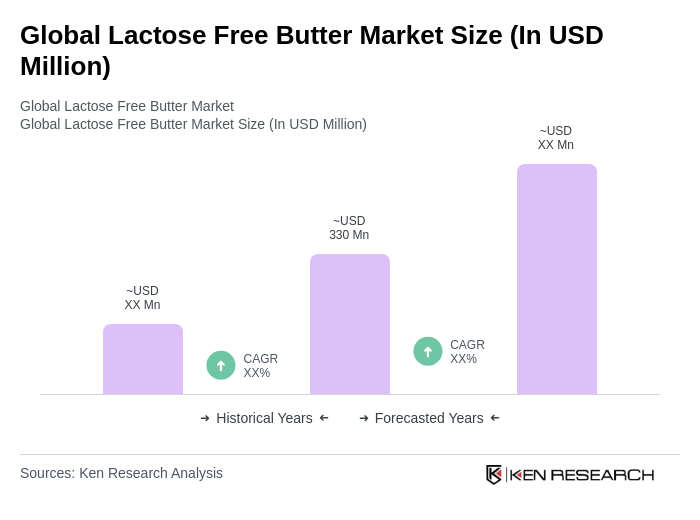
The Global Lactose Free Butter Market, valued at USD 330 million, is growing due to increasing health consciousness, lactose intolerance prevalence, and innovations in dairy alternatives.

Region:Global

Author(s):Dev

Product Code:KRAB0413

Pages:88

Published On:August 2025
About the Report

Base Year 2024

Global Lactose Free Butter Market Overview

  • The Global Lactose Free Butter Market is valued at USD 330 million, based on a five-year historical analysis. This valuation aligns with multiple market analyses that place the market a little above USD 310 million in the earlier period and in the mid-USD 330 million range in the latest base estimates . This growth is primarily driven by the increasing prevalence of lactose intolerance among consumers, coupled with a rising demand for dairy alternatives that do not compromise on taste and quality. The market has seen a significant uptick in product innovation, with manufacturers applying enzymatic lactase treatment and filtration to deliver butter with traditional functionality and improved digestibility .
  • Key players in this market include the United States, Germany, and Australia, which dominate due to their advanced dairy processing technologies and strong consumer awareness regarding lactose-free products. North America is reported as a leading market, with Europe also significant given strong retail penetration of lactose-free dairy; mature dairy sectors in the U.S., Germany, and Australia support production capacity and exports .
  • In 2023, the European Union implemented regulations mandating clearer labeling for lactose-free products, ensuring that consumers can easily identify suitable options. EU guidance and harmonization under general food information rules require accurate nutrition and allergen labeling; industry reports note increased emphasis on “lactose-free” and “low-lactose” claims to improve consumer clarity in retail across the EU market .
Global Lactose Free Butter Market Size

Global Lactose Free Butter Market Segmentation

By Type:The lactose-free butter market is segmented into various types, including Salted, Unsalted, Flavored, Organic, and Whipped. Among these, the salted variant is particularly popular due to its versatility in cooking and baking, while organic options are gaining traction among health-conscious consumers. The flavored segment is also witnessing growth as consumers seek unique taste experiences .
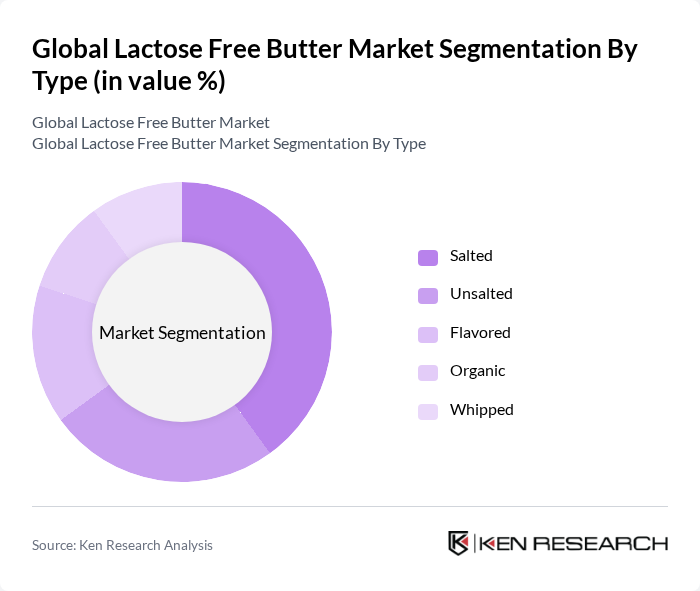
Global Lactose Free Butter Market segmentation by Type.

By End-User:The market is further segmented by end-user categories, including Household/Retail, Foodservice (HORECA), Food & Beverage Manufacturers (Bakery, Confectionery, Ready Meals), and Institutional (Hospitals, Schools, Catering). The household segment dominates due to the increasing trend of home cooking and baking, while the foodservice sector is also significant, driven by the demand for lactose-free options in restaurants and cafes .
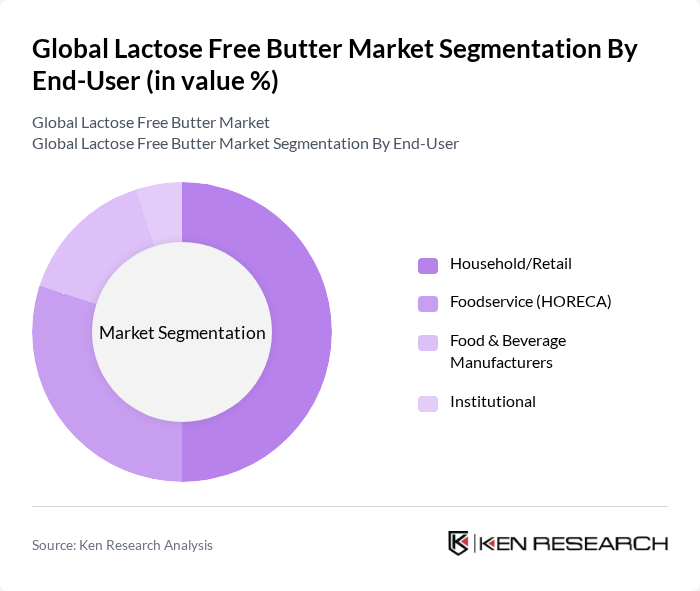
Global Lactose Free Butter Market segmentation by End-User.

Global Lactose Free Butter Market Competitive Landscape

The Global Lactose Free Butter Market is characterized by a dynamic mix of regional and international players. Leading participants such as Arla Foods amba, Lactalis Group (Président, Valio license partnerships), Land O'Lakes, Inc., Ornua Co-operative Limited (Kerrygold), Saputo Inc., Fonterra Co-operative Group Limited (Anchor), Valio Ltd, Upfield Holdings B.V. (Flora/Lätta lactose-free butter blends), Green Valley Creamery, Lurpak (Arla brand), FrieslandCampina, Danone S.A. (Alpro dairy-alternative adjacency, LF dairy lines), Amul – Gujarat Cooperative Milk Marketing Federation (GCMMF), Yili Group, Lacteeze (lactase-enabled dairy brand) contribute to innovation, geographic expansion, and service delivery in this space .

Arla Foods amba

1881

Viby J, Denmark

Lactalis Group

1933

Laval, France

Land O'Lakes, Inc.

1921

Arden Hills, Minnesota, USA

Ornua Co-operative Limited

1961

Dublin, Ireland

Saputo Inc.

1954

Montreal, Canada

Company

Establishment Year

Headquarters

Group Size (Global, Regional, or Niche)

Lactose-Free Portfolio Breadth (SKUs, variants)

Revenue Growth Rate (LF butter, % YoY)

Market Penetration (countries/retail banners)

Average Realized Price per kg (by region)

Product Innovation Rate (new LF butter launches/year)

Global Lactose Free Butter Market Industry Analysis

Growth Drivers

  • Increasing Health Consciousness:The global health and wellness market is projected to reach $4.24 trillion in future, driving consumers towards healthier food options. Lactose-free products, including butter, are increasingly favored due to their perceived health benefits. In future, 68% of consumers reported actively seeking lactose-free options, reflecting a significant shift in dietary preferences. This trend is particularly strong among millennials, who prioritize health and wellness in their purchasing decisions, further propelling the lactose-free butter market.
  • Rising Demand for Dairy Alternatives:The dairy alternatives market is expected to reach $38.86 billion in future, with lactose-free butter being a key segment. This growth is fueled by a 20% increase in lactose intolerance diagnoses globally, leading to a surge in demand for lactose-free products. Additionally, the rise of plant-based diets has prompted consumers to seek dairy alternatives, with lactose-free butter positioned as a viable option for those avoiding traditional dairy while still desiring similar flavors and textures.
  • Expanding Vegan and Lactose-Intolerant Population:The global vegan population is projected to reach 1.5 billion in future, significantly impacting the lactose-free butter market. With approximately 65% of the global population experiencing some form of lactose intolerance, the demand for lactose-free butter is expected to rise. This demographic shift is driving manufacturers to innovate and expand their product lines, catering to both lactose-intolerant individuals and those adopting vegan lifestyles, thus enhancing market growth.

Market Challenges

  • High Production Costs:The production of lactose-free butter involves advanced processing techniques, which can increase costs significantly. For instance, the cost of enzyme treatment to remove lactose can add up to 30% to production expenses. This financial burden can limit the ability of smaller manufacturers to compete, leading to higher retail prices that may deter price-sensitive consumers. Consequently, this challenge can hinder market penetration and growth in various regions.
  • Limited Consumer Awareness:Despite the growing popularity of lactose-free products, consumer awareness remains a significant barrier. A survey indicated that only 45% of consumers were aware of lactose-free butter as an option. This lack of knowledge can lead to lower demand and sales, particularly in regions where traditional dairy products dominate. Educational initiatives and marketing strategies are essential to increase awareness and drive consumer interest in lactose-free butter.

Global Lactose Free Butter Market Future Outlook

The lactose-free butter market is poised for significant growth, driven by increasing health consciousness and the rising demand for dairy alternatives. Innovations in product offerings, such as organic and sustainably sourced options, are expected to attract environmentally conscious consumers. Additionally, the expansion of e-commerce platforms will facilitate greater accessibility to lactose-free products, allowing manufacturers to reach a broader audience. As consumer preferences continue to evolve, the market is likely to adapt, presenting new opportunities for growth and diversification.

Market Opportunities

  • Expansion into Emerging Markets:Emerging markets, particularly in Asia and Africa, present significant growth opportunities for lactose-free butter. With rising disposable incomes and increasing awareness of lactose intolerance, these regions are expected to see a surge in demand. For instance, the Asian lactose-free market is projected to grow by 15% annually, providing a lucrative avenue for manufacturers to expand their product offerings and capture new consumer segments.
  • Product Diversification:There is a growing opportunity for manufacturers to diversify their product lines by introducing flavored lactose-free butter and incorporating functional ingredients. The demand for specialty products, such as those enriched with omega-3 fatty acids or probiotics, is on the rise. This trend is supported by a report indicating that 40% of consumers are willing to pay a premium for functional food products, highlighting the potential for innovation in the lactose-free butter segment.

Scope of the Report

SegmentSub-Segments
By Type

Salted

Unsalted

Flavored

Organic

Whipped

By End-User

Household/Retail

Foodservice (HORECA)

Food & Beverage Manufacturers (Bakery, Confectionery, Ready Meals)

Institutional (Hospitals, Schools, Catering)

By Distribution Channel

Supermarkets/Hypermarkets

Online Retail (E-grocery, D2C)

Specialty & Health Food Stores

Convenience Stores

By Packaging Type

Tubs

Sticks/Blocks

Foil-Wrapped Portions

Pouches

By Price Range

Premium

Mid-Range

Economy

By Region

North America

Europe

Asia-Pacific

Latin America

By Product Form

Spreadable

Block

Clarified/Ghee (Lactose-Free Certified)

Others

By Production Method

Enzymatic Lactase Treatment

Membrane Filtration/Ultrafiltration

Fermentation-Assisted

Hybrid Methods

Key Target Audience

Investors and Venture Capitalist Firms

Government and Regulatory Bodies (e.g., Food and Drug Administration, European Food Safety Authority)

Manufacturers and Producers

Distributors and Retailers

Health and Wellness Organizations

Food Safety and Quality Assurance Agencies

Industry Associations (e.g., Dairy Farmers of America)

Financial Institutions

Players Mentioned in the Report:

Arla Foods amba

Lactalis Group (President, Valio license partnerships)

Land O'Lakes, Inc.

Ornua Co-operative Limited (Kerrygold)

Saputo Inc.

Fonterra Co-operative Group Limited (Anchor)

Valio Ltd

Upfield Holdings B.V. (Flora/Latta lactose-free butter blends)

Green Valley Creamery

Lurpak (Arla brand)

FrieslandCampina

Danone S.A. (Alpro dairy-alternative adjacency, LF dairy lines)

Amul Gujarat Cooperative Milk Marketing Federation (GCMMF)

Yili Group

Lacteeze (lactase-enabled dairy brand)

Table of Contents

Market Assessment Phase

1. Executive Summary and Approach


2. Global Lactose Free Butter Market Overview

2.1 Key Insights and Strategic Recommendations

2.2 Global Lactose Free Butter Market Overview

2.3 Definition and Scope

2.4 Evolution of Market Ecosystem

2.5 Timeline of Key Regulatory Milestones

2.6 Value Chain & Stakeholder Mapping

2.7 Business Cycle Analysis

2.8 Policy & Incentive Landscape


3. Global Lactose Free Butter Market Analysis

3.1 Growth Drivers

3.1.1 Increasing Health Consciousness
3.1.2 Rising Demand for Dairy Alternatives
3.1.3 Expanding Vegan and Lactose-Intolerant Population
3.1.4 Innovations in Product Offerings

3.2 Market Challenges

3.2.1 High Production Costs
3.2.2 Limited Consumer Awareness
3.2.3 Competition from Other Dairy Alternatives
3.2.4 Regulatory Hurdles

3.3 Market Opportunities

3.3.1 Expansion into Emerging Markets
3.3.2 Product Diversification
3.3.3 Collaborations with Health Food Brands
3.3.4 E-commerce Growth

3.4 Market Trends

3.4.1 Increased Focus on Sustainability
3.4.2 Rise of Organic Lactose Free Butter
3.4.3 Customization and Personalization of Products
3.4.4 Growth of Subscription Services

3.5 Government Regulation

3.5.1 Labeling Requirements for Lactose Free Products
3.5.2 Standards for Food Safety and Quality
3.5.3 Import Tariffs on Dairy Products
3.5.4 Subsidies for Lactose Free Product Development

4. SWOT Analysis


5. Stakeholder Analysis


6. Porter's Five Forces Analysis


7. Global Lactose Free Butter Market Market Size, 2019-2024

7.1 By Value

7.2 By Volume

7.3 By Average Selling Price


8. Global Lactose Free Butter Market Segmentation

8.1 By Type

8.1.1 Salted
8.1.2 Unsalted
8.1.3 Flavored
8.1.4 Organic
8.1.5 Whipped

8.2 By End-User

8.2.1 Household/Retail
8.2.2 Foodservice (HORECA)
8.2.3 Food & Beverage Manufacturers (Bakery, Confectionery, Ready Meals)
8.2.4 Institutional (Hospitals, Schools, Catering)

8.3 By Distribution Channel

8.3.1 Supermarkets/Hypermarkets
8.3.2 Online Retail (E-grocery, D2C)
8.3.3 Specialty & Health Food Stores
8.3.4 Convenience Stores

8.4 By Packaging Type

8.4.1 Tubs
8.4.2 Sticks/Blocks
8.4.3 Foil-Wrapped Portions
8.4.4 Pouches

8.5 By Price Range

8.5.1 Premium
8.5.2 Mid-Range
8.5.3 Economy

8.6 By Region

8.6.1 North America
8.6.2 Europe
8.6.3 Asia-Pacific
8.6.4 Latin America

8.7 By Product Form

8.7.1 Spreadable
8.7.2 Block
8.7.3 Clarified/Ghee (Lactose-Free Certified)
8.7.4 Others

8.8 By Production Method

8.8.1 Enzymatic Lactase Treatment
8.8.2 Membrane Filtration/Ultrafiltration
8.8.3 Fermentation-Assisted
8.8.4 Hybrid Methods

9. Global Lactose Free Butter Market Competitive Analysis

9.1 Market Share of Key Players

9.2 Cross Comparison of Key Players

9.2.1 Company Name
9.2.2 Group Size (Global, Regional, or Niche)
9.2.3 Lactose-Free Portfolio Breadth (SKUs, variants)
9.2.4 Revenue Growth Rate (LF butter, % YoY)
9.2.5 Market Penetration (countries/retail banners)
9.2.6 Average Realized Price per kg (by region)
9.2.7 Product Innovation Rate (new LF butter launches/year)
9.2.8 Capacity & Supply Reliability (plants, OEE, fill rate)
9.2.9 Distribution Mix (% modern trade, % online, % foodservice)
9.2.10 Brand Awareness/Preference Score (tracking studies)
9.2.11 Certification & Claims (lactose-free tests, organic, grass-fed)
9.2.12 Sustainability Metrics (Scope 1–3 intensity, recyclable packs)

9.3 SWOT Analysis of Top Players

9.4 Pricing Analysis

9.5 Detailed Profile of Major Companies

9.5.1 Arla Foods amba
9.5.2 Lactalis Group (Président, Valio license partnerships)
9.5.3 Land O'Lakes, Inc.
9.5.4 Ornua Co-operative Limited (Kerrygold)
9.5.5 Saputo Inc.
9.5.6 Fonterra Co-operative Group Limited (Anchor)
9.5.7 Valio Ltd
9.5.8 Upfield Holdings B.V. (Flora/Lätta lactose-free butter blends)
9.5.9 Green Valley Creamery
9.5.10 Lurpak (Arla brand)
9.5.11 FrieslandCampina
9.5.12 Danone S.A. (Alpro dairy-alternative adjacency, LF dairy lines)
9.5.13 Amul – Gujarat Cooperative Milk Marketing Federation (GCMMF)
9.5.14 Yili Group
9.5.15 Lacteeze (lactase-enabled dairy brand)

10. Global Lactose Free Butter Market End-User Analysis

10.1 Procurement Behavior of Key Ministries

10.1.1 Government Procurement Policies
10.1.2 Budget Allocations for Dairy Products
10.1.3 Supplier Selection Criteria
10.1.4 Sustainability Considerations

10.2 Corporate Spend on Infrastructure & Energy

10.2.1 Investment in Dairy Processing Facilities
10.2.2 Energy Efficiency Initiatives
10.2.3 Infrastructure Development for Distribution

10.3 Pain Point Analysis by End-User Category

10.3.1 Quality Assurance Issues
10.3.2 Supply Chain Disruptions
10.3.3 Price Volatility

10.4 User Readiness for Adoption

10.4.1 Awareness of Lactose Free Options
10.4.2 Willingness to Pay a Premium
10.4.3 Availability of Products

10.5 Post-Deployment ROI and Use Case Expansion

10.5.1 Measurement of Cost Savings
10.5.2 Customer Feedback Mechanisms
10.5.3 Opportunities for Product Line Expansion

11. Global Lactose Free Butter Market Future Size, 2025-2030

11.1 By Value

11.2 By Volume

11.3 By Average Selling Price


Go-To-Market Strategy Phase

1. Whitespace Analysis + Business Model Canvas

1.1 Market Gaps Identification

1.2 Value Proposition Development

1.3 Revenue Streams Analysis

1.4 Customer Segmentation

1.5 Key Partnerships

1.6 Cost Structure Analysis

1.7 Channels of Distribution


2. Marketing and Positioning Recommendations

2.1 Branding Strategies

2.2 Product USPs


3. Distribution Plan

3.1 Urban Retail vs Rural NGO Tie-ups


4. Channel & Pricing Gaps

4.1 Underserved Routes

4.2 Pricing Bands


5. Unmet Demand & Latent Needs

5.1 Category Gaps

5.2 Consumer Segments


6. Customer Relationship

6.1 Loyalty Programs

6.2 After-sales Service


7. Value Proposition

7.1 Sustainability

7.2 Integrated Supply Chains


8. Key Activities

8.1 Regulatory Compliance

8.2 Branding

8.3 Distribution Setup


9. Entry Strategy Evaluation

9.1 Domestic Market Entry Strategy

9.1.1 Product Mix
9.1.2 Pricing Band
9.1.3 Packaging

9.2 Export Entry Strategy

9.2.1 Target Countries
9.2.2 Compliance Roadmap

10. Entry Mode Assessment

10.1 JV

10.2 Greenfield

10.3 M&A

10.4 Distributor Model


11. Capital and Timeline Estimation

11.1 Capital Requirements

11.2 Timelines


12. Control vs Risk Trade-Off

12.1 Ownership vs Partnerships


13. Profitability Outlook

13.1 Breakeven Analysis

13.2 Long-term Sustainability


14. Potential Partner List

14.1 Distributors

14.2 JVs

14.3 Acquisition Targets


15. Execution Roadmap

15.1 Phased Plan for Market Entry

15.1.1 Market Setup
15.1.2 Market Entry
15.1.3 Growth Acceleration
15.1.4 Scale & Stabilize

15.2 Key Activities and Milestones

15.2.1 Milestone Planning
15.2.2 Activity Tracking

Research Methodology

ApproachModellingSample

Phase 1: Approach1

Desk Research

  • Analysis of industry reports from dairy associations and market research firms
  • Review of academic journals and publications on lactose-free products and consumer trends
  • Examination of government publications and health guidelines related to lactose intolerance

Primary Research

  • Interviews with dairy product manufacturers specializing in lactose-free butter
  • Surveys with nutritionists and dietitians to understand consumer preferences
  • Focus groups with lactose-intolerant consumers to gather insights on product acceptance

Validation & Triangulation

  • Cross-validation of findings through multiple data sources including sales data and consumer surveys
  • Triangulation of insights from industry experts and market analysts
  • Sanity checks through feedback from a panel of lactose-free product specialists

Phase 2: Market Size Estimation1

Top-down Assessment

  • Estimation of market size based on overall dairy market growth and lactose-free segment share
  • Analysis of demographic trends influencing lactose-free butter consumption
  • Incorporation of health trends and dietary shifts towards lactose-free products

Bottom-up Modeling

  • Volume estimates based on production data from leading lactose-free butter manufacturers
  • Pricing analysis to determine average selling prices across different regions
  • Calculation of market size using volume x price methodology for various distribution channels

Forecasting & Scenario Analysis

  • Multi-variable forecasting considering factors such as population growth and dietary changes
  • Scenario analysis based on potential regulatory changes affecting dairy products
  • Development of baseline, optimistic, and pessimistic market growth projections through 2030

Phase 3: CATI Sample Composition1

Scope Item/SegmentSample SizeTarget Respondent Profiles
Lactose-Free Butter Retail Sales140Retail Category Managers, Category Buyers
Consumer Preferences for Dairy Alternatives150Lactose-Intolerant Consumers, Health-Conscious Shoppers
Food Service Industry Insights100Executive Chefs, Restaurant Owners
Nutritionist and Dietitian Perspectives80Registered Dietitians, Nutrition Consultants
Market Trends in Dairy Alternatives120Market Analysts, Industry Experts

Frequently Asked Questions

What is the current value of the Global Lactose Free Butter Market?

The Global Lactose Free Butter Market is valued at approximately USD 330 million, reflecting a steady growth trend driven by increasing consumer demand for lactose-free products and innovations in dairy alternatives.

What factors are driving the growth of the lactose-free butter market?

Which regions are leading in the lactose-free butter market?

What are the main types of lactose-free butter available in the market?

Why Buy From Us?

Refine Robust Result (RRR) Framework

What makes us stand out is that our consultants follow Robust, Refine and Result (RRR) methodology. Robust for clear definitions, approaches and sanity checking, Refine for differentiating respondents' facts and opinions, and Result for presenting data with story.

Our Reach Is Unmatched

We have set a benchmark in the industry by offering our clients with syndicated and customized market research reports featuring coverage of entire market as well as meticulous research and analyst insights.

Shifting the Research Paradigm

While we don't replace traditional research, we flip the method upside down. Our dual approach of Top Bottom & Bottom Top ensures quality deliverable by not just verifying company fundamentals but also looking at the sector and macroeconomic factors.

More Insights-Better Decisions

With one step in the future, our research team constantly tries to show you the bigger picture. We help with some of the tough questions you may encounter along the way: How is the industry positioned? Best marketing channel? KPI's of competitors? By aligning every element, we help maximize success.

Transparency and Trust

Our report gives you instant access to the answers and sources that other companies might choose to hide. We elaborate each steps of research methodology we have used and showcase you the sample size to earn your trust.

Round the Clock Support

If you need any support, we are here! We pride ourselves on universe strength, data quality, and quick, friendly, and professional service.

Why Clients Choose Us?

400000+
Reports in repository
150+
Consulting projects a year
100+
Analysts
8000+
Client Queries in 2022








