Region:Global
Author(s):Dev
Product Code:KRAB0605
Pages:87
Published On:August 2025
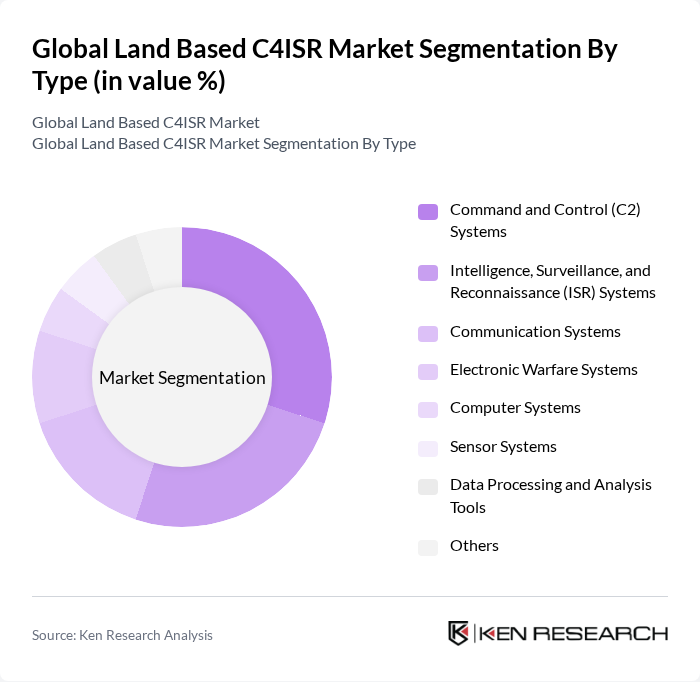
By Type:The market is segmented into various types, including Command and Control (C2) Systems, Intelligence, Surveillance, and Reconnaissance (ISR) Systems, Communication Systems, Electronic Warfare Systems, Computer Systems, Sensor Systems, Data Processing and Analysis Tools, and Others. Among these, the Command and Control (C2) Systems segment is leading due to the increasing demand for effective decision-making, operational coordination, and network-centric warfare capabilities in military operations. The integration of advanced technologies such as AI, machine learning, and secure cloud-based architectures into C2 systems is enhancing their performance, resilience, and interoperability, making them indispensable for modern military strategies .
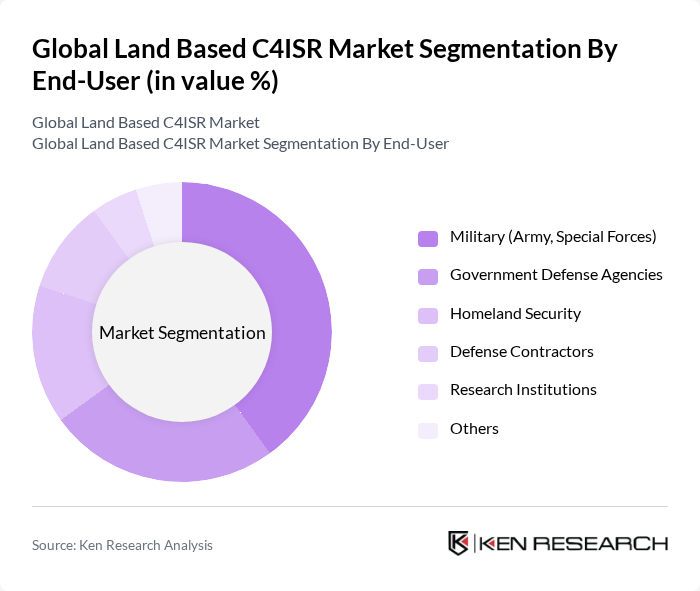
By End-User:The market is segmented by end-users, including Military (Army, Special Forces), Government Defense Agencies, Homeland Security, Defense Contractors, Research Institutions, and Others. The Military segment is the dominant end-user, driven by the increasing need for advanced C4ISR capabilities to enhance operational effectiveness, situational awareness, and rapid response in complex threat environments. The ongoing modernization initiatives and adoption of digital battlefield solutions by military forces worldwide are further propelling the demand for C4ISR systems .
The Global Land Based C4ISR Market is characterized by a dynamic mix of regional and international players. Leading participants such as Lockheed Martin Corporation, Northrop Grumman Corporation, RTX Corporation (formerly Raytheon Technologies), Thales Group, BAE Systems plc, General Dynamics Corporation, Elbit Systems Ltd., Leonardo S.p.A., L3Harris Technologies, Inc., Saab AB, Rheinmetall AG, Indra Sistemas, S.A., Hanwha Systems Co., Ltd., Cubic Corporation, Israel Aerospace Industries (IAI) contribute to innovation, geographic expansion, and service delivery in this space.
The future of the C4ISR market is poised for significant transformation, driven by rapid technological advancements and evolving defense strategies. As militaries increasingly adopt artificial intelligence and machine learning, operational capabilities will enhance, leading to more efficient decision-making processes. Additionally, the integration of Internet of Things (IoT) technologies will further streamline data collection and analysis, enabling real-time situational awareness. These trends indicate a robust growth trajectory for the C4ISR market, with a focus on innovation and modernization.
| Segment | Sub-Segments |
|---|---|
| By Type | Command and Control (C2) Systems Intelligence, Surveillance, and Reconnaissance (ISR) Systems Communication Systems Electronic Warfare Systems Computer Systems Sensor Systems Data Processing and Analysis Tools Others |
| By End-User | Military (Army, Special Forces) Government Defense Agencies Homeland Security Defense Contractors Research Institutions Others |
| By Component | Hardware Software Services |
| By Application | Border Security Disaster Management Tactical Operations Training and Simulation Intelligence Gathering |
| By Geography | North America (United States, Canada) Europe (Germany, United Kingdom, France, Russia, Rest of Europe) Asia-Pacific (China, India, Japan, South Korea, Rest of Asia-Pacific) Latin America (Brazil, Rest of Latin America) Middle East & Africa (Saudi Arabia, United Arab Emirates, South Africa, Rest of Middle East & Africa) |
| Scope Item/Segment | Sample Size | Target Respondent Profiles |
|---|---|---|
| Military Procurement Strategies | 100 | Procurement Officers, Defense Analysts |
| C4ISR Technology Adoption | 90 | Technology Managers, Systems Engineers |
| Operational Command Insights | 80 | Operational Commanders, Strategic Planners |
| Defense Budget Allocation | 70 | Financial Analysts, Budget Officers |
| Emerging C4ISR Trends | 60 | Industry Experts, Research Analysts |
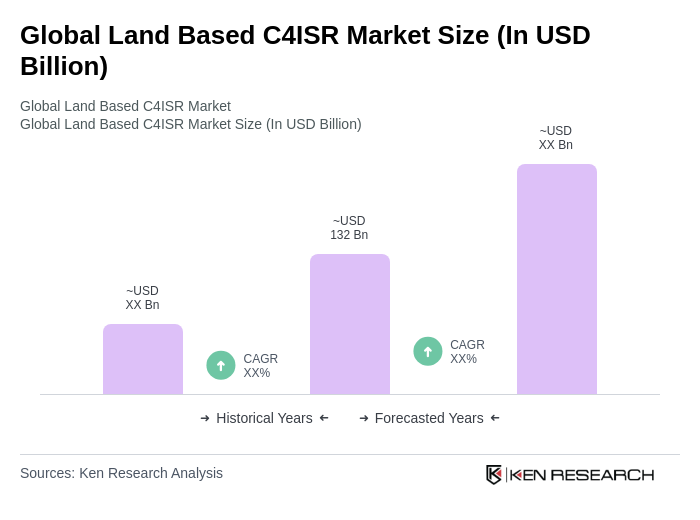
The Global Land Based C4ISR Market is valued at approximately USD 132 billion, reflecting significant growth driven by increased defense budgets and advancements in technology, particularly in communication, surveillance, and electronic warfare systems.

What makes us stand out is that our consultants follow Robust, Refine and Result (RRR) methodology. Robust for clear definitions, approaches and sanity checking, Refine for differentiating respondents' facts and opinions, and Result for presenting data with story.

We have set a benchmark in the industry by offering our clients with syndicated and customized market research reports featuring coverage of entire market as well as meticulous research and analyst insights.

While we don't replace traditional research, we flip the method upside down. Our dual approach of Top Bottom & Bottom Top ensures quality deliverable by not just verifying company fundamentals but also looking at the sector and macroeconomic factors.

With one step in the future, our research team constantly tries to show you the bigger picture. We help with some of the tough questions you may encounter along the way: How is the industry positioned? Best marketing channel? KPI's of competitors? By aligning every element, we help maximize success.

Our report gives you instant access to the answers and sources that other companies might choose to hide. We elaborate each steps of research methodology we have used and showcase you the sample size to earn your trust.

If you need any support, we are here! We pride ourselves on universe strength, data quality, and quick, friendly, and professional service.













