Region:Global
Author(s):Shubham
Product Code:KRAD3571
Pages:81
Published On:November 2025
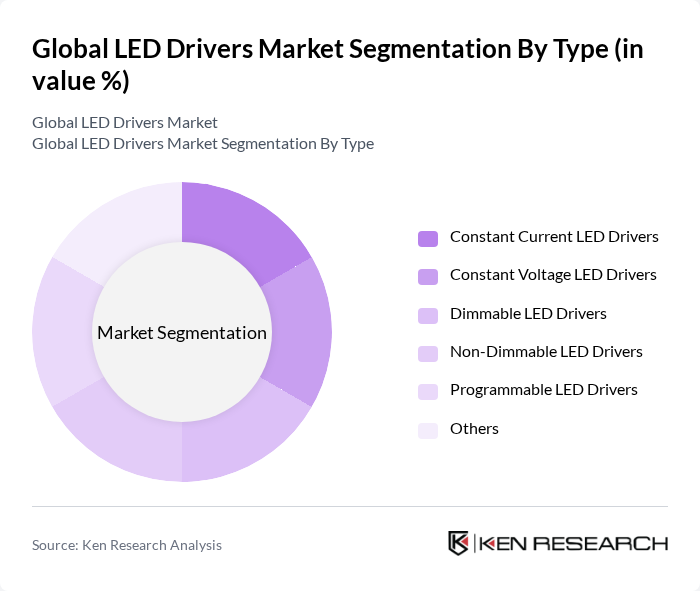
By Type:The LED drivers market is segmented into Constant Current LED Drivers, Constant Voltage LED Drivers, Dimmable LED Drivers, Non-Dimmable LED Drivers, Programmable LED Drivers, and Others. Among these,Constant Current LED Drivershold the largest market share due to their widespread application in general lighting, displays, and electronic devices, ensuring consistent brightness and optimal energy efficiency. The demand forDimmable LED Driversis also increasing, driven by consumer preference for customizable lighting environments in both residential and commercial settings, as well as the integration of smart lighting controls.
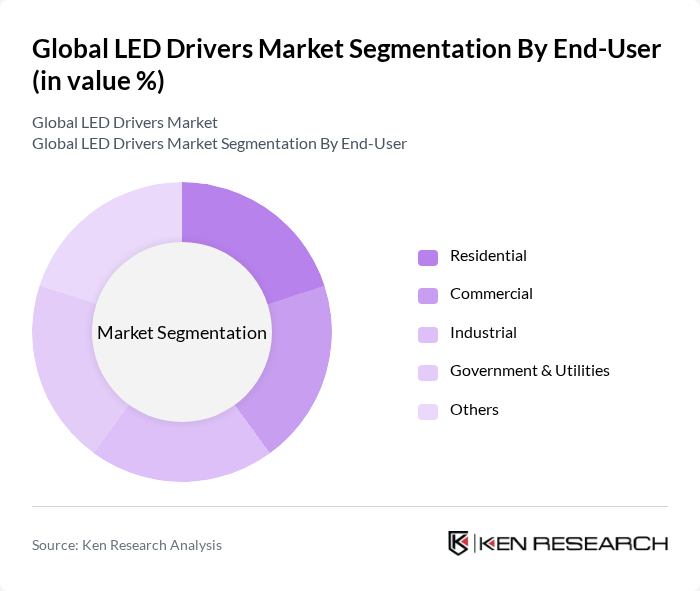
By End-User:The market is segmented by end-user into Residential, Commercial, Industrial, Government & Utilities, and Others. TheResidential segmentcurrently leads the market, driven by the increasing adoption of energy-efficient LED lighting in homes and apartments. TheCommercial sectoris experiencing robust growth due to the rising demand for smart lighting systems in offices, retail spaces, and hospitality, which enhance energy savings and operational efficiency. Industrial and government sectors are also increasingly deploying LED drivers for infrastructure upgrades and public lighting projects.
The Global LED Drivers Market is characterized by a dynamic mix of regional and international players. Leading participants such as Signify Holding (formerly Philips Lighting), Osram Licht AG, Cree, Inc. (now part of SGH, Smart Global Holdings), General Electric Company (GE Current, a Daintree Company), Nichia Corporation, Eaton Corporation, Tridonic GmbH & Co KG, Mean Well Enterprises Co., Ltd., Inventronics, Inc., Lutron Electronics Co., Inc., Analog Devices, Inc., Texas Instruments Incorporated, Bridgelux, Inc., Samsung Electronics Co., Ltd., Panasonic Corporation, Acuity Brands Lighting, Inc., Hubbell Lighting, Inc., ZUMTOBEL GROUP AG, Dialight plc, Universal Lighting Technologies, Inc. contribute to innovation, geographic expansion, and service delivery in this space.
The future of the LED drivers market appears promising, driven by the increasing integration of smart technologies and the growing emphasis on sustainability. As urban areas expand, the demand for energy-efficient lighting solutions will likely rise, supported by government incentives and technological advancements. Additionally, the shift towards smart cities will enhance the adoption of connected lighting systems, further propelling market growth. The focus on reducing carbon footprints will also encourage the transition to LED technology, ensuring a robust market landscape in the coming years.
| Segment | Sub-Segments |
|---|---|
| By Type | Constant Current LED Drivers Constant Voltage LED Drivers Dimmable LED Drivers Non-Dimmable LED Drivers Programmable LED Drivers Others |
| By End-User | Residential Commercial Industrial Government & Utilities Others |
| By Region | North America Europe Asia-Pacific Latin America Middle East & Africa |
| By Technology | Linear LED Drivers Switching LED Drivers Buck LED Drivers Boost LED Drivers Others |
| By Application | Indoor Lighting Outdoor Lighting Automotive Lighting Architectural Lighting Others |
| By Investment Source | Private Investments Public Funding Joint Ventures Government Grants Others |
| By Policy Support | Subsidies for LED Products Tax Incentives for Manufacturers Renewable Energy Certificates (RECs) Others |
| Scope Item/Segment | Sample Size | Target Respondent Profiles |
|---|---|---|
| Commercial Lighting Applications | 120 | Facility Managers, Lighting Designers |
| Residential LED Driver Usage | 80 | Homeowners, Electrical Contractors |
| Industrial LED Driver Integration | 60 | Plant Engineers, Maintenance Supervisors |
| Smart Lighting Solutions | 50 | IoT Developers, Product Managers |
| Retail Sector LED Implementations | 40 | Store Managers, Visual Merchandisers |
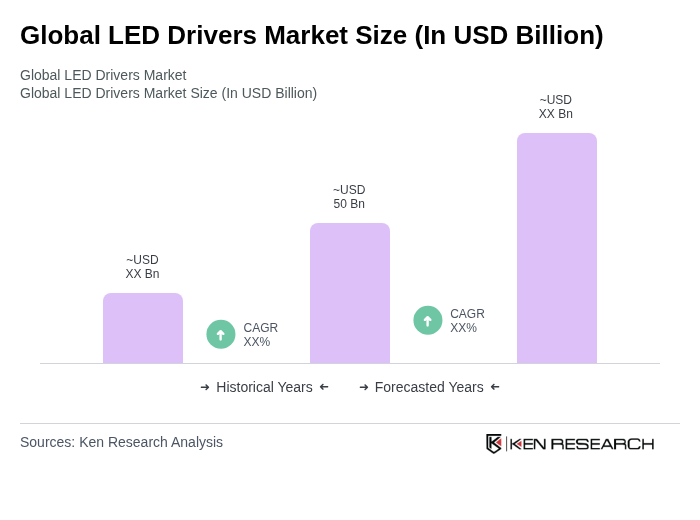
The Global LED Drivers Market is valued at approximately USD 50 billion, driven by the increasing demand for energy-efficient lighting solutions and advancements in LED technology across various sectors, including residential, commercial, and industrial.

What makes us stand out is that our consultants follow Robust, Refine and Result (RRR) methodology. Robust for clear definitions, approaches and sanity checking, Refine for differentiating respondents' facts and opinions, and Result for presenting data with story.

We have set a benchmark in the industry by offering our clients with syndicated and customized market research reports featuring coverage of entire market as well as meticulous research and analyst insights.

While we don't replace traditional research, we flip the method upside down. Our dual approach of Top Bottom & Bottom Top ensures quality deliverable by not just verifying company fundamentals but also looking at the sector and macroeconomic factors.

With one step in the future, our research team constantly tries to show you the bigger picture. We help with some of the tough questions you may encounter along the way: How is the industry positioned? Best marketing channel? KPI's of competitors? By aligning every element, we help maximize success.

Our report gives you instant access to the answers and sources that other companies might choose to hide. We elaborate each steps of research methodology we have used and showcase you the sample size to earn your trust.

If you need any support, we are here! We pride ourselves on universe strength, data quality, and quick, friendly, and professional service.













