About the Report
Base Year 2024Global Leveraged Loan Market Overview
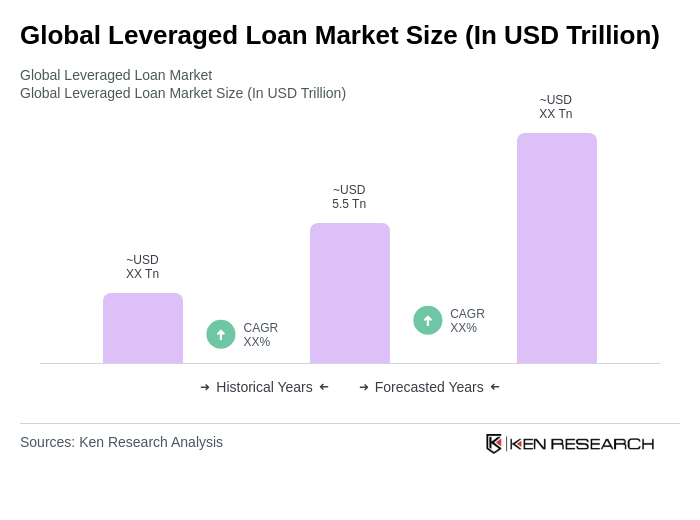
- The Global Leveraged Loan Market is valued at approximately USD 5.5 trillion, based on a five-year analysis. Growth is driven by surging demand for refinancing, repricing, and corporate financing, particularly among private equity sponsors, as well as robust investor appetite for floating rate instruments. The market has experienced a significant rebound in issuance, with refinancing and repricing accounting for the majority of activity, while leveraged buyouts and mergers and acquisitions continue to contribute meaningfully to overall loan demand .
- The United States remains the dominant region in the Global Leveraged Loan Market, supported by its large and diverse corporate base and the presence of major private equity firms and institutional investors. Europe, particularly the UK and Germany, also maintains a significant share, driven by a resilient financial sector and increased leveraged finance activity, though new issuance for M&A and LBOs has lagged historical averages .
- In 2023, while there was heightened regulatory focus on leveraged lending risk management and transparency in both the United States and Europe, there were no new U.S. Securities and Exchange Commission (SEC) regulations specifically mandating additional public disclosure of leveraged loan terms or borrower creditworthiness. Instead, regulatory agencies, including the Federal Reserve and OCC, continued to emphasize robust underwriting standards and risk assessments for leveraged lending .
Global Leveraged Loan Market Segmentation
By Type:The leveraged loan market is segmented into First-Lien Loans, Second-Lien Loans, Unitranche Loans, Mezzanine Loans, and Bridge Loans. First-Lien Loans continue to dominate due to their seniority in the capital structure, offering lower risk to lenders and higher repayment priority in the event of default. This segment is favored by both traditional and non-bank lenders seeking to balance risk and return, while Second-Lien and Unitranche Loans have gained traction among borrowers seeking flexible capital structures for acquisitions and refinancing .

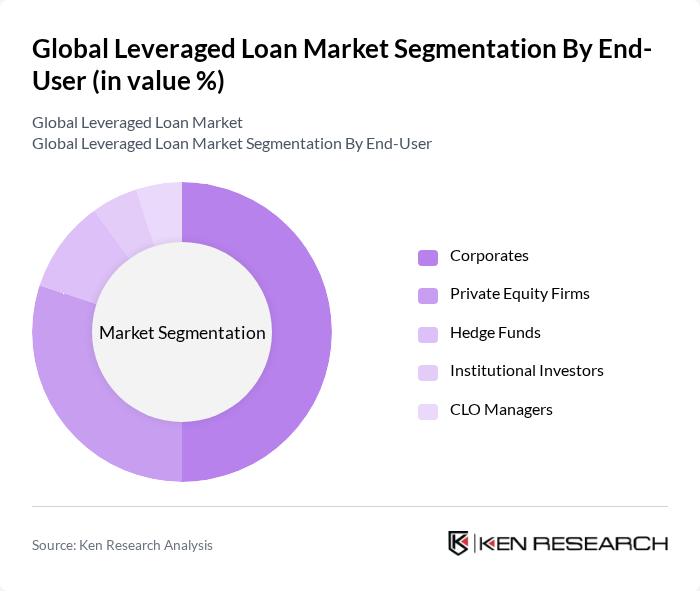
By End-User:The end-user segmentation includes Corporates, Private Equity Firms, Hedge Funds, Institutional Investors, and CLO Managers. Corporates remain the largest end-users, leveraging loans for acquisitions, refinancing, and operational expansion. Private equity firms are also significant participants, utilizing leveraged loans to finance buyouts and portfolio company growth. CLO Managers and institutional investors play a growing role as buyers and arrangers, reflecting the increasing institutionalization of the leveraged loan market .
Global Leveraged Loan Market Competitive Landscape
The Global Leveraged Loan Market is characterized by a dynamic mix of regional and international players. Leading participants such as JPMorgan Chase & Co., Bank of America Merrill Lynch, Citigroup Inc., Wells Fargo & Co., Goldman Sachs Group, Inc., Barclays PLC, Deutsche Bank AG, Credit Suisse Group AG, Morgan Stanley, UBS Group AG, BNP Paribas S.A., HSBC Holdings PLC, RBC Capital Markets, Macquarie Group Limited, Apollo Global Management, Inc., Ares Management Corporation, KKR & Co. Inc., Blackstone Inc., Carlyle Group Inc., and Bain Capital contribute to innovation, geographic expansion, and service delivery in this space.
Global Leveraged Loan Market Industry Analysis
Growth Drivers
- Increased Corporate Borrowing:In future, corporate borrowing is projected to reach approximately $2.5 trillion, driven by companies seeking capital for expansion and operational needs. This surge is largely attributed to favorable economic conditions, including a GDP growth rate of approximately 3% in major economies, which encourages businesses to leverage loans for strategic investments. The demand for leveraged loans is further fueled by the need for quick access to funds, allowing firms to capitalize on market opportunities effectively.
- Low-Interest Rate Environment:The average interest rate for leveraged loans is expected to remain around 4.5% in future, significantly lower than historical averages. This low-interest environment is a result of central banks maintaining accommodative monetary policies to stimulate economic growth. As borrowing costs decrease, companies are more inclined to utilize leveraged loans, enhancing their capital structure and enabling them to undertake larger projects without excessive financial strain.
- Demand for Flexible Financing Solutions:The global demand for flexible financing solutions is anticipated to increase, with the leveraged loan market expected to facilitate over $1 trillion in new issuances in future. Companies are increasingly favoring these loans due to their customizable terms and structures, which allow for tailored repayment schedules. This trend is particularly evident in sectors such as technology and healthcare, where rapid innovation necessitates agile financing options to support growth initiatives.
Market Challenges
- Economic Uncertainty:Economic uncertainty remains a significant challenge for the leveraged loan market, with global inflation rates projected to hover around 5% in future. This inflationary pressure can lead to increased borrowing costs and reduced consumer spending, impacting corporate revenues. Additionally, geopolitical tensions and supply chain disruptions may further exacerbate economic instability, causing lenders to exercise caution in extending credit, which could dampen market growth.
- Regulatory Scrutiny:The leveraged loan market faces heightened regulatory scrutiny, particularly in the wake of rising default rates, which are expected to reach approximately 3% in future. Regulatory bodies are increasingly focused on ensuring transparency and risk management within the lending process. Compliance with regulations such as the Dodd-Frank Act and Basel III capital requirements may impose additional operational burdens on lenders, potentially limiting their ability to offer competitive loan products.
Global Leveraged Loan Market Future Outlook
The future of the leveraged loan market appears promising, driven by ongoing corporate demand for flexible financing solutions and the continued evolution of lending practices. As companies increasingly seek to optimize their capital structures, the market is likely to witness a rise in innovative loan products tailored to specific industry needs. Additionally, the integration of advanced technologies in loan management will enhance operational efficiencies, enabling lenders to better serve their clients while navigating regulatory challenges effectively.
Market Opportunities
- Expansion in Emerging Markets:Emerging markets are projected to experience a surge in leveraged loan activity, with an estimated increase of 20% in loan issuances in future. This growth is driven by rising middle-class populations and increasing foreign direct investment, creating a favorable environment for corporate borrowing. Lenders can capitalize on this trend by tailoring products to meet the unique needs of these markets.
- Increased Demand for Sustainable Financing:The demand for sustainable financing solutions is expected to grow, with green and ESG-focused loans projected to account for 15% of total leveraged loans in future. Companies are increasingly prioritizing sustainability in their operations, creating opportunities for lenders to develop innovative financing products that align with environmental and social governance criteria, thus attracting a broader client base.
Scope of the Report
| Segment | Sub-Segments |
|---|---|
| By Type | First-Lien Loans Second-Lien Loans Unitranche Loans Mezzanine Loans Bridge Loans |
| By End-User | Corporates Private Equity Firms Hedge Funds Institutional Investors CLO Managers |
| By Loan Size | Small Loans (< USD 100 million) Medium Loans (USD 100–500 million) Large Loans (> USD 500 million) |
| By Industry | Technology Healthcare Consumer Goods Energy Industrials Telecommunications Others |
| By Geographical Focus | North America Europe Asia-Pacific Latin America Middle East & Africa |
| By Investment Type | Secured Loans Unsecured Loans |
| By Maturity Period | Short-Term Loans (< 3 years) Medium-Term Loans (3–7 years) Long-Term Loans (> 7 years) |
Key Target Audience
Investors and Venture Capitalist Firms
Government and Regulatory Bodies (e.g., Securities and Exchange Commission, Financial Industry Regulatory Authority)
Commercial Banks and Credit Unions
Private Equity Firms
Hedge Funds
Investment Banks
Credit Rating Agencies
Insurance Companies
Players Mentioned in the Report:
JPMorgan Chase & Co.
Bank of America Merrill Lynch
Citigroup Inc.
Wells Fargo & Co.
Goldman Sachs Group, Inc.
Barclays PLC
Deutsche Bank AG
Credit Suisse Group AG
Morgan Stanley
UBS Group AG
BNP Paribas S.A.
HSBC Holdings PLC
RBC Capital Markets
Macquarie Group Limited
Apollo Global Management, Inc.
Ares Management Corporation
KKR & Co. Inc.
Blackstone Inc.
Carlyle Group Inc.
Bain Capital
Table of Contents
Market Assessment Phase
1. Executive Summary and Approach
2. Global Leveraged Loan Market Overview
2.1 Key Insights and Strategic Recommendations
2.2 Global Leveraged Loan Market Overview
2.3 Definition and Scope
2.4 Evolution of Market Ecosystem
2.5 Timeline of Key Regulatory Milestones
2.6 Value Chain & Stakeholder Mapping
2.7 Business Cycle Analysis
2.8 Policy & Incentive Landscape
3. Global Leveraged Loan Market Analysis
3.1 Growth Drivers
3.1.1 Increased Corporate Borrowing
3.1.2 Low-Interest Rate Environment
3.1.3 Demand for Flexible Financing Solutions
3.1.4 Growth in Private Equity Investments
3.2 Market Challenges
3.2.1 Economic Uncertainty
3.2.2 Regulatory Scrutiny
3.2.3 Rising Default Rates
3.2.4 Competition from Alternative Financing
3.3 Market Opportunities
3.3.1 Expansion in Emerging Markets
3.3.2 Technological Advancements in Loan Management
3.3.3 Increased Demand for Sustainable Financing
3.3.4 Strategic Partnerships with Fintech Companies
3.4 Market Trends
3.4.1 Growth of ESG-focused Loans
3.4.2 Rise of Direct Lending Platforms
3.4.3 Increased Use of Data Analytics in Lending
3.4.4 Shift Towards More Transparent Pricing Models
3.5 Government Regulation
3.5.1 Dodd-Frank Act Compliance
3.5.2 Basel III Capital Requirements
3.5.3 Anti-Money Laundering Regulations
3.5.4 Consumer Financial Protection Bureau Guidelines
4. SWOT Analysis
5. Stakeholder Analysis
6. Porter's Five Forces Analysis
7. Global Leveraged Loan Market Market Size, 2019-2024
7.1 By Value
7.2 By Volume
7.3 By Average Selling Price
8. Global Leveraged Loan Market Segmentation
8.1 By Type
8.1.1 First-Lien Loans
8.1.2 Second-Lien Loans
8.1.3 Unitranche Loans
8.1.4 Mezzanine Loans
8.1.5 Bridge Loans
8.2 By End-User
8.2.1 Corporates
8.2.2 Private Equity Firms
8.2.3 Hedge Funds
8.2.4 Institutional Investors
8.2.5 CLO Managers
8.3 By Loan Size
8.3.1 Small Loans (< USD 100 million)
8.3.2 Medium Loans (USD 100–500 million)
8.3.3 Large Loans (> USD 500 million)
8.4 By Industry
8.4.1 Technology
8.4.2 Healthcare
8.4.3 Consumer Goods
8.4.4 Energy
8.4.5 Industrials
8.4.6 Telecommunications
8.4.7 Others
8.5 By Geographical Focus
8.5.1 North America
8.5.2 Europe
8.5.3 Asia-Pacific
8.5.4 Latin America
8.5.5 Middle East & Africa
8.6 By Investment Type
8.6.1 Secured Loans
8.6.2 Unsecured Loans
8.7 By Maturity Period
8.7.1 Short-Term Loans (< 3 years)
8.7.2 Medium-Term Loans (3–7 years)
8.7.3 Long-Term Loans (> 7 years)
9. Global Leveraged Loan Market Competitive Analysis
9.1 Market Share of Key Players
9.2 Cross Comparison of Key Players
9.2.1 Company Name
9.2.2 Group Size (Large, Medium, or Small as per industry convention)
9.2.3 Total Leveraged Loan Volume (USD)
9.2.4 Market Share (%)
9.2.5 Number of Deals Closed
9.2.6 Average Loan Size (USD)
9.2.7 Weighted Average Spread (bps)
9.2.8 Default Rate (%)
9.2.9 Revenue from Leveraged Lending (USD)
9.2.10 Return on Equity (ROE, %)
9.2.11 Non-Performing Loan Ratio (%)
9.2.12 Syndication Participation Rate (%)
9.2.13 Geographic Diversification Index
9.2.14 ESG Loan Volume (%)
9.3 SWOT Analysis of Top Players
9.4 Pricing Analysis
9.5 Detailed Profile of Major Companies
9.5.1 JPMorgan Chase & Co.
9.5.2 Bank of America Merrill Lynch
9.5.3 Citigroup Inc.
9.5.4 Wells Fargo & Co.
9.5.5 Goldman Sachs Group, Inc.
9.5.6 Barclays PLC
9.5.7 Deutsche Bank AG
9.5.8 Credit Suisse Group AG
9.5.9 Morgan Stanley
9.5.10 UBS Group AG
9.5.11 BNP Paribas S.A.
9.5.12 HSBC Holdings PLC
9.5.13 RBC Capital Markets
9.5.14 Macquarie Group Limited
9.5.15 Apollo Global Management, Inc.
9.5.16 Ares Management Corporation
9.5.17 KKR & Co. Inc.
9.5.18 Blackstone Inc.
9.5.19 Carlyle Group Inc.
9.5.20 Bain Capital
10. Global Leveraged Loan Market End-User Analysis
10.1 Procurement Behavior of Key Ministries
10.1.1 Government Financing Needs
10.1.2 Loan Approval Processes
10.1.3 Budget Allocation Trends
10.2 Corporate Spend on Infrastructure & Energy
10.2.1 Investment in Infrastructure Projects
10.2.2 Energy Sector Financing
10.2.3 Corporate Debt Management Strategies
10.3 Pain Point Analysis by End-User Category
10.3.1 Access to Capital
10.3.2 Interest Rate Fluctuations
10.3.3 Regulatory Compliance Costs
10.4 User Readiness for Adoption
10.4.1 Awareness of Leveraged Loans
10.4.2 Financial Literacy Levels
10.4.3 Risk Appetite
10.5 Post-Deployment ROI and Use Case Expansion
10.5.1 Performance Metrics
10.5.2 Case Studies of Successful Deployments
10.5.3 Future Investment Plans
11. Global Leveraged Loan Market Future Size, 2025-2030
11.1 By Value
11.2 By Volume
11.3 By Average Selling Price
Go-To-Market Strategy Phase
1. Whitespace Analysis + Business Model Canvas
1.1 Market Gaps Identification
1.2 Value Proposition Development
1.3 Revenue Streams Analysis
1.4 Cost Structure Evaluation
1.5 Key Partnerships Exploration
1.6 Customer Segmentation
1.7 Channels of Distribution
2. Marketing and Positioning Recommendations
2.1 Branding Strategies
2.2 Product USPs
2.3 Target Market Identification
2.4 Communication Strategies
2.5 Digital Marketing Approaches
3. Distribution Plan
3.1 Urban Retail Strategies
3.2 Rural NGO Tie-ups
3.3 Online Distribution Channels
3.4 Direct Sales Approaches
4. Channel & Pricing Gaps
4.1 Underserved Routes
4.2 Pricing Bands Analysis
4.3 Competitor Pricing Strategies
5. Unmet Demand & Latent Needs
5.1 Category Gaps
5.2 Consumer Segments Analysis
5.3 Emerging Trends Identification
6. Customer Relationship
6.1 Loyalty Programs
6.2 After-sales Service
6.3 Customer Feedback Mechanisms
7. Value Proposition
7.1 Sustainability Initiatives
7.2 Integrated Supply Chains
7.3 Competitive Advantages
8. Key Activities
8.1 Regulatory Compliance
8.2 Branding Efforts
8.3 Distribution Setup
9. Entry Strategy Evaluation
9.1 Domestic Market Entry Strategy
9.1.1 Product Mix Considerations
9.1.2 Pricing Band Strategy
9.1.3 Packaging Options
9.2 Export Entry Strategy
9.2.1 Target Countries
9.2.2 Compliance Roadmap
10. Entry Mode Assessment
10.1 Joint Ventures
10.2 Greenfield Investments
10.3 Mergers & Acquisitions
10.4 Distributor Model
11. Capital and Timeline Estimation
11.1 Capital Requirements
11.2 Timelines for Implementation
12. Control vs Risk Trade-Off
12.1 Ownership Considerations
12.2 Partnerships Evaluation
13. Profitability Outlook
13.1 Breakeven Analysis
13.2 Long-term Sustainability Strategies
14. Potential Partner List
14.1 Distributors
14.2 Joint Ventures
14.3 Acquisition Targets
15. Execution Roadmap
15.1 Phased Plan for Market Entry
15.1.1 Market Setup
15.1.2 Market Entry
15.1.3 Growth Acceleration
15.1.4 Scale & Stabilize
15.2 Key Activities and Milestones
15.2.1 Milestone Planning
15.2.2 Activity Tracking
Research Methodology
Phase 1: Approach1
Desk Research
- Analysis of market reports from financial institutions and investment banks
- Review of industry publications and white papers on leveraged loans
- Examination of regulatory filings and updates from the SEC and other financial authorities
Primary Research
- Interviews with senior executives at leading investment firms and hedge funds
- Surveys targeting loan syndication professionals and credit analysts
- Field interviews with corporate treasurers and CFOs involved in leveraged financing
Validation & Triangulation
- Cross-validation of findings through multiple data sources including market trends and financial metrics
- Triangulation of insights from primary interviews with secondary data from industry reports
- Sanity checks conducted through expert panel discussions and feedback sessions
Phase 2: Market Size Estimation1
Top-down Assessment
- Estimation of total leveraged loan volume based on historical market data
- Segmentation by industry verticals and geographical regions
- Incorporation of macroeconomic indicators influencing loan demand
Bottom-up Modeling
- Analysis of loan issuance data from major banks and financial institutions
- Estimation of average loan sizes and terms based on recent transactions
- Volume x interest rate basis for revenue projections in the leveraged loan market
Forecasting & Scenario Analysis
- Multi-variable regression analysis incorporating interest rate trends and economic growth forecasts
- Scenario modeling based on potential regulatory changes and market volatility
- Baseline, optimistic, and pessimistic forecasts through 2030
Phase 3: CATI Sample Composition1
| Scope Item/Segment | Sample Size | Target Respondent Profiles |
|---|---|---|
| Investment Firms Leveraging Loans | 70 | Portfolio Managers, Credit Analysts |
| Corporate Borrowers in High-Leverage Sectors | 60 | CFOs, Financial Controllers |
| Loan Syndication Professionals | 40 | Loan Officers, Syndication Managers |
| Regulatory Bodies and Financial Authorities | 40 | Regulators, Compliance Officers |
| Market Analysts and Researchers | 50 | Market Analysts, Research Directors |
Frequently Asked Questions
What is the current value of the Global Leveraged Loan Market?
The Global Leveraged Loan Market is valued at approximately USD 5.5 trillion, driven by strong demand for refinancing, corporate financing, and investor interest in floating rate instruments. This valuation reflects a significant rebound in loan issuance activity.
What factors are driving growth in the leveraged loan market?
Which regions dominate the Global Leveraged Loan Market?
What types of loans are included in the leveraged loan market?
Other Regional/Country Reports
Indonesia Leveraged Loan Market
Malaysia Leveraged Loan Market
APAC Leveraged Loan Market
SEA Leveraged Loan Market
Why Buy From Us?

What makes us stand out is that our consultants follow Robust, Refine and Result (RRR) methodology. Robust for clear definitions, approaches and sanity checking, Refine for differentiating respondents' facts and opinions, and Result for presenting data with story.

We have set a benchmark in the industry by offering our clients with syndicated and customized market research reports featuring coverage of entire market as well as meticulous research and analyst insights.

While we don't replace traditional research, we flip the method upside down. Our dual approach of Top Bottom & Bottom Top ensures quality deliverable by not just verifying company fundamentals but also looking at the sector and macroeconomic factors.

With one step in the future, our research team constantly tries to show you the bigger picture. We help with some of the tough questions you may encounter along the way: How is the industry positioned? Best marketing channel? KPI's of competitors? By aligning every element, we help maximize success.

Our report gives you instant access to the answers and sources that other companies might choose to hide. We elaborate each steps of research methodology we have used and showcase you the sample size to earn your trust.

If you need any support, we are here! We pride ourselves on universe strength, data quality, and quick, friendly, and professional service.