Global Li Fi Market

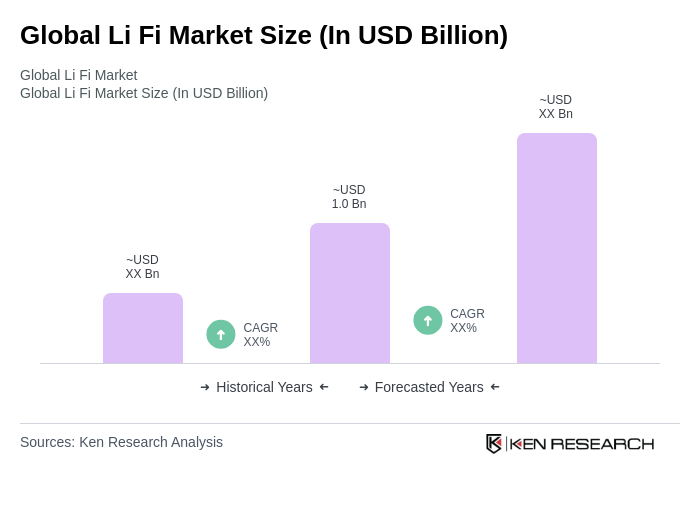
The global Li Fi market, valued at USD 1.0 billion, is growing due to high-speed data needs, smart devices, and secure connectivity across industries like industrial and healthcare.

Region:Global

Author(s):Rebecca

Product Code:KRAD0289

Pages:83

Published On:August 2025
About the Report

Base Year 2024

Global Li Fi Market Overview

  • The Global Li Fi Market is valued at USD 1.0 billion, based on a five-year historical analysis. This growth is primarily driven by the increasing demand for high-speed wireless communication, the proliferation of smart devices, and the need for secure, interference-free connectivity in sensitive environments. The technology's ability to provide secure and high-capacity data transmission using light has attracted significant interest from sectors such as healthcare, education, defense, and retail, where data security and low-latency communication are critical requirements .
  • Key players in this market include countries like the United States, Germany, and Japan, which dominate due to their advanced technological infrastructure and significant investments in research and development. These nations are at the forefront of innovation in Li Fi technology, leveraging their robust telecommunications sectors and strong regulatory frameworks to integrate Li Fi solutions into existing networks and mission-critical applications .
  • In recent years, the European Union has promoted the adoption of Li Fi technology as part of its Green Deal and digital transformation initiatives. These efforts encourage the use of energy-efficient communication technologies, including Li Fi, by providing funding and incentives for research and development, aiming to reduce carbon emissions and enhance digital connectivity across member states .
Global Li Fi Market Size

Global Li Fi Market Segmentation

By Type:The market is segmented into Indoor Networking Solutions, Outdoor Networking Solutions, In-Flight Communication and Entertainment, Underwater Communication, Location-Based Services (LBS), Smartphone Integration, and Others. Each of these sub-segments addresses specific connectivity needs: Indoor Networking Solutions are used in offices, homes, and commercial buildings for high-speed, secure data transfer; Outdoor Networking Solutions support smart city infrastructure and public lighting systems; In-Flight Communication and Entertainment provides passengers with high-speed internet and infotainment; Underwater Communication enables subsea data transmission where radio frequencies are ineffective; Location-Based Services (LBS) offer precise indoor navigation and asset tracking; Smartphone Integration is emerging as Li Fi chips are embedded in mobile devices, enabling fast, secure data exchange; and Others include applications in industrial automation, logistics, and defense .
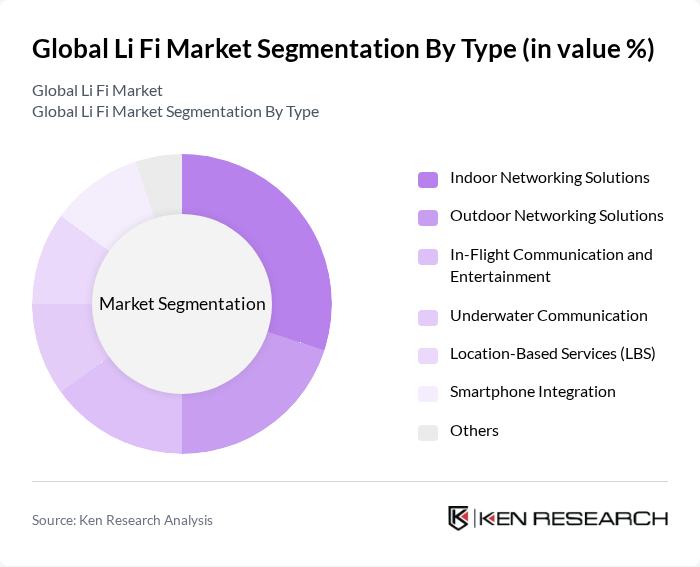
Global Li Fi Market segmentation by Type.

The Indoor Networking Solutions sub-segment is currently dominating the market due to the increasing demand for high-speed internet access in homes, offices, and commercial environments. This segment benefits from the rapid adoption of smart building technologies and the need for reliable, interference-free connectivity in urban areas. The efficiency and security of using light for data transmission in indoor environments have made it a preferred choice for both consumers and enterprises .

By End-User Industry:The market is segmented into Industrial, Healthcare, Retail, Corporate Buildings, Education, Residential, Aerospace and Defense, Automotive and Transportation, and Other End-User Industries (such as Hospitality and Disaster Management). Each industry has unique requirements that Li Fi technology can address: Industrial environments benefit from secure, EMI-free communication; Healthcare requires interference-free, secure data transfer for patient safety; Retail leverages Li Fi for indoor navigation and customer engagement; Corporate Buildings and Education use Li Fi for secure, high-speed connectivity; Residential adoption is driven by smart home trends; Aerospace and Defense require secure, low-latency communications; Automotive and Transportation use Li Fi for vehicle-to-everything (V2X) communication; and Other End-User Industries apply Li Fi in specialized scenarios .
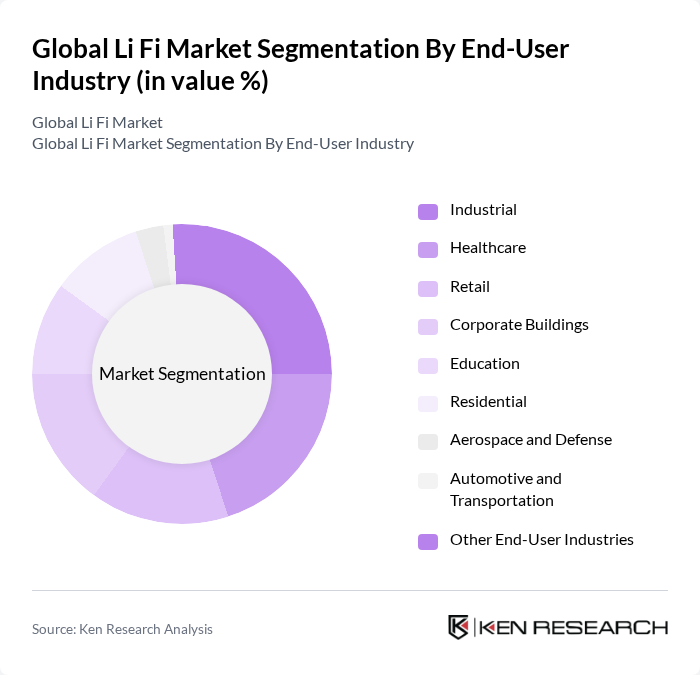
Global Li Fi Market segmentation by End-User Industry.

The Industrial sector is leading the market due to the increasing need for efficient and secure communication systems in manufacturing, logistics, and process automation. Li Fi's ability to provide high-speed data transfer in environments where radio frequency communication is limited or restricted is particularly valuable. The healthcare sector is also witnessing significant adoption, driven by the need for secure, interference-free data transmission in hospitals and medical facilities, supporting critical care and patient safety .

Global Li Fi Market Competitive Landscape

The Global Li Fi Market is characterized by a dynamic mix of regional and international players. Leading participants such as pureLiFi Ltd., Oledcomm S.A.S., Signify N.V. (formerly Philips Lighting), Panasonic Corporation, Qualcomm Technologies, Inc., LightBee S.L., VLNComm Inc., LiFi Labs, Inc., General Electric Company, Cisco Systems, Inc., Acuity Brands, Inc., Huawei Technologies Co., Ltd., Broadcom Inc., Infineon Technologies AG, and Lucibel S.A. contribute to innovation, geographic expansion, and service delivery in this space.

pureLiFi Ltd.

2012

Edinburgh, Scotland

Oledcomm S.A.S.

2013

Paris, France

Signify N.V.

2016

Eindhoven, Netherlands

Panasonic Corporation

1918

Osaka, Japan

Qualcomm Technologies, Inc.

1985

San Diego, California, USA

Company

Establishment Year

Headquarters

Group Size (Large, Medium, or Small as per industry convention)

Revenue Growth Rate (Li-Fi Segment)

Market Penetration Rate (Li-Fi Installations/Deployments)

R&D Intensity (R&D Spend as % of Revenue)

Number of Patents/Intellectual Property Assets

Product Portfolio Breadth (Number of Li-Fi Solutions/Applications)

Global Li Fi Market Industry Analysis

Growth Drivers

  • Increasing Demand for High-Speed Data Transmission:The global demand for high-speed data transmission is projected to reach 1.5 billion gigabytes per second in future, driven by the proliferation of data-intensive applications. This surge is fueled by the increasing number of internet users, which is expected to exceed 5 billion globally. As businesses and consumers seek faster connectivity, Li Fi technology, with its potential to deliver speeds up to 100 Gbps, becomes an attractive solution, particularly in urban environments where traditional Wi-Fi struggles to meet demand.
  • Rising Adoption of Smart Lighting Solutions:The smart lighting market is anticipated to grow to $100 billion in future, with Li Fi technology playing a crucial role in this transformation. As cities invest in smart infrastructure, the integration of Li Fi with LED lighting systems offers a dual benefit of energy efficiency and high-speed data transmission. This trend is supported by the global push for sustainable urban development, with over 1,000 smart city projects underway worldwide, enhancing the appeal of Li Fi as a communication medium.
  • Enhanced Security Features of Li Fi Technology:Li Fi technology offers superior security compared to traditional wireless communication methods, as it uses light to transmit data, which cannot penetrate walls. This characteristic is particularly appealing to sectors requiring stringent data protection, such as finance and healthcare. With cybercrime costs projected to reach $10.5 trillion annually in future, organizations are increasingly seeking secure communication solutions, positioning Li Fi as a viable alternative to Wi-Fi in sensitive environments.

Market Challenges

  • Limited Range of Li Fi Technology:One of the primary challenges facing Li Fi technology is its limited operational range, typically confined to a few meters. This limitation restricts its application in larger spaces, such as warehouses or outdoor environments. As urban areas continue to expand, the need for broader coverage solutions becomes critical. The average urban area is projected to grow by 1.5% annually, necessitating communication technologies that can effectively cover larger distances without compromising performance.
  • High Initial Setup Costs:The initial investment required for Li Fi technology can be a significant barrier to adoption. The cost of installing Li Fi infrastructure, including specialized LED lights and receivers, can exceed $10,000 for a medium-sized business. This upfront expense can deter potential users, especially in regions where budget constraints are prevalent. As organizations increasingly prioritize cost-effective solutions, the high setup costs of Li Fi may hinder its widespread implementation in the short term.

Global Li Fi Market Future Outlook

The future of Li Fi technology appears promising, driven by ongoing advancements in optical wireless communication and increasing investments in research and development. As urbanization accelerates, the demand for efficient, high-speed communication solutions will likely rise. Furthermore, the integration of Li Fi with emerging technologies, such as augmented reality and IoT, will enhance its applicability across various sectors, paving the way for innovative use cases and broader market acceptance in future.

Market Opportunities

  • Expansion in Emerging Markets:Emerging markets, particularly in Asia and Africa, present significant opportunities for Li Fi technology. With internet penetration rates expected to increase by 20% in these regions in future, the demand for reliable communication solutions will grow. This expansion offers a fertile ground for Li Fi adoption, especially in urban areas where traditional infrastructure is lacking.
  • Integration with IoT Devices:The integration of Li Fi technology with IoT devices is poised to revolutionize smart home and industrial applications. With the number of connected IoT devices projected to reach 30 billion in future, leveraging Li Fi for data transmission can enhance connectivity and efficiency. This synergy will create new avenues for innovation, driving further adoption of Li Fi solutions in various sectors.

Scope of the Report

SegmentSub-Segments
By Type

Indoor Networking Solutions

Outdoor Networking Solutions

In-Flight Communication and Entertainment

Underwater Communication

Location-Based Services (LBS)

Smartphone Integration

Others

By End-User Industry

Industrial

Healthcare

Retail

Corporate Buildings

Education

Residential

Aerospace and Defense

Automotive and Transportation

Other End-User Industries (Hospitality, Disaster Management, etc.)

By Application

Smart Lighting

Data Communication

Security Systems

Healthcare Monitoring

Others

By Component

LED (Light-Emitting Diode)

Photodetector

Microcontroller

Optical Sensing

Software Solutions

By Distribution Mode

Direct Sales

Online Sales

Distributors

Retail Sales

By Investment Source

Private Investments

Government Funding

Venture Capital

Public-Private Partnerships

By Policy Support

Subsidies for Technology Development

Tax Incentives for Adoption

Grants for Research Initiatives

Regulatory Support for Deployment

Key Target Audience

Investors and Venture Capitalist Firms

Government and Regulatory Bodies (e.g., Federal Communications Commission, International Telecommunication Union)

Manufacturers and Producers of Li-Fi Technology

Telecommunications Service Providers

Network Infrastructure Companies

Smart City Development Agencies

Industry Associations (e.g., Li-Fi Consortium)

Financial Institutions and Investment Banks

Players Mentioned in the Report:

pureLiFi Ltd.

Oledcomm S.A.S.

Signify N.V. (formerly Philips Lighting)

Panasonic Corporation

Qualcomm Technologies, Inc.

LightBee S.L.

VLNComm Inc.

LiFi Labs, Inc.

General Electric Company

Cisco Systems, Inc.

Acuity Brands, Inc.

Huawei Technologies Co., Ltd.

Broadcom Inc.

Infineon Technologies AG

Lucibel S.A.

Table of Contents

Market Assessment Phase

1. Executive Summary and Approach


2. Global Li Fi Market Overview

2.1 Key Insights and Strategic Recommendations

2.2 Global Li Fi Market Overview

2.3 Definition and Scope

2.4 Evolution of Market Ecosystem

2.5 Timeline of Key Regulatory Milestones

2.6 Value Chain & Stakeholder Mapping

2.7 Business Cycle Analysis

2.8 Policy & Incentive Landscape


3. Global Li Fi Market Analysis

3.1 Growth Drivers

3.1.1 Increasing Demand for High-Speed Data Transmission
3.1.2 Rising Adoption of Smart Lighting Solutions
3.1.3 Growing Need for Wireless Communication in Dense Urban Areas
3.1.4 Enhanced Security Features of Li Fi Technology

3.2 Market Challenges

3.2.1 Limited Range of Li Fi Technology
3.2.2 High Initial Setup Costs
3.2.3 Competition from Established Wi-Fi Technologies
3.2.4 Lack of Standardization in the Industry

3.3 Market Opportunities

3.3.1 Expansion in Emerging Markets
3.3.2 Integration with IoT Devices
3.3.3 Development of Hybrid Communication Systems
3.3.4 Government Initiatives for Smart Cities

3.4 Market Trends

3.4.1 Increasing Investment in R&D for Li Fi Technology
3.4.2 Growing Focus on Energy-Efficient Solutions
3.4.3 Rising Popularity of Augmented Reality Applications
3.4.4 Shift Towards Sustainable Communication Technologies

3.5 Government Regulation

3.5.1 Regulations Promoting Wireless Communication Standards
3.5.2 Policies Supporting Smart City Initiatives
3.5.3 Guidelines for Spectrum Allocation
3.5.4 Safety Standards for Optical Wireless Communication

4. SWOT Analysis


5. Stakeholder Analysis


6. Porter's Five Forces Analysis


7. Global Li Fi Market Market Size, 2019-2024

7.1 By Value

7.2 By Volume

7.3 By Average Selling Price


8. Global Li Fi Market Segmentation

8.1 By Type

8.1.1 Indoor Networking Solutions
8.1.2 Outdoor Networking Solutions
8.1.3 In-Flight Communication and Entertainment
8.1.4 Underwater Communication
8.1.5 Location-Based Services (LBS)
8.1.6 Smartphone Integration
8.1.7 Others

8.2 By End-User Industry

8.2.1 Industrial
8.2.2 Healthcare
8.2.3 Retail
8.2.4 Corporate Buildings
8.2.5 Education
8.2.6 Residential
8.2.7 Aerospace and Defense
8.2.8 Automotive and Transportation
8.2.9 Other End-User Industries (Hospitality, Disaster Management, etc.)

8.3 By Application

8.3.1 Smart Lighting
8.3.2 Data Communication
8.3.3 Security Systems
8.3.4 Healthcare Monitoring
8.3.5 Others

8.4 By Component

8.4.1 LED (Light-Emitting Diode)
8.4.2 Photodetector
8.4.3 Microcontroller
8.4.4 Optical Sensing
8.4.5 Software Solutions

8.5 By Distribution Mode

8.5.1 Direct Sales
8.5.2 Online Sales
8.5.3 Distributors
8.5.4 Retail Sales

8.6 By Investment Source

8.6.1 Private Investments
8.6.2 Government Funding
8.6.3 Venture Capital
8.6.4 Public-Private Partnerships

8.7 By Policy Support

8.7.1 Subsidies for Technology Development
8.7.2 Tax Incentives for Adoption
8.7.3 Grants for Research Initiatives
8.7.4 Regulatory Support for Deployment

9. Global Li Fi Market Competitive Analysis

9.1 Market Share of Key Players

9.2 Cross Comparison of Key Players

9.2.1 Company Name
9.2.2 Group Size (Large, Medium, or Small as per industry convention)
9.2.3 Revenue Growth Rate (Li-Fi Segment)
9.2.4 Market Penetration Rate (Li-Fi Installations/Deployments)
9.2.5 R&D Intensity (R&D Spend as % of Revenue)
9.2.6 Number of Patents/Intellectual Property Assets
9.2.7 Product Portfolio Breadth (Number of Li-Fi Solutions/Applications)
9.2.8 Strategic Partnerships/Collaborations
9.2.9 Customer Base Diversification (by Industry/Region)
9.2.10 Return on Investment (ROI) for Li-Fi Projects

9.3 SWOT Analysis of Top Players

9.4 Pricing Analysis

9.5 Detailed Profile of Major Companies

9.5.1 pureLiFi Ltd.
9.5.2 Oledcomm S.A.S.
9.5.3 Signify N.V. (formerly Philips Lighting)
9.5.4 Panasonic Corporation
9.5.5 Qualcomm Technologies, Inc.
9.5.6 LightBee S.L.
9.5.7 VLNComm Inc.
9.5.8 LiFi Labs, Inc.
9.5.9 General Electric Company
9.5.10 Cisco Systems, Inc.
9.5.11 Acuity Brands, Inc.
9.5.12 Huawei Technologies Co., Ltd.
9.5.13 Broadcom Inc.
9.5.14 Infineon Technologies AG
9.5.15 Lucibel S.A.

10. Global Li Fi Market End-User Analysis

10.1 Procurement Behavior of Key Ministries

10.1.1 Government Procurement Policies
10.1.2 Budget Allocations for Technology
10.1.3 Decision-Making Processes

10.2 Corporate Spend on Infrastructure & Energy

10.2.1 Investment Trends in Communication Technologies
10.2.2 Budgeting for Smart Infrastructure
10.2.3 Corporate Sustainability Initiatives

10.3 Pain Point Analysis by End-User Category

10.3.1 Connectivity Issues in Urban Areas
10.3.2 High Costs of Traditional Communication
10.3.3 Security Concerns with Wireless Networks

10.4 User Readiness for Adoption

10.4.1 Awareness of Li Fi Technology
10.4.2 Training and Support Needs
10.4.3 Infrastructure Compatibility

10.5 Post-Deployment ROI and Use Case Expansion

10.5.1 Measurement of ROI Post-Implementation
10.5.2 Expansion into New Use Cases
10.5.3 Long-Term Benefits Realization

11. Global Li Fi Market Future Size, 2025-2030

11.1 By Value

11.2 By Volume

11.3 By Average Selling Price


Go-To-Market Strategy Phase

1. Whitespace Analysis + Business Model Canvas

1.1 Market Gaps Identification

1.2 Value Proposition Development

1.3 Revenue Streams Analysis

1.4 Key Partnerships Exploration

1.5 Cost Structure Assessment

1.6 Customer Segmentation

1.7 Channels of Distribution


2. Marketing and Positioning Recommendations

2.1 Branding Strategies

2.2 Product USPs

2.3 Target Market Identification

2.4 Communication Strategies

2.5 Digital Marketing Approaches


3. Distribution Plan

3.1 Urban Retail Strategies

3.2 Rural NGO Tie-Ups

3.3 Online Distribution Channels

3.4 Partnerships with Local Distributors


4. Channel & Pricing Gaps

4.1 Underserved Routes

4.2 Pricing Bands Analysis

4.3 Competitor Pricing Strategies

4.4 Customer Willingness to Pay


5. Unmet Demand & Latent Needs

5.1 Category Gaps Identification

5.2 Consumer Segments Analysis

5.3 Emerging Trends in Consumer Preferences


6. Customer Relationship

6.1 Loyalty Programs Development

6.2 After-Sales Service Strategies

6.3 Customer Feedback Mechanisms


7. Value Proposition

7.1 Sustainability Initiatives

7.2 Integrated Supply Chains

7.3 Competitive Advantages


8. Key Activities

8.1 Regulatory Compliance

8.2 Branding Initiatives

8.3 Distribution Setup


9. Entry Strategy Evaluation

9.1 Domestic Market Entry Strategy

9.1.1 Product Mix Considerations
9.1.2 Pricing Band Strategy
9.1.3 Packaging Solutions

9.2 Export Entry Strategy

9.2.1 Target Countries Identification
9.2.2 Compliance Roadmap Development

10. Entry Mode Assessment

10.1 Joint Ventures

10.2 Greenfield Investments

10.3 Mergers & Acquisitions

10.4 Distributor Model Evaluation


11. Capital and Timeline Estimation

11.1 Capital Requirements Analysis

11.2 Timelines for Market Entry


12. Control vs Risk Trade-Off

12.1 Ownership vs Partnerships

12.2 Risk Management Strategies


13. Profitability Outlook

13.1 Breakeven Analysis

13.2 Long-Term Sustainability Strategies


14. Potential Partner List

14.1 Distributors Identification

14.2 Joint Ventures Opportunities

14.3 Acquisition Targets


15. Execution Roadmap

15.1 Phased Plan for Market Entry

15.1.1 Market Setup
15.1.2 Market Entry
15.1.3 Growth Acceleration
15.1.4 Scale & Stabilize

15.2 Key Activities and Milestones

15.2.1 Milestone Planning
15.2.2 Activity Tracking

Research Methodology

ApproachModellingSample

Phase 1: Approach1

Desk Research

  • Industry reports from leading market research firms focusing on Li-Fi technology
  • White papers and technical publications from academic institutions on Li-Fi advancements
  • Market analysis from telecommunications and networking associations

Primary Research

  • Interviews with technology developers and manufacturers specializing in Li-Fi solutions
  • Surveys with end-users in sectors such as healthcare, education, and retail
  • Focus groups with industry experts and thought leaders in wireless communication

Validation & Triangulation

  • Cross-validation of findings through multiple data sources including market reports and expert opinions
  • Triangulation of data from primary interviews and secondary research findings
  • Sanity checks through feedback from a panel of industry experts

Phase 2: Market Size Estimation1

Top-down Assessment

  • Analysis of global telecommunications spending trends to estimate Li-Fi market potential
  • Segmentation of the market by application areas such as smart cities, healthcare, and education
  • Incorporation of government initiatives promoting wireless communication technologies

Bottom-up Modeling

  • Estimation of market size based on sales data from leading Li-Fi technology providers
  • Operational cost analysis of Li-Fi installations across various sectors
  • Volume and pricing analysis based on projected adoption rates in target markets

Forecasting & Scenario Analysis

  • Multi-variable regression analysis incorporating factors like internet penetration and urbanization rates
  • Scenario modeling based on technological advancements and regulatory changes
  • Development of baseline, optimistic, and pessimistic market forecasts through 2030

Phase 3: CATI Sample Composition1

Scope Item/SegmentSample SizeTarget Respondent Profiles
Healthcare Sector Li-Fi Implementation100IT Managers, Facility Directors
Educational Institutions Adopting Li-Fi75Network Administrators, IT Coordinators
Retail Environments Utilizing Li-Fi60Store Managers, Technology Officers
Smart City Projects Integrating Li-Fi85Urban Planners, Project Managers
Telecommunications Providers Offering Li-Fi Solutions50Product Managers, Sales Directors

Frequently Asked Questions

What is the current value of the Global Li Fi Market?

The Global Li Fi Market is valued at approximately USD 1.0 billion, driven by the increasing demand for high-speed wireless communication and secure connectivity in various sectors, including healthcare, education, and retail.

What are the main drivers of growth in the Li Fi Market?

Which countries are leading in the Li Fi Market?

What are the main applications of Li Fi technology?

Other Regional/Country Reports

UAE Li Fi MarketKSA Li Fi Market

Indonesia Li Fi Market

Malaysia Li Fi Market

APAC Li Fi Market

SEA Li Fi Market

Why Buy From Us?

Refine Robust Result (RRR) Framework

What makes us stand out is that our consultants follow Robust, Refine and Result (RRR) methodology. Robust for clear definitions, approaches and sanity checking, Refine for differentiating respondents' facts and opinions, and Result for presenting data with story.

Our Reach Is Unmatched

We have set a benchmark in the industry by offering our clients with syndicated and customized market research reports featuring coverage of entire market as well as meticulous research and analyst insights.

Shifting the Research Paradigm

While we don't replace traditional research, we flip the method upside down. Our dual approach of Top Bottom & Bottom Top ensures quality deliverable by not just verifying company fundamentals but also looking at the sector and macroeconomic factors.

More Insights-Better Decisions

With one step in the future, our research team constantly tries to show you the bigger picture. We help with some of the tough questions you may encounter along the way: How is the industry positioned? Best marketing channel? KPI's of competitors? By aligning every element, we help maximize success.

Transparency and Trust

Our report gives you instant access to the answers and sources that other companies might choose to hide. We elaborate each steps of research methodology we have used and showcase you the sample size to earn your trust.

Round the Clock Support

If you need any support, we are here! We pride ourselves on universe strength, data quality, and quick, friendly, and professional service.

Why Clients Choose Us?

400000+
Reports in repository
150+
Consulting projects a year
100+
Analysts
8000+
Client Queries in 2022








