Region:Global
Author(s):Shubham
Product Code:KRAA1899
Pages:88
Published On:August 2025
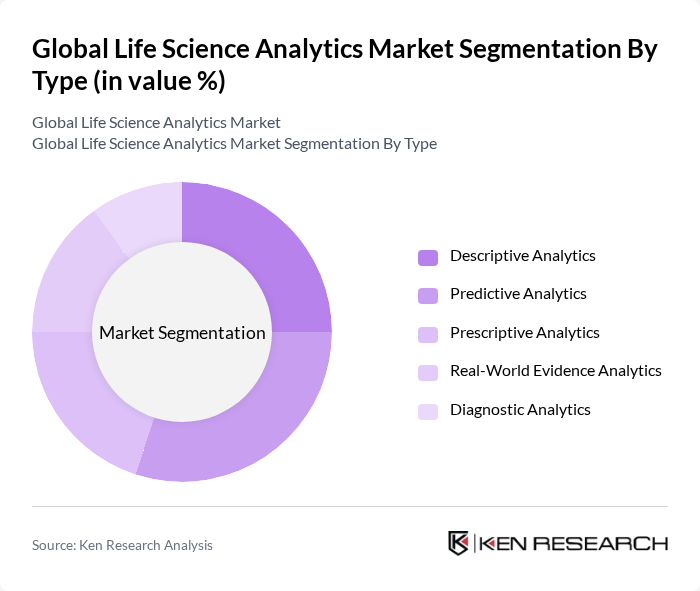
By Type:The market is segmented into various types of analytics, including Descriptive Analytics, Predictive Analytics, Prescriptive Analytics, Real-World Evidence Analytics, and Diagnostic Analytics. Each of these sub-segments plays a crucial role in enhancing decision-making processes within the life sciences sector. Descriptive Analytics is widely used for summarizing historical data, while Predictive Analytics is gaining traction for its ability to forecast future trends based on existing data. The increasing complexity of healthcare data is driving the demand for these analytics types. Recent adoption is further propelled by AI/ML, cloud platforms, and integration of EHR, genomics, and RWE data to support clinical development and pharmacovigilance .
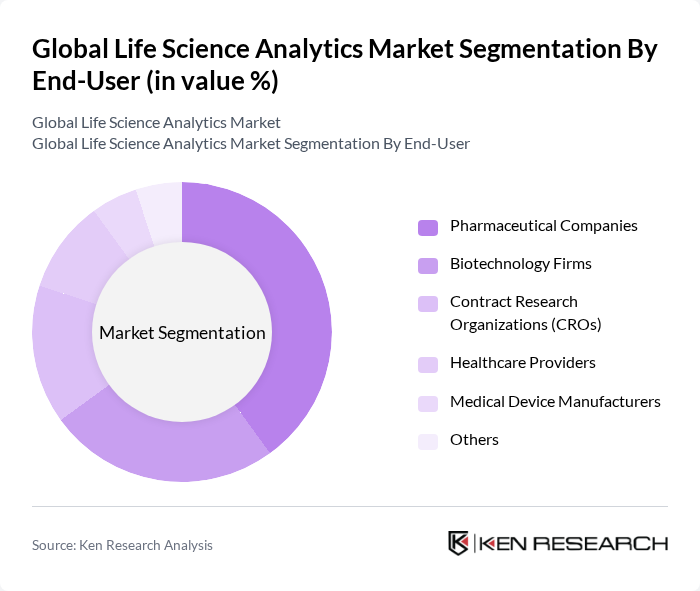
By End-User:The end-users of life science analytics include Pharmaceutical Companies, Biotechnology Firms, Contract Research Organizations (CROs), Healthcare Providers, Medical Device Manufacturers, and Others. Pharmaceutical Companies are the leading end-users, leveraging analytics for drug discovery, clinical trials, safety surveillance, commercial optimization, and market access strategies. The increasing focus on personalized medicine, real-world evidence, and the need for regulatory compliance are driving the adoption of analytics among these organizations .
The Global Life Science Analytics Market is characterized by a dynamic mix of regional and international players. Leading participants such as IQVIA, SAS Institute Inc., Oracle Corporation, Accenture plc, Cognizant Technology Solutions, IBM Corporation, Optum, Inc., Veeva Systems Inc., Medidata Solutions, Inc. (Dassault Systèmes), Parexel International Corporation, Veradigm Inc. (formerly Allscripts), Flatiron Health, Inc., Axtria, Inc., Elsevier, Komodo Health, Inc. contribute to innovation, geographic expansion, and service delivery in this space.
The future of the life science analytics market appears promising, driven by technological advancements and increasing healthcare demands. The integration of artificial intelligence and machine learning is expected to enhance predictive analytics capabilities, enabling more accurate patient outcomes. Additionally, the shift towards personalized medicine will further propel the need for sophisticated analytics tools, as healthcare providers seek tailored treatment options. As these trends evolve, the market is likely to witness significant growth and innovation in analytics solutions.
| Segment | Sub-Segments |
|---|---|
| By Type | Descriptive Analytics Predictive Analytics Prescriptive Analytics Real-World Evidence Analytics Diagnostic Analytics |
| By End-User | Pharmaceutical Companies Biotechnology Firms Contract Research Organizations (CROs) Healthcare Providers Medical Device Manufacturers Others |
| By Application | Drug Discovery and Development Clinical Trials (Patient Recruitment, Site Selection, Risk-Based Monitoring) Regulatory & Pharmacovigilance (Safety, Signal Detection) Sales & Marketing/Commercial Analytics (Market Access, CRM, Omnichannel) Patient Engagement & Population Health Management Supply Chain & Manufacturing Analytics Others |
| By Deployment Mode | On-Premises Cloud-Based Hybrid |
| By Region | North America Europe Asia-Pacific Latin America Middle East & Africa |
| By Pricing Model | Subscription-Based Pay-Per-Use License Fee Value-Based/Outcome-Based Contracts |
| By Data Source | Clinical Trial & EHR Data Genomic/Omics Data Real-World Data (Claims, Registries, Wearables) Patient-Reported Outcomes Others |
| Scope Item/Segment | Sample Size | Target Respondent Profiles |
|---|---|---|
| Pharmaceutical Analytics | 120 | Data Analysts, R&D Managers |
| Clinical Trial Data Management | 100 | Clinical Research Coordinators, Biostatisticians |
| Healthcare Provider Analytics | 80 | Healthcare Administrators, IT Managers |
| Biotech Data Solutions | 70 | Product Managers, Data Scientists |
| Patient Management Systems | 90 | Healthcare IT Specialists, Operations Directors |
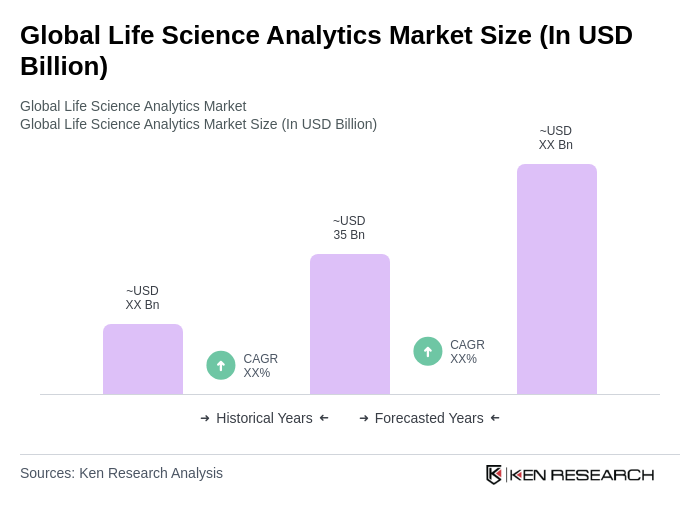
The Global Life Science Analytics Market is valued at approximately USD 35 billion, driven by the increasing demand for data-driven decision-making in healthcare, advancements in technology, and the need for efficient drug development processes.

What makes us stand out is that our consultants follow Robust, Refine and Result (RRR) methodology. Robust for clear definitions, approaches and sanity checking, Refine for differentiating respondents' facts and opinions, and Result for presenting data with story.

We have set a benchmark in the industry by offering our clients with syndicated and customized market research reports featuring coverage of entire market as well as meticulous research and analyst insights.

While we don't replace traditional research, we flip the method upside down. Our dual approach of Top Bottom & Bottom Top ensures quality deliverable by not just verifying company fundamentals but also looking at the sector and macroeconomic factors.

With one step in the future, our research team constantly tries to show you the bigger picture. We help with some of the tough questions you may encounter along the way: How is the industry positioned? Best marketing channel? KPI's of competitors? By aligning every element, we help maximize success.

Our report gives you instant access to the answers and sources that other companies might choose to hide. We elaborate each steps of research methodology we have used and showcase you the sample size to earn your trust.

If you need any support, we are here! We pride ourselves on universe strength, data quality, and quick, friendly, and professional service.













