Region:Global
Author(s):Geetanshi
Product Code:KRAD0086
Pages:96
Published On:August 2025
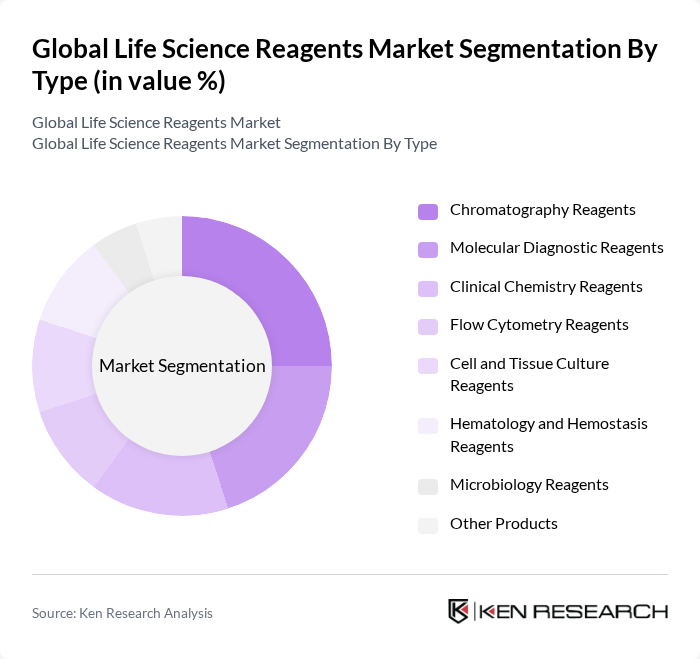
By Type:The life science reagents market is segmented into various types, including chromatography reagents, molecular diagnostic reagents, clinical chemistry reagents, flow cytometry reagents, cell and tissue culture reagents, hematology and hemostasis reagents, microbiology reagents, and other products. Chromatography reagents and molecular diagnostic reagents are particularly significant due to their extensive applications in research and clinical diagnostics. Recent trends highlight the growing importance of cell and tissue culture reagents, driven by the expansion of cell therapy and regenerative medicine .
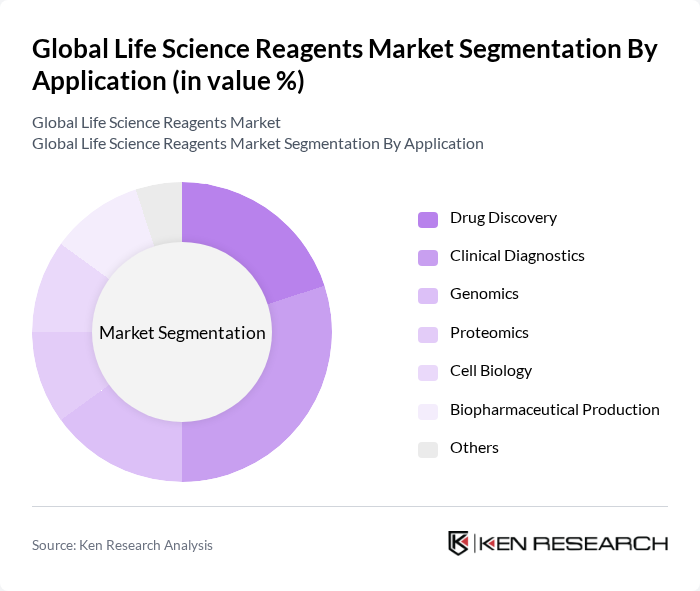
By Application:The applications of life science reagents include drug discovery, clinical diagnostics, genomics, proteomics, cell biology, biopharmaceutical production, and others. The clinical diagnostics segment is currently leading the market due to the increasing demand for accurate and rapid diagnostic tests, especially in the wake of global health challenges such as COVID-19 and the rising incidence of chronic diseases. Drug discovery and genomics are also experiencing robust growth, driven by advances in personalized medicine and genetic research .
The Global Life Science Reagents Market is characterized by a dynamic mix of regional and international players. Leading participants such as Thermo Fisher Scientific Inc., Merck KGaA, Bio-Rad Laboratories, Inc., Agilent Technologies, Inc., Roche Diagnostics, Sigma-Aldrich (now part of Merck KGaA), PerkinElmer, Inc., QIAGEN N.V., Abbott Laboratories, Illumina, Inc., GE HealthCare Technologies Inc., BD (Becton, Dickinson and Company), Eppendorf SE, Lonza Group AG, Promega Corporation, Siemens Healthineers AG, Beckman Coulter, Inc. (a Danaher company), Waters Corporation, Sysmex Corporation, Bio-Techne Corporation, Miltenyi Biotec B.V. & Co. KG, STEMCELL Technologies Inc., and Biotium, Inc. contribute to innovation, geographic expansion, and service delivery in this space.
The future of the life science reagents market appears promising, driven by ongoing advancements in technology and increasing investments in healthcare research. As the demand for personalized medicine continues to rise, the market is likely to see a shift towards more specialized and innovative reagents. Additionally, the integration of artificial intelligence in reagent development is expected to enhance efficiency and accuracy, paving the way for new applications and improved laboratory workflows in the coming years.
| Segment | Sub-Segments |
|---|---|
| By Type | Chromatography Reagents Molecular Diagnostic Reagents Clinical Chemistry Reagents Flow Cytometry Reagents Cell and Tissue Culture Reagents Hematology and Hemostasis Reagents Microbiology Reagents Other Products |
| By Application | Drug Discovery Clinical Diagnostics Genomics Proteomics Cell Biology Biopharmaceutical Production Others |
| By End-User | Academic Research Institutes Pharmaceutical Companies Biotechnology Firms Contract Research Organizations (CROs) Hospitals and Diagnostic Laboratories Clinical Research Centers Others |
| By Distribution Channel | Direct Sales Online Sales Distributors Retail Pharmacies Others |
| By Region | North America Europe Asia-Pacific Latin America Middle East & Africa Others |
| By Price Range | Low Price Mid Price High Price |
| By Packaging Type | Bulk Packaging Single-Use Packaging Multi-Use Packaging Others |
| Scope Item/Segment | Sample Size | Target Respondent Profiles |
|---|---|---|
| Pharmaceutical Reagents | 100 | R&D Managers, Quality Control Analysts |
| Biotechnology Applications | 80 | Product Development Scientists, Lab Technicians |
| Clinical Diagnostics | 60 | Clinical Lab Directors, Pathologists |
| Academic Research Institutions | 50 | Research Professors, Graduate Students |
| Environmental Testing | 40 | Environmental Scientists, Compliance Officers |
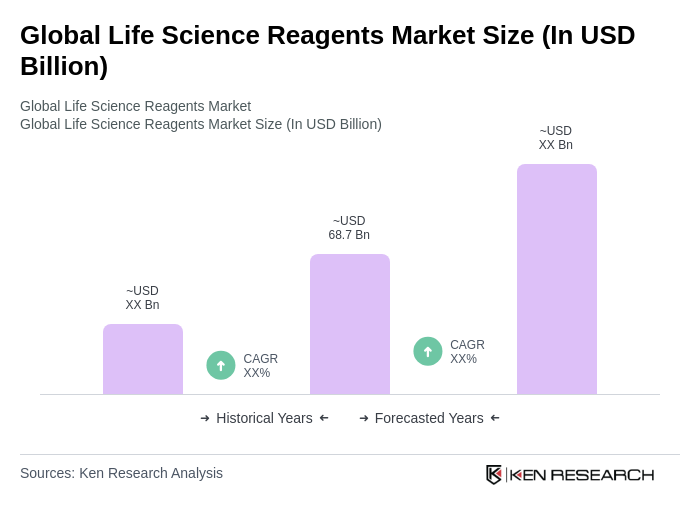
The Global Life Science Reagents Market is valued at approximately USD 68.7 billion, driven by advancements in biotechnology, increased research and development activities, and the rising prevalence of chronic diseases necessitating diagnostic testing and therapeutic development.

What makes us stand out is that our consultants follow Robust, Refine and Result (RRR) methodology. Robust for clear definitions, approaches and sanity checking, Refine for differentiating respondents' facts and opinions, and Result for presenting data with story.

We have set a benchmark in the industry by offering our clients with syndicated and customized market research reports featuring coverage of entire market as well as meticulous research and analyst insights.

While we don't replace traditional research, we flip the method upside down. Our dual approach of Top Bottom & Bottom Top ensures quality deliverable by not just verifying company fundamentals but also looking at the sector and macroeconomic factors.

With one step in the future, our research team constantly tries to show you the bigger picture. We help with some of the tough questions you may encounter along the way: How is the industry positioned? Best marketing channel? KPI's of competitors? By aligning every element, we help maximize success.

Our report gives you instant access to the answers and sources that other companies might choose to hide. We elaborate each steps of research methodology we have used and showcase you the sample size to earn your trust.

If you need any support, we are here! We pride ourselves on universe strength, data quality, and quick, friendly, and professional service.













