Global Lifestyle Related Disease Supplements Market

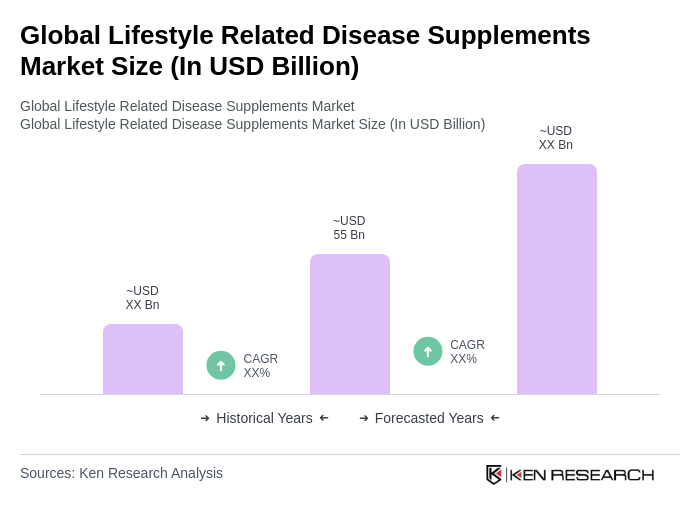
The global lifestyle related disease supplements market, valued at USD 55 billion, is growing due to increasing prevalence of lifestyle diseases, health consciousness, and aging population, with opportunities in personalized nutrition.

Region:Global

Author(s):Shubham

Product Code:KRAA1855

Pages:81

Published On:August 2025
About the Report

Base Year 2024

Global Lifestyle Related Disease Supplements Market Overview

  • The Global Lifestyle Related Disease Supplements Market is valued at USD 55 billion, based on a five-year historical analysis. This growth is primarily driven by increasing health awareness, rising prevalence of lifestyle-related diseases, and a growing trend towards preventive healthcare. Consumers are increasingly seeking dietary supplements to support their health and well-being, leading to a surge in demand for various supplement types.
  • The United States, Germany, and China are among the largest markets for dietary supplements, supported by large consumer bases, established retail and e-commerce channels, and high health expenditure; North America leads share, with Asia-Pacific showing the fastest growth and Europe remaining a major market .
  • In 2023, the U.S. Food and Drug Administration increased oversight of dietary supplements by advancing initiatives on ingredient listing and warning letters, while reiterating that dietary supplements remain regulated under the Dietary Supplement Health and Education Act with existing current Good Manufacturing Practices and labeling requirements; no new across-the-board labeling regulation specific to 2023 mandated universally “more detailed labeling” beyond existing requirements .
Global Lifestyle Related Disease Supplements Market Size

Global Lifestyle Related Disease Supplements Market Segmentation

By Type:The market is segmented into various types of supplements, including vitamins, minerals, herbal/botanical supplements, probiotics and prebiotics, omega-3 and other fatty acids, amino acids and proteins, and specialty/condition-specific actives. Among these, vitamins and minerals are the most popular due to their essential roles in maintaining health and preventing deficiencies. The increasing awareness of the benefits of these supplements drives their demand, particularly among health-conscious consumers .
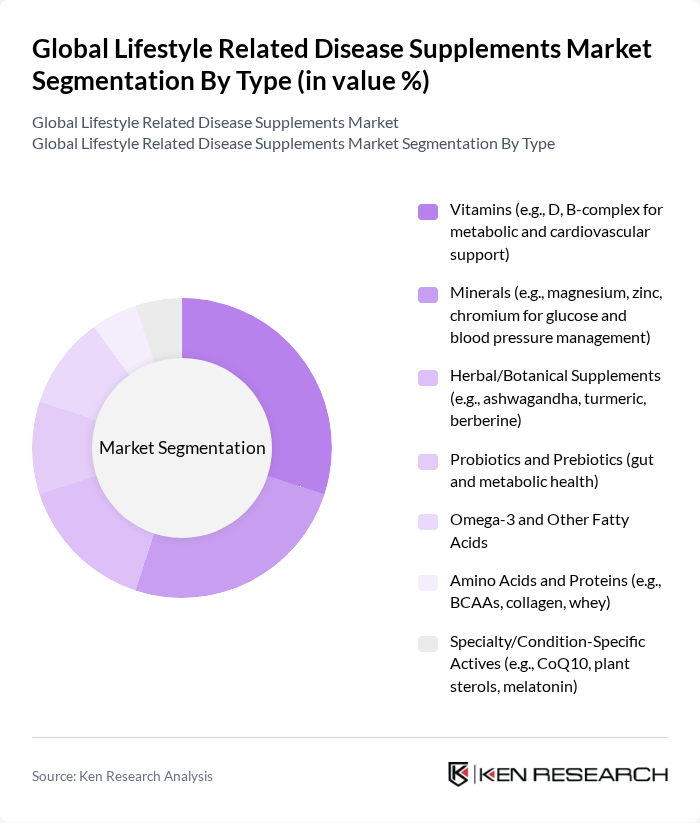
Global Lifestyle Related Disease Supplements Market segmentation by Type.

By End-User:The end-user segmentation includes adults (18–59), seniors (60+), adolescents & children, and athletes & fitness-oriented consumers. Adults represent the largest segment, driven by a growing focus on health and wellness, while seniors are increasingly turning to supplements to manage age-related health issues. Athletes and fitness-oriented consumers also contribute significantly to the market, seeking supplements to enhance performance and recovery .
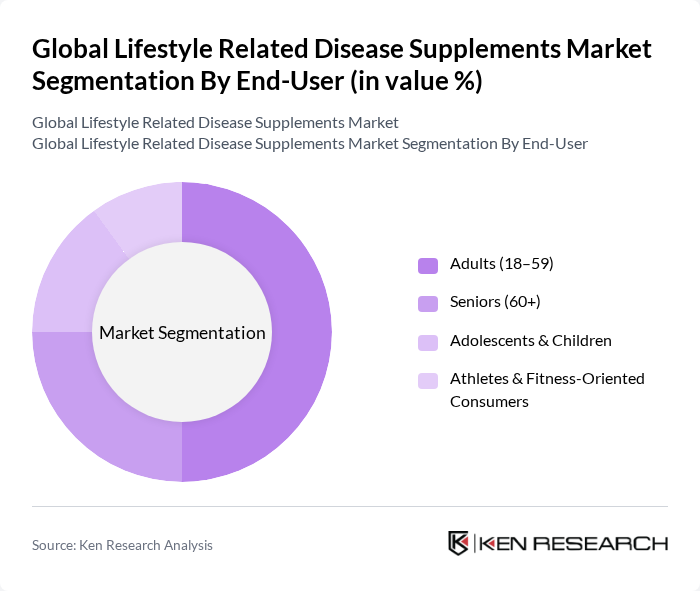
Global Lifestyle Related Disease Supplements Market segmentation by End-User.

Global Lifestyle Related Disease Supplements Market Competitive Landscape

The Global Lifestyle Related Disease Supplements Market is characterized by a dynamic mix of regional and international players. Leading participants such as Abbott Laboratories, Bayer AG, Amway Corporation, Nestlé Health Science, Herbalife Nutrition Ltd., GNC Holdings, LLC, The Nature’s Bounty Co. (now The Bountiful Company), Pharmavite LLC (Nature Made), Church & Dwight Co., Inc. (vitafusion, L’il Critters), NOW Foods, Optimum Nutrition, Inc. (Glanbia Performance Nutrition), Solgar (The Bountiful Company), Swanson Health Products, USANA Health Sciences, Inc., Nature’s Way Brands, LLC contribute to innovation, geographic expansion, and service delivery in this space .

Abbott Laboratories

1888

Abbott Park, Illinois, USA

Bayer AG

1863

Leverkusen, Germany

Amway Corporation

1959

Ada, Michigan, USA

Nestlé Health Science

2011

Lausanne, Switzerland

Herbalife Nutrition Ltd.

1980

Los Angeles, California, USA

Company

Establishment Year

Headquarters

Group Size (Large, Medium, or Small)

Global Lifestyle-Disease Supplement Revenue (USD, latest FY)

Revenue Growth Rate (CAGR, 3–5 years)

Portfolio Mix by Condition (% of sales: cardiometabolic, diabetes, weight, digestive, bone/joint)

Geographic Footprint (countries served; top-3 regions by revenue)

Market Penetration (active SKUs, e-commerce share, pharmacy coverage)

Global Lifestyle Related Disease Supplements Market Industry Analysis

Growth Drivers

  • Increasing Prevalence of Lifestyle-Related Diseases:The World Health Organization reported that non-communicable diseases (NCDs) accounted for 71% of global deaths in 2020, with lifestyle-related factors contributing significantly. In 2024, it is projected that over 1.5 billion adults will be living with obesity, a key risk factor for NCDs. This rising prevalence drives demand for supplements aimed at managing and preventing these diseases, creating a robust market for lifestyle-related disease supplements.
  • Rising Health Consciousness Among Consumers:A 2023 survey by the International Food Information Council indicated that 77% of consumers are actively trying to improve their health through diet and supplements. This trend is expected to continue, with the global health and wellness market projected to reach $4.5 trillion by 2024. As consumers become more health-conscious, the demand for lifestyle-related disease supplements is anticipated to grow significantly, reflecting a shift towards preventive health measures.
  • Growth in the Aging Population:According to the United Nations, the global population aged 60 and older is expected to reach 2.1 billion by 2050, up from 1 billion in 2020. This demographic shift is associated with an increased incidence of lifestyle-related diseases, leading to higher demand for supplements that support health in older adults. In 2024, the aging population will significantly influence the market, as older consumers seek products that enhance their quality of life and manage chronic conditions.

Market Challenges

  • Stringent Regulatory Frameworks:The dietary supplement industry faces rigorous regulations, particularly in regions like the EU and the U.S. The FDA's guidelines require extensive safety and efficacy data before products can be marketed. In 2024, compliance costs are expected to rise, with companies spending an average of $1 million annually to meet regulatory standards. This can hinder market entry for new players and limit innovation in supplement formulations.
  • Consumer Skepticism Regarding Supplement Efficacy:A 2023 report from the Council for Responsible Nutrition found that 40% of consumers are skeptical about the effectiveness of dietary supplements. This skepticism can be attributed to misinformation and a lack of scientific backing for many products. In 2024, overcoming this challenge will be crucial for companies, as they must invest in education and transparent marketing to build trust and credibility with consumers.

Global Lifestyle Related Disease Supplements Market Future Outlook

The future of the lifestyle-related disease supplements market appears promising, driven by increasing health awareness and demographic shifts. As consumers prioritize preventive healthcare, the demand for innovative and effective supplements is expected to rise. Companies will likely focus on developing personalized products tailored to individual health needs, leveraging technology for better delivery systems. Additionally, partnerships with healthcare professionals will enhance credibility and foster consumer trust, further propelling market growth in the coming years.

Market Opportunities

  • Development of Personalized Supplements:The trend towards personalized nutrition is gaining traction, with consumers seeking supplements tailored to their specific health needs. By 2024, the personalized nutrition market is projected to reach $11.5 billion, presenting a significant opportunity for supplement manufacturers to innovate and cater to individual preferences, enhancing customer satisfaction and loyalty.
  • Expansion into Emerging Markets:Emerging markets, particularly in Asia and Africa, are witnessing a surge in health awareness and disposable income. The global health supplement market in these regions is expected to grow by 15% annually through 2024. Companies that strategically enter these markets can capitalize on the increasing demand for lifestyle-related disease supplements, driving substantial revenue growth.

Scope of the Report

SegmentSub-Segments
By Type

Vitamins (e.g., D, B-complex for metabolic and cardiovascular support)

Minerals (e.g., magnesium, zinc, chromium for glucose and blood pressure management)

Herbal/Botanical Supplements (e.g., ashwagandha, turmeric, berberine)

Probiotics and Prebiotics (gut and metabolic health)

Omega-3 and Other Fatty Acids

Amino Acids and Proteins (e.g., BCAAs, collagen, whey)

Specialty/Condition-Specific Actives (e.g., CoQ10, plant sterols, melatonin)

By End-User

Adults (18–59)

Seniors (60+)

Adolescents & Children

Athletes & Fitness-Oriented Consumers

By Distribution Channel

Online Retail (e-commerce, D2C)

Supermarkets/Hypermarkets

Health & Specialty Stores

Pharmacies/Drug Stores

By Formulation

Tablets

Capsules & Softgels

Powders

Liquids & Shots

Gummies & Chewables

By Price Range

Budget

Mid-Range

Premium

By Packaging Type

Bottles

Blister Packs

Pouches & Sachets

By Region

North America

Europe

Asia-Pacific

Latin America

Middle East & Africa

By Health Condition

Cardiometabolic Health (cholesterol, hypertension, heart health)

Diabetes & Blood Sugar Support

Weight Management & Obesity

Bone & Joint Health

Digestive & Liver Health

Stress, Sleep & Cognitive Health

Key Target Audience

Investors and Venture Capitalist Firms

Government and Regulatory Bodies (e.g., Food and Drug Administration, European Food Safety Authority)

Manufacturers and Producers

Distributors and Retailers

Health and Wellness Organizations

Pharmaceutical Companies

Insurance Companies

Market Analysts and Industry Experts

Players Mentioned in the Report:

Abbott Laboratories

Bayer AG

Amway Corporation

Nestle Health Science

Herbalife Nutrition Ltd.

GNC Holdings, LLC

The Natures Bounty Co. (now The Bountiful Company)

Pharmavite LLC (Nature Made)

Church & Dwight Co., Inc. (vitafusion, Lil Critters)

NOW Foods

Optimum Nutrition, Inc. (Glanbia Performance Nutrition)

Solgar (The Bountiful Company)

Swanson Health Products

USANA Health Sciences, Inc.

Natures Way Brands, LLC

Table of Contents

Market Assessment Phase

1. Executive Summary and Approach


2. Global Lifestyle Related Disease Supplements Market Overview

2.1 Key Insights and Strategic Recommendations

2.2 Global Lifestyle Related Disease Supplements Market Overview

2.3 Definition and Scope

2.4 Evolution of Market Ecosystem

2.5 Timeline of Key Regulatory Milestones

2.6 Value Chain & Stakeholder Mapping

2.7 Business Cycle Analysis

2.8 Policy & Incentive Landscape


3. Global Lifestyle Related Disease Supplements Market Analysis

3.1 Growth Drivers

3.1.1 Increasing prevalence of lifestyle-related diseases
3.1.2 Rising health consciousness among consumers
3.1.3 Growth in the aging population
3.1.4 Expansion of e-commerce platforms for supplements

3.2 Market Challenges

3.2.1 Stringent regulatory frameworks
3.2.2 High competition among existing players
3.2.3 Consumer skepticism regarding supplement efficacy
3.2.4 Fluctuating raw material prices

3.3 Market Opportunities

3.3.1 Development of personalized supplements
3.3.2 Expansion into emerging markets
3.3.3 Increasing demand for plant-based supplements
3.3.4 Collaborations with healthcare professionals

3.4 Market Trends

3.4.1 Growing popularity of preventive healthcare
3.4.2 Rise of online health communities
3.4.3 Increased focus on sustainability in product sourcing
3.4.4 Integration of technology in supplement delivery

3.5 Government Regulation

3.5.1 FDA guidelines on dietary supplements
3.5.2 EU regulations on health claims
3.5.3 Labeling requirements for supplements
3.5.4 Import/export regulations for health products

4. SWOT Analysis


5. Stakeholder Analysis


6. Porter's Five Forces Analysis


7. Global Lifestyle Related Disease Supplements Market Market Size, 2019-2024

7.1 By Value

7.2 By Volume

7.3 By Average Selling Price


8. Global Lifestyle Related Disease Supplements Market Segmentation

8.1 By Type

8.1.1 Vitamins (e.g., D, B-complex for metabolic and cardiovascular support)
8.1.2 Minerals (e.g., magnesium, zinc, chromium for glucose and blood pressure management)
8.1.3 Herbal/Botanical Supplements (e.g., ashwagandha, turmeric, berberine)
8.1.4 Probiotics and Prebiotics (gut and metabolic health)
8.1.5 Omega-3 and Other Fatty Acids
8.1.6 Amino Acids and Proteins (e.g., BCAAs, collagen, whey)
8.1.7 Specialty/Condition-Specific Actives (e.g., CoQ10, plant sterols, melatonin)

8.2 By End-User

8.2.1 Adults (18–59)
8.2.2 Seniors (60+)
8.2.3 Adolescents & Children
8.2.4 Athletes & Fitness-Oriented Consumers

8.3 By Distribution Channel

8.3.1 Online Retail (e-commerce, D2C)
8.3.2 Supermarkets/Hypermarkets
8.3.3 Health & Specialty Stores
8.3.4 Pharmacies/Drug Stores

8.4 By Formulation

8.4.1 Tablets
8.4.2 Capsules & Softgels
8.4.3 Powders
8.4.4 Liquids & Shots
8.4.5 Gummies & Chewables

8.5 By Price Range

8.5.1 Budget
8.5.2 Mid-Range
8.5.3 Premium

8.6 By Packaging Type

8.6.1 Bottles
8.6.2 Blister Packs
8.6.3 Pouches & Sachets

8.7 By Region

8.7.1 North America
8.7.2 Europe
8.7.3 Asia-Pacific
8.7.4 Latin America
8.7.5 Middle East & Africa

8.8 By Health Condition

8.8.1 Cardiometabolic Health (cholesterol, hypertension, heart health)
8.8.2 Diabetes & Blood Sugar Support
8.8.3 Weight Management & Obesity
8.8.4 Bone & Joint Health
8.8.5 Digestive & Liver Health
8.8.6 Stress, Sleep & Cognitive Health

9. Global Lifestyle Related Disease Supplements Market Competitive Analysis

9.1 Market Share of Key Players

9.2 Cross Comparison of Key Players

9.2.1 Company Name
9.2.2 Group Size (Large, Medium, or Small)
9.2.3 Global Lifestyle-Disease Supplement Revenue (USD, latest FY)
9.2.4 Revenue Growth Rate (CAGR, 3–5 years)
9.2.5 Portfolio Mix by Condition (% of sales: cardiometabolic, diabetes, weight, digestive, bone/joint)
9.2.6 Geographic Footprint (countries served; top-3 regions by revenue)
9.2.7 Market Penetration (active SKUs, e-commerce share, pharmacy coverage)
9.2.8 R&D and Claims Strength (clinical trials count; authorized claims/approvals)
9.2.9 Quality & Compliance (GMP certifications; recalls in last 3 years)
9.2.10 Channel Mix (% D2C, marketplaces, retail, pharmacy)
9.2.11 Pricing Positioning (average price per daily dose; premium index vs market)
9.2.12 Customer Metrics (repeat purchase rate; subscription share)
9.2.13 Sustainability & Sourcing (plant-based share; certifications such as NSF, MSC, Non-GMO)

9.3 SWOT Analysis of Top Players

9.4 Pricing Analysis

9.5 Detailed Profile of Major Companies

9.5.1 Abbott Laboratories
9.5.2 Bayer AG
9.5.3 Amway Corporation
9.5.4 Nestlé Health Science
9.5.5 Herbalife Nutrition Ltd.
9.5.6 GNC Holdings, LLC
9.5.7 The Nature’s Bounty Co. (now The Bountiful Company)
9.5.8 Pharmavite LLC (Nature Made)
9.5.9 Church & Dwight Co., Inc. (vitafusion, L’il Critters)
9.5.10 NOW Foods
9.5.11 Optimum Nutrition, Inc. (Glanbia Performance Nutrition)
9.5.12 Solgar (The Bountiful Company)
9.5.13 Swanson Health Products
9.5.14 USANA Health Sciences, Inc.
9.5.15 Nature’s Way Brands, LLC

10. Global Lifestyle Related Disease Supplements Market End-User Analysis

10.1 Procurement Behavior of Key Ministries

10.1.1 Health Ministry Initiatives
10.1.2 Educational Programs on Supplements
10.1.3 Public Health Campaigns

10.2 Corporate Spend on Infrastructure & Energy

10.2.1 Investment in Health Programs
10.2.2 Corporate Wellness Initiatives

10.3 Pain Point Analysis by End-User Category

10.3.1 Accessibility of Supplements
10.3.2 Affordability Concerns
10.3.3 Quality Assurance Issues

10.4 User Readiness for Adoption

10.4.1 Awareness Levels
10.4.2 Trust in Supplement Brands

10.5 Post-Deployment ROI and Use Case Expansion

10.5.1 Long-term Health Benefits
10.5.2 Cost Savings on Healthcare

11. Global Lifestyle Related Disease Supplements Market Future Size, 2025-2030

11.1 By Value

11.2 By Volume

11.3 By Average Selling Price


Go-To-Market Strategy Phase

1. Whitespace Analysis + Business Model Canvas

1.1


2. Marketing and Positioning Recommendations

2.1


3. Distribution Plan

3.1


4. Channel & Pricing Gaps

4.1


5. Unmet Demand & Latent Needs

5.1


6. Customer Relationship

6.1


7. Value Proposition

7.1


8. Key Activities

8.1


9. Entry Strategy Evaluation

9.1 Domestic Market Entry Strategy

9.1.1

9.2 Export Entry Strategy

9.2.1

10. Entry Mode Assessment

10.1


11. Capital and Timeline Estimation

11.1


12. Control vs Risk Trade-Off

12.1


13. Profitability Outlook

13.1


14. Potential Partner List

14.1


15. Execution Roadmap

15.1 Phased Plan for Market Entry

15.1.1

15.2 Key Activities and Milestones

15.2.1

Research Methodology

ApproachModellingSample

Phase 1: Approach1

Desk Research

  • Analysis of market reports from health and wellness organizations
  • Review of academic journals focusing on lifestyle-related diseases and supplements
  • Examination of government health statistics and dietary guidelines

Primary Research

  • Interviews with healthcare professionals specializing in nutrition and lifestyle diseases
  • Surveys conducted with consumers regarding supplement usage and preferences
  • Focus groups with patients managing lifestyle-related diseases to understand their supplement choices

Validation & Triangulation

  • Cross-validation of findings with industry expert opinions and market trends
  • Triangulation of data from consumer surveys and healthcare professional interviews
  • Sanity checks through peer reviews and expert panel discussions

Phase 2: Market Size Estimation1

Top-down Assessment

  • Estimation of total market size based on global health expenditure on lifestyle diseases
  • Segmentation by product type, including vitamins, minerals, and herbal supplements
  • Incorporation of demographic trends affecting supplement consumption

Bottom-up Modeling

  • Collection of sales data from leading supplement manufacturers and retailers
  • Estimation of average pricing across different supplement categories
  • Volume estimates based on consumer purchasing behavior and market penetration rates

Forecasting & Scenario Analysis

  • Multi-variable forecasting using trends in health awareness and preventive healthcare
  • Scenario analysis based on potential regulatory changes and market disruptions
  • Development of baseline, optimistic, and pessimistic market growth projections through 2030

Phase 3: CATI Sample Composition1

Scope Item/SegmentSample SizeTarget Respondent Profiles
Consumer Supplement Usage150Health-conscious individuals, Supplement users
Healthcare Professional Insights100Nutritionists, Dietitians, General Practitioners
Market Trends in Retail80Retail Managers, Health Store Owners
Patient Perspectives on Supplements70Patients with lifestyle-related diseases, Caregivers
Industry Expert Opinions50Market Analysts, Industry Consultants

Frequently Asked Questions

What is the current value of the Global Lifestyle Related Disease Supplements Market?

The Global Lifestyle Related Disease Supplements Market is valued at approximately USD 55 billion, reflecting a significant growth trend driven by increasing health awareness and the rising prevalence of lifestyle-related diseases.

Which regions are leading in the dietary supplements market?

What types of supplements are most popular in this market?

Who are the primary consumers of lifestyle-related disease supplements?

Other Regional/Country Reports

UAE Lifestyle Related Disease Supplements MarketKSA Lifestyle Related Disease Supplements Market

Indonesia Lifestyle Related Disease Supplements Market

Malaysia Lifestyle Related Disease Supplements Market

APAC Lifestyle Related Disease Supplements Market

SEA Lifestyle Related Disease Supplements Market

Why Buy From Us?

Refine Robust Result (RRR) Framework

What makes us stand out is that our consultants follow Robust, Refine and Result (RRR) methodology. Robust for clear definitions, approaches and sanity checking, Refine for differentiating respondents' facts and opinions, and Result for presenting data with story.

Our Reach Is Unmatched

We have set a benchmark in the industry by offering our clients with syndicated and customized market research reports featuring coverage of entire market as well as meticulous research and analyst insights.

Shifting the Research Paradigm

While we don't replace traditional research, we flip the method upside down. Our dual approach of Top Bottom & Bottom Top ensures quality deliverable by not just verifying company fundamentals but also looking at the sector and macroeconomic factors.

More Insights-Better Decisions

With one step in the future, our research team constantly tries to show you the bigger picture. We help with some of the tough questions you may encounter along the way: How is the industry positioned? Best marketing channel? KPI's of competitors? By aligning every element, we help maximize success.

Transparency and Trust

Our report gives you instant access to the answers and sources that other companies might choose to hide. We elaborate each steps of research methodology we have used and showcase you the sample size to earn your trust.

Round the Clock Support

If you need any support, we are here! We pride ourselves on universe strength, data quality, and quick, friendly, and professional service.

Why Clients Choose Us?

400000+
Reports in repository
150+
Consulting projects a year
100+
Analysts
8000+
Client Queries in 2022








