Global Lipase Market

Global Lipase Market, worth USD 600-620 million, is propelled by enzyme applications in food, feed, pharma, and biofuels, featuring key players like Novozymes and IFF.

Region:Global

Author(s):Shubham

Product Code:KRAD0608

Pages:96

Published On:August 2025

About the Report

Base Year 2024

Global Lipase Market Overview

  • The Global Lipase Market is valued at approximately USD 600–620 million, based on a five-year analysis.
  • Key producing and consuming markets include the United States, Germany, and China, supported by advanced biotechnology capabilities, established enzyme manufacturing, and strong downstream demand in food, feed, and pharma.
  • In the European Union, food enzyme products (including lipases) must be authorized under Regulation (EC) No 1332/2008 and assessed by EFSA, with approvals published in the Union list, ensuring rigorous safety evaluation for enzymes used in food applications.

Global Lipase Market Segmentation

By Type:The lipase market is segmented into four main types: Microbial Lipase, Animal-Derived Lipase, Plant-Derived Lipase, and Recombinant/Engineered Lipase. Among these,Microbial Lipaseis the leading subsegment due to its broad substrate specificity, process robustness in industrial fermentation, and regulatory familiarity in food processing, baking, dairy, and detergents. The increasing preference for microbial sources over animal-derived options, driven by ethical, halal/kosher compliance, supply consistency, and sustainability considerations, further supports its dominance.
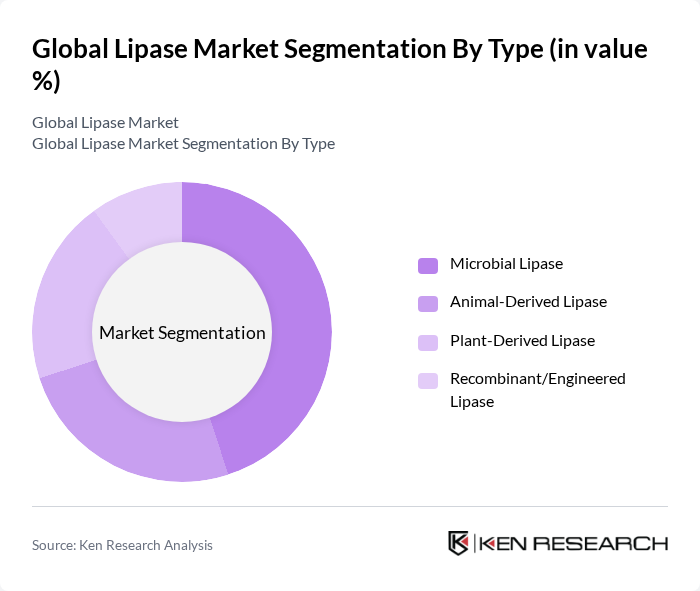
Global Lipase Market segmentation by Type.

By End-User:The end-user segmentation includes Food & Beverage Manufacturers, Animal Nutrition & Feed Producers, Pharmaceutical & Biotechnology Companies, Household & Industrial Care (Detergents/Cleaners), and Bioenergy & Chemical Processing. TheFood & Beverage Manufacturerssegment is the largest, supported by enzyme-enabled improvements in flavor development, dairy fat modification, bakery texture enhancement, and process efficiency, as well as clean-label and natural processing trends.
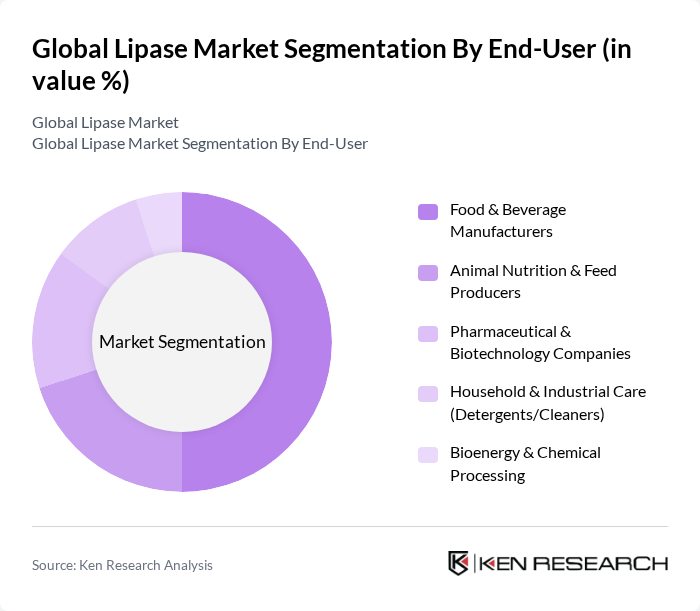
Global Lipase Market segmentation by End-User.

Global Lipase Market Competitive Landscape

The Global Lipase Market is characterized by a dynamic mix of regional and international players. Leading participants such as Novozymes A/S, International Flavors & Fragrances Inc. (IFF Nutrition & Biosciences), dsm-firmenich, AB Enzymes GmbH, and BASF SE contribute to innovation, geographic expansion, and service delivery in this space.

Novozymes A/S

1925

Bagsværd, Denmark

International Flavors & Fragrances Inc.

1909

New York, USA

dsm-firmenich

1902

Heerlen, Netherlands

AB Enzymes GmbH

1907

Darmstadt, Germany

BASF SE

1865

Ludwigshafen, Germany

Company

Establishment Year

Headquarters

Group Size (Global scale by enzyme revenue: Large > USD 1B, Mid USD 100M–1B, Small < USD 100M)

Enzyme/Lipase Segment Revenue and Growth (YoY/CAGR)

Geographic Footprint (regions served, manufacturing sites)

End-Market Exposure Mix (Food, Feed, Detergents, Pharma, Bioenergy)

Product Portfolio Breadth (microbial vs animal; forms; immobilized)

R&D Intensity (R&D as % of sales; active patents/publications)

Global Lipase Market Industry Analysis

Growth Drivers

  • Increasing Demand for Enzymes in Food Industry:The food industry is projected to consume approximately 1.5 million tons of enzymes in the future, with lipases playing a crucial role in fat digestion and flavor enhancement. The global enzyme market is expected to reach eight point five billion dollars, driven by the rising demand for processed foods. This trend is particularly evident in regions with growing populations, where the need for efficient food production methods is paramount, thus boosting lipase utilization significantly.
  • Rising Health Consciousness Among Consumers:In the future, the health and wellness market is estimated to be valued at four point five trillion dollars, with consumers increasingly seeking natural and functional foods. This shift is leading to a higher demand for lipases, which aid in the digestion of fats and improve nutrient absorption. The growing awareness of the benefits of enzymes in promoting digestive health is expected to drive the lipase market, particularly in health-focused food products.
  • Expansion of Biofuel Production:The biofuel sector is anticipated to grow by ten percent annually, with lipases being integral in the production of biodiesel from fats and oils. In the future, biofuel production is projected to reach one hundred fifty billion liters globally, creating a substantial demand for lipases. This growth is driven by government initiatives promoting renewable energy sources, thus enhancing the role of lipases in sustainable energy solutions and contributing to market expansion.

Market Challenges

  • High Production Costs:The production of lipases involves significant costs, with estimates indicating that enzyme manufacturing can account for up to thirty percent of total operational expenses. In the future, the average cost of enzyme production is projected to be around fifty dollars per kilogram. These high costs can deter small and medium enterprises from entering the market, limiting competition and innovation, which poses a challenge for overall market growth.
  • Regulatory Compliance Issues:The lipase market faces stringent regulatory frameworks, particularly in food and pharmaceutical applications. Compliance with regulations can incur costs exceeding one million dollars for companies seeking approval for new enzyme products. In the future, the increasing complexity of regulatory requirements is expected to challenge manufacturers, potentially delaying product launches and limiting market access for innovative lipase solutions.

Global Lipase Market Future Outlook

The future of the lipase market appears promising, driven by the increasing integration of enzymes in various industries, particularly food and biofuels. As consumer preferences shift towards natural and organic products, the demand for lipases is expected to rise. Additionally, advancements in enzyme production technologies will likely enhance efficiency and reduce costs, fostering innovation. The focus on sustainability and health will further propel the market, creating a dynamic landscape for growth and development in the coming years.

Market Opportunities

  • Growth in Animal Feed Industry:The animal feed sector is projected to reach five hundred billion dollars in the future, with lipases enhancing nutrient absorption and feed efficiency. This growth presents a significant opportunity for lipase manufacturers to develop specialized products tailored for livestock, thereby increasing their market share in this expanding segment.
  • Increasing Use in Pharmaceutical Applications:The pharmaceutical industry is expected to grow to one point five trillion dollars in the future, with lipases being utilized in drug formulation and production. This trend offers a lucrative opportunity for lipase producers to innovate and create enzyme-based solutions that cater to the specific needs of pharmaceutical applications, enhancing their market presence.

Scope of the Report

SegmentSub-Segments
By Type

Microbial Lipase

Animal-Derived Lipase

Plant-Derived Lipase

Recombinant/Engineered Lipase

By End-User

Food & Beverage Manufacturers

Animal Nutrition & Feed Producers

Pharmaceutical & Biotechnology Companies

Household & Industrial Care (Detergents/Cleaners)

Bioenergy & Chemical Processing

By Application

Bakery (dough conditioning, crumb softness, shelf life)

Dairy (cheese flavor development, lipolysis, UHT)

Oils & Fats Modification (interesterification, transesterification)

Detergents & Cleaning (degreasing, stain removal)

Animal Feed (digestibility enhancement)

Pharmaceuticals & Nutraceuticals (API synthesis, pancreatin)

Biofuels & Biolubricants

Personal Care & Cosmetics (enzymatic exfoliation)

By Source

Fungal (e.g., Aspergillus, Rhizopus, Candida)

Bacterial (e.g., Bacillus, Pseudomonas, Burkholderia)

Animal (pancreatic, gastric)

Yeast and Other Microbial Sources

By Formulation

Liquid

Powder

Granular/Granulate

Encapsulated/Immobilized

By Distribution Channel

Direct (Key Account/OEM)

Distributors & System Integrators

Online/Marketplace

Specialty Chemical Suppliers

By Region

North America

Europe

Asia-Pacific

Latin America

Middle East & Africa

Key Target Audience

Investors and Venture Capitalist Firms

Government and Regulatory Bodies (e.g., Food and Drug Administration, European Food Safety Authority)

Manufacturers and Producers

Distributors and Retailers

Pharmaceutical Companies

Biotechnology Firms

Food and Beverage Industry Stakeholders

Health and Wellness Product Developers

Players Mentioned in the Report:

Novonesis (Novozymes A/S + Chr. Hansen Holding A/S)

International Flavors & Fragrances Inc. (IFF Nutrition & Biosciences, including DuPont enzymes)

dsm-firmenich

AB Enzymes GmbH (Associated British Foods)

BASF SE

Amano Enzyme Inc.

Advanced Enzyme Technologies Ltd.

Biocatalysts Ltd. (part of Brain Biotech)

Enzyme Development Corporation

Koninklijke DSM N.V. (legacy enzyme assets within dsm-firmenich)

Kerry Group plc (Enmex/enzymes portfolio)

Lumis Bio (formerly Specialty Enzymes & Biotechnologies)

Meito Sangyo Co., Ltd.

Creative Enzymes

Aumgene Biosciences Pvt. Ltd.

Table of Contents

Market Assessment Phase

1. Executive Summary and Approach


2. Global Lipase Market Overview

2.1 Key Insights and Strategic Recommendations

2.2 Global Lipase Market Overview

2.3 Definition and Scope

2.4 Evolution of Market Ecosystem

2.5 Timeline of Key Regulatory Milestones

2.6 Value Chain & Stakeholder Mapping

2.7 Business Cycle Analysis

2.8 Policy & Incentive Landscape


3. Global Lipase Market Analysis

3.1 Growth Drivers

3.1.1 Increasing Demand for Enzymes in Food Industry
3.1.2 Rising Health Consciousness Among Consumers
3.1.3 Expansion of Biofuel Production
3.1.4 Technological Advancements in Enzyme Production

3.2 Market Challenges

3.2.1 High Production Costs
3.2.2 Regulatory Compliance Issues
3.2.3 Competition from Alternative Products
3.2.4 Limited Awareness in Emerging Markets

3.3 Market Opportunities

3.3.1 Growth in Animal Feed Industry
3.3.2 Increasing Use in Pharmaceutical Applications
3.3.3 Expansion into Untapped Markets
3.3.4 Development of Innovative Lipase Products

3.4 Market Trends

3.4.1 Shift Towards Natural and Organic Products
3.4.2 Increasing Investment in R&D
3.4.3 Rising Popularity of Plant-Based Diets
3.4.4 Focus on Sustainable Production Practices

3.5 Government Regulation

3.5.1 Food Safety Regulations
3.5.2 Environmental Protection Standards
3.5.3 Labeling Requirements for Enzymes
3.5.4 Import/Export Regulations for Enzyme Products

4. SWOT Analysis


5. Stakeholder Analysis


6. Porter's Five Forces Analysis


7. Global Lipase Market Market Size, 2019-2024

7.1 By Value

7.2 By Volume

7.3 By Average Selling Price


8. Global Lipase Market Segmentation

8.1 By Type

8.1.1 Microbial Lipase
8.1.2 Animal-Derived Lipase
8.1.3 Plant-Derived Lipase
8.1.4 Recombinant/Engineered Lipase

8.2 By End-User

8.2.1 Food & Beverage Manufacturers
8.2.2 Animal Nutrition & Feed Producers
8.2.3 Pharmaceutical & Biotechnology Companies
8.2.4 Household & Industrial Care (Detergents/Cleaners)
8.2.5 Bioenergy & Chemical Processing

8.3 By Application

8.3.1 Bakery (dough conditioning, crumb softness, shelf life)
8.3.2 Dairy (cheese flavor development, lipolysis, UHT)
8.3.3 Oils & Fats Modification (interesterification, transesterification)
8.3.4 Detergents & Cleaning (degreasing, stain removal)
8.3.5 Animal Feed (digestibility enhancement)
8.3.6 Pharmaceuticals & Nutraceuticals (API synthesis, pancreatin)
8.3.7 Biofuels & Biolubricants
8.3.8 Personal Care & Cosmetics (enzymatic exfoliation)

8.4 By Source

8.4.1 Fungal (e.g., Aspergillus, Rhizopus, Candida)
8.4.2 Bacterial (e.g., Bacillus, Pseudomonas, Burkholderia)
8.4.3 Animal (pancreatic, gastric)
8.4.4 Yeast and Other Microbial Sources

8.5 By Formulation

8.5.1 Liquid
8.5.2 Powder
8.5.3 Granular/Granulate
8.5.4 Encapsulated/Immobilized

8.6 By Distribution Channel

8.6.1 Direct (Key Account/OEM)
8.6.2 Distributors & System Integrators
8.6.3 Online/Marketplace
8.6.4 Specialty Chemical Suppliers

8.7 By Region

8.7.1 North America
8.7.2 Europe
8.7.3 Asia-Pacific
8.7.4 Latin America
8.7.5 Middle East & Africa

9. Global Lipase Market Competitive Analysis

9.1 Market Share of Key Players

9.2 Cross Comparison of Key Players

9.2.1 Company Name
9.2.2 Group Size (Global scale by enzyme revenue: Large > USD 1B, Mid USD 100M–1B, Small < USD 100M)
9.2.3 Enzyme/Lipase Segment Revenue and Growth (YoY/CAGR)
9.2.4 Geographic Footprint (regions served, manufacturing sites)
9.2.5 End-Market Exposure Mix (Food, Feed, Detergents, Pharma, Bioenergy)
9.2.6 Product Portfolio Breadth (microbial vs animal; forms; immobilized)
9.2.7 R&D Intensity (R&D as % of sales; active patents/publications)
9.2.8 Key Regulatory/Quality Certifications (GRAS, EFSA approvals, GMP, FAMI-QS)
9.2.9 Strategic Partnerships and OEM Integrations
9.2.10 Pricing Positioning (premium/mainstream/value; contract vs spot)
9.2.11 Supply Chain Reliability (capacity, backward integration, redundancy)
9.2.12 Innovation Pipeline (new strains, engineered variants, application launches)

9.3 SWOT Analysis of Top Players

9.4 Pricing Analysis

9.5 Detailed Profile of Major Companies

9.5.1 Novonesis (Novozymes A/S + Chr. Hansen Holding A/S)
9.5.2 International Flavors & Fragrances Inc. (IFF Nutrition & Biosciences, including DuPont enzymes)
9.5.3 dsm-firmenich
9.5.4 AB Enzymes GmbH (Associated British Foods)
9.5.5 BASF SE
9.5.6 Amano Enzyme Inc.
9.5.7 Advanced Enzyme Technologies Ltd.
9.5.8 Biocatalysts Ltd. (part of Brain Biotech)
9.5.9 Enzyme Development Corporation
9.5.10 Koninklijke DSM N.V. (legacy enzyme assets within dsm-firmenich)
9.5.11 Kerry Group plc (Enmex/enzymes portfolio)
9.5.12 Lumis Bio (formerly Specialty Enzymes & Biotechnologies)
9.5.13 Meito Sangyo Co., Ltd.
9.5.14 Creative Enzymes
9.5.15 Aumgene Biosciences Pvt. Ltd.

10. Global Lipase Market End-User Analysis

10.1 Procurement Behavior of Key Ministries

10.1.1 Government Procurement Policies
10.1.2 Budget Allocations for Enzyme Products
10.1.3 Evaluation Criteria for Suppliers

10.2 Corporate Spend on Infrastructure & Energy

10.2.1 Investment Trends in Enzyme Production
10.2.2 Budgeting for R&D in Enzyme Applications

10.3 Pain Point Analysis by End-User Category

10.3.1 Quality Assurance Challenges
10.3.2 Supply Chain Disruptions
10.3.3 Cost Management Issues

10.4 User Readiness for Adoption

10.4.1 Awareness of Lipase Benefits
10.4.2 Training and Support Needs

10.5 Post-Deployment ROI and Use Case Expansion

10.5.1 Measurement of Performance Metrics
10.5.2 Case Studies of Successful Implementations

11. Global Lipase Market Future Size, 2025-2030

11.1 By Value

11.2 By Volume

11.3 By Average Selling Price


Go-To-Market Strategy Phase

1. Whitespace Analysis + Business Model Canvas

1.1 Identification of Market Gaps

1.2 Business Model Framework


2. Marketing and Positioning Recommendations

2.1 Branding Strategies

2.2 Product USPs


3. Distribution Plan

3.1 Urban Retail Strategies

3.2 Rural NGO Tie-ups


4. Channel & Pricing Gaps

4.1 Underserved Routes

4.2 Pricing Bands


5. Unmet Demand & Latent Needs

5.1 Category Gaps

5.2 Consumer Segments


6. Customer Relationship

6.1 Loyalty Programs

6.2 After-Sales Service


7. Value Proposition

7.1 Sustainability Initiatives

7.2 Integrated Supply Chains


8. Key Activities

8.1 Regulatory Compliance

8.2 Branding Efforts

8.3 Distribution Setup


9. Entry Strategy Evaluation

9.1 Domestic Market Entry Strategy

9.1.1 Product Mix Considerations
9.1.2 Pricing Band Strategy
9.1.3 Packaging Solutions

9.2 Export Entry Strategy

9.2.1 Target Countries
9.2.2 Compliance Roadmap

10. Entry Mode Assessment

10.1 Joint Ventures

10.2 Greenfield Investments

10.3 Mergers & Acquisitions

10.4 Distributor Model


11. Capital and Timeline Estimation

11.1 Capital Requirements

11.2 Timelines for Implementation


12. Control vs Risk Trade-Off

12.1 Ownership Considerations

12.2 Partnerships Evaluation


13. Profitability Outlook

13.1 Breakeven Analysis

13.2 Long-Term Sustainability


14. Potential Partner List

14.1 Distributors

14.2 Joint Ventures

14.3 Acquisition Targets


15. Execution Roadmap

15.1 Phased Plan for Market Entry

15.1.1 Market Setup
15.1.2 Market Entry
15.1.3 Growth Acceleration
15.1.4 Scale & Stabilize

15.2 Key Activities and Milestones

15.2.1 Milestone Planning
15.2.2 Activity Tracking

Research Methodology

ApproachModellingSample

Phase 1: Approach1

Desk Research

  • Analysis of industry reports from organizations such as the International Lipase Association
  • Review of market trends and forecasts from scientific journals and publications
  • Examination of trade statistics and import/export data from global trade databases

Primary Research

  • Interviews with key opinion leaders in the enzyme production sector
  • Surveys targeting food and beverage manufacturers utilizing lipase
  • Field interviews with researchers and product developers in biotechnology firms

Validation & Triangulation

  • Cross-validation of findings through multiple data sources including academic and industry publications
  • Triangulation of market insights from primary interviews and secondary data
  • Sanity checks conducted through expert panels comprising industry veterans

Phase 2: Market Size Estimation1

Top-down Assessment

  • Estimation of global lipase market size based on overall enzyme market growth
  • Segmentation analysis by application areas such as food processing, pharmaceuticals, and biofuels
  • Incorporation of regional market dynamics and growth drivers

Bottom-up Modeling

  • Collection of sales data from leading lipase manufacturers and distributors
  • Estimation of market share based on product types and applications
  • Volume and pricing analysis to derive revenue projections for each segment

Forecasting & Scenario Analysis

  • Utilization of time-series analysis to project future market trends
  • Scenario modeling based on regulatory changes and technological advancements
  • Development of baseline, optimistic, and pessimistic forecasts through 2030

Phase 3: CATI Sample Composition1

Scope Item/SegmentSample SizeTarget Respondent Profiles
Food Processing Industry120Production Managers, Quality Control Specialists
Pharmaceutical Applications90R&D Directors, Regulatory Affairs Managers
Animal Feed Production70Feed Formulation Experts, Nutritionists
Biofuel Sector60Process Engineers, Sustainability Managers
Cosmetic Industry50Product Development Managers, Marketing Executives

Frequently Asked Questions

What is the current value of the Global Lipase Market?

The Global Lipase Market is valued at approximately USD 600620 million, based on a comprehensive five-year analysis. This valuation reflects the market's growth and demand across various sectors, including food, feed, and pharmaceuticals.

Which regions are the key producers and consumers of lipase?

What are the main types of lipase available in the market?

Who are the major players in the Global Lipase Market?

Other Regional/Country Reports

UAE Lipase MarketKSA Lipase Market

Indonesia Lipase Market

Malaysia Lipase Market

APAC Lipase Market

SEA Lipase Market

Why Buy From Us?

Refine Robust Result (RRR) Framework

What makes us stand out is that our consultants follow Robust, Refine and Result (RRR) methodology. Robust for clear definitions, approaches and sanity checking, Refine for differentiating respondents' facts and opinions, and Result for presenting data with story.

Our Reach Is Unmatched

We have set a benchmark in the industry by offering our clients with syndicated and customized market research reports featuring coverage of entire market as well as meticulous research and analyst insights.

Shifting the Research Paradigm

While we don't replace traditional research, we flip the method upside down. Our dual approach of Top Bottom & Bottom Top ensures quality deliverable by not just verifying company fundamentals but also looking at the sector and macroeconomic factors.

More Insights-Better Decisions

With one step in the future, our research team constantly tries to show you the bigger picture. We help with some of the tough questions you may encounter along the way: How is the industry positioned? Best marketing channel? KPI's of competitors? By aligning every element, we help maximize success.

Transparency and Trust

Our report gives you instant access to the answers and sources that other companies might choose to hide. We elaborate each steps of research methodology we have used and showcase you the sample size to earn your trust.

Round the Clock Support

If you need any support, we are here! We pride ourselves on universe strength, data quality, and quick, friendly, and professional service.

Why Clients Choose Us?

400000+
Reports in repository
150+
Consulting projects a year
100+
Analysts
8000+
Client Queries in 2022








