About the Report
Base Year 2024Global Liquid Crystal on Silicon Display Market Overview
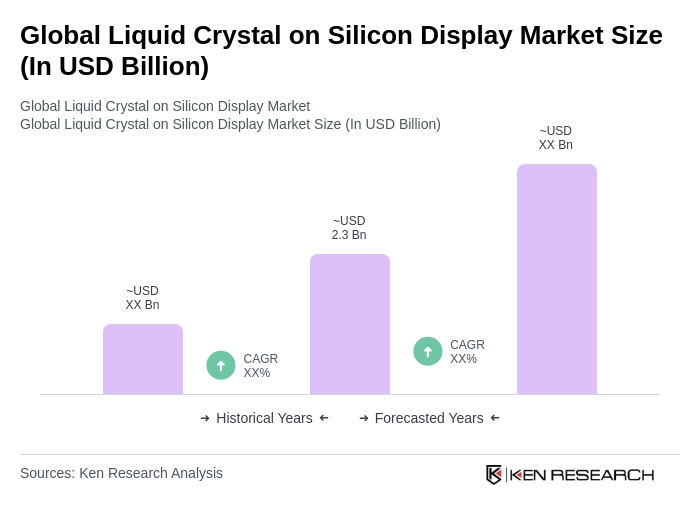
- The Global Liquid Crystal on Silicon Display Market is valued at USD 2.3 billion, based on a five-year historical analysis. This growth is primarily driven by the increasing demand for high-resolution displays in consumer electronics, automotive applications, and medical devices. Recent trends highlight the rapid adoption of LCoS in augmented reality (AR), virtual reality (VR), and automotive head-up displays, as well as ongoing innovation in miniaturized, energy-efficient, and high pixel density displays. The rise in technological advancements and the integration of LCoS technology in various applications have further propelled market expansion.
- Key players in this market include countries like the United States, Japan, South Korea, and China, which dominate due to their strong technological infrastructure, significant investments in research and development, and robust consumer electronics and automotive industries. These regions are home to major manufacturers and innovators, contributing to their leadership in the global market. Asia-Pacific, in particular, is emerging as the fastest-growing region, driven by widespread adoption in AR/VR, gaming, and automotive applications, supported by expanding electronics manufacturing capabilities and government initiatives.
- The Ecodesign Requirements for Electronic Displays (EU Regulation 2019/2021), issued by the European Commission, sets binding energy efficiency and resource efficiency standards for all new electronic displays, including LCoS-based devices. This regulation mandates maximum allowable energy consumption thresholds, requirements for recyclability, and information disclosure obligations for manufacturers, directly influencing the adoption of more efficient LCoS technologies and supporting the European Union’s sustainability and circular economy objectives.
Global Liquid Crystal on Silicon Display Market Segmentation
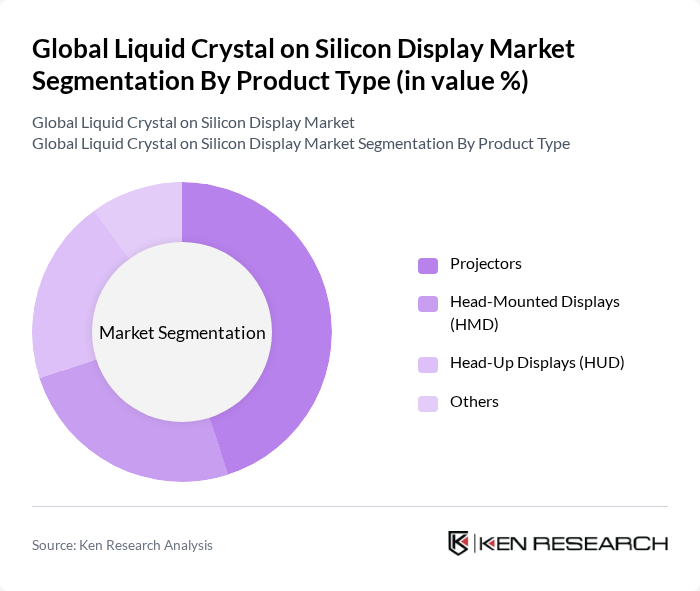
By Product Type:The product type segmentation includes categories such as projectors, head-mounted displays (HMD), head-up displays (HUD), and others. Projectors currently lead the market, driven by their widespread use in educational institutions, corporate environments, and home theaters. The increasing demand for immersive and high-quality visual experiences, especially in business, education, and entertainment, has accelerated the adoption of advanced projector technologies. Head-mounted displays and head-up displays are also experiencing significant growth, propelled by the expansion of AR/VR applications and automotive safety systems.
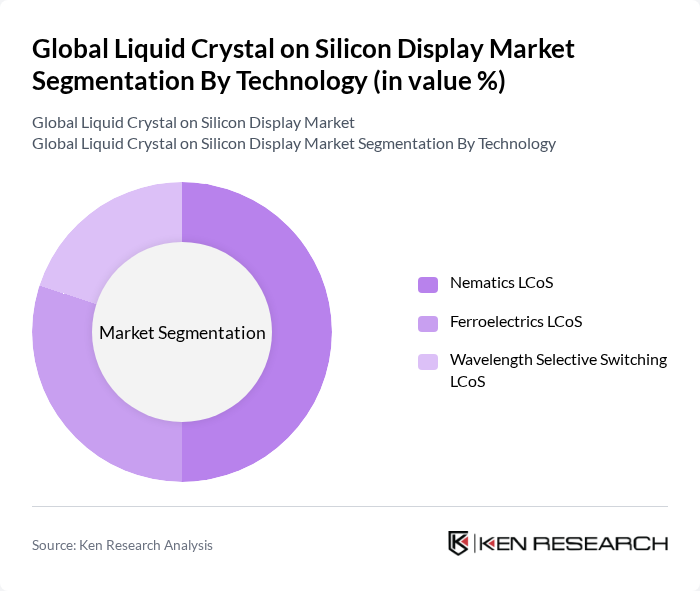
By Technology:The technology segmentation encompasses nematics LCoS, ferroelectrics LCoS, and wavelength selective switching LCoS. Nematics LCoS technology dominates the market due to its superior image quality, high resolution, and energy efficiency, making it the preferred choice for consumer electronics and professional display applications. Ferroelectric and wavelength selective switching LCoS technologies are gaining traction in specialized applications, including high-speed spatial light modulation and advanced optical systems. The increasing demand for high-definition and energy-efficient displays across sectors continues to reinforce the leadership of nematics LCoS.
Global Liquid Crystal on Silicon Display Market Competitive Landscape
The Global Liquid Crystal on Silicon Display Market is characterized by a dynamic mix of regional and international players. Leading participants such as Sony Corporation, JVC Kenwood Corporation, Canon Inc., Himax Technologies, Inc., LG Electronics Inc., Samsung Electronics Co., Ltd., Hitachi Ltd., AAXA Technologies Inc., MicroVision, Inc., Syndiant, Inc., 3M Company, Texas Instruments Incorporated, Santec Corporation, Jasper Display Corp., HOLOEYE Photonics AG contribute to innovation, geographic expansion, and service delivery in this space.
Global Liquid Crystal on Silicon Display Market Industry Analysis
Growth Drivers
- Increasing Demand for High-Resolution Displays:The global demand for high-resolution displays is projected to reach 1.6 billion units in future, driven by consumer preferences for enhanced visual experiences. The proliferation of 4K and 8K content, alongside the rise of streaming services, has significantly contributed to this trend. According to the International Data Corporation (IDC), the average selling price of high-resolution displays is expected to decline by 8% annually, making them more accessible to consumers and further fueling demand.
- Advancements in Display Technology:Continuous advancements in display technology, particularly in Liquid Crystal on Silicon (LCoS) displays, are enhancing image quality and performance. The introduction of new materials and manufacturing techniques has improved resolution and color accuracy. For instance, the adoption of quantum dot technology is expected to increase color gamut by 25% in future, according to a report by Display Supply Chain Consultants (DSCC). This innovation is crucial for applications in both consumer electronics and professional displays.
- Rising Adoption in Consumer Electronics:The consumer electronics sector is witnessing a surge in the adoption of LCoS displays, with an estimated 650 million units expected to be shipped in future. This growth is attributed to the increasing integration of LCoS technology in smartphones, tablets, and televisions. The Consumer Technology Association (CTA) reports that 80% of new televisions sold in future will feature advanced display technologies, including LCoS, highlighting the shift towards superior display solutions in consumer devices.
Market Challenges
- High Manufacturing Costs:The production of LCoS displays involves complex manufacturing processes, leading to high costs. In future, the average cost of producing LCoS displays is projected to be around $140 per unit, significantly higher than competing technologies like LCD and OLED. This cost barrier limits market penetration, particularly in price-sensitive segments. According to industry reports, manufacturers are investing heavily in R&D to reduce these costs, but challenges remain in achieving economies of scale.
- Intense Competition from Alternative Technologies:The LCoS display market faces fierce competition from alternative technologies such as OLED and MicroLED, which are gaining traction due to their superior performance and lower production costs. In future, OLED displays are expected to capture 45% of the overall display market share, according to the OLED Association. This competitive landscape poses a significant challenge for LCoS manufacturers, necessitating innovation and differentiation to maintain market relevance.
Global Liquid Crystal on Silicon Display Market Future Outlook
The future of the LCoS display market appears promising, driven by technological advancements and increasing consumer demand for high-quality displays. As manufacturers focus on reducing production costs and enhancing display performance, the market is likely to witness significant growth. Additionally, the integration of LCoS technology with emerging applications such as augmented reality (AR) and virtual reality (VR) is expected to create new avenues for expansion. The emphasis on energy-efficient solutions will further shape the market landscape in the coming years.
Market Opportunities
- Expansion in Emerging Markets:Emerging markets, particularly in Asia-Pacific and Latin America, present significant growth opportunities for LCoS displays. With a projected increase in smartphone penetration rates to 85% in future, manufacturers can tap into a growing consumer base seeking advanced display technologies. This trend is supported by rising disposable incomes and urbanization, which are driving demand for high-quality consumer electronics.
- Development of Flexible and Foldable Displays:The development of flexible and foldable LCoS displays is poised to revolutionize the market. With the global flexible display market expected to reach $35 billion in future, LCoS technology can play a crucial role in this segment. The increasing demand for innovative form factors in smartphones and wearables will drive investment in R&D, leading to new product offerings and enhanced consumer experiences.
Scope of the Report
| Segment | Sub-Segments |
|---|---|
| By Product Type | Projectors Head-Mounted Displays (HMD) Head-Up Displays (HUD) Others |
| By Technology | Nematics LCoS Ferroelectrics LCoS Wavelength Selective Switching LCoS |
| By Application | Consumer Electronics Automotive Aviation Military & Defense Optical 3D Measurement Medical Devices Others |
| By Region | North America Europe Asia-Pacific Latin America Middle East & Africa |
Key Target Audience
Investors and Venture Capitalist Firms
Government and Regulatory Bodies (e.g., Federal Communications Commission, International Telecommunication Union)
Manufacturers and Producers
Distributors and Retailers
Technology Providers
Industry Associations (e.g., Society for Information Display)
Financial Institutions
Original Equipment Manufacturers (OEMs)
Players Mentioned in the Report:
Sony Corporation
JVC Kenwood Corporation
Canon Inc.
Himax Technologies, Inc.
LG Electronics Inc.
Samsung Electronics Co., Ltd.
Hitachi Ltd.
AAXA Technologies Inc.
MicroVision, Inc.
Syndiant, Inc.
3M Company
Texas Instruments Incorporated
Santec Corporation
Jasper Display Corp.
HOLOEYE Photonics AG
Table of Contents
Market Assessment Phase
1. Executive Summary and Approach
2. Global Liquid Crystal on Silicon Display Market Overview
2.1 Key Insights and Strategic Recommendations
2.2 Global Liquid Crystal on Silicon Display Market Overview
2.3 Definition and Scope
2.4 Evolution of Market Ecosystem
2.5 Timeline of Key Regulatory Milestones
2.6 Value Chain & Stakeholder Mapping
2.7 Business Cycle Analysis
2.8 Policy & Incentive Landscape
3. Global Liquid Crystal on Silicon Display Market Analysis
3.1 Growth Drivers
3.1.1 Increasing demand for high-resolution displays
3.1.2 Advancements in display technology
3.1.3 Rising adoption in consumer electronics
3.1.4 Growth in automotive display applications
3.2 Market Challenges
3.2.1 High manufacturing costs
3.2.2 Intense competition from alternative technologies
3.2.3 Supply chain disruptions
3.2.4 Regulatory compliance issues
3.3 Market Opportunities
3.3.1 Expansion in emerging markets
3.3.2 Development of flexible and foldable displays
3.3.3 Integration with IoT devices
3.3.4 Increasing demand for AR/VR applications
3.4 Market Trends
3.4.1 Shift towards energy-efficient displays
3.4.2 Growing popularity of OLED and MicroLED technologies
3.4.3 Customization and personalization in display solutions
3.4.4 Rise of smart home and connected devices
3.5 Government Regulation
3.5.1 Environmental regulations on manufacturing processes
3.5.2 Standards for display quality and safety
3.5.3 Incentives for energy-efficient technologies
3.5.4 Trade regulations affecting imports and exports
4. SWOT Analysis
5. Stakeholder Analysis
6. Porter's Five Forces Analysis
7. Global Liquid Crystal on Silicon Display Market Market Size, 2019-2024
7.1 By Value
7.2 By Volume
7.3 By Average Selling Price
8. Global Liquid Crystal on Silicon Display Market Segmentation
8.1 By Product Type
8.1.1 Projectors
8.1.2 Head-Mounted Displays (HMD)
8.1.3 Head-Up Displays (HUD)
8.1.4 Others
8.2 By Technology
8.2.1 Nematics LCoS
8.2.2 Ferroelectrics LCoS
8.2.3 Wavelength Selective Switching LCoS
8.3 By Application
8.3.1 Consumer Electronics
8.3.2 Automotive
8.3.3 Aviation
8.3.4 Military & Defense
8.3.5 Optical 3D Measurement
8.3.6 Medical Devices
8.3.7 Others
8.4 By Region
8.4.1 North America
8.4.2 Europe
8.4.3 Asia-Pacific
8.4.4 Latin America
8.4.5 Middle East & Africa
9. Global Liquid Crystal on Silicon Display Market Competitive Analysis
9.1 Market Share of Key Players
9.2 KPIs for Cross Comparison of Key Players
9.2.1 Company Name
9.2.2 Market Share (%)
9.2.3 Revenue (USD Million)
9.2.4 Revenue Growth Rate (YoY %)
9.2.5 R&D Expenditure (% of Revenue)
9.2.6 Product Portfolio Breadth
9.2.7 Patent Count
9.2.8 Geographic Presence (Number of Countries)
9.2.9 Strategic Partnerships & Alliances
9.2.10 Innovation Index (New Product Launches per Year)
9.2.11 Customer Base (Major End-User Segments)
9.3 SWOT Analysis of Top Players
9.4 Pricing Analysis
9.5 Detailed Profile of Major Companies
9.5.1 Sony Corporation
9.5.2 JVC Kenwood Corporation
9.5.3 Canon Inc.
9.5.4 Himax Technologies, Inc.
9.5.5 LG Electronics Inc.
9.5.6 Samsung Electronics Co., Ltd.
9.5.7 Hitachi Ltd.
9.5.8 AAXA Technologies Inc.
9.5.9 MicroVision, Inc.
9.5.10 Syndiant, Inc.
9.5.11 3M Company
9.5.12 Texas Instruments Incorporated
9.5.13 Santec Corporation
9.5.14 Jasper Display Corp.
9.5.15 HOLOEYE Photonics AG
10. Global Liquid Crystal on Silicon Display Market End-User Analysis
10.1 Procurement Behavior of Key Ministries
10.1.1 Government procurement policies
10.1.2 Budget allocation for technology upgrades
10.1.3 Evaluation criteria for display technologies
10.2 Corporate Spend on Infrastructure & Energy
10.2.1 Investment in display technology
10.2.2 Budget trends in corporate sectors
10.2.3 Impact of display technology on operational efficiency
10.3 Pain Point Analysis by End-User Category
10.3.1 Challenges in display integration
10.3.2 Cost-related issues
10.3.3 Technical support and maintenance concerns
10.4 User Readiness for Adoption
10.4.1 Awareness of new technologies
10.4.2 Training and support requirements
10.4.3 Adoption barriers in various sectors
10.5 Post-Deployment ROI and Use Case Expansion
10.5.1 Measurement of ROI post-implementation
10.5.2 Expansion into new applications
10.5.3 Long-term benefits of display technology
11. Global Liquid Crystal on Silicon Display Market Future Size, 2025-2030
11.1 By Value
11.2 By Volume
11.3 By Average Selling Price
Go-To-Market Strategy Phase
1. Whitespace Analysis + Business Model Canvas
1.1 Market gaps and opportunities
1.2 Business model components
1.3 Value proposition analysis
1.4 Competitive landscape overview
1.5 Customer segmentation
1.6 Revenue streams
1.7 Cost structure
2. Marketing and Positioning Recommendations
2.1 Branding strategies
2.2 Product USPs
2.3 Target audience identification
2.4 Communication strategies
2.5 Digital marketing tactics
3. Distribution Plan
3.1 Urban retail strategies
3.2 Rural NGO tie-ups
3.3 E-commerce strategies
3.4 Partnerships with distributors
4. Channel & Pricing Gaps
4.1 Underserved routes
4.2 Pricing bands analysis
4.3 Competitor pricing strategies
4.4 Customer willingness to pay
5. Unmet Demand & Latent Needs
5.1 Category gaps
5.2 Consumer segments analysis
5.3 Emerging trends and needs
6. Customer Relationship
6.1 Loyalty programs
6.2 After-sales service
6.3 Customer feedback mechanisms
7. Value Proposition
7.1 Sustainability initiatives
7.2 Integrated supply chains
7.3 Unique selling points
8. Key Activities
8.1 Regulatory compliance
8.2 Branding efforts
8.3 Distribution setup
9. Entry Strategy Evaluation
9.1 Domestic Market Entry Strategy
9.1.1 Product mix considerations
9.1.2 Pricing band strategies
9.1.3 Packaging options
9.2 Export Entry Strategy
9.2.1 Target countries analysis
9.2.2 Compliance roadmap
10. Entry Mode Assessment
10.1 Joint Ventures
10.2 Greenfield investments
10.3 Mergers & Acquisitions
10.4 Distributor Model
11. Capital and Timeline Estimation
11.1 Capital requirements
11.2 Timelines for market entry
12. Control vs Risk Trade-Off
12.1 Ownership considerations
12.2 Partnerships evaluation
13. Profitability Outlook
13.1 Breakeven analysis
13.2 Long-term sustainability strategies
14. Potential Partner List
14.1 Distributors
14.2 Joint Ventures
14.3 Acquisition targets
15. Execution Roadmap
15.1 Phased Plan for Market Entry
15.1.1 Market Setup
15.1.2 Market Entry
15.1.3 Growth Acceleration
15.1.4 Scale & Stabilize
15.2 Key Activities and Milestones
15.2.1 Milestone planning
15.2.2 Activity tracking
Research Methodology
Phase 1: Approach1
Desk Research
- Industry reports from market research firms focusing on liquid crystal technology
- Published articles and white papers from academic journals on display technologies
- Data from trade associations and industry bodies related to the electronics sector
Primary Research
- Interviews with product managers at leading display manufacturers
- Surveys with end-users in sectors such as consumer electronics and automotive
- Field interviews with engineers and R&D specialists in display technology
Validation & Triangulation
- Cross-validation of findings through multiple data sources including sales and shipment data
- Triangulation of insights from primary interviews with secondary research findings
- Sanity checks conducted through expert panel discussions and feedback sessions
Phase 2: Market Size Estimation1
Top-down Assessment
- Analysis of global display market size and growth trends to estimate liquid crystal segment
- Segmentation by application areas such as televisions, smartphones, and automotive displays
- Incorporation of macroeconomic factors influencing consumer electronics demand
Bottom-up Modeling
- Volume estimates based on production data from major liquid crystal display manufacturers
- Cost analysis derived from component pricing and manufacturing expenses
- Estimation of market share based on sales data from key product categories
Forecasting & Scenario Analysis
- Multi-variable forecasting models incorporating technological advancements and market trends
- Scenario analysis based on potential regulatory changes and environmental considerations
- Development of baseline, optimistic, and pessimistic market projections through 2030
Phase 3: CATI Sample Composition1
| Scope Item/Segment | Sample Size | Target Respondent Profiles |
|---|---|---|
| Consumer Electronics Manufacturers | 100 | Product Development Managers, Supply Chain Analysts |
| Automotive Display Integrators | 80 | Engineering Managers, Procurement Specialists |
| Retail Electronics Outlets | 60 | Store Managers, Sales Directors |
| Research Institutions in Display Technology | 40 | Research Scientists, Technology Analysts |
| End-User Surveys in Consumer Electronics | 80 | Consumers, Tech Enthusiasts |
Frequently Asked Questions
What is the current value of the Global Liquid Crystal on Silicon Display Market?
The Global Liquid Crystal on Silicon Display Market is valued at approximately USD 2.3 billion, driven by the increasing demand for high-resolution displays across various sectors, including consumer electronics, automotive applications, and medical devices.
What are the key growth drivers for the LCoS display market?
Which regions are leading in the LCoS display market?
What are the main product types in the LCoS display market?
Other Regional/Country Reports
Indonesia Liquid Crystal on Silicon Display Market
Malaysia Liquid Crystal on Silicon Display Market
APAC Liquid Crystal on Silicon Display Market
SEA Liquid Crystal on Silicon Display Market
Other Adjacent Reports
Belgium Augmented Reality Device Market
Brazil Virtual Reality Headset Market
Singapore Automotive Head-Up Display Market
Kuwait Digital Projector Market
Indonesia Microdisplay Technology Market
UAE OLED Display Market
South Korea Micro-LED Display Market
Philippines Wearable Display Market
Egypt Medical Imaging Display Market
Vietnam Optical Component Market
Why Buy From Us?

What makes us stand out is that our consultants follow Robust, Refine and Result (RRR) methodology. Robust for clear definitions, approaches and sanity checking, Refine for differentiating respondents' facts and opinions, and Result for presenting data with story.

We have set a benchmark in the industry by offering our clients with syndicated and customized market research reports featuring coverage of entire market as well as meticulous research and analyst insights.

While we don't replace traditional research, we flip the method upside down. Our dual approach of Top Bottom & Bottom Top ensures quality deliverable by not just verifying company fundamentals but also looking at the sector and macroeconomic factors.

With one step in the future, our research team constantly tries to show you the bigger picture. We help with some of the tough questions you may encounter along the way: How is the industry positioned? Best marketing channel? KPI's of competitors? By aligning every element, we help maximize success.

Our report gives you instant access to the answers and sources that other companies might choose to hide. We elaborate each steps of research methodology we have used and showcase you the sample size to earn your trust.

If you need any support, we are here! We pride ourselves on universe strength, data quality, and quick, friendly, and professional service.