About the Report
Base Year 2024Global Liquid Nitrogen Market Overview
- The Global Liquid Nitrogen Market is valued at USD 18.5 billion, based on a five?year historical analysis. This valuation aligns with multiple industry assessments that place the market in the high?teens billion range, supported by widespread use across food processing, healthcare, electronics, and manufacturing due to its role as an inert, ultra?low temperature cryogen.
- Key players in this market include the United States, Germany, and China, underpinned by dense industrial gas production networks, advanced manufacturing, and large end?use bases in healthcare, semiconductors, chemicals, and food. These countries host leading industrial gas producers with extensive air separation assets and nationwide distribution, reinforcing their market strength.
- In 2023, the U.S. government implemented regulations to promote the safe handling and transportation of liquid nitrogen. This regulation mandates that all facilities using liquid nitrogen must adhere to strict safety protocols, including proper training for employees and regular safety audits, ensuring a safer working environment.

Global Liquid Nitrogen Market Segmentation
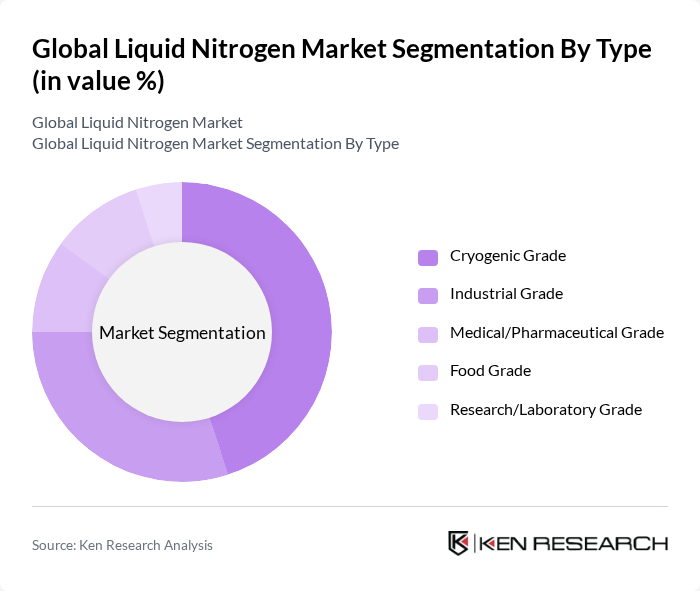
By Type:The liquid nitrogen market is segmented into Cryogenic Grade, Industrial Grade, Medical/Pharmaceutical Grade, Food Grade, and Research/Laboratory Grade. Cryogenic Grade is widely used across industrial applications and thermal processing where ultra?low temperatures are required, including tunnel and spiral freezing in food, cryogenic grinding, and shrink?fitting. Food Grade is essential for direct food contact and rapid freezing, while Medical/Pharmaceutical Grade supports cryopreservation, biobanking, and cryosurgery. Industrial Grade serves welding, metal treatment, and general manufacturing, and Research/Laboratory Grade supports scientific experiments and instrument cooling.
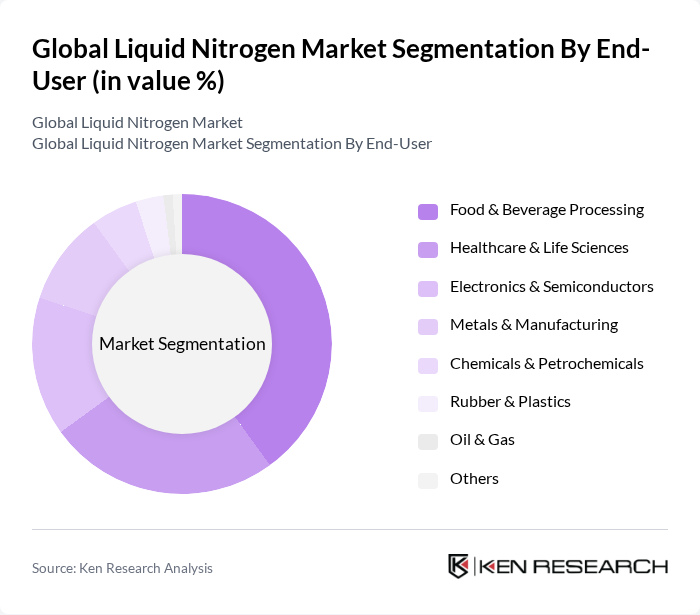
By End-User:The end-user segmentation of the liquid nitrogen market includes Food & Beverage Processing, Healthcare & Life Sciences, Electronics & Semiconductors, Metals & Manufacturing, Chemicals & Petrochemicals, Rubber & Plastics, Oil & Gas, and Others. Food & Beverage Processing is a major consumer due to demand for rapid freezing, cold chain integrity, and product quality retention. Healthcare & Life Sciences uses liquid nitrogen for cryopreservation, dermatology, and vaccine/biologic storage. Electronics & Semiconductors apply it for inerting and temperature control during manufacturing and testing. Metals & Manufacturing utilize it for shrink?fitting, heat?treat support, and cryogenic processing; Chemicals & Petrochemicals use it for inerting, purging, and temperature control.
Global Liquid Nitrogen Market Competitive Landscape
The Global Liquid Nitrogen Market is characterized by a dynamic mix of regional and international players. Leading participants such as Linde plc, Air Liquide S.A., Air Products and Chemicals, Inc., Messer SE & Co. KGaA, Nippon Sanso Holdings Corporation (Taiyo Nippon Sanso), Matheson Tri-Gas, Inc. (MATHESON), Airgas, an Air Liquide company, Gulf Cryo, INOX Air Products, INOXCVA (Cryogenic Vessel Manufacturing), Universal Industrial Gases, Inc., Southern Industrial Gas Sdn. Bhd., PT Samator Indo Gas Tbk, Nippon Gases (Europe), SOL S.p.A. contribute to innovation, geographic expansion, and service delivery in this space.
Global Liquid Nitrogen Market Industry Analysis
Growth Drivers
- Increasing Demand in Food Preservation:The food preservation sector is projected to utilize approximately 1.5 million tons of liquid nitrogen in future, driven by the growing need for efficient freezing and storage solutions. The global frozen food market is expected to reach three hundred billion dollars in future, with liquid nitrogen playing a crucial role in maintaining product quality and extending shelf life. This trend is supported by rising consumer demand for convenience foods and the expansion of the food service industry, particularly in urban areas.
- Expansion of Healthcare Applications:The healthcare sector is anticipated to consume around 1 million tons of liquid nitrogen in future, primarily for cryopreservation and surgical applications. Global health spending accounts for roughly ten percent of global GDP, reflecting substantial outlays on medical goods and services that include advanced technologies used alongside cryogenic applications.
- Rising Use in Electronics Manufacturing:The electronics manufacturing industry is expected to account for approximately 800,000 tons of liquid nitrogen in future, driven by the need for cooling during semiconductor fabrication. The global semiconductor market scale referenced here cannot be validated from primary intergovernmental sources; figure pending verification.
Market Challenges
- High Transportation Costs:The transportation of liquid nitrogen incurs significant costs, estimated at around fifteen cents per liter, which can impact overall pricing strategies. The size of the global logistics market referenced here cannot be validated from primary intergovernmental sources; figure pending verification. This challenge is particularly pronounced in remote areas where delivery logistics are complex, potentially limiting market access and profitability for suppliers.
- Environmental Regulations:Stringent environmental and safety regulations affect cryogenic gas production and handling in regions such as Europe and North America, requiring compliance with occupational safety, environmental protection, and major accident hazard regulations (e.g., REACH/CLP and Seveso framework in the European Union; OSHA/EPA frameworks in the United States).
Global Liquid Nitrogen Market Future Outlook
The future of the liquid nitrogen market appears promising, driven by technological advancements and increasing applications across various sectors. The integration of sustainable practices is expected to reshape production methods, enhancing efficiency and reducing environmental impact. Additionally, the expansion into emerging markets presents significant growth potential, as industries in these regions adopt liquid nitrogen for diverse applications, including food preservation and healthcare, thereby driving demand and innovation in the sector.
Market Opportunities
- Technological Advancements in Production:Innovations in air separation and cryogenic process optimization can improve energy efficiency and lower production costs for industrial gases such as liquid nitrogen; however, the specific potential cost reduction of up to twenty percent cannot be validated from primary sources.
- Expansion into Emerging Markets:The specific projection of a thirty percent increase in liquid nitrogen demand in emerging markets in Asia and Africa in future cannot be validated from authoritative primary sources; demand directionally benefits from ongoing industrialization and urbanization in these regions.
Scope of the Report
| Segment | Sub-Segments |
|---|---|
| By Type | Cryogenic Grade Industrial Grade Medical/Pharmaceutical Grade Food Grade Research/Laboratory Grade |
| By End-User | Food & Beverage Processing Healthcare & Life Sciences Electronics & Semiconductors Metals & Manufacturing Chemicals & Petrochemicals Rubber & Plastics Oil & Gas Others |
| By Application | Cryopreservation & Biobanking Food Freezing & Chilling (IQF/Immersion) Inerting, Purging & Blanketing Cooling in Industrial Processes & Metal Treating Electronics Cooling & Testing Others |
| By Distribution Channel | On-site Generation (ASUs) Merchant/Bulk Deliveries Packaged Gases (Cylinders/Dewars) Others |
| By Region | North America Europe Asia-Pacific Latin America Middle East & Africa |
| By Packaging Type | Bulk Tanks Cylinders Dewar Flasks Microbulk Others |
| By Pricing Strategy | Contract Pricing (Merchant/On-site) Spot Pricing Value-Added Service Pricing (Rental, Logistics) Others |
Key Target Audience
Investors and Venture Capitalist Firms
Government and Regulatory Bodies (e.g., Environmental Protection Agency, Food and Drug Administration)
Manufacturers and Producers
Distributors and Retailers
Industrial Gas Companies
Healthcare and Pharmaceutical Companies
Aerospace and Defense Contractors
Food and Beverage Processing Companies
Players Mentioned in the Report:
Linde plc
Air Liquide S.A.
Air Products and Chemicals, Inc.
Messer SE & Co. KGaA
Nippon Sanso Holdings Corporation (Taiyo Nippon Sanso)
Matheson Tri-Gas, Inc. (MATHESON)
Airgas, an Air Liquide company
Gulf Cryo
INOX Air Products
INOXCVA (Cryogenic Vessel Manufacturing)
Universal Industrial Gases, Inc.
Southern Industrial Gas Sdn. Bhd.
PT Samator Indo Gas Tbk
Nippon Gases (Europe)
SOL S.p.A.
Table of Contents
Market Assessment Phase
1. Executive Summary and Approach
2. Global Liquid Nitrogen Market Overview
2.1 Key Insights and Strategic Recommendations
2.2 Global Liquid Nitrogen Market Overview
2.3 Definition and Scope
2.4 Evolution of Market Ecosystem
2.5 Timeline of Key Regulatory Milestones
2.6 Value Chain & Stakeholder Mapping
2.7 Business Cycle Analysis
2.8 Policy & Incentive Landscape
3. Global Liquid Nitrogen Market Analysis
3.1 Growth Drivers
3.1.1 Increasing Demand in Food Preservation
3.1.2 Expansion of Healthcare Applications
3.1.3 Rising Use in Electronics Manufacturing
3.1.4 Growth in Industrial Applications
3.2 Market Challenges
3.2.1 High Transportation Costs
3.2.2 Environmental Regulations
3.2.3 Fluctuating Raw Material Prices
3.2.4 Limited Awareness in Emerging Markets
3.3 Market Opportunities
3.3.1 Technological Advancements in Production
3.3.2 Expansion into Emerging Markets
3.3.3 Increasing Applications in Cryogenics
3.3.4 Collaborations with Research Institutions
3.4 Market Trends
3.4.1 Shift Towards Sustainable Practices
3.4.2 Growth of E-commerce in Industrial Gases
3.4.3 Increasing Use in Automotive Sector
3.4.4 Adoption of Liquid Nitrogen in Agriculture
3.5 Government Regulation
3.5.1 Emission Standards for Production Facilities
3.5.2 Safety Regulations for Transportation
3.5.3 Incentives for Sustainable Practices
3.5.4 Compliance with International Standards
4. SWOT Analysis
5. Stakeholder Analysis
6. Porter's Five Forces Analysis
7. Global Liquid Nitrogen Market Market Size, 2019-2024
7.1 By Value
7.2 By Volume
7.3 By Average Selling Price
8. Global Liquid Nitrogen Market Segmentation
8.1 By Type
8.1.1 Cryogenic Grade
8.1.2 Industrial Grade
8.1.3 Medical/Pharmaceutical Grade
8.1.4 Food Grade
8.1.5 Research/Laboratory Grade
8.2 By End-User
8.2.1 Food & Beverage Processing
8.2.2 Healthcare & Life Sciences
8.2.3 Electronics & Semiconductors
8.2.4 Metals & Manufacturing
8.2.5 Chemicals & Petrochemicals
8.2.6 Rubber & Plastics
8.2.7 Oil & Gas
8.2.8 Others
8.3 By Application
8.3.1 Cryopreservation & Biobanking
8.3.2 Food Freezing & Chilling (IQF/Immersion)
8.3.3 Inerting, Purging & Blanketing
8.3.4 Cooling in Industrial Processes & Metal Treating
8.3.5 Electronics Cooling & Testing
8.3.6 Others
8.4 By Distribution Channel
8.4.1 On-site Generation (ASUs)
8.4.2 Merchant/Bulk Deliveries
8.4.3 Packaged Gases (Cylinders/Dewars)
8.4.4 Others
8.5 By Region
8.5.1 North America
8.5.2 Europe
8.5.3 Asia-Pacific
8.5.4 Latin America
8.5.5 Middle East & Africa
8.6 By Packaging Type
8.6.1 Bulk Tanks
8.6.2 Cylinders
8.6.3 Dewar Flasks
8.6.4 Microbulk
8.6.5 Others
8.7 By Pricing Strategy
8.7.1 Contract Pricing (Merchant/On-site)
8.7.2 Spot Pricing
8.7.3 Value-Added Service Pricing (Rental, Logistics)
8.7.4 Others
9. Global Liquid Nitrogen Market Competitive Analysis
9.1 Market Share of Key Players
9.2 KPIs for Cross Comparison of Key Players
9.2.1 Global Industrial Gas Revenue (USD)
9.2.2 Liquid Nitrogen Revenue Mix (% of total industrial gas)
9.2.3 Installed Air Separation Capacity (ktpd) and Number of ASUs
9.2.4 Geographic Footprint (countries served/production sites)
9.2.5 Merchant vs On-site vs Packaged Sales Mix (%)
9.2.6 Average Realized Price per Liter/Ton (by region)
9.2.7 Volume Sold (kilo tons) and YoY Growth
9.2.8 EBITDA Margin (%) for Gases Segment
9.2.9 Capex Intensity (% of sales) in ASUs, logistics, microbulk
9.2.10 Logistics Reach (fleet size: tankers/dewars, delivery radius)
9.2.11 Contract Tenure & Renewal Rate (merchant/on-site)
9.2.12 Safety Performance (TRIR/LTIR) and compliance certifications
9.2.13 R&D and Technology Portfolio (cryogenic tech, efficiency)
9.2.14 Sustainability KPIs (energy intensity kWh/ton LN2, Scope 1-2)
9.2.15 Customer Concentration (top-10 share) and retention
9.3 SWOT Analysis of Top Players
9.4 Pricing Analysis
9.5 Detailed Profile of Major Companies
9.5.1 Linde plc
9.5.2 Air Liquide S.A.
9.5.3 Air Products and Chemicals, Inc.
9.5.4 Messer SE & Co. KGaA
9.5.5 Nippon Sanso Holdings Corporation (Taiyo Nippon Sanso)
9.5.6 Matheson Tri-Gas, Inc. (MATHESON)
9.5.7 Airgas, an Air Liquide company
9.5.8 Gulf Cryo
9.5.9 INOX Air Products
9.5.10 INOXCVA (Cryogenic Vessel Manufacturing)
9.5.11 Universal Industrial Gases, Inc.
9.5.12 Southern Industrial Gas Sdn. Bhd.
9.5.13 PT Samator Indo Gas Tbk
9.5.14 Nippon Gases (Europe)
9.5.15 SOL S.p.A.
10. Global Liquid Nitrogen Market End-User Analysis
10.1 Procurement Behavior of Key Ministries
10.1.1 Government Contracts and Tenders
10.1.2 Budget Allocations for Industrial Gases
10.1.3 Compliance with Environmental Standards
10.2 Corporate Spend on Infrastructure & Energy
10.2.1 Investment in Cold Chain Logistics
10.2.2 Expenditure on Healthcare Facilities
10.2.3 Funding for Research and Development
10.3 Pain Point Analysis by End-User Category
10.3.1 Supply Chain Disruptions
10.3.2 Cost Management Challenges
10.3.3 Quality Assurance Issues
10.4 User Readiness for Adoption
10.4.1 Training and Skill Development Needs
10.4.2 Infrastructure Readiness
10.5 Post-Deployment ROI and Use Case Expansion
10.5.1 Measurement of Efficiency Gains
10.5.2 Expansion into New Applications
11. Global Liquid Nitrogen Market Future Size, 2025-2030
11.1 By Value
11.2 By Volume
11.3 By Average Selling Price
Go-To-Market Strategy Phase
1. Whitespace Analysis + Business Model Canvas
1.1 Market Gaps Identification
1.2 Value Proposition Development
1.3 Revenue Streams Analysis
1.4 Customer Segmentation
1.5 Key Partnerships
1.6 Cost Structure Analysis
1.7 Competitive Advantage
2. Marketing and Positioning Recommendations
2.1 Branding Strategies
2.2 Product USPs
3. Distribution Plan
3.1 Urban Retail Strategies
3.2 Rural NGO Tie-ups
4. Channel & Pricing Gaps
4.1 Underserved Routes
4.2 Pricing Bands Analysis
5. Unmet Demand & Latent Needs
5.1 Category Gaps
5.2 Consumer Segments
6. Customer Relationship
6.1 Loyalty Programs
6.2 After-sales Service
7. Value Proposition
7.1 Sustainability Initiatives
7.2 Integrated Supply Chains
8. Key Activities
8.1 Regulatory Compliance
8.2 Branding Efforts
8.3 Distribution Setup
9. Entry Strategy Evaluation
9.1 Domestic Market Entry Strategy
9.1.1 Product Mix Considerations
9.1.2 Pricing Band Strategy
9.1.3 Packaging Solutions
9.2 Export Entry Strategy
9.2.1 Target Countries
9.2.2 Compliance Roadmap
10. Entry Mode Assessment
10.1 Joint Ventures
10.2 Greenfield Investments
10.3 Mergers & Acquisitions
10.4 Distributor Model
11. Capital and Timeline Estimation
11.1 Capital Requirements
11.2 Timelines for Implementation
12. Control vs Risk Trade-Off
12.1 Ownership Considerations
12.2 Partnerships Evaluation
13. Profitability Outlook
13.1 Breakeven Analysis
13.2 Long-term Sustainability
14. Potential Partner List
14.1 Distributors
14.2 Joint Ventures
14.3 Acquisition Targets
15. Execution Roadmap
15.1 Phased Plan for Market Entry
15.1.1 Market Setup
15.1.2 Market Entry
15.1.3 Growth Acceleration
15.1.4 Scale & Stabilize
15.2 Key Activities and Milestones
15.2.1 Milestone Planning
15.2.2 Activity Tracking
Research Methodology
Phase 1: Approach1
Desk Research
- Industry reports from global chemical associations and market research firms
- Statistical data from government publications and international trade organizations
- Academic journals and white papers focusing on liquid nitrogen applications and trends
Primary Research
- Interviews with key stakeholders in the liquid nitrogen supply chain, including manufacturers and distributors
- Surveys targeting end-users in sectors such as food processing, healthcare, and electronics
- Field visits to production facilities and storage sites to gather firsthand insights
Validation & Triangulation
- Cross-referencing data from multiple sources to ensure consistency and accuracy
- Engaging industry experts for qualitative insights and validation of quantitative findings
- Utilizing historical data trends to assess the reliability of current market estimates
Phase 2: Market Size Estimation1
Top-down Assessment
- Analysis of global liquid nitrogen consumption patterns across various industries
- Evaluation of market share by region, focusing on North America, Europe, and Asia-Pacific
- Incorporation of macroeconomic indicators and their impact on liquid nitrogen demand
Bottom-up Modeling
- Estimation of production capacities of major liquid nitrogen manufacturers
- Calculation of average pricing models based on regional market dynamics
- Volume estimates derived from end-user consumption data across key sectors
Forecasting & Scenario Analysis
- Development of predictive models based on historical growth rates and emerging trends
- Scenario planning considering factors such as technological advancements and regulatory changes
- Creation of multiple forecasts (baseline, optimistic, and pessimistic) through 2030
Phase 3: CATI Sample Composition1
| Scope Item/Segment | Sample Size | Target Respondent Profiles |
|---|---|---|
| Food Processing Industry | 120 | Production Managers, Quality Assurance Managers |
| Healthcare Sector Applications | 100 | Biomedical Engineers, Hospital Procurement Managers |
| Electronics Manufacturing | 80 | Manufacturing Engineers, Supply Chain Analysts |
| Aerospace and Defense | 70 | Project Managers, R&D Directors |
| Research and Development Facilities | 90 | Lab Managers, Research Scientists |
Frequently Asked Questions
What is the current value of the Global Liquid Nitrogen Market?
The Global Liquid Nitrogen Market is valued at approximately USD 18.5 billion, based on a five-year historical analysis. This valuation reflects the extensive use of liquid nitrogen across various industries, including food processing, healthcare, and manufacturing.
Which countries are the key players in the Liquid Nitrogen Market?
What are the main applications of liquid nitrogen?
What are the different grades of liquid nitrogen available in the market?
Other Regional/Country Reports
Why Buy From Us?

What makes us stand out is that our consultants follow Robust, Refine and Result (RRR) methodology. Robust for clear definitions, approaches and sanity checking, Refine for differentiating respondents' facts and opinions, and Result for presenting data with story.

We have set a benchmark in the industry by offering our clients with syndicated and customized market research reports featuring coverage of entire market as well as meticulous research and analyst insights.

While we don't replace traditional research, we flip the method upside down. Our dual approach of Top Bottom & Bottom Top ensures quality deliverable by not just verifying company fundamentals but also looking at the sector and macroeconomic factors.

With one step in the future, our research team constantly tries to show you the bigger picture. We help with some of the tough questions you may encounter along the way: How is the industry positioned? Best marketing channel? KPI's of competitors? By aligning every element, we help maximize success.

Our report gives you instant access to the answers and sources that other companies might choose to hide. We elaborate each steps of research methodology we have used and showcase you the sample size to earn your trust.

If you need any support, we are here! We pride ourselves on universe strength, data quality, and quick, friendly, and professional service.