Global Livestock and Meat Market

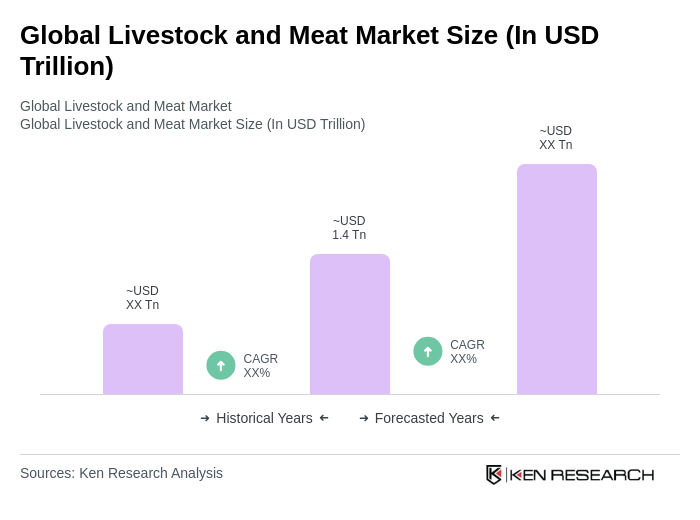
Global Livestock and Meat Market, valued at USD 1.4 trillion, is driven by increasing meat consumption and protein demand, with key players in US, Brazil, and China leading production.

Region:Global

Author(s):Rebecca

Product Code:KRAA2101

Pages:90

Published On:August 2025
About the Report

Base Year 2024

Global Livestock and Meat Market Overview

  • The Global Livestock and Meat Market is valued at approximately USD 1.4 trillion, based on a five-year historical analysis. This growth is primarily driven by increasing global population, rapid urbanization, rising disposable incomes, and evolving dietary preferences toward protein-rich foods. The demand for meat products continues to surge, particularly in developing regions, where meat consumption is becoming a dietary staple. Additionally, growing consumer interest in processed and convenient meat products, as well as heightened health and nutrition awareness, are further accelerating market expansion .
  • Countries such as the United States, Brazil, and China dominate the Global Livestock and Meat Market due to their large-scale production capabilities, advanced agricultural technologies, and significant domestic consumption. The United States is a leader in beef production, Brazil excels in poultry and pork, and China remains the largest consumer of pork globally, driving their respective market shares. These countries also play a pivotal role in global meat exports and imports, influencing international trade flows and market dynamics .
  • In 2023, the European Union adopted Regulation (EU) 2023/1230 of the European Parliament and of the Council, which introduced stricter requirements for livestock farming practices to enhance animal welfare and reduce environmental impact. This regulation mandates all livestock farms to comply with specific welfare standards, including minimum space allowances, access to outdoor areas, and regular welfare monitoring, aiming to improve meat product quality and promote sustainable farming practices .
Global Livestock and Meat Market Size

Global Livestock and Meat Market Segmentation

By Livestock Activity:This segmentation includes various activities related to livestock, such as the trade of live animals, the production of edible meat, meat byproducts, and livestock products. The market is influenced by consumer preferences, health trends, and the demand for organic and sustainably sourced products .
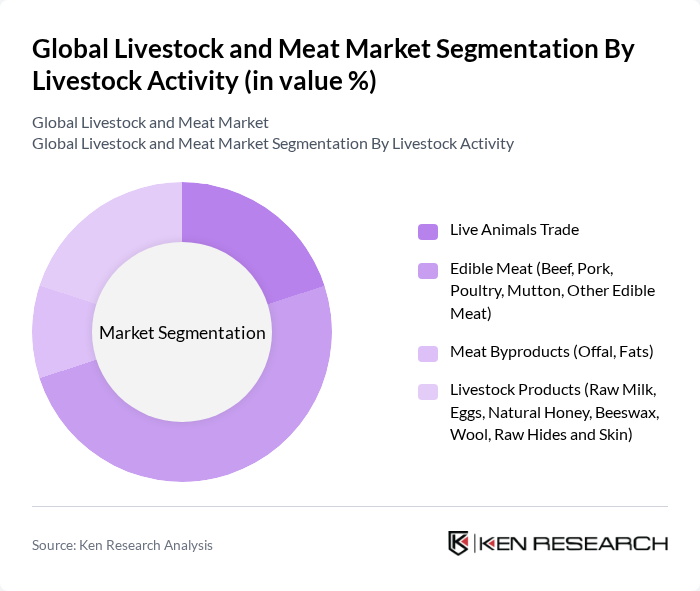
Global Livestock and Meat Market segmentation by Livestock Activity.

By Meat Type:This segmentation categorizes the market based on different types of meat, including beef, pork, poultry, mutton/lamb, goat, and others. Consumer preferences, health considerations, and cultural factors significantly influence the demand for each type of meat. Poultry continues to lead global consumption due to affordability and versatility, while beef and pork maintain strong positions in key markets .
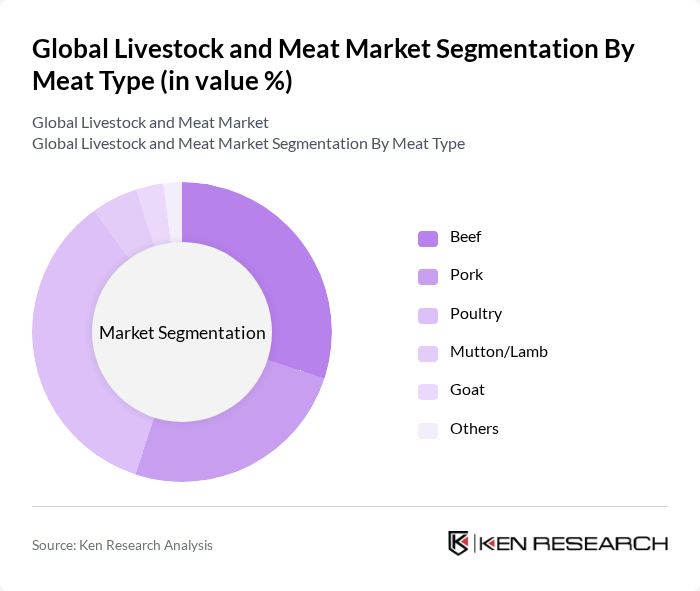
Global Livestock and Meat Market segmentation by Meat Type.

Global Livestock and Meat Market Competitive Landscape

The Global Livestock and Meat Market is characterized by a dynamic mix of regional and international players. Leading participants such as JBS S.A., Tyson Foods, Inc., Cargill, Inc., BRF S.A., Smithfield Foods, Inc., Hormel Foods Corporation, Pilgrim's Pride Corporation, Marfrig Global Foods S.A., Danish Crown A.M.B.A., NH Foods Ltd., Perdue Farms, Inc., Seaboard Foods LLC, Vion Food Group, Tönnies Group, and Olam International Limited contribute to innovation, geographic expansion, and service delivery in this space.

JBS S.A.

1953

São Paulo, Brazil

Tyson Foods, Inc.

1935

Springdale, Arkansas, USA

Cargill, Inc.

1865

Wayzata, Minnesota, USA

BRF S.A.

1934

São Paulo, Brazil

Smithfield Foods, Inc.

1936

Smithfield, Virginia, USA

Company

Establishment Year

Headquarters

Group Size (Large, Medium, or Small as per industry convention)

Revenue (USD, annual)

Revenue Growth Rate (%)

Market Share (%)

Production Volume (metric tons/year)

Geographic Presence (number of countries/regions)

Global Livestock and Meat Market Industry Analysis

Growth Drivers

  • Increasing Global Meat Consumption:The global meat consumption reached approximately 360 million metric tons in future, with projections indicating a rise to 350 million metric tons by future. This growth is driven by population increases, particularly in developing regions, where meat consumption per capita is expected to rise from 34 kg to 36 kg. The demand for meat is further fueled by urbanization and changing dietary preferences, particularly in Asia and Africa, where meat is increasingly viewed as a staple.
  • Rising Demand for Protein Sources:The global protein market is projected to grow significantly, with meat accounting for a substantial share. In future, the demand for protein sources surged, with meat contributing to over 50% of total protein consumption. By future, the protein market is expected to reach $1.2 trillion, driven by health trends emphasizing protein-rich diets. This trend is particularly pronounced in regions like North America and Europe, where consumers are increasingly prioritizing high-protein foods.
  • Technological Advancements in Livestock Farming:The livestock sector is experiencing rapid technological advancements, with investments in precision farming technologies expected to exceed $10 billion in future. Innovations such as genetic engineering, automated feeding systems, and data analytics are enhancing productivity and efficiency. For instance, the adoption of precision livestock farming can increase feed efficiency by up to 20%, significantly reducing costs and improving sustainability, thus driving market growth in the livestock sector.

Market Challenges

  • Animal Disease Outbreaks:The livestock industry faces significant challenges from animal disease outbreaks, which can lead to substantial economic losses. For example, the recent outbreak of African Swine Fever resulted in a loss of approximately 30 million pigs globally, impacting supply chains and driving prices up by 15%. Such outbreaks not only threaten food security but also lead to increased regulatory scrutiny and consumer concerns regarding food safety.
  • Regulatory Compliance Costs:Compliance with stringent regulations is a growing challenge for the livestock sector. In future, it is estimated that compliance costs will account for nearly 10% of total operational expenses for livestock producers. These costs arise from adhering to food safety standards, animal welfare regulations, and environmental protection laws. As regulations become more stringent, particularly in developed markets, producers face increased financial burdens that can hinder profitability and market entry.

Global Livestock and Meat Market Future Outlook

The future of the livestock and meat market is poised for transformation, driven by sustainability initiatives and technological innovations. As consumer preferences shift towards ethically sourced and environmentally friendly products, the demand for organic and plant-based alternatives is expected to rise. Additionally, advancements in meat processing technologies will enhance product quality and safety. The expansion into emerging markets will further provide growth opportunities, as these regions increasingly adopt meat consumption patterns similar to developed nations, creating a dynamic market landscape.

Market Opportunities

  • Growth in Organic Meat Products:The organic meat segment is projected to grow significantly, with sales expected to reach $20 billion by future. This growth is driven by increasing consumer awareness of health and sustainability, leading to a shift towards organic and grass-fed meat options. Retailers are expanding their organic offerings, catering to the rising demand for clean-label products that align with consumer values.
  • Innovations in Meat Processing Technologies:The meat processing industry is witnessing innovations that enhance efficiency and product quality. Investments in automation and smart processing technologies are expected to exceed $5 billion in future. These advancements not only improve operational efficiency but also address consumer demands for transparency and traceability, positioning companies to capitalize on evolving market trends and consumer preferences.

Scope of the Report

SegmentSub-Segments
By Livestock Activity

Live Animals Trade

Edible Meat (Beef, Pork, Poultry, Mutton, Other Edible Meat)

Meat Byproducts (Offal, Fats)

Livestock Products (Raw Milk, Eggs, Natural Honey, Beeswax, Wool, Raw Hides and Skin)

By Meat Type

Beef

Pork

Poultry

Mutton/Lamb

Goat

Others

By Product Form

Fresh Meat

Frozen Meat

Processed Meat

Canned Meat

Others

By Distribution Channel

Supermarkets/Hypermarkets

Butcher Shops

Online Retail

Food Service/Restaurants

Direct Sales

Others

By End-User

Retail Consumers

Food Service Industry

Food Processing Companies

Export Markets

Others

By Region

North America (United States, Canada, Mexico, Rest of North America)

Europe (Germany, United Kingdom, France, Spain, Russia, Italy, Rest of Europe)

Asia-Pacific (China, India, Australia, Japan, Rest of Asia-Pacific)

South America (Brazil, Argentina, Rest of South America)

Middle East & Africa (Saudi Arabia, South Africa, Rest of Middle East & Africa)

By Price Range

Economy

Mid-Range

Premium

Others

Key Target Audience

Investors and Venture Capitalist Firms

Government and Regulatory Bodies (e.g., Food and Agriculture Organization, U.S. Department of Agriculture)

Livestock Producers and Farmers

Meat Processing Companies

Export and Import Agencies

Animal Health and Nutrition Companies

Retail Chains and Supermarkets

Food Safety and Quality Assurance Organizations

Players Mentioned in the Report:

JBS S.A.

Tyson Foods, Inc.

Cargill, Inc.

BRF S.A.

Smithfield Foods, Inc.

Hormel Foods Corporation

Pilgrim's Pride Corporation

Marfrig Global Foods S.A.

Danish Crown A.M.B.A.

NH Foods Ltd.

Perdue Farms, Inc.

Seaboard Foods LLC

Vion Food Group

Tonnies Group

Olam International Limited

Table of Contents

Market Assessment Phase

1. Executive Summary and Approach


2. Global Livestock and Meat Market Overview

2.1 Key Insights and Strategic Recommendations

2.2 Global Livestock and Meat Market Overview

2.3 Definition and Scope

2.4 Evolution of Market Ecosystem

2.5 Timeline of Key Regulatory Milestones

2.6 Value Chain & Stakeholder Mapping

2.7 Business Cycle Analysis

2.8 Policy & Incentive Landscape


3. Global Livestock and Meat Market Analysis

3.1 Growth Drivers

3.1.1 Increasing Global Meat Consumption
3.1.2 Rising Demand for Protein Sources
3.1.3 Technological Advancements in Livestock Farming
3.1.4 Expansion of Export Markets

3.2 Market Challenges

3.2.1 Animal Disease Outbreaks
3.2.2 Regulatory Compliance Costs
3.2.3 Environmental Concerns and Sustainability Issues
3.2.4 Fluctuating Feed Prices

3.3 Market Opportunities

3.3.1 Growth in Organic Meat Products
3.3.2 Innovations in Meat Processing Technologies
3.3.3 Increasing Demand for Plant-Based Alternatives
3.3.4 Expansion into Emerging Markets

3.4 Market Trends

3.4.1 Shift Towards Sustainable Farming Practices
3.4.2 Rise of E-commerce in Meat Sales
3.4.3 Increasing Consumer Awareness of Animal Welfare
3.4.4 Growth of Traceability and Transparency in Supply Chains

3.5 Government Regulation

3.5.1 Food Safety Standards
3.5.2 Animal Welfare Regulations
3.5.3 Environmental Protection Laws
3.5.4 Trade Tariffs and Import Regulations

4. SWOT Analysis


5. Stakeholder Analysis


6. Porter's Five Forces Analysis


7. Global Livestock and Meat Market Market Size, 2019-2024

7.1 By Value

7.2 By Volume

7.3 By Average Selling Price


8. Global Livestock and Meat Market Segmentation

8.1 By Livestock Activity

8.1.1 Live Animals Trade
8.1.2 Edible Meat (Beef, Pork, Poultry, Mutton, Other Edible Meat)
8.1.3 Meat Byproducts (Offal, Fats)
8.1.4 Livestock Products (Raw Milk, Eggs, Natural Honey, Beeswax, Wool, Raw Hides and Skin)

8.2 By Meat Type

8.2.1 Beef
8.2.2 Pork
8.2.3 Poultry
8.2.4 Mutton/Lamb
8.2.5 Goat
8.2.6 Others

8.3 By Product Form

8.3.1 Fresh Meat
8.3.2 Frozen Meat
8.3.3 Processed Meat
8.3.4 Canned Meat
8.3.5 Others

8.4 By Distribution Channel

8.4.1 Supermarkets/Hypermarkets
8.4.2 Butcher Shops
8.4.3 Online Retail
8.4.4 Food Service/Restaurants
8.4.5 Direct Sales
8.4.6 Others

8.5 By End-User

8.5.1 Retail Consumers
8.5.2 Food Service Industry
8.5.3 Food Processing Companies
8.5.4 Export Markets
8.5.5 Others

8.6 By Region

8.6.1 North America (United States, Canada, Mexico, Rest of North America)
8.6.2 Europe (Germany, United Kingdom, France, Spain, Russia, Italy, Rest of Europe)
8.6.3 Asia-Pacific (China, India, Australia, Japan, Rest of Asia-Pacific)
8.6.4 South America (Brazil, Argentina, Rest of South America)
8.6.5 Middle East & Africa (Saudi Arabia, South Africa, Rest of Middle East & Africa)

8.7 By Price Range

8.7.1 Economy
8.7.2 Mid-Range
8.7.3 Premium
8.7.4 Others

9. Global Livestock and Meat Market Competitive Analysis

9.1 Market Share of Key Players

9.2 KPIs for Cross Comparison of Key Players

9.2.1 Company Name
9.2.2 Group Size (Large, Medium, or Small as per industry convention)
9.2.3 Revenue (USD, annual)
9.2.4 Revenue Growth Rate (%)
9.2.5 Market Share (%)
9.2.6 Production Volume (metric tons/year)
9.2.7 Geographic Presence (number of countries/regions)
9.2.8 Product Portfolio Breadth (number of product categories)
9.2.9 EBITDA Margin (%)
9.2.10 R&D Investment (% of revenue)
9.2.11 Sustainability Initiatives (qualitative/quantitative)
9.2.12 Supply Chain Efficiency (lead time, logistics KPIs)
9.2.13 Customer Segments Served
9.2.14 Certifications & Compliance (e.g., ISO, HACCP, animal welfare)

9.3 SWOT Analysis of Top Players

9.4 Pricing Analysis

9.5 Detailed Profile of Major Companies

9.5.1 JBS S.A.
9.5.2 Tyson Foods, Inc.
9.5.3 Cargill, Inc.
9.5.4 BRF S.A.
9.5.5 Smithfield Foods, Inc.
9.5.6 Hormel Foods Corporation
9.5.7 Pilgrim's Pride Corporation
9.5.8 Marfrig Global Foods S.A.
9.5.9 Danish Crown A.M.B.A.
9.5.10 NH Foods Ltd.
9.5.11 Perdue Farms, Inc.
9.5.12 Seaboard Foods LLC
9.5.13 Vion Food Group
9.5.14 Tönnies Group
9.5.15 Olam International Limited

10. Global Livestock and Meat Market End-User Analysis

10.1 Procurement Behavior of Key Ministries

10.1.1 Government Procurement Policies
10.1.2 Budget Allocations for Livestock
10.1.3 Supplier Selection Criteria
10.1.4 Contract Management Practices

10.2 Corporate Spend on Infrastructure & Energy

10.2.1 Investment in Livestock Facilities
10.2.2 Energy Consumption Patterns
10.2.3 Infrastructure Development Needs

10.3 Pain Point Analysis by End-User Category

10.3.1 Supply Chain Disruptions
10.3.2 Quality Assurance Challenges
10.3.3 Cost Management Issues

10.4 User Readiness for Adoption

10.4.1 Technology Adoption Rates
10.4.2 Training and Skill Development Needs

10.5 Post-Deployment ROI and Use Case Expansion

10.5.1 Measurement of ROI Metrics
10.5.2 Expansion Opportunities Post-Implementation

11. Global Livestock and Meat Market Future Size, 2025-2030

11.1 By Value

11.2 By Volume

11.3 By Average Selling Price


Go-To-Market Strategy Phase

1. Whitespace Analysis + Business Model Canvas

1.1 Market Gaps Identification

1.2 Value Proposition Development

1.3 Revenue Streams Analysis

1.4 Customer Segmentation

1.5 Key Partnerships

1.6 Cost Structure Analysis

1.7 Channels of Distribution


2. Marketing and Positioning Recommendations

2.1 Branding Strategies

2.2 Product USPs

2.3 Target Market Identification

2.4 Communication Strategies

2.5 Digital Marketing Approaches


3. Distribution Plan

3.1 Urban Retail Strategies

3.2 Rural NGO Tie-ups

3.3 Direct-to-Consumer Models

3.4 E-commerce Integration


4. Channel & Pricing Gaps

4.1 Underserved Routes

4.2 Pricing Bands Analysis

4.3 Competitor Pricing Strategies


5. Unmet Demand & Latent Needs

5.1 Category Gaps

5.2 Consumer Segments Analysis

5.3 Emerging Trends Identification


6. Customer Relationship

6.1 Loyalty Programs

6.2 After-sales Service

6.3 Customer Feedback Mechanisms


7. Value Proposition

7.1 Sustainability Initiatives

7.2 Integrated Supply Chains

7.3 Competitive Advantages


8. Key Activities

8.1 Regulatory Compliance

8.2 Branding Efforts

8.3 Distribution Setup


9. Entry Strategy Evaluation

9.1 Domestic Market Entry Strategy

9.1.1 Product Mix Considerations
9.1.2 Pricing Band Strategies
9.1.3 Packaging Innovations

9.2 Export Entry Strategy

9.2.1 Target Countries Identification
9.2.2 Compliance Roadmap Development

10. Entry Mode Assessment

10.1 Joint Ventures

10.2 Greenfield Investments

10.3 Mergers & Acquisitions

10.4 Distributor Models


11. Capital and Timeline Estimation

11.1 Capital Requirements

11.2 Timelines for Implementation


12. Control vs Risk Trade-Off

12.1 Ownership vs Partnerships


13. Profitability Outlook

13.1 Breakeven Analysis

13.2 Long-term Sustainability Strategies


14. Potential Partner List

14.1 Distributors

14.2 Joint Ventures

14.3 Acquisition Targets


15. Execution Roadmap

15.1 Phased Plan for Market Entry

15.1.1 Market Setup
15.1.2 Market Entry
15.1.3 Growth Acceleration
15.1.4 Scale & Stabilize

15.2 Key Activities and Milestones

15.2.1 Milestone Planning
15.2.2 Activity Tracking

Research Methodology

ApproachModellingSample

Phase 1: Approach1

Desk Research

  • Analysis of global livestock production statistics from FAO and USDA reports
  • Review of market trends and forecasts from industry publications and trade associations
  • Examination of regulatory frameworks impacting livestock and meat production across key regions

Primary Research

  • Interviews with livestock producers and meat processors to gather insights on operational challenges
  • Surveys with industry experts and market analysts to understand market dynamics and consumer preferences
  • Field visits to farms and processing plants to observe practices and gather qualitative data

Validation & Triangulation

  • Cross-validation of data through multiple sources including government reports and industry surveys
  • Triangulation of findings from primary interviews with secondary data trends
  • Sanity checks conducted through expert panel reviews to ensure data reliability

Phase 2: Market Size Estimation1

Top-down Assessment

  • Estimation of market size based on global meat consumption trends and livestock population data
  • Segmentation of the market by type of meat (beef, pork, poultry) and geographical region
  • Incorporation of macroeconomic factors such as GDP growth and population dynamics

Bottom-up Modeling

  • Collection of production and sales data from leading livestock and meat companies
  • Estimation of average prices per kilogram for different types of meat across regions
  • Volume x price calculations to derive total market value for each segment

Forecasting & Scenario Analysis

  • Multi-factor regression analysis incorporating variables such as dietary trends and health concerns
  • Scenario modeling based on potential impacts of climate change and sustainability initiatives
  • Development of baseline, optimistic, and pessimistic forecasts through 2030

Phase 3: CATI Sample Composition1

Scope Item/SegmentSample SizeTarget Respondent Profiles
Beef Production Insights60Cattle Farmers, Meat Processors
Poultry Market Dynamics50Poultry Farmers, Supply Chain Managers
Pork Industry Trends45Swine Producers, Retail Meat Buyers
Meat Export and Import Analysis55Export Managers, Trade Analysts
Consumer Preferences in Meat Consumption70Food Industry Analysts, Nutritionists

Frequently Asked Questions

What is the current value of the Global Livestock and Meat Market?

The Global Livestock and Meat Market is valued at approximately USD 1.4 trillion, driven by factors such as increasing global population, urbanization, rising disposable incomes, and evolving dietary preferences towards protein-rich foods.

Which countries are the largest producers in the Global Livestock and Meat Market?

What are the main drivers of growth in the livestock and meat market?

What challenges does the livestock industry face?

Other Regional/Country Reports

UAE Livestock and Meat MarketKSA Livestock and Meat Market

Indonesia Livestock and Meat Market

Malaysia Livestock and Meat Market

APAC Livestock and Meat Market

SEA Livestock and Meat Market

Why Buy From Us?

Refine Robust Result (RRR) Framework

What makes us stand out is that our consultants follow Robust, Refine and Result (RRR) methodology. Robust for clear definitions, approaches and sanity checking, Refine for differentiating respondents' facts and opinions, and Result for presenting data with story.

Our Reach Is Unmatched

We have set a benchmark in the industry by offering our clients with syndicated and customized market research reports featuring coverage of entire market as well as meticulous research and analyst insights.

Shifting the Research Paradigm

While we don't replace traditional research, we flip the method upside down. Our dual approach of Top Bottom & Bottom Top ensures quality deliverable by not just verifying company fundamentals but also looking at the sector and macroeconomic factors.

More Insights-Better Decisions

With one step in the future, our research team constantly tries to show you the bigger picture. We help with some of the tough questions you may encounter along the way: How is the industry positioned? Best marketing channel? KPI's of competitors? By aligning every element, we help maximize success.

Transparency and Trust

Our report gives you instant access to the answers and sources that other companies might choose to hide. We elaborate each steps of research methodology we have used and showcase you the sample size to earn your trust.

Round the Clock Support

If you need any support, we are here! We pride ourselves on universe strength, data quality, and quick, friendly, and professional service.

Why Clients Choose Us?

400000+
Reports in repository
150+
Consulting projects a year
100+
Analysts
8000+
Client Queries in 2022








