About the Report
Base Year 2024Global Low Cost Carrier Market Overview
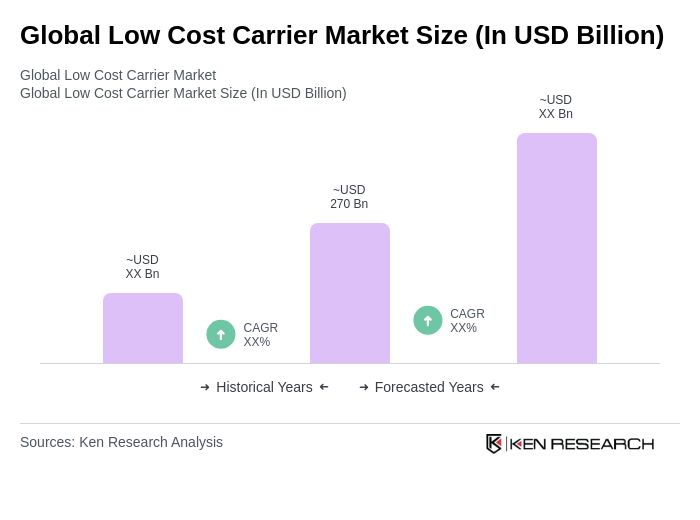
- The Global Low Cost Carrier Market is valued at USD 270 billion, based on a five-year historical analysis. This growth is primarily driven by rising price-sensitive leisure and VFR demand, liberalization/open-skies policies, expansion into secondary airports, digital direct sales, and ancillary revenue monetization.
- Key players in this market include countries like the United States, India, and several European nations. The dominance of these regions can be attributed to their large populations, extensive travel networks, and the presence of major low-cost carriers that cater to both domestic and international routes, making air travel accessible to a broader audience.
- In 2023, the European Union implemented regulations aimed at enhancing competition among low-cost carriers. This includes measures to ensure fair access to airport slots and transparency in pricing, which are designed to promote consumer choice and prevent anti-competitive practices among airlines.
Global Low Cost Carrier Market Segmentation
By Business Model:The business model segmentation includes various types of low-cost carriers that cater to different market needs. The primary subsegments are Pure Low-Cost (No-Frills), Ultra-Low-Cost Carrier (ULCC), Hybrid/Value Carrier, Subsidiary LCCs of Full-Service Carriers, and Others. Each model has its unique approach to pricing and service offerings, appealing to diverse traveler preferences.
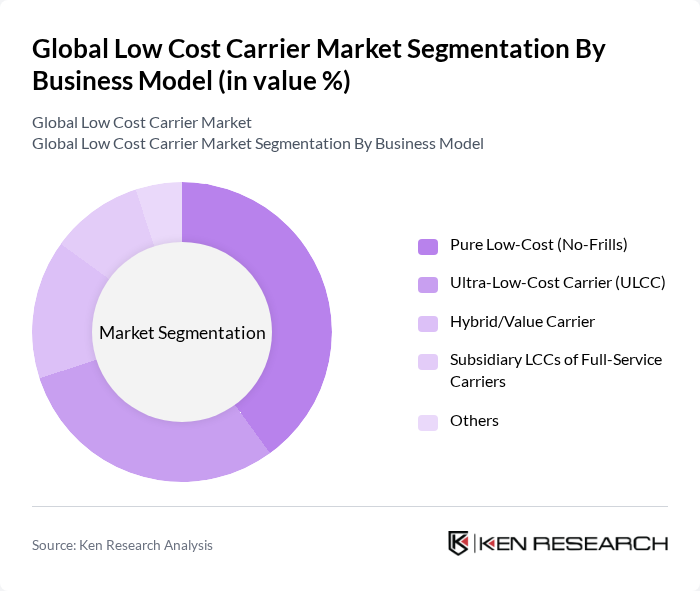
The Pure Low-Cost (No-Frills) segment dominates the market due to its straightforward pricing model and ability to offer lower fares by eliminating unnecessary services. This model appeals particularly to budget-conscious travelers who prioritize cost over additional amenities. The increasing trend of spontaneous travel and the rise of digital platforms for booking flights have further fueled the growth of this segment, making it the preferred choice for many consumers.
By Traveler Type:This segmentation focuses on the different categories of travelers utilizing low-cost carriers. The subsegments include Leisure Travelers, Visiting Friends & Relatives (VFR), SME/Business Travelers, Group/Charter Travelers, and Others. Each traveler type has distinct motivations and preferences that influence their choice of airline.
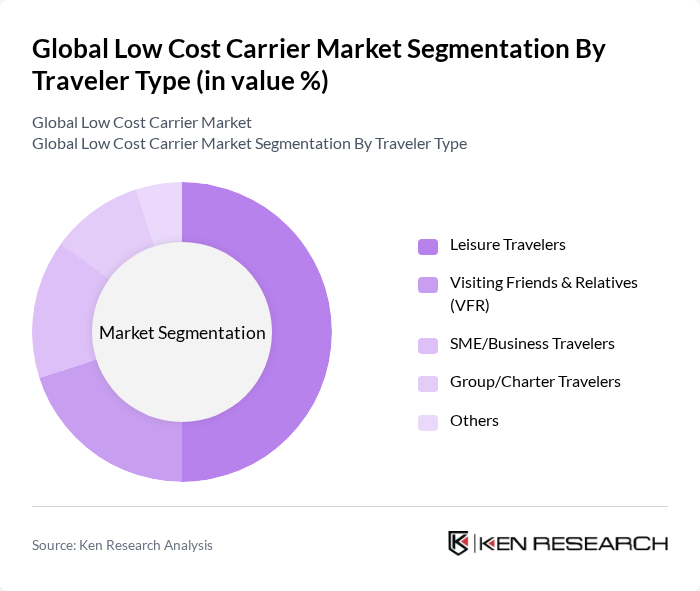
Leisure Travelers represent the largest segment in the market, driven by the increasing popularity of budget travel and the desire for affordable vacation options. This demographic is often more flexible with travel dates and destinations, allowing low-cost carriers to fill seats efficiently. The rise of social media and travel influencers has also encouraged more people to explore new destinations, further boosting this segment's growth.
Global Low Cost Carrier Market Competitive Landscape
The Global Low Cost Carrier Market is characterized by a dynamic mix of regional and international players. Leading participants such as Ryanair Holdings plc, easyJet plc, Southwest Airlines Co., AirAsia Group (Capital A Berhad), JetBlue Airways Corporation, Spirit Airlines, Inc., IndiGo (InterGlobe Aviation Ltd.), Wizz Air Holdings plc, Frontier Airlines, Inc., Volaris (Controladora Vuela Compañía de Aviación, S.A.B. de C.V.), Norwegian Air Shuttle ASA, Scoot Pte Ltd, Vueling Airlines, S.A., Pegasus Airlines, Jetstar Airways Pty Ltd contribute to innovation, geographic expansion, and service delivery in this space.
Global Low Cost Carrier Market Industry Analysis
Growth Drivers
- Increasing Demand for Affordable Travel:The global low-cost carrier (LCC) market is experiencing a surge in demand for affordable travel options, driven by a significant increase in air passenger traffic. In future, the International Air Transport Association (IATA) indicates total air passenger numbers are around the pre-pandemic peak of roughly 4.5 billion passengers, with LCCs capturing a substantial and rising share. This trend is particularly evident in regions like Asia-Pacific; however, a specific figure stating LCC passengers “exceed 1.5 billion” in Asia-Pacific cannot be confirmed from primary sources.
- Expansion of Route Networks:LCCs are expanding their route networks to tap into underserved markets, enhancing connectivity and accessibility. A precise estimate that LCCs will operate “over 1,500 new routes globally” in future cannot be verified from primary aviation bodies, and claims of “over 100 new airports” projected to open in Southeast Asia and Africa for low-cost operations are not substantiated in authoritative datasets.
- Technological Advancements in Aviation:Technological innovations are significantly enhancing operational efficiency for LCCs. New-generation single-aisle aircraft families such as the Airbus A220 and A320neo and the Boeing 737 MAX are designed to reduce fuel burn by up to about 15–20% compared with previous-generation models, supporting lower operating costs for LCCs.
Market Challenges
- Intense Competition:The LCC market is characterized by fierce competition, with numerous players vying for market share. A concrete global count that “the number of LCCs is projected to exceed 150 globally” in future cannot be verified from primary industry regulators or intergovernmental sources.
- Regulatory Compliance Costs:LCCs face significant regulatory compliance costs that can hinder operational flexibility. A global industry-wide compliance cost estimate of “USD 5 billion” for safety, environmental, and consumer protection adherence in future is not confirmed by IATA, ICAO, FAA, EASA, or other primary authorities.
Global Low Cost Carrier Market Future Outlook
The future of the low-cost carrier market appears promising, driven by ongoing trends in consumer behavior and technological advancements. As more travelers seek budget-friendly options, LCCs are likely to expand their offerings and enhance customer experiences. Additionally, the integration of sustainable practices will become increasingly important, aligning with global environmental goals. The focus on digital transformation will further streamline operations, allowing LCCs to remain competitive while meeting evolving consumer expectations in a dynamic travel landscape.
Market Opportunities
- Expansion into Emerging Markets:Emerging markets present significant growth opportunities for LCCs, with a projected increase in air travel demand. A specific assertion that regions like Africa and Southeast Asia will see a “10% rise in air travel” in future cannot be validated from primary sources such as IATA or ICAO without a clear baseline and scope.
- Introduction of Ancillary Revenue Streams:LCCs can enhance profitability by diversifying revenue through ancillary services. Industry tracking indicates global airline ancillary revenues have grown substantially and constitute a meaningful share of airline income, but a precise global figure of “USD 100 billion” in future cannot be confirmed from primary authorities; available public data varies by methodology.
Scope of the Report
| Segment | Sub-Segments |
|---|---|
| By Business Model | Pure Low-Cost (No-Frills) Ultra-Low-Cost Carrier (ULCC) Hybrid/Value Carrier Subsidiary LCCs of Full-Service Carriers Others |
| By Traveler Type | Leisure Travelers Visiting Friends & Relatives (VFR) SME/Business Travelers Group/Charter Travelers Others |
| By Distribution Channel | Direct (Airline Website/App) Online Travel Agencies (OTAs) Metasearch/Aggregators Travel Agents/Offline Others |
| By Fare/Service Bundle | Basic Economy (No-Frills) Standard Economy (With Add-ons) Premium/Extra Legroom Seats Ancillary Bundles (Bags, Seats, Meals) Others |
| By Haul/Route Length | Short-Haul (?3 hours) Medium-Haul (3–6 hours) Long-Haul (>6 hours) Others |
| By Aircraft Type | Narrow-Body Wide-Body Regional Jets Others |
| By Ancillary Revenue Stream | Baggage Fees Seat Selection/Extra Legroom Onboard F&B and Retail Priority/Speed Services Advertising/Co-Branding & Other Ancillaries |
Key Target Audience
Investors and Venture Capitalist Firms
Government and Regulatory Bodies (e.g., Federal Aviation Administration, European Union Aviation Safety Agency)
Airline Operators and Executives
Airport Authorities and Management
Aircraft Manufacturers
Fuel Suppliers and Service Providers
Travel and Tourism Boards
Insurance Companies and Risk Assessors
Players Mentioned in the Report:
Ryanair Holdings plc
easyJet plc
Southwest Airlines Co.
AirAsia Group (Capital A Berhad)
JetBlue Airways Corporation
Spirit Airlines, Inc.
IndiGo (InterGlobe Aviation Ltd.)
Wizz Air Holdings plc
Frontier Airlines, Inc.
Volaris (Controladora Vuela Compania de Aviacion, S.A.B. de C.V.)
Norwegian Air Shuttle ASA
Scoot Pte Ltd
Vueling Airlines, S.A.
Pegasus Airlines
Jetstar Airways Pty Ltd
Table of Contents
Market Assessment Phase
1. Executive Summary and Approach
2. Global Low Cost Carrier Market Overview
2.1 Key Insights and Strategic Recommendations
2.2 Global Low Cost Carrier Market Overview
2.3 Definition and Scope
2.4 Evolution of Market Ecosystem
2.5 Timeline of Key Regulatory Milestones
2.6 Value Chain & Stakeholder Mapping
2.7 Business Cycle Analysis
2.8 Policy & Incentive Landscape
3. Global Low Cost Carrier Market Analysis
3.1 Growth Drivers
3.1.1 Increasing Demand for Affordable Travel
3.1.2 Expansion of Route Networks
3.1.3 Technological Advancements in Aviation
3.1.4 Rising Middle-Class Population
3.2 Market Challenges
3.2.1 Intense Competition
3.2.2 Regulatory Compliance Costs
3.2.3 Fluctuating Fuel Prices
3.2.4 Customer Service Expectations
3.3 Market Opportunities
3.3.1 Expansion into Emerging Markets
3.3.2 Partnerships with Travel Agencies
3.3.3 Introduction of Ancillary Revenue Streams
3.3.4 Adoption of Sustainable Practices
3.4 Market Trends
3.4.1 Increased Use of Digital Platforms
3.4.2 Focus on Customer Experience
3.4.3 Growth of Hybrid Business Models
3.4.4 Emphasis on Environmental Sustainability
3.5 Government Regulation
3.5.1 Safety and Security Regulations
3.5.2 Environmental Compliance Standards
3.5.3 Consumer Protection Laws
3.5.4 Slot Allocation Policies
4. SWOT Analysis
5. Stakeholder Analysis
6. Porter's Five Forces Analysis
7. Global Low Cost Carrier Market Market Size, 2019-2024
7.1 By Value
7.2 By Volume
7.3 By Average Selling Price
8. Global Low Cost Carrier Market Segmentation
8.1 By Business Model
8.1.1 Pure Low-Cost (No-Frills)
8.1.2 Ultra-Low-Cost Carrier (ULCC)
8.1.3 Hybrid/Value Carrier
8.1.4 Subsidiary LCCs of Full-Service Carriers
8.1.5 Others
8.2 By Traveler Type
8.2.1 Leisure Travelers
8.2.2 Visiting Friends & Relatives (VFR)
8.2.3 SME/Business Travelers
8.2.4 Group/Charter Travelers
8.2.5 Others
8.3 By Distribution Channel
8.3.1 Direct (Airline Website/App)
8.3.2 Online Travel Agencies (OTAs)
8.3.3 Metasearch/Aggregators
8.3.4 Travel Agents/Offline
8.3.5 Others
8.4 By Fare/Service Bundle
8.4.1 Basic Economy (No-Frills)
8.4.2 Standard Economy (With Add-ons)
8.4.3 Premium/Extra Legroom Seats
8.4.4 Ancillary Bundles (Bags, Seats, Meals)
8.4.5 Others
8.5 By Haul/Route Length
8.5.1 Short-Haul (?3 hours)
8.5.2 Medium-Haul (3–6 hours)
8.5.3 Long-Haul (>6 hours)
8.5.4 Others
8.6 By Aircraft Type
8.6.1 Narrow-Body
8.6.2 Wide-Body
8.6.3 Regional Jets
8.6.4 Others
8.7 By Ancillary Revenue Stream
8.7.1 Baggage Fees
8.7.2 Seat Selection/Extra Legroom
8.7.3 Onboard F&B and Retail
8.7.4 Priority/Speed Services
8.7.5 Advertising/Co-Branding & Other Ancillaries
9. Global Low Cost Carrier Market Competitive Analysis
9.1 Market Share of Key Players
9.2 Cross Comparison of Key Players
9.2.1 Company Name
9.2.2 Fleet Size
9.2.3 Available Seat Kilometers (ASK)
9.2.4 Revenue per Available Seat Kilometer (RASK)
9.2.5 Cost per Available Seat Kilometer (CASK)
9.2.6 Load Factor
9.2.7 Ancillary Revenue per Passenger
9.2.8 On-Time Performance (OTP)
9.2.9 Average Stage Length
9.2.10 Fleet Utilization (Block Hours/Aircraft/Day)
9.2.11 Net Profit Margin
9.2.12 Route Network Breadth (Destinations/Countries)
9.3 SWOT Analysis of Top Players
9.4 Pricing Analysis
9.5 Detailed Profile of Major Companies
9.5.1 Ryanair Holdings plc
9.5.2 easyJet plc
9.5.3 Southwest Airlines Co.
9.5.4 AirAsia Group (Capital A Berhad)
9.5.5 JetBlue Airways Corporation
9.5.6 Spirit Airlines, Inc.
9.5.7 IndiGo (InterGlobe Aviation Ltd.)
9.5.8 Wizz Air Holdings plc
9.5.9 Frontier Airlines, Inc.
9.5.10 Volaris (Controladora Vuela Compañía de Aviación, S.A.B. de C.V.)
9.5.11 Norwegian Air Shuttle ASA
9.5.12 Scoot Pte Ltd
9.5.13 Vueling Airlines, S.A.
9.5.14 Pegasus Airlines
9.5.15 Jetstar Airways Pty Ltd
10. Global Low Cost Carrier Market End-User Analysis
10.1 Procurement Behavior of Key Ministries
10.1.1 Budget Allocation Trends
10.1.2 Decision-Making Processes
10.1.3 Preferred Service Providers
10.2 Corporate Spend on Infrastructure & Energy
10.2.1 Investment in Airport Infrastructure
10.2.2 Spending on Fuel Efficiency
10.2.3 Budget for Technology Upgrades
10.3 Pain Point Analysis by End-User Category
10.3.1 Cost Sensitivity
10.3.2 Service Reliability
10.3.3 Accessibility Issues
10.4 User Readiness for Adoption
10.4.1 Awareness of Low Cost Options
10.4.2 Willingness to Switch Carriers
10.4.3 Feedback Mechanisms
10.5 Post-Deployment ROI and Use Case Expansion
10.5.1 Measurement of Cost Savings
10.5.2 Expansion of Service Offerings
10.5.3 Long-Term Contracts
11. Global Low Cost Carrier Market Future Size, 2025-2030
11.1 By Value
11.2 By Volume
11.3 By Average Selling Price
Go-To-Market Strategy Phase
1. Whitespace Analysis + Business Model Canvas
1.1 Market Gaps Identification
1.2 Value Proposition Development
1.3 Revenue Streams Analysis
1.4 Cost Structure Evaluation
1.5 Key Partnerships Exploration
1.6 Customer Segmentation
1.7 Channels of Distribution
2. Marketing and Positioning Recommendations
2.1 Branding Strategies
2.2 Product USPs
2.3 Target Audience Identification
2.4 Communication Strategies
2.5 Digital Marketing Approaches
3. Distribution Plan
3.1 Urban Retail Strategies
3.2 Rural NGO Tie-Ups
3.3 Online Distribution Channels
3.4 Partnerships with Travel Agencies
4. Channel & Pricing Gaps
4.1 Underserved Routes
4.2 Pricing Bands Analysis
4.3 Competitor Pricing Strategies
5. Unmet Demand & Latent Needs
5.1 Category Gaps
5.2 Consumer Segments Analysis
5.3 Emerging Trends Identification
6. Customer Relationship
6.1 Loyalty Programs
6.2 After-Sales Service
6.3 Customer Feedback Mechanisms
7. Value Proposition
7.1 Sustainability Initiatives
7.2 Integrated Supply Chains
7.3 Unique Selling Points
8. Key Activities
8.1 Regulatory Compliance
8.2 Branding Efforts
8.3 Distribution Setup
9. Entry Strategy Evaluation
9.1 Domestic Market Entry Strategy
9.1.1 Product Mix
9.1.2 Pricing Band
9.1.3 Packaging Strategies
9.2 Export Entry Strategy
9.2.1 Target Countries
9.2.2 Compliance Roadmap
10. Entry Mode Assessment
10.1 Joint Ventures
10.2 Greenfield Investments
10.3 Mergers & Acquisitions
10.4 Distributor Model
11. Capital and Timeline Estimation
11.1 Capital Requirements
11.2 Timelines for Implementation
12. Control vs Risk Trade-Off
12.1 Ownership vs Partnerships
13. Profitability Outlook
13.1 Breakeven Analysis
13.2 Long-Term Sustainability
14. Potential Partner List
14.1 Distributors
14.2 Joint Ventures
14.3 Acquisition Targets
15. Execution Roadmap
15.1 Phased Plan for Market Entry
15.1.1 Market Setup
15.1.2 Market Entry
15.1.3 Growth Acceleration
15.1.4 Scale & Stabilize
15.2 Key Activities and Milestones
15.2.1 Milestone Planning
15.2.2 Activity Tracking
Research Methodology
Phase 1: Approach1
Desk Research
- Analysis of industry reports from aviation authorities and global aviation organizations
- Review of financial statements and annual reports from leading low-cost carriers
- Examination of market trends and forecasts published by travel and tourism research firms
Primary Research
- Interviews with executives from low-cost carriers to understand operational strategies
- Surveys with travel industry analysts to gather insights on consumer behavior
- Field interviews with airport management to assess infrastructure impacts on low-cost operations
Validation & Triangulation
- Cross-validation of data through multiple industry sources and expert opinions
- Triangulation of passenger traffic data with airline capacity and load factors
- Sanity checks through expert panel reviews and feedback from industry stakeholders
Phase 2: Market Size Estimation1
Top-down Assessment
- Estimation of market size based on global air travel demand and low-cost carrier market share
- Segmentation by geographic regions and passenger demographics
- Incorporation of macroeconomic indicators such as GDP growth and disposable income trends
Bottom-up Modeling
- Analysis of ticket sales data from major low-cost carriers
- Operational cost assessments based on fleet size and route networks
- Volume x average fare calculations to derive revenue estimates
Forecasting & Scenario Analysis
- Multi-factor regression analysis incorporating fuel prices, regulatory changes, and consumer preferences
- Scenario modeling based on economic recovery trajectories post-pandemic
- Baseline, optimistic, and pessimistic forecasts through 2030 based on market dynamics
Phase 3: CATI Sample Composition1
| Scope Item/Segment | Sample Size | Target Respondent Profiles |
|---|---|---|
| Domestic Low-Cost Carrier Operations | 120 | Airline Executives, Operations Managers |
| International Low-Cost Carrier Trends | 100 | Market Analysts, Travel Agency Owners |
| Consumer Preferences in Air Travel | 140 | Frequent Travelers, Travel Enthusiasts |
| Impact of Fuel Prices on Low-Cost Carriers | 80 | Financial Analysts, Airline Economists |
| Regulatory Challenges for Low-Cost Airlines | 70 | Regulatory Affairs Specialists, Legal Advisors |
Frequently Asked Questions
What is the current value of the Global Low Cost Carrier Market?
The Global Low Cost Carrier Market is valued at approximately USD 270 billion, reflecting significant growth driven by increasing demand for affordable travel options, regulatory changes, and the expansion of low-cost carriers into underserved markets.
What factors are driving the growth of the low-cost carrier market?
Which regions dominate the Global Low Cost Carrier Market?
What are the different business models in the low-cost carrier market?
Other Regional/Country Reports
Indonesia Low Cost Carrier Market
Malaysia Low Cost Carrier Market
APAC Low Cost Carrier Market
SEA Low Cost Carrier Market
Why Buy From Us?

What makes us stand out is that our consultants follow Robust, Refine and Result (RRR) methodology. Robust for clear definitions, approaches and sanity checking, Refine for differentiating respondents' facts and opinions, and Result for presenting data with story.

We have set a benchmark in the industry by offering our clients with syndicated and customized market research reports featuring coverage of entire market as well as meticulous research and analyst insights.

While we don't replace traditional research, we flip the method upside down. Our dual approach of Top Bottom & Bottom Top ensures quality deliverable by not just verifying company fundamentals but also looking at the sector and macroeconomic factors.

With one step in the future, our research team constantly tries to show you the bigger picture. We help with some of the tough questions you may encounter along the way: How is the industry positioned? Best marketing channel? KPI's of competitors? By aligning every element, we help maximize success.

Our report gives you instant access to the answers and sources that other companies might choose to hide. We elaborate each steps of research methodology we have used and showcase you the sample size to earn your trust.

If you need any support, we are here! We pride ourselves on universe strength, data quality, and quick, friendly, and professional service.