About the Report
Base Year 2024Global Lpg Tanker Market Overview
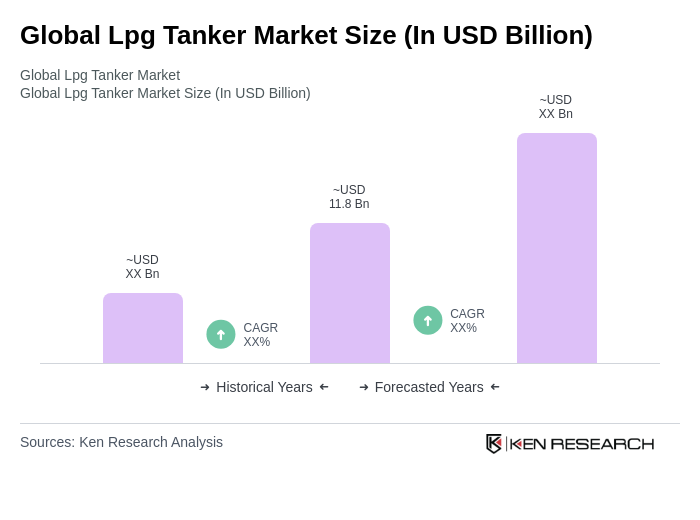
- The Global LPG Tanker Market is valued at USD 11.8 billion, based on a five-year historical analysis. This growth is primarily driven by the increasing demand for liquefied petroleum gas (LPG) in various sectors, including residential, commercial, and industrial applications. The rising adoption of LPG as a cleaner alternative to traditional fuels has significantly contributed to the market's expansion.
- Key players in this market include countries such as the United States, Saudi Arabia, and China, which dominate due to their substantial production capacities and strategic geographical locations. The U.S. is a leading exporter of LPG, while Saudi Arabia benefits from its vast oil reserves, and China has a growing domestic demand for LPG, making these regions pivotal in the global market.
- In 2023, the International Maritime Organization (IMO) implemented regulations aimed at reducing greenhouse gas emissions from shipping, which includes the LPG tanker sector. These regulations require vessels to comply with stricter emissions standards, promoting the use of cleaner fuels and technologies to enhance environmental sustainability in maritime operations.
Global Lpg Tanker Market Segmentation
By Type:The LPG tanker market is segmented into various types based on vessel size. Very Large Gas Carriers (VLGC) are the most prominent due to their ability to transport large volumes of LPG efficiently, catering to the high demand from major importing countries. Large Gas Carriers (LGC) and Medium Gas Carriers (MGC) also play significant roles, particularly in regional trade routes. Small Gas Carriers (SGC) are utilized for niche markets and smaller deliveries, but they represent a smaller share of the overall market.

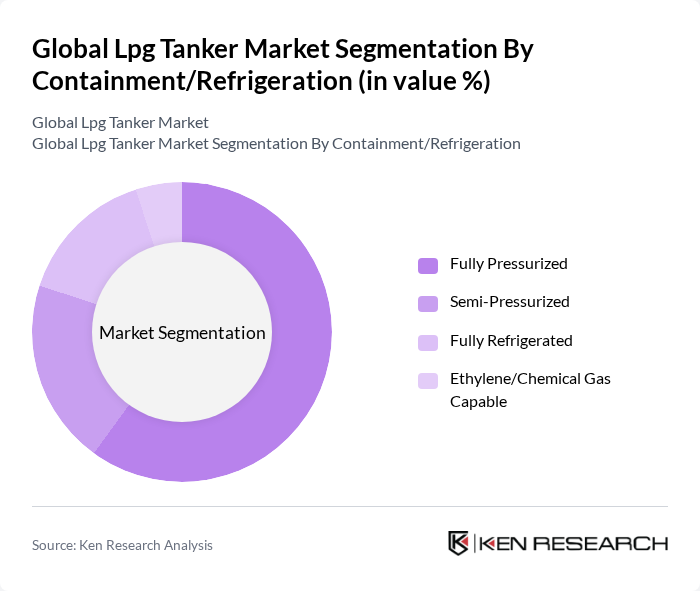
By Containment/Refrigeration:This segmentation includes various containment and refrigeration methods used in LPG tankers. Fully Pressurized vessels are widely used due to their cost-effectiveness and efficiency in transporting LPG. Semi-Pressurized vessels are also significant, offering flexibility in cargo handling. Fully Refrigerated vessels are utilized for specific cargo types requiring lower temperatures, while Ethylene/Chemical Gas Capable vessels cater to specialized markets, although they represent a smaller segment.
Global Lpg Tanker Market Competitive Landscape
The Global LPG Tanker Market is characterized by a dynamic mix of regional and international players. Leading participants such as BW LPG Limited, Dorian LPG Ltd., Avance Gas Holding Ltd, StealthGas Inc., EXMAR NV, Navigator Gas, Petredec Global, Epic Gas (a Lauritzen Kosan company), Kuwait Oil Tanker Company (KOTC), The Great Eastern Shipping Co. Ltd., Hyundai Heavy Industries Co., Ltd. (shipbuilder), Kawasaki Heavy Industries, Ltd. (shipbuilder), Mitsubishi Heavy Industries, Ltd. (shipbuilder), Naftomar Shipping and Trading Co. Ltd., SHV Energy (through Primagaz/Calor, chartering) contribute to innovation, geographic expansion, and service delivery in this space.
Global Lpg Tanker Market Industry Analysis
Growth Drivers
- Increasing Demand for LPG in Emerging Markets:The global demand for liquefied petroleum gas (LPG) is projected to reach 400 million tons in the future, driven primarily by emerging markets such as India and China. In India alone, LPG consumption is expected to grow by 6% annually, fueled by government initiatives promoting cleaner cooking fuels. This rising demand is creating a robust need for LPG transportation, thereby boosting the LPG tanker market significantly.
- Expansion of LPG Infrastructure:As of the future, investments in LPG infrastructure are estimated to exceed twenty-five billion dollars globally, with significant projects in Asia and Africa. Countries like Nigeria are expanding their LPG distribution networks, which is expected to increase the number of LPG terminals by 40% over the next five years. This infrastructure growth is essential for enhancing the efficiency of LPG transportation and distribution, thereby driving the tanker market.
- Environmental Regulations Favoring Cleaner Fuels:Stricter environmental regulations are pushing countries to transition to cleaner fuels, with LPG being a preferred alternative. The International Energy Agency (IEA) reported that global LPG consumption could reduce CO2 emissions by approximately 250 million tons annually in the future. This regulatory push is encouraging investments in LPG tankers, as companies seek to comply with emissions standards while meeting rising fuel demands.
Market Challenges
- Volatility in LPG Prices:The LPG market is subject to significant price fluctuations, with prices varying from four hundred to seven hundred dollars per ton in the future. This volatility can impact the profitability of LPG transportation companies, as unpredictable costs make it challenging to maintain stable operations. Such price instability can deter investment in new tanker fleets, posing a challenge to market growth.
- Regulatory Compliance Costs:Compliance with international safety and environmental regulations can impose substantial costs on LPG tanker operators. In the future, it is estimated that compliance costs could account for up to 20% of operational expenses. These costs include retrofitting vessels to meet emission standards and adhering to safety protocols, which can strain the financial resources of smaller operators in the market.
Global Lpg Tanker Market Future Outlook
The LPG tanker market is poised for significant transformation as digitalization and sustainability become central themes. Companies are increasingly adopting advanced technologies to optimize operations, reduce costs, and enhance safety. Furthermore, the shift towards small-scale LPG distribution is expected to create new business models, allowing for greater market penetration. As regulatory frameworks evolve, the industry will likely see increased collaboration among stakeholders to address environmental concerns while meeting growing energy demands.
Market Opportunities
- Growth in LPG Exports:The global LPG export market is projected to reach 120 million tons in the future, with the U.S. and Qatar leading the charge. This growth presents significant opportunities for tanker operators to expand their fleets and enhance shipping capabilities, catering to the rising demand from importing countries in Asia and Europe.
- Investment in Modern Tanker Fleet:The need for modern, efficient LPG tankers is critical, with an estimated ten billion dollars expected to be invested in fleet upgrades in the future. This investment will not only improve operational efficiency but also help companies comply with stringent environmental regulations, positioning them favorably in a competitive market.
Scope of the Report
| Segment | Sub-Segments |
|---|---|
| By Type | Very Large Gas Carriers (VLGC) Large Gas Carriers (LGC) Medium Gas Carriers (MGC) Small Gas Carriers (SGC) |
| By Containment/Refrigeration | Fully Pressurized Semi-Pressurized Fully Refrigerated Ethylene/Chemical Gas Capable |
| By Trade Route | Middle East to Asia U.S. to Asia West Africa to Europe Intra-Regional/Short-Sea |
| By Charter Type | Time Charter Spot/Voyage Charter Bareboat Charter Contract of Affreightment (CoA) |
| By Cargo | Propane Butane Mixed LPG (Propane/Butane) Petrochemical Gases (e.g., Ethylene) |
| By Vessel Age | –5 Years –10 Years –20 Years + Years |
| By Region | North America Europe Asia-Pacific Latin America Middle East & Africa Others |
Key Target Audience
Investors and Venture Capitalist Firms
Government and Regulatory Bodies (e.g., International Maritime Organization, U.S. Coast Guard)
Manufacturers and Producers of LPG Tankers
Shipping and Logistics Companies
Port Authorities and Terminal Operators
Energy and Utility Companies
Environmental Agencies (e.g., Environmental Protection Agency)
Insurance Companies and Underwriters
Players Mentioned in the Report:
BW LPG Limited
Dorian LPG Ltd.
Avance Gas Holding Ltd
StealthGas Inc.
EXMAR NV
Navigator Gas
Petredec Global
Epic Gas (a Lauritzen Kosan company)
Kuwait Oil Tanker Company (KOTC)
The Great Eastern Shipping Co. Ltd.
Hyundai Heavy Industries Co., Ltd. (shipbuilder)
Kawasaki Heavy Industries, Ltd. (shipbuilder)
Mitsubishi Heavy Industries, Ltd. (shipbuilder)
Naftomar Shipping and Trading Co. Ltd.
SHV Energy (through Primagaz/Calor, chartering)
Table of Contents
Market Assessment Phase
1. Executive Summary and Approach
2. Global Lpg Tanker Market Overview
2.1 Key Insights and Strategic Recommendations
2.2 Global Lpg Tanker Market Overview
2.3 Definition and Scope
2.4 Evolution of Market Ecosystem
2.5 Timeline of Key Regulatory Milestones
2.6 Value Chain & Stakeholder Mapping
2.7 Business Cycle Analysis
2.8 Policy & Incentive Landscape
3. Global Lpg Tanker Market Analysis
3.1 Growth Drivers
3.1.1 Increasing Demand for LPG in Emerging Markets
3.1.2 Expansion of LPG Infrastructure
3.1.3 Environmental Regulations Favoring Cleaner Fuels
3.1.4 Technological Advancements in LPG Transportation
3.2 Market Challenges
3.2.1 Volatility in LPG Prices
3.2.2 Regulatory Compliance Costs
3.2.3 Competition from Alternative Energy Sources
3.2.4 Safety and Environmental Concerns
3.3 Market Opportunities
3.3.1 Growth in LPG Exports
3.3.2 Development of New Shipping Routes
3.3.3 Investment in Modern Tanker Fleet
3.3.4 Strategic Partnerships and Alliances
3.4 Market Trends
3.4.1 Shift Towards Digitalization in Operations
3.4.2 Increasing Focus on Sustainability
3.4.3 Adoption of Advanced Safety Protocols
3.4.4 Growth of Small-Scale LPG Distribution
3.5 Government Regulation
3.5.1 Emission Standards for LPG Tankers
3.5.2 Safety Regulations for LPG Transportation
3.5.3 Subsidies for LPG Infrastructure Development
3.5.4 International Maritime Organization (IMO) Guidelines
4. SWOT Analysis
5. Stakeholder Analysis
6. Porter's Five Forces Analysis
7. Global Lpg Tanker Market Market Size, 2019-2024
7.1 By Value
7.2 By Volume
7.3 By Average Selling Price
8. Global Lpg Tanker Market Segmentation
8.1 By Type
8.1.1 Very Large Gas Carriers (VLGC)
8.1.2 Large Gas Carriers (LGC)
8.1.3 Medium Gas Carriers (MGC)
8.1.4 Small Gas Carriers (SGC)
8.2 By Containment/Refrigeration
8.2.1 Fully Pressurized
8.2.2 Semi-Pressurized
8.2.3 Fully Refrigerated
8.2.4 Ethylene/Chemical Gas Capable
8.3 By Trade Route
8.3.1 Middle East to Asia
8.3.2 U.S. to Asia
8.3.3 West Africa to Europe
8.3.4 Intra-Regional/Short-Sea
8.4 By Charter Type
8.4.1 Time Charter
8.4.2 Spot/Voyage Charter
8.4.3 Bareboat Charter
8.4.4 Contract of Affreightment (CoA)
8.5 By Cargo
8.5.1 Propane
8.5.2 Butane
8.5.3 Mixed LPG (Propane/Butane)
8.5.4 Petrochemical Gases (e.g., Ethylene)
8.6 By Vessel Age
8.6.1 0–5 Years
8.6.2 6–10 Years
8.6.3 11–20 Years
8.6.4 20+ Years
8.7 By Region
8.7.1 North America
8.7.2 Europe
8.7.3 Asia-Pacific
8.7.4 Latin America
8.7.5 Middle East & Africa
8.7.6 Others
9. Global Lpg Tanker Market Competitive Analysis
9.1 Market Share of Key Players(Micro, Small, Medium, Large Enterprises)
9.2 Cross Comparison of Key Players
9.2.1 Company Name
9.2.2 Fleet Size (number of LPG vessels; VLGC/LGC/MGC/SGC mix)
9.2.3 Carrying Capacity (cbm) and Average Vessel Size
9.2.4 Revenue Growth Rate (YoY, LPG shipping segment)
9.2.5 Time-Charter Equivalent (TCE) Rates / Average Day Rates
9.2.6 Fleet Utilization Rate (%)
9.2.7 Orderbook (vessels on order; % of existing fleet)
9.2.8 Leverage (Net Debt/EBITDA) and Liquidity
9.2.9 Safety Incident Rate (LTIF/TRIR) and PSC Detentions
9.2.10 CO? Intensity (AER/EEXI/CII rating) and Eco/VLEC/VLGC dual-fuel share
9.2.11 Geographic Exposure (primary trade lanes) and Customer Concentration
9.2.12 Charter Mix (spot vs time charter vs CoA)
9.3 SWOT Analysis of Top Players
9.4 Pricing Analysis(By Class and Payload)
9.5 Detailed Profile of Major Companies
9.5.1 BW LPG Limited
9.5.2 Dorian LPG Ltd.
9.5.3 Avance Gas Holding Ltd
9.5.4 StealthGas Inc.
9.5.5 EXMAR NV
9.5.6 Navigator Gas
9.5.7 Petredec Global
9.5.8 Epic Gas (a Lauritzen Kosan company)
9.5.9 Kuwait Oil Tanker Company (KOTC)
9.5.10 The Great Eastern Shipping Co. Ltd.
9.5.11 Hyundai Heavy Industries Co., Ltd. (shipbuilder)
9.5.12 Kawasaki Heavy Industries, Ltd. (shipbuilder)
9.5.13 Mitsubishi Heavy Industries, Ltd. (shipbuilder)
9.5.14 Naftomar Shipping and Trading Co. Ltd.
9.5.15 SHV Energy (through Primagaz/Calor, chartering)
10. Global Lpg Tanker Market End-User Analysis
10.1 Procurement Behavior of Key Ministries
10.1.1 Government Procurement Policies
10.1.2 Budget Allocations for LPG Projects
10.1.3 Tendering Processes
10.1.4 Supplier Selection Criteria
10.2 Corporate Spend on Infrastructure & Energy
10.2.1 Investment in LPG Infrastructure
10.2.2 Energy Procurement Strategies
10.2.3 Budgeting for LPG Supply
10.2.4 Long-term Contracts vs Spot Purchases
10.3 Pain Point Analysis by End-User Category
10.3.1 Supply Chain Disruptions
10.3.2 Cost Management Challenges
10.3.3 Regulatory Compliance Issues
10.3.4 Safety and Risk Management Concerns
10.4 User Readiness for Adoption
10.4.1 Awareness of LPG Benefits
10.4.2 Training and Support Needs
10.4.3 Infrastructure Readiness
10.4.4 Financial Readiness
10.5 Post-Deployment ROI and Use Case Expansion
10.5.1 Measurement of ROI
10.5.2 Expansion into New Applications
10.5.3 Long-term Value Creation
10.5.4 Customer Feedback and Iteration
11. Global Lpg Tanker Market Future Size, 2025-2030
11.1 By Value
11.2 By Volume
11.3 By Average Selling Price
Go-To-Market Strategy Phase
1. Whitespace Analysis + Business Model Canvas
1.1 Market Gaps Identification
1.2 Value Proposition Development
1.3 Revenue Streams Analysis
1.4 Cost Structure Evaluation
1.5 Key Partnerships Exploration
1.6 Customer Segmentation
1.7 Channels of Distribution
2. Marketing and Positioning Recommendations
2.1 Branding Strategies
2.2 Product USPs
2.3 Target Market Identification
2.4 Communication Strategies
2.5 Digital Marketing Approaches
3. Distribution Plan
3.1 Urban Retail Strategies
3.2 Rural NGO Tie-ups
3.3 Logistics Optimization
3.4 Distribution Partnerships
4. Channel & Pricing Gaps
4.1 Underserved Routes
4.2 Pricing Bands Analysis
4.3 Competitive Pricing Strategies
5. Unmet Demand & Latent Needs
5.1 Category Gaps
5.2 Consumer Segments Analysis
5.3 Emerging Trends Identification
6. Customer Relationship
6.1 Loyalty Programs
6.2 After-sales Service
6.3 Customer Engagement Strategies
7. Value Proposition
7.1 Sustainability Initiatives
7.2 Integrated Supply Chains
7.3 Customer-Centric Approaches
8. Key Activities
8.1 Regulatory Compliance
8.2 Branding Initiatives
8.3 Distribution Setup
9. Entry Strategy Evaluation
9.1 Domestic Market Entry Strategy
9.1.1 Product Mix Considerations
9.1.2 Pricing Band Strategy
9.1.3 Packaging Innovations
9.2 Export Entry Strategy
9.2.1 Target Countries Identification
9.2.2 Compliance Roadmap Development
10. Entry Mode Assessment
10.1 Joint Ventures
10.2 Greenfield Investments
10.3 Mergers & Acquisitions
10.4 Distributor Model Evaluation
11. Capital and Timeline Estimation
11.1 Capital Requirements
11.2 Timelines for Implementation
12. Control vs Risk Trade-Off
12.1 Ownership vs Partnerships
13. Profitability Outlook
13.1 Breakeven Analysis
13.2 Long-term Sustainability Strategies
14. Potential Partner List
14.1 Distributors
14.2 Joint Ventures
14.3 Acquisition Targets
15. Execution Roadmap
15.1 Phased Plan for Market Entry
15.1.1 Market Setup
15.1.2 Market Entry
15.1.3 Growth Acceleration
15.1.4 Scale & Stabilize
15.2 Key Activities and Milestones
15.2.1 Milestone Planning
15.2.2 Activity Tracking
Research Methodology
Phase 1: Approach1
Desk Research
- Analysis of global LPG tanker market reports from industry associations and maritime organizations
- Review of shipping and logistics publications for trends in LPG transportation
- Examination of regulatory frameworks and safety standards from maritime authorities
Primary Research
- Interviews with fleet managers and operators of LPG tankers
- Surveys with logistics coordinators in the energy sector
- Field interviews with port authorities and customs officials involved in LPG shipping
Validation & Triangulation
- Cross-validation of data through multiple industry reports and expert opinions
- Triangulation of findings from primary interviews with secondary data sources
- Sanity checks conducted through expert panel discussions and feedback sessions
Phase 2: Market Size Estimation1
Top-down Assessment
- Estimation of the global LPG market size and its impact on tanker demand
- Analysis of regional consumption patterns and their influence on shipping routes
- Incorporation of macroeconomic indicators affecting the LPG industry
Bottom-up Modeling
- Volume estimates based on fleet capacity and utilization rates of LPG tankers
- Operational cost analysis derived from shipping contracts and freight rates
- Calculation of revenue potential based on shipping frequency and distance
Forecasting & Scenario Analysis
- Multi-variable regression analysis incorporating global energy demand and pricing trends
- Scenario modeling based on geopolitical factors and environmental regulations
- Development of baseline, optimistic, and pessimistic forecasts through 2030
Phase 3: CATI Sample Composition1
| Scope Item/Segment | Sample Size | Target Respondent Profiles |
|---|---|---|
| Global LPG Tanker Operators | 120 | Fleet Managers, Operations Directors |
| Energy Sector Logistics Coordinators | 90 | Logistics Managers, Supply Chain Analysts |
| Port Authorities and Customs Officials | 60 | Port Managers, Regulatory Compliance Officers |
| Shipping and Freight Forwarding Companies | 75 | Business Development Managers, Sales Directors |
| Environmental and Safety Compliance Experts | 50 | Safety Officers, Environmental Managers |
Frequently Asked Questions
What is the current value of the Global LPG Tanker Market?
The Global LPG Tanker Market is valued at approximately USD 11.8 billion, reflecting a significant growth trend driven by the increasing demand for liquefied petroleum gas (LPG) across residential, commercial, and industrial sectors.
Which countries are the key players in the LPG tanker market?
What are the main types of LPG tankers?
How do environmental regulations impact the LPG tanker market?
Other Regional/Country Reports
Indonesia Lpg Tanker Market
Malaysia Lpg Tanker Market
APAC Lpg Tanker Market
SEA Lpg Tanker Market
Why Buy From Us?

What makes us stand out is that our consultants follow Robust, Refine and Result (RRR) methodology. Robust for clear definitions, approaches and sanity checking, Refine for differentiating respondents' facts and opinions, and Result for presenting data with story.

We have set a benchmark in the industry by offering our clients with syndicated and customized market research reports featuring coverage of entire market as well as meticulous research and analyst insights.

While we don't replace traditional research, we flip the method upside down. Our dual approach of Top Bottom & Bottom Top ensures quality deliverable by not just verifying company fundamentals but also looking at the sector and macroeconomic factors.

With one step in the future, our research team constantly tries to show you the bigger picture. We help with some of the tough questions you may encounter along the way: How is the industry positioned? Best marketing channel? KPI's of competitors? By aligning every element, we help maximize success.

Our report gives you instant access to the answers and sources that other companies might choose to hide. We elaborate each steps of research methodology we have used and showcase you the sample size to earn your trust.

If you need any support, we are here! We pride ourselves on universe strength, data quality, and quick, friendly, and professional service.