About the Report
Base Year 2024Global Manufactured Homes Market Overview
- The Global Manufactured Homes Market is valued at approximately USD 24 billion, based on a five-year historical analysis, reflecting sustained demand for affordable, factory-built housing solutions. This growth is primarily driven by the increasing demand for affordable housing solutions, coupled with the rising trend of urbanization and the need for quick construction methods. The market has seen increased interest from consumers and institutional investors, as manufactured homes provide cost-effective housing with faster delivery than site-built construction.
- The United States dominates the manufactured homes market due to its established HUD-code framework, financing channels through chattel and mortgage products, a deep network of plants/retailers, and a large consumer base seeking affordability. North America accounts for the largest regional share, with the United States leading, while Canada and Australia also see demand supported by affordability needs and supply constraints.
- In 2023, the U.S. Department of Housing and Urban Development advanced rulemaking to update the Manufactured Home Construction and Safety Standards (HUD Code), including enhancements to energy efficiency and safety provisions, aligning with ongoing federal efforts to elevate quality and performance of HUD-code homes.

Global Manufactured Homes Market Segmentation
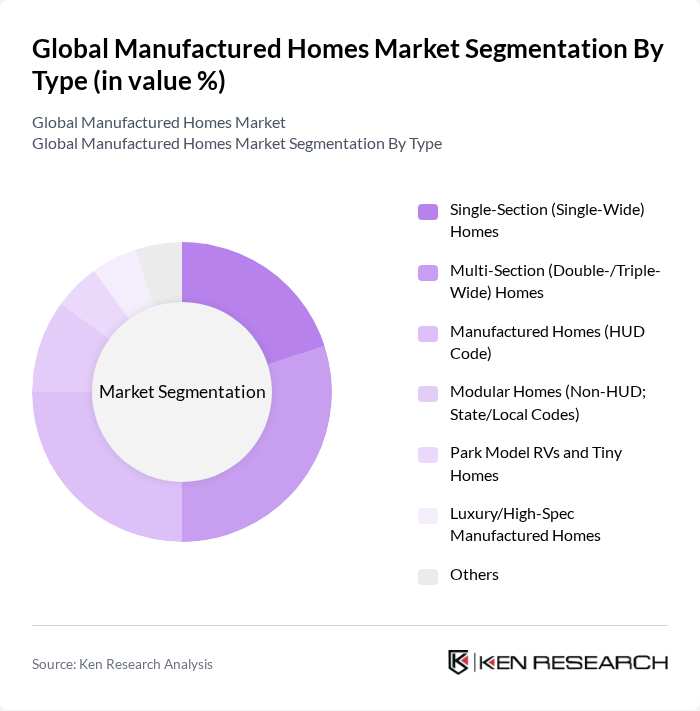
By Type:The manufactured homes market can be segmented into various types, including Single-Section (Single-Wide) Homes, Multi-Section (Double-/Triple-Wide) Homes, Manufactured Homes (HUD Code), Modular Homes (Non-HUD; State/Local Codes), Park Model RVs and Tiny Homes, Luxury/High-Spec Manufactured Homes, and Others. Each of these subsegments caters to different consumer preferences and needs, influencing their market dynamics.
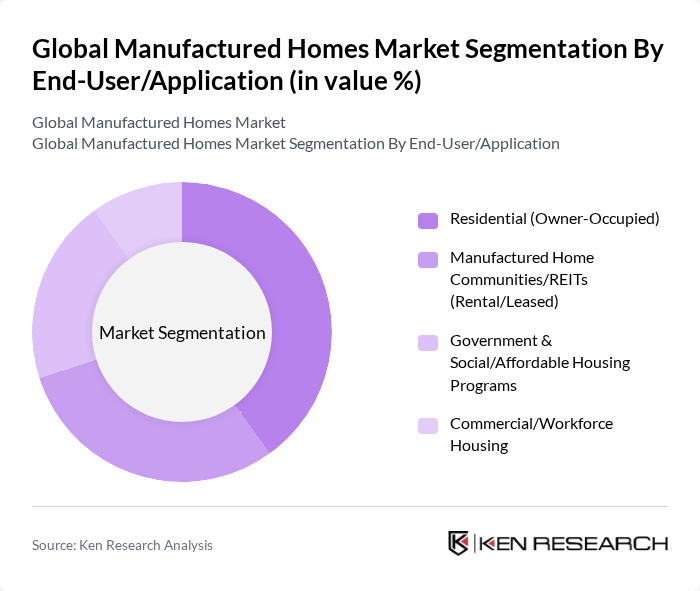
By End-User/Application:The market can also be segmented based on end-users, which include Residential (Owner-Occupied), Manufactured Home Communities/REITs (Rental/Leased), Government & Social/Affordable Housing Programs, and Commercial/Workforce Housing. Each application serves distinct market needs, with varying levels of demand and growth potential.
Global Manufactured Homes Market Competitive Landscape
The Global Manufactured Homes Market is characterized by a dynamic mix of regional and international players. Leading participants such as Clayton Homes, Inc. (Berkshire Hathaway), Skyline Champion Corporation, Cavco Industries, Inc., Champion Home Builders (a Skyline Champion brand), Fleetwood Homes (a Cavco brand), Palm Harbor Homes (a Cavco brand), Fairmont Homes (a Cavco brand), Commodore Homes (Commodore Homes of Pennsylvania/Indiana), Redman Homes (a Skyline Champion brand), TruMH (a Clayton Homes brand), Marlette Homes (a Clayton Homes brand), Karsten Homes (Karsten Manufacturing; legacy brand in NM/TX), Giles Industries, Inc., Deer Valley Homebuilders, Inc., Adventure Homes, LLC contribute to innovation, geographic expansion, and service delivery in this space.
Global Manufactured Homes Market Industry Analysis
Growth Drivers
- Increasing Demand for Affordable Housing:The global housing crisis has intensified the need for affordable housing solutions, with over1.6 billionpeople lacking adequate shelter. In future, the average cost of traditional homes in urban areas is projected to exceedUSD 300,000, while manufactured homes can be acquired for approximatelyUSD 100,000. This significant price difference drives demand for manufactured homes, particularly among low- to middle-income families seeking cost-effective housing options.
- Rising Awareness of Sustainable Living:As environmental concerns grow, the demand for sustainable living solutions is increasing. In future, the global green building market is expected to reachUSD 1.6 trillion, with manufactured homes offering eco-friendly options. These homes often utilize energy-efficient materials and designs, appealing to environmentally conscious consumers. The shift towards sustainability is further supported by a20%increase in consumers prioritizing eco-friendly housing solutions over the past three years.
- Technological Advancements in Manufacturing:Innovations in manufacturing processes are enhancing the quality and efficiency of produced homes. In future, the adoption of automation and robotics in the construction sector is projected to increase by30%, leading to reduced production costs and improved quality control. These advancements enable manufacturers to deliver customized homes faster, meeting the growing consumer demand for personalized living spaces while maintaining affordability.
Market Challenges
- Perception Issues Regarding Quality:Despite advancements, manufactured homes often face stigma related to quality and durability. A survey indicated that40%of potential buyers still perceive manufactured homes as inferior to traditional homes. This perception can hinder market growth, as consumers may be reluctant to invest in what they view as lower-quality housing options, impacting overall sales and market penetration.
- Regulatory Hurdles in Different Regions:The manufactured homes market is significantly affected by varying regulations across regions. In future, over30%of manufactured home projects are expected to face delays due to complex zoning laws and building codes. These regulatory challenges can increase costs and extend timelines, discouraging manufacturers from entering certain markets and limiting the availability of affordable housing options.
Global Manufactured Homes Market Future Outlook
The future of the manufactured homes market appears promising, driven by increasing consumer demand for affordable and sustainable housing solutions. As technological advancements continue to reshape manufacturing processes, the industry is likely to see enhanced customization options and improved quality. Additionally, the growing trend of eco-friendly living will further propel the market, encouraging manufacturers to innovate and adapt to changing consumer preferences. Overall, the landscape is set for significant transformation, with opportunities for growth in various segments.
Market Opportunities
- Expansion into Emerging Markets:Emerging markets present significant growth opportunities for manufactured homes. Countries like India and Brazil, with rising urbanization rates of2.5%and1.8%respectively, are experiencing increased demand for affordable housing. By targeting these regions, manufacturers can tap into a growing customer base seeking cost-effective housing solutions, potentially increasing market share and revenue.
- Integration of Smart Home Technologies:The integration of smart home technologies is becoming a key differentiator in the housing market. In future, the global smart home market is projected to reachUSD 135 billion, with consumers increasingly seeking homes equipped with smart features. By incorporating these technologies into manufactured homes, manufacturers can enhance appeal and attract tech-savvy buyers, driving sales and market growth.
Scope of the Report
| Segment | Sub-Segments |
|---|---|
| By Type | Single-Section (Single-Wide) Homes Multi-Section (Double-/Triple-Wide) Homes Manufactured Homes (HUD Code) Modular Homes (Non-HUD; State/Local Codes) Park Model RVs and Tiny Homes Luxury/High-Spec Manufactured Homes Others |
| By End-User/Application | Residential (Owner-Occupied) Manufactured Home Communities/REITs (Rental/Leased) Government & Social/Affordable Housing Programs Commercial/Workforce Housing |
| By Sales Channel | Manufacturer-Direct Sales Independent Retailers/Dealers Online/Digital Sales Distributors/Channel Partners |
| By Price Range | Entry-Level (Value) Homes Mid-Range Homes Premium Homes |
| By Financing Type | Cash Purchases Chattel (Home-Only) Loans Mortgage/Real Property Loans Lease-to-Own/Installment |
| By Installation/Land Tenure | Private Land (Fee Simple) Land-Lease Communities Temporary/Relocatable Sites |
| By Region | North America Europe Asia-Pacific Latin America Middle East & Africa |
Key Target Audience
Investors and Venture Capitalist Firms
Government and Regulatory Bodies (e.g., U.S. Department of Housing and Urban Development, National Association of Home Builders)
Manufacturers and Producers
Distributors and Retailers
Real Estate Developers
Financial Institutions
Insurance Companies
Trade Associations
Players Mentioned in the Report:
Clayton Homes, Inc. (Berkshire Hathaway)
Skyline Champion Corporation
Cavco Industries, Inc.
Champion Home Builders (a Skyline Champion brand)
Fleetwood Homes (a Cavco brand)
Palm Harbor Homes (a Cavco brand)
Fairmont Homes (a Cavco brand)
Commodore Homes (Commodore Homes of Pennsylvania/Indiana)
Redman Homes (a Skyline Champion brand)
TruMH (a Clayton Homes brand)
Marlette Homes (a Clayton Homes brand)
Karsten Homes (Karsten Manufacturing; legacy brand in NM/TX)
Giles Industries, Inc.
Deer Valley Homebuilders, Inc.
Adventure Homes, LLC
Table of Contents
Market Assessment Phase
1. Executive Summary and Approach
2. Global Manufactured Homes Market Overview
2.1 Key Insights and Strategic Recommendations
2.2 Global Manufactured Homes Market Overview
2.3 Definition and Scope
2.4 Evolution of Market Ecosystem
2.5 Timeline of Key Regulatory Milestones
2.6 Value Chain & Stakeholder Mapping
2.7 Business Cycle Analysis
2.8 Policy & Incentive Landscape
3. Global Manufactured Homes Market Analysis
3.1 Growth Drivers
3.1.1 Increasing Demand for Affordable Housing
3.1.2 Rising Awareness of Sustainable Living
3.1.3 Technological Advancements in Manufacturing
3.1.4 Government Incentives for Manufactured Homes
3.2 Market Challenges
3.2.1 Perception Issues Regarding Quality
3.2.2 Regulatory Hurdles in Different Regions
3.2.3 Competition from Traditional Housing Markets
3.2.4 Supply Chain Disruptions
3.3 Market Opportunities
3.3.1 Expansion into Emerging Markets
3.3.2 Customization and Personalization Trends
3.3.3 Integration of Smart Home Technologies
3.3.4 Partnerships with Financial Institutions
3.4 Market Trends
3.4.1 Shift Towards Eco-Friendly Materials
3.4.2 Growth of Modular and Prefabricated Homes
3.4.3 Increasing Popularity of Tiny Homes
3.4.4 Rise in Online Sales Platforms
3.5 Government Regulation
3.5.1 Zoning Laws and Land Use Regulations
3.5.2 Building Codes and Safety Standards
3.5.3 Environmental Regulations
3.5.4 Financing and Subsidy Programs
4. SWOT Analysis
5. Stakeholder Analysis
6. Porter's Five Forces Analysis
7. Global Manufactured Homes Market Market Size, 2019-2024
7.1 By Value
7.2 By Volume
7.3 By Average Selling Price
8. Global Manufactured Homes Market Segmentation
8.1 By Type
8.1.1 Single-Section (Single-Wide) Homes
8.1.2 Multi-Section (Double-/Triple-Wide) Homes
8.1.3 Manufactured Homes (HUD Code)
8.1.4 Modular Homes (Non-HUD; State/Local Codes)
8.1.5 Park Model RVs and Tiny Homes
8.1.6 Luxury/High-Spec Manufactured Homes
8.1.7 Others
8.2 By End-User/Application
8.2.1 Residential (Owner-Occupied)
8.2.2 Manufactured Home Communities/REITs (Rental/Leased)
8.2.3 Government & Social/Affordable Housing Programs
8.2.4 Commercial/Workforce Housing
8.3 By Sales Channel
8.3.1 Manufacturer-Direct Sales
8.3.2 Independent Retailers/Dealers
8.3.3 Online/Digital Sales
8.3.4 Distributors/Channel Partners
8.4 By Price Range
8.4.1 Entry-Level (Value) Homes
8.4.2 Mid-Range Homes
8.4.3 Premium Homes
8.5 By Financing Type
8.5.1 Cash Purchases
8.5.2 Chattel (Home-Only) Loans
8.5.3 Mortgage/Real Property Loans
8.5.4 Lease-to-Own/Installment
8.6 By Installation/Land Tenure
8.6.1 Private Land (Fee Simple)
8.6.2 Land-Lease Communities
8.6.3 Temporary/Relocatable Sites
8.7 By Region
8.7.1 North America
8.7.2 Europe
8.7.3 Asia-Pacific
8.7.4 Latin America
8.7.5 Middle East & Africa
9. Global Manufactured Homes Market Competitive Analysis
9.1 Market Share of Key Players
9.2 Cross Comparison of Key Players
9.2.1 Company Name
9.2.2 Group Size (Large, Medium, or Small as per industry convention)
9.2.3 Manufactured Home Shipments (Units)
9.2.4 Revenue from Manufactured Housing (USD)
9.2.5 Average Selling Price per Home (USD)
9.2.6 Capacity/Plants and Geographic Footprint
9.2.7 Product Mix (Single- vs Multi-Section %)
9.2.8 Order Backlog/Lead Times
9.2.9 Financing Penetration (Share of Sales via Chattel/Mortgage)
9.2.10 Community/Retail Network Size (Dealers/Communities Count)
9.2.11 On-Time Delivery Rate / Cycle Time
9.2.12 Warranty Claims Rate / Service Cost per Unit
9.2.13 Energy Efficiency Certifications (e.g., ENERGY STAR/HUD compliance)
9.2.14 R&D/Innovation Intensity (New Models, Smart/Green Features)
9.2.15 International Sales Share (%)
9.3 SWOT Analysis of Top Players
9.4 Pricing Analysis
9.5 Detailed Profile of Major Companies
9.5.1 Clayton Homes, Inc. (Berkshire Hathaway)
9.5.2 Skyline Champion Corporation
9.5.3 Cavco Industries, Inc.
9.5.4 Champion Home Builders (a Skyline Champion brand)
9.5.5 Fleetwood Homes (a Cavco brand)
9.5.6 Palm Harbor Homes (a Cavco brand)
9.5.7 Fairmont Homes (a Cavco brand)
9.5.8 Commodore Homes (Commodore Homes of Pennsylvania/Indiana)
9.5.9 Redman Homes (a Skyline Champion brand)
9.5.10 TruMH (a Clayton Homes brand)
9.5.11 Marlette Homes (a Clayton Homes brand)
9.5.12 Karsten Homes (Karsten Manufacturing; legacy brand in NM/TX)
9.5.13 Giles Industries, Inc.
9.5.14 Deer Valley Homebuilders, Inc.
9.5.15 Adventure Homes, LLC
10. Global Manufactured Homes Market End-User Analysis
10.1 Procurement Behavior of Key Ministries
10.1.1 Budget Allocation for Housing
10.1.2 Preference for Sustainable Solutions
10.1.3 Evaluation Criteria for Suppliers
10.1.4 Decision-Making Process
10.2 Corporate Spend on Infrastructure & Energy
10.2.1 Investment Trends in Housing
10.2.2 Budgeting for Manufactured Homes
10.2.3 Long-Term Financial Commitments
10.3 Pain Point Analysis by End-User Category
10.3.1 Affordability Concerns
10.3.2 Quality Assurance Issues
10.3.3 Regulatory Compliance Challenges
10.4 User Readiness for Adoption
10.4.1 Awareness of Manufactured Homes
10.4.2 Financial Readiness
10.4.3 Acceptance of Alternative Housing Solutions
10.5 Post-Deployment ROI and Use Case Expansion
10.5.1 Cost Savings Analysis
10.5.2 Performance Metrics
10.5.3 Expansion Opportunities
11. Global Manufactured Homes Market Future Size, 2025-2030
11.1 By Value
11.2 By Volume
11.3 By Average Selling Price
Go-To-Market Strategy Phase
1. Whitespace Analysis + Business Model Canvas
1.1 Market Gaps Identification
1.2 Value Proposition Development
1.3 Revenue Streams Analysis
1.4 Cost Structure Evaluation
1.5 Key Partnerships Exploration
1.6 Customer Segmentation
1.7 Channels of Distribution
2. Marketing and Positioning Recommendations
2.1 Branding Strategies
2.2 Product USPs
2.3 Target Market Identification
2.4 Communication Strategies
2.5 Digital Marketing Approaches
3. Distribution Plan
3.1 Urban Retail vs Rural NGO Tie-ups
3.2 Logistics and Supply Chain Management
3.3 Distribution Partnerships
3.4 Inventory Management Strategies
4. Channel & Pricing Gaps
4.1 Underserved Routes
4.2 Pricing Bands
4.3 Competitive Pricing Analysis
4.4 Value-Based Pricing Strategies
5. Unmet Demand & Latent Needs
5.1 Category Gaps
5.2 Consumer Segments
5.3 Emerging Trends Analysis
6. Customer Relationship
6.1 Loyalty Programs
6.2 After-Sales Service
6.3 Customer Feedback Mechanisms
7. Value Proposition
7.1 Sustainability
7.2 Integrated Supply Chains
7.3 Customer-Centric Innovations
8. Key Activities
8.1 Regulatory Compliance
8.2 Branding
8.3 Distribution Setup
9. Entry Strategy Evaluation
9.1 Domestic Market Entry Strategy
9.1.1 Product Mix
9.1.2 Pricing Band
9.1.3 Packaging
9.2 Export Entry Strategy
9.2.1 Target Countries
9.2.2 Compliance Roadmap
10. Entry Mode Assessment
10.1 JV
10.2 Greenfield
10.3 M&A
10.4 Distributor Model
11. Capital and Timeline Estimation
11.1 Capital Requirements
11.2 Timelines
12. Control vs Risk Trade-Off
12.1 Ownership vs Partnerships
13. Profitability Outlook
13.1 Breakeven Analysis
13.2 Long-Term Sustainability
14. Potential Partner List
14.1 Distributors
14.2 JVs
14.3 Acquisition Targets
15. Execution Roadmap
15.1 Phased Plan for Market Entry
15.1.1 Market Setup
15.1.2 Market Entry
15.1.3 Growth Acceleration
15.1.4 Scale & Stabilize
15.2 Key Activities and Milestones
15.2.1 Activity Planning
15.2.2 Milestone Tracking
Research Methodology
Phase 1: Approach1
Desk Research
- Industry reports from global housing associations and manufactured home councils
- Market analysis from government housing departments and real estate agencies
- Published articles and white papers on trends in the manufactured homes sector
Primary Research
- Interviews with manufacturers and suppliers of manufactured homes
- Surveys with homeowners and potential buyers of manufactured homes
- Field interviews with real estate agents specializing in manufactured housing
Validation & Triangulation
- Cross-validation using historical sales data and market growth rates
- Triangulation of insights from primary interviews and secondary data sources
- Sanity checks through expert panel discussions and feedback sessions
Phase 2: Market Size Estimation1
Top-down Assessment
- Analysis of national housing market trends and manufactured home sales data
- Segmentation by geographic regions and demographic profiles of buyers
- Incorporation of economic indicators affecting housing affordability and demand
Bottom-up Modeling
- Volume estimates based on production data from leading manufacturers
- Cost analysis of materials and labor involved in manufactured home production
- Sales projections based on historical growth rates and market penetration
Forecasting & Scenario Analysis
- Multi-variable regression analysis incorporating interest rates and consumer confidence
- Scenario modeling based on regulatory changes and environmental considerations
- Baseline, optimistic, and pessimistic forecasts through 2030
Phase 3: CATI Sample Composition1
| Scope Item/Segment | Sample Size | Target Respondent Profiles |
|---|---|---|
| Manufactured Home Buyers | 140 | First-time Homebuyers, Retirees |
| Manufactured Home Manufacturers | 90 | Production Managers, Sales Directors |
| Real Estate Agents Specializing in Manufactured Homes | 80 | Real Estate Brokers, Market Analysts |
| Financial Institutions Offering Loans for Manufactured Homes | 70 | Loan Officers, Mortgage Brokers |
| Regulatory Bodies and Housing Authorities | 50 | Policy Makers, Housing Inspectors |
Frequently Asked Questions
What is the current value of the Global Manufactured Homes Market?
The Global Manufactured Homes Market is valued at approximately USD 24 billion, reflecting a sustained demand for affordable, factory-built housing solutions. This growth is driven by urbanization and the need for quick construction methods, appealing to both consumers and institutional investors.
Which regions dominate the manufactured homes market?
What types of manufactured homes are available in the market?
What are the main drivers of growth in the manufactured homes market?
Other Regional/Country Reports
Indonesia Manufactured Homes Market
Malaysia Manufactured Homes Market
Why Buy From Us?

What makes us stand out is that our consultants follow Robust, Refine and Result (RRR) methodology. Robust for clear definitions, approaches and sanity checking, Refine for differentiating respondents' facts and opinions, and Result for presenting data with story.

We have set a benchmark in the industry by offering our clients with syndicated and customized market research reports featuring coverage of entire market as well as meticulous research and analyst insights.

While we don't replace traditional research, we flip the method upside down. Our dual approach of Top Bottom & Bottom Top ensures quality deliverable by not just verifying company fundamentals but also looking at the sector and macroeconomic factors.

With one step in the future, our research team constantly tries to show you the bigger picture. We help with some of the tough questions you may encounter along the way: How is the industry positioned? Best marketing channel? KPI's of competitors? By aligning every element, we help maximize success.

Our report gives you instant access to the answers and sources that other companies might choose to hide. We elaborate each steps of research methodology we have used and showcase you the sample size to earn your trust.

If you need any support, we are here! We pride ourselves on universe strength, data quality, and quick, friendly, and professional service.