Global Medical Gas Analyzer Market

The Global Medical Gas Analyzer Market, valued at USD 360 million, is growing due to increasing respiratory disease burden, technological innovations, and demand for portable analyzers in hospitals and ambulatory centers.

Region:Global

Author(s):Shubham

Product Code:KRAD0710

Pages:83

Published On:August 2025

About the Report

Base Year 2024

Global Medical Gas Analyzer Market Overview

  • The Global Medical Gas Analyzer Market is valued at USD 360 million, based on a five-year historical analysis. This level aligns with multiple industry trackers that place the market in the low-hundreds of millions rather than the billion range, reflecting reported market valuations in the mid-200s to high-300s across recent cycles .
  • Growth is primarily driven by rising respiratory disease burden (e.g., COPD, asthma), expansion of ambulatory surgery centers and anesthesia monitoring, and advances in sensor technologies (infrared, electrochemical, optical) improving accuracy and portability of analyzers for hospital environments and biomedical engineering teams .
  • Key players in this market include the United States, Germany, and Japan, which dominate due to advanced healthcare infrastructure, strong investments in medical technology, and the presence of leading manufacturers and regulatory frameworks supporting quality and safety in monitoring medical gases across care settings .
  • In 2023, the U.S. Food and Drug Administration (FDA) did not issue a new blanket regulation specifically for “medical gas analyzers”; rather, analyzers used for patient monitoring are regulated as medical devices (e.g., under existing 510(k) pathways and applicable consensus standards such as IEC 60601-1 and performance-specific standards), and medical gas systems in facilities follow NFPA 99 and related compliance regimes. Manufacturers marketing analyzers in the United States continue to require appropriate device clearance or compliance, but no single new 2023 rule mandating enhanced testing specific to medical gas analyzers was issued .
Global Medical Gas Analyzer Market Size

Global Medical Gas Analyzer Market Segmentation

By Type:The market is segmented into various types of medical gas analyzers, including Single-Gas Analyzers, Multi-Gas Analyzers, Portable/Handheld Medical Gas Analyzers, Benchtop/Stationary Medical Gas Analyzers, and Inline/Continuous Monitoring Analyzers. Each type serves specific applications and user needs, with the demand for portable analyzers increasing due to their convenience and ease of use in various healthcare settings .
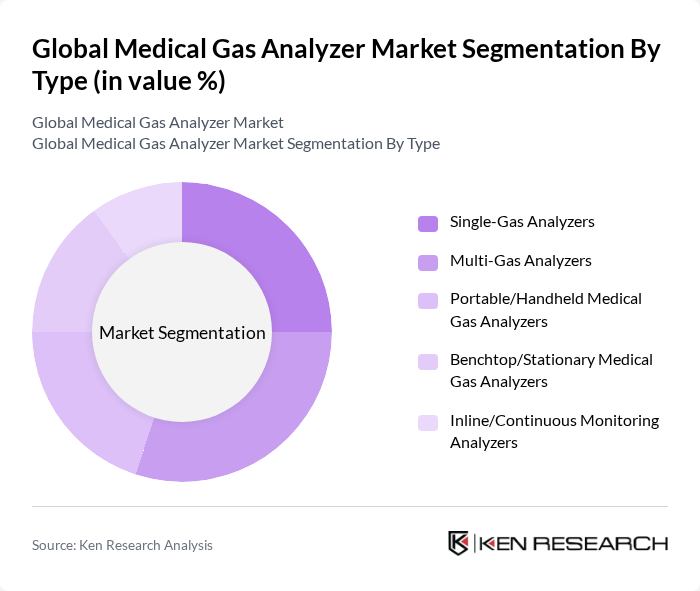
Global Medical Gas Analyzer Market segmentation by Type.

The Multi-Gas Analyzers segment is currently dominating the market due to their versatility and ability to measure multiple gases simultaneously, which is essential in critical care environments. Hospitals and healthcare facilities prefer these analyzers for their efficiency in monitoring various gases, including oxygen, carbon dioxide, and nitrous oxide, thereby enhancing patient safety. The trend towards integrated solutions that offer comprehensive monitoring capabilities is driving the growth of this segment .

By End-User:The market is segmented by end-users, including Hospitals, Ambulatory Surgery Centers, Clinical Laboratories & Biomedical Engineering Departments, Home Healthcare Providers, Pharmaceutical & Medical Device Manufacturers, and Others. Each end-user category has distinct requirements for gas analysis, influencing the types of analyzers they utilize .
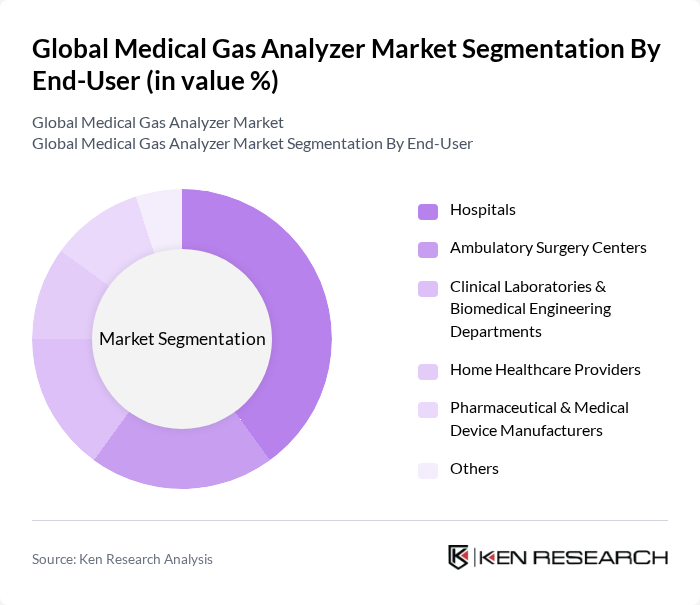
Global Medical Gas Analyzer Market segmentation by End-User.

Hospitals are the leading end-user segment, accounting for a significant share of the market. This dominance is attributed to the high demand for medical gas analyzers in critical care units, operating rooms, and emergency departments. The increasing focus on patient safety and regulatory compliance in hospitals drives the need for reliable gas monitoring solutions, making them the primary consumers of medical gas analyzers .

Global Medical Gas Analyzer Market Competitive Landscape

The Global Medical Gas Analyzer Market is characterized by a dynamic mix of regional and international players. Leading participants such as Fluke Biomedical, Drägerwerk AG & Co. KGaA, Teledyne Technologies Incorporated, Maxtec (a Perma Pure company), IMT Analytics AG, TSI Incorporated, Bacharach, Inc. (Ametek Mocon), Servomex (Servomex Group Limited), WITT-Gasetechnik GmbH & Co KG, OxyGuard International A/S, BK Medical ApS, UVP LLC (Analytical Technologies), Cambridge Sensotec Ltd (Rapidox), Sable Systems International, GSS Ltd (Gas Sensing Solutions) contribute to innovation, geographic expansion, and service delivery in this space.

Fluke Biomedical

1948

Everett, Washington, USA

Drägerwerk AG & Co. KGaA

1889

Lübeck, Germany

Teledyne Technologies Incorporated

1960

Thousand Oaks, California, USA

Maxtec (a Perma Pure company)

1985

Salt Lake City, Utah, USA

IMT Analytics AG

2002

Zurich, Switzerland

Company

Establishment Year

Headquarters

Group Size (Large, Medium, or Small as per industry convention)

Global Medical Gas Analyzer Revenue (USD) and 3-year CAGR

Installed Base/Units in Field

Regulatory Footprint (FDA 510(k)/EU MDR/CE approvals count)

Product Portfolio Breadth (Single-, Multi-gas; Handheld, Benchtop, Inline)

Accuracy/Performance Specs (e.g., %RD accuracy, response time)

Global Medical Gas Analyzer Market Industry Analysis

Growth Drivers

  • Increasing Demand for Medical Gases:The global demand for medical gases is projected to reach approximately 1.5 million tons by, driven by the expansion of healthcare facilities. The World Health Organization reported that healthcare spending is expected to increase by 5% annually, leading to a higher requirement for medical gases in hospitals and clinics. This surge in demand necessitates advanced gas analyzers to ensure the quality and safety of these gases, thereby propelling market growth.
  • Technological Advancements in Gas Analysis:The medical gas analyzer market is witnessing rapid technological advancements, with innovations such as real-time monitoring and automated systems. According to a report by the International Society for Automation, the integration of advanced sensors and IoT technology is expected to enhance the accuracy of gas analysis, reducing error rates by up to 30%. This technological evolution is crucial for improving patient safety and operational efficiency in healthcare settings.
  • Rising Awareness of Patient Safety:The increasing focus on patient safety and quality control in healthcare is driving the demand for reliable medical gas analyzers. The Joint Commission reported that hospitals with stringent safety protocols have seen a 20% reduction in adverse events. As healthcare providers prioritize patient outcomes, the need for precise gas monitoring systems becomes essential, further stimulating market growth in the medical gas analyzer sector.

Market Challenges

  • High Initial Investment Costs:The high initial investment required for advanced medical gas analyzers poses a significant challenge for healthcare facilities, particularly in developing regions. The average cost of a sophisticated gas analyzer can range from USD 10,000 to USD 50,000, which may deter smaller hospitals from upgrading their systems. This financial barrier can limit the adoption of essential monitoring technologies, impacting overall market growth.
  • Stringent Regulatory Requirements:Compliance with stringent regulatory standards, such as ISO 13485 and FDA regulations, presents a challenge for manufacturers of medical gas analyzers. The process of obtaining necessary certifications can take up to 18 months and incur costs exceeding USD 100,000. These regulatory hurdles can slow down product development and market entry, hindering the growth of the medical gas analyzer market.

Global Medical Gas Analyzer Market Future Outlook

The future of the medical gas analyzer market appears promising, driven by ongoing advancements in technology and a growing emphasis on patient safety. The integration of IoT and AI in gas monitoring systems is expected to enhance operational efficiency and accuracy. Additionally, the shift towards preventive healthcare will likely increase the demand for reliable gas analyzers. As healthcare infrastructure continues to expand globally, the market is poised for significant growth, with innovative solutions addressing emerging healthcare needs.

Market Opportunities

  • Growth in Home Healthcare Services:The rise of home healthcare services is creating new opportunities for portable medical gas analyzers. With an estimated 20% increase in home healthcare spending projected by, the demand for compact and efficient gas monitoring solutions is expected to grow, allowing patients to receive quality care in their homes.
  • Increasing Adoption of Telemedicine:The growing adoption of telemedicine is opening avenues for remote gas monitoring solutions. As telehealth services expand, the need for reliable medical gas analyzers that can be integrated into telemedicine platforms is anticipated to rise, enhancing patient monitoring and care delivery in remote settings.

Scope of the Report

SegmentSub-Segments
By Type

Single-Gas Analyzers

Multi-Gas Analyzers

Portable/Handheld Medical Gas Analyzers

Benchtop/Stationary Medical Gas Analyzers

Inline/Continuous Monitoring Analyzers

By End-User

Hospitals

Ambulatory Surgery Centers

Clinical Laboratories & Biomedical Engineering Departments

Home Healthcare Providers

Pharmaceutical & Medical Device Manufacturers

Others

By Application

Anesthesia and Respiratory Gas Monitoring

Medical Gas Pipeline System (MGPS) Verification & Compliance Testing

Ventilator and Respiratory Therapy Calibration

Gas Purity and Contaminant Detection (O2, N2O, CO2, CO, H2O)

Pharmaceutical Cleanroom and Manufacturing QA/QC

Others

By Component

Sensors (Electrochemical, Infrared/NDIR, Paramagnetic, Thermal Conductivity)

Software & Connectivity (Data Logging, IoT/Remote Monitoring)

Calibration Gas & Fixtures

Displays & User Interfaces

Housings, Power & Accessories

By Sales Channel

Direct Sales to Healthcare Facilities

Authorized Distributors/Value-Added Resellers

OEM/Private Label

Online/Tenders & e-Procurement

Others

By Distribution Mode

Wholesale Distribution

Retail/Dealer Networks

Direct-to-Healthcare Provider

Others

By Price Range

Entry (Under $2,000)

Mid ($2,000–$8,000)

Premium ($8,000+)

Others

Key Target Audience

Investors and Venture Capitalist Firms

Government and Regulatory Bodies (e.g., Food and Drug Administration, European Medicines Agency)

Manufacturers and Producers of Medical Gas Analyzers

Distributors and Retailers of Medical Equipment

Healthcare Providers and Hospitals

Medical Device Regulatory Consultants

Industry Associations (e.g., Medical Device Manufacturers Association)

Financial Institutions and Investment Banks

Players Mentioned in the Report:

Fluke Biomedical

Dragerwerk AG & Co. KGaA

Teledyne Technologies Incorporated

Maxtec (a Perma Pure company)

IMT Analytics AG

TSI Incorporated

Bacharach, Inc. (Ametek Mocon)

Servomex (Servomex Group Limited)

WITT-Gasetechnik GmbH & Co KG

OxyGuard International A/S

BK Medical ApS

UVP LLC (Analytical Technologies)

Cambridge Sensotec Ltd (Rapidox)

Sable Systems International

GSS Ltd (Gas Sensing Solutions)

Table of Contents

Market Assessment Phase

1. Executive Summary and Approach


2. Global Medical Gas Analyzer Market Overview

2.1 Key Insights and Strategic Recommendations

2.2 Global Medical Gas Analyzer Market Overview

2.3 Definition and Scope

2.4 Evolution of Market Ecosystem

2.5 Timeline of Key Regulatory Milestones

2.6 Value Chain & Stakeholder Mapping

2.7 Business Cycle Analysis

2.8 Policy & Incentive Landscape


3. Global Medical Gas Analyzer Market Analysis

3.1 Growth Drivers

3.1.1 Increasing demand for medical gases in healthcare facilities
3.1.2 Technological advancements in gas analysis
3.1.3 Rising awareness of patient safety and quality control
3.1.4 Expansion of healthcare infrastructure globally

3.2 Market Challenges

3.2.1 High initial investment costs
3.2.2 Stringent regulatory requirements
3.2.3 Limited availability of skilled professionals
3.2.4 Competition from alternative monitoring technologies

3.3 Market Opportunities

3.3.1 Growth in home healthcare services
3.3.2 Increasing adoption of telemedicine
3.3.3 Development of portable gas analyzers
3.3.4 Rising investments in healthcare R&D

3.4 Market Trends

3.4.1 Integration of IoT in medical gas monitoring
3.4.2 Shift towards preventive healthcare
3.4.3 Focus on sustainability and eco-friendly solutions
3.4.4 Customization of gas analyzers for specific applications

3.5 Government Regulation

3.5.1 Compliance with ISO standards for medical devices
3.5.2 FDA regulations on medical gas analyzers
3.5.3 CE marking requirements in Europe
3.5.4 National health policies promoting safety in healthcare

4. SWOT Analysis


5. Stakeholder Analysis


6. Porter's Five Forces Analysis


7. Global Medical Gas Analyzer Market Market Size, 2019-2024

7.1 By Value

7.2 By Volume

7.3 By Average Selling Price


8. Global Medical Gas Analyzer Market Segmentation

8.1 By Type

8.1.1 Single-Gas Analyzers
8.1.2 Multi-Gas Analyzers
8.1.3 Portable/Handheld Medical Gas Analyzers
8.1.4 Benchtop/Stationary Medical Gas Analyzers
8.1.5 Inline/Continuous Monitoring Analyzers

8.2 By End-User

8.2.1 Hospitals
8.2.2 Ambulatory Surgery Centers
8.2.3 Clinical Laboratories & Biomedical Engineering Departments
8.2.4 Home Healthcare Providers
8.2.5 Pharmaceutical & Medical Device Manufacturers
8.2.6 Others

8.3 By Application

8.3.1 Anesthesia and Respiratory Gas Monitoring
8.3.2 Medical Gas Pipeline System (MGPS) Verification & Compliance Testing
8.3.3 Ventilator and Respiratory Therapy Calibration
8.3.4 Gas Purity and Contaminant Detection (O2, N2O, CO2, CO, H2O)
8.3.5 Pharmaceutical Cleanroom and Manufacturing QA/QC
8.3.6 Others

8.4 By Component

8.4.1 Sensors (Electrochemical, Infrared/NDIR, Paramagnetic, Thermal Conductivity)
8.4.2 Software & Connectivity (Data Logging, IoT/Remote Monitoring)
8.4.3 Calibration Gas & Fixtures
8.4.4 Displays & User Interfaces
8.4.5 Housings, Power & Accessories

8.5 By Sales Channel

8.5.1 Direct Sales to Healthcare Facilities
8.5.2 Authorized Distributors/Value-Added Resellers
8.5.3 OEM/Private Label
8.5.4 Online/Tenders & e-Procurement
8.5.5 Others

8.6 By Distribution Mode

8.6.1 Wholesale Distribution
8.6.2 Retail/Dealer Networks
8.6.3 Direct-to-Healthcare Provider
8.6.4 Others

8.7 By Price Range

8.7.1 Entry (Under $2,000)
8.7.2 Mid ($2,000–$8,000)
8.7.3 Premium ($8,000+)
8.7.4 Others

9. Global Medical Gas Analyzer Market Competitive Analysis

9.1 Market Share of Key Players

9.2 Cross Comparison of Key Players

9.2.1 Company Name
9.2.2 Group Size (Large, Medium, or Small as per industry convention)
9.2.3 Global Medical Gas Analyzer Revenue (USD) and 3-year CAGR
9.2.4 Installed Base/Units in Field
9.2.5 Regulatory Footprint (FDA 510(k)/EU MDR/CE approvals count)
9.2.6 Product Portfolio Breadth (Single-, Multi-gas; Handheld, Benchtop, Inline)
9.2.7 Accuracy/Performance Specs (e.g., %RD accuracy, response time)
9.2.8 Service & Calibration Network Coverage (regions, turnaround time)
9.2.9 R&D Intensity (R&D as % of revenue; patents filed)
9.2.10 Average Selling Price (ASP) and Pricing Positioning
9.2.11 Key Healthcare End-Markets Penetration (Hospitals, ASCs, Pharma)
9.2.12 Strategic Partnerships/OEM Integrations
9.2.13 Customer Satisfaction/Net Promoter Score (NPS)

9.3 SWOT Analysis of Top Players

9.4 Pricing Analysis

9.5 Detailed Profile of Major Companies

9.5.1 Fluke Biomedical
9.5.2 Drägerwerk AG & Co. KGaA
9.5.3 Teledyne Technologies Incorporated
9.5.4 Maxtec (a Perma Pure company)
9.5.5 IMT Analytics AG
9.5.6 TSI Incorporated
9.5.7 Bacharach, Inc. (Ametek Mocon)
9.5.8 Servomex (Servomex Group Limited)
9.5.9 WITT-Gasetechnik GmbH & Co KG
9.5.10 OxyGuard International A/S
9.5.11 BK Medical ApS
9.5.12 UVP LLC (Analytical Technologies)
9.5.13 Cambridge Sensotec Ltd (Rapidox)
9.5.14 Sable Systems International
9.5.15 GSS Ltd (Gas Sensing Solutions)

10. Global Medical Gas Analyzer Market End-User Analysis

10.1 Procurement Behavior of Key Ministries

10.1.1 Government healthcare procurement policies
10.1.2 Budget allocation for medical equipment
10.1.3 Evaluation criteria for supplier selection
10.1.4 Trends in public-private partnerships

10.2 Corporate Spend on Infrastructure & Energy

10.2.1 Investment in healthcare infrastructure
10.2.2 Spending on energy-efficient solutions
10.2.3 Budgeting for technology upgrades

10.3 Pain Point Analysis by End-User Category

10.3.1 Challenges in gas supply management
10.3.2 Issues with equipment reliability
10.3.3 Need for training and support

10.4 User Readiness for Adoption

10.4.1 Awareness of medical gas analyzers
10.4.2 Willingness to invest in new technology
10.4.3 Training requirements for staff

10.5 Post-Deployment ROI and Use Case Expansion

10.5.1 Measurement of cost savings
10.5.2 Evaluation of improved patient outcomes
10.5.3 Opportunities for scaling usage

11. Global Medical Gas Analyzer Market Future Size, 2025-2030

11.1 By Value

11.2 By Volume

11.3 By Average Selling Price


Go-To-Market Strategy Phase

1. Whitespace Analysis + Business Model Canvas

1.1 Market Gaps Identification

1.2 Business Model Development


2. Marketing and Positioning Recommendations

2.1 Branding Strategies

2.2 Product USPs


3. Distribution Plan

3.1 Urban Retail Strategies

3.2 Rural NGO Tie-ups


4. Channel & Pricing Gaps

4.1 Underserved Routes

4.2 Pricing Bands Analysis


5. Unmet Demand & Latent Needs

5.1 Category Gaps

5.2 Consumer Segments


6. Customer Relationship

6.1 Loyalty Programs

6.2 After-Sales Service


7. Value Proposition

7.1 Sustainability Initiatives

7.2 Integrated Supply Chains


8. Key Activities

8.1 Regulatory Compliance

8.2 Branding Efforts

8.3 Distribution Setup


9. Entry Strategy Evaluation

9.1 Domestic Market Entry Strategy

9.1.1 Product Mix Considerations
9.1.2 Pricing Band Strategy
9.1.3 Packaging Solutions

9.2 Export Entry Strategy

9.2.1 Target Countries Identification
9.2.2 Compliance Roadmap Development

10. Entry Mode Assessment

10.1 Joint Ventures

10.2 Greenfield Investments

10.3 Mergers & Acquisitions

10.4 Distributor Model Evaluation


11. Capital and Timeline Estimation

11.1 Capital Requirements

11.2 Timelines for Implementation


12. Control vs Risk Trade-Off

12.1 Ownership Considerations

12.2 Partnerships Evaluation


13. Profitability Outlook

13.1 Breakeven Analysis

13.2 Long-Term Sustainability Strategies


14. Potential Partner List

14.1 Distributors Identification

14.2 Joint Ventures Opportunities

14.3 Acquisition Targets


15. Execution Roadmap

15.1 Phased Plan for Market Entry

15.1.1 Market Setup Activities
15.1.2 Market Entry Steps
15.1.3 Growth Acceleration Strategies
15.1.4 Scale & Stabilize Actions

15.2 Key Activities and Milestones

15.2.1 Milestone Identification
15.2.2 Activity Scheduling

Research Methodology

ApproachModellingSample

Phase 1: Approach1

Desk Research

  • Analysis of industry reports from medical gas associations and healthcare organizations
  • Review of published market studies and white papers on medical gas technologies
  • Examination of regulatory frameworks and compliance guidelines from health authorities

Primary Research

  • Interviews with key opinion leaders in the medical gas manufacturing sector
  • Surveys with hospital procurement managers and biomedical engineers
  • Field interviews with technicians and operators in medical gas facilities

Validation & Triangulation

  • Cross-validation of findings through multiple data sources including trade publications
  • Triangulation of insights from primary interviews and secondary data analysis
  • Sanity checks conducted through expert panel discussions and feedback sessions

Phase 2: Market Size Estimation1

Top-down Assessment

  • Estimation of market size based on healthcare expenditure trends and medical gas usage
  • Segmentation analysis by application areas such as hospitals, clinics, and home care
  • Incorporation of growth rates from emerging markets and technological advancements

Bottom-up Modeling

  • Volume estimates derived from sales data of leading medical gas suppliers
  • Cost analysis based on pricing models for different types of medical gases
  • Calculation of market size using unit sales multiplied by average selling prices

Forecasting & Scenario Analysis

  • Multi-variable forecasting using historical data and projected healthcare trends
  • Scenario analysis based on potential regulatory changes and market disruptions
  • Development of baseline, optimistic, and pessimistic market growth scenarios through 2030

Phase 3: CATI Sample Composition1

Scope Item/SegmentSample SizeTarget Respondent Profiles
Hospital Medical Gas Management150Facility Managers, Biomedical Engineers
Home Healthcare Providers100Procurement Officers, Home Care Coordinators
Medical Gas Equipment Suppliers80Sales Managers, Product Development Leads
Regulatory Compliance in Medical Gas70Quality Assurance Managers, Compliance Officers
Research Institutions Utilizing Medical Gases60Research Scientists, Lab Managers

Frequently Asked Questions

What is the current value of the Global Medical Gas Analyzer Market?

The Global Medical Gas Analyzer Market is valued at approximately USD 360 million, based on a five-year historical analysis. This valuation reflects the market's position in the low-hundreds of millions, rather than the billion range.

What factors are driving the growth of the medical gas analyzer market?

Which countries are leading in the medical gas analyzer market?

How are medical gas analyzers regulated in the United States?

Other Regional/Country Reports

Indonesia Global Medical Gas Analyzer Market

Malaysia Global Medical Gas Analyzer Market

KSA Global Medical Gas Analyzer Market

APAC Global Medical Gas Analyzer Market

SEA Global Medical Gas Analyzer Market

Vietnam Global Medical Gas Analyzer Market

Why Buy From Us?

Refine Robust Result (RRR) Framework

What makes us stand out is that our consultants follow Robust, Refine and Result (RRR) methodology. Robust for clear definitions, approaches and sanity checking, Refine for differentiating respondents' facts and opinions, and Result for presenting data with story.

Our Reach Is Unmatched

We have set a benchmark in the industry by offering our clients with syndicated and customized market research reports featuring coverage of entire market as well as meticulous research and analyst insights.

Shifting the Research Paradigm

While we don't replace traditional research, we flip the method upside down. Our dual approach of Top Bottom & Bottom Top ensures quality deliverable by not just verifying company fundamentals but also looking at the sector and macroeconomic factors.

More Insights-Better Decisions

With one step in the future, our research team constantly tries to show you the bigger picture. We help with some of the tough questions you may encounter along the way: How is the industry positioned? Best marketing channel? KPI's of competitors? By aligning every element, we help maximize success.

Transparency and Trust

Our report gives you instant access to the answers and sources that other companies might choose to hide. We elaborate each steps of research methodology we have used and showcase you the sample size to earn your trust.

Round the Clock Support

If you need any support, we are here! We pride ourselves on universe strength, data quality, and quick, friendly, and professional service.

Why Clients Choose Us?

400000+
Reports in repository
150+
Consulting projects a year
100+
Analysts
8000+
Client Queries in 2022








