About the Report
Base Year 2024Listen to the audio summary
Global Medical Implants Market Overview
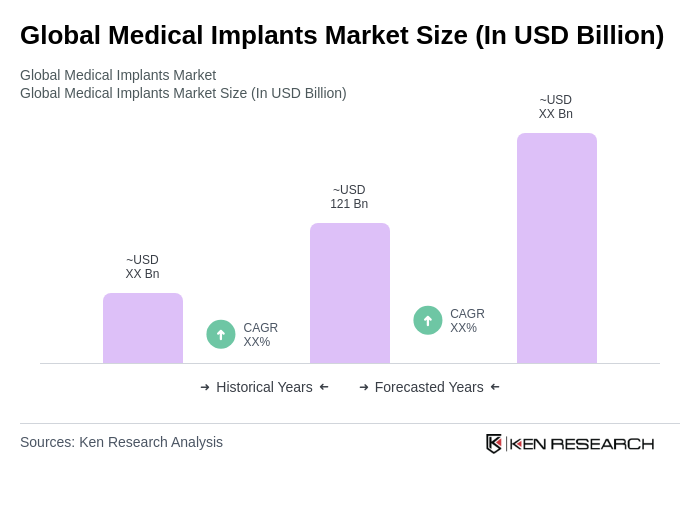
- The Global Medical Implants Market is valued at USD 121 billion, based on a five-year historical analysis. This growth is primarily driven by the increasing prevalence of chronic diseases, advancements in medical technology, and a growing aging population that requires surgical interventions. The demand for innovative and effective medical implants has surged, leading to significant investments in research and development by key players in the industry.
- The United States, Germany, and Japan dominate the Global Medical Implants Market due to their advanced healthcare infrastructure, high healthcare expenditure, and strong presence of leading medical device manufacturers. These countries benefit from robust regulatory frameworks that support innovation and ensure the safety and efficacy of medical implants, further solidifying their market leadership. North America, led by the United States, remains the largest market, while Asia Pacific is emerging rapidly due to increased healthcare investments.
- In 2023, the U.S. Food and Drug Administration (FDA) implemented new regulations aimed at enhancing the safety and effectiveness of medical implants. This includes stricter pre-market approval processes and post-market surveillance requirements, ensuring that all medical implants meet high safety standards before reaching consumers. These regulations are designed to protect patient health and improve overall outcomes in medical procedures.
Global Medical Implants Market Segmentation
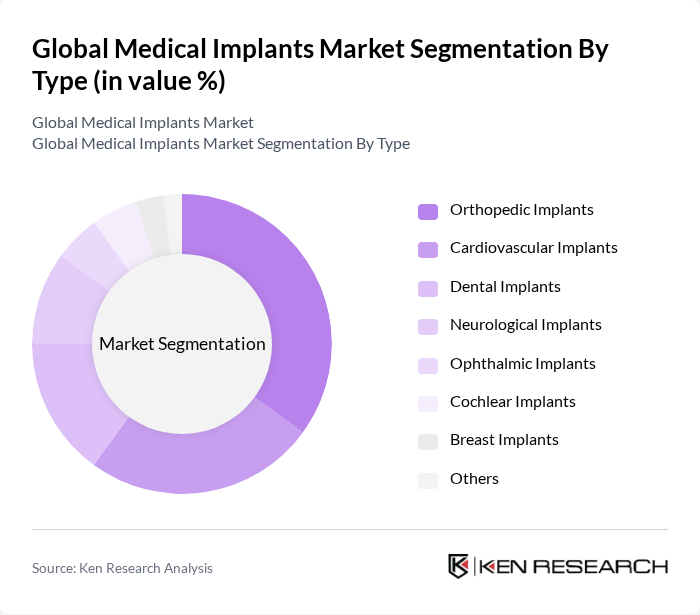
By Type:The market is segmented into various types of implants, including orthopedic, cardiovascular, dental, neurological, ophthalmic, cochlear, breast implants, and others. Among these, orthopedic implants are leading the market due to the rising incidence of orthopedic disorders and the increasing number of joint replacement surgeries. The demand for advanced materials, minimally invasive procedures, and smart implant technologies in orthopedic implants is driving innovation and growth in this segment.
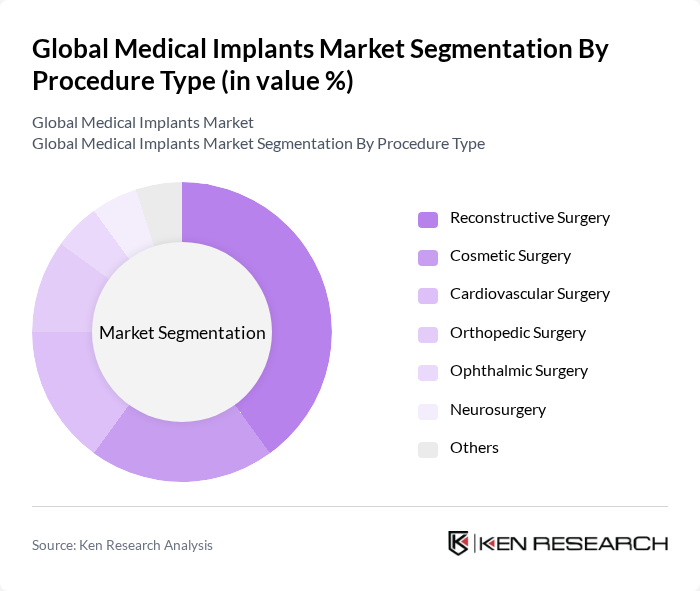
By Procedure Type:This segmentation includes reconstructive surgery, cosmetic surgery, cardiovascular surgery, orthopedic surgery, ophthalmic surgery, neurosurgery, and others. The reconstructive surgery segment is currently dominating the market due to the increasing number of surgical procedures performed globally, driven by trauma cases, congenital defects, and the rising adoption of advanced reconstructive techniques. The growing awareness and demand for cosmetic enhancements is also contributing to the rise in cosmetic surgery procedures.
Global Medical Implants Market Competitive Landscape
The Global Medical Implants Market is characterized by a dynamic mix of regional and international players. Leading participants such as Medtronic plc, Johnson & Johnson (DePuy Synthes), Stryker Corporation, Zimmer Biomet Holdings, Inc., Boston Scientific Corporation, Abbott Laboratories, B. Braun Melsungen AG, Smith & Nephew plc, NuVasive, Inc., Conmed Corporation, Orthofix Medical Inc., Integra LifeSciences Holdings Corporation, Hologic, Inc., Wright Medical Group N.V., Straumann Group, Dentsply Sirona, 3M Health Care, Cardinal Health, Coloplast A/S, Cochlear Limited contribute to innovation, geographic expansion, and service delivery in this space.
Global Medical Implants Market Industry Analysis
Growth Drivers
- Increasing Prevalence of Chronic Diseases:The rise in chronic diseases such as diabetes and cardiovascular conditions is a significant growth driver for the medical implants market. According to the World Health Organization, approximately 422 million people worldwide have diabetes, and cardiovascular diseases account for 31% of global deaths. This increasing patient population necessitates advanced medical implants, leading to a projected increase in demand for devices like stents and pacemakers, which are essential for managing these conditions effectively.
- Advancements in Implant Technology:Technological innovations in medical implants, including the development of bioresorbable stents and smart implants, are propelling market growth. The global investment in medical technology is expected to reach $500 billion in future, fostering advancements that enhance the functionality and safety of implants. These innovations not only improve patient outcomes but also reduce recovery times, making them more appealing to healthcare providers and patients alike, thus driving market expansion.
- Rising Geriatric Population:The global geriatric population is projected to reach 1.5 billion in future, according to the United Nations. This demographic shift is a crucial driver for the medical implants market, as older adults are more susceptible to conditions requiring implants, such as joint replacements and cardiac devices. In future, the number of hip and knee replacement surgeries is expected to exceed 1 million in the U.S. alone, highlighting the growing demand for medical implants tailored to this age group.
Market Challenges
- High Cost of Medical Implants:The high cost associated with medical implants poses a significant challenge to market growth. For instance, the average cost of a hip replacement can range from $30,000 to $50,000, which can be prohibitive for many patients, especially in regions with limited healthcare funding. This financial barrier can lead to delayed surgeries and reduced access to necessary treatments, ultimately impacting the overall market potential for medical implants.
- Stringent Regulatory Requirements:The medical implants market faces stringent regulatory requirements that can hinder innovation and market entry. In the U.S., the FDA mandates rigorous testing and approval processes for new devices, which can take several years and significant financial investment. For example, the average time for a new medical device to receive FDA approval is approximately 3-7 years, creating delays that can stifle market growth and limit the introduction of innovative products.
Global Medical Implants Market Future Outlook
The future of the medical implants market appears promising, driven by ongoing technological advancements and an increasing focus on patient-centric care. As the demand for minimally invasive procedures rises, the integration of smart technology into implants is expected to enhance patient monitoring and outcomes. Additionally, the expansion into emerging markets will provide new growth avenues, as healthcare infrastructure improves and access to advanced medical technologies increases, fostering a more inclusive healthcare environment.
Market Opportunities
- Emerging Markets Expansion:Emerging markets present significant opportunities for growth in the medical implants sector. Countries like India and Brazil are investing heavily in healthcare infrastructure, with healthcare spending projected to reach $1 trillion in future. This investment will facilitate greater access to advanced medical implants, catering to the rising demand from their growing populations.
- Innovations in Biocompatible Materials:The development of biocompatible materials is a key opportunity for the medical implants market. Innovations in materials science are leading to the creation of implants that reduce the risk of rejection and improve integration with human tissue. The global biocompatible materials market is expected to reach $20 billion in future, indicating a strong potential for growth in this area, which can enhance the performance and acceptance of medical implants.
Scope of the Report
| Segment | Sub-Segments |
|---|---|
| By Type | Orthopedic Implants Cardiovascular Implants Dental Implants Neurological Implants Ophthalmic Implants Cochlear Implants Breast Implants Others |
| By Procedure Type | Reconstructive Surgery Cosmetic Surgery Cardiovascular Surgery Orthopedic Surgery Ophthalmic Surgery Neurosurgery Others |
| By End-User | Hospitals Ambulatory Surgical Centers Specialty Clinics Research and Academic Institutes |
| By Material | Metal Implants Polymer Implants Ceramic Implants Composite Implants |
| By Application | Joint Replacement Spine Surgery Cardiovascular Procedures Dental Restoration Hearing Restoration Cosmetic Enhancement |
| By Distribution Channel | Direct Sales Distributors Online Sales |
| By Region | North America Europe Asia-Pacific Latin America Middle East & Africa |
| By Price Range | Low Price Range Mid Price Range High Price Range |
Key Target Audience
Investors and Venture Capitalist Firms
Government and Regulatory Bodies (e.g., U.S. Food and Drug Administration, European Medicines Agency)
Manufacturers and Producers
Distributors and Retailers
Healthcare Providers and Hospitals
Medical Device Regulatory Consultants
Industry Associations (e.g., Medical Device Manufacturers Association)
Insurance Companies and Payers
Players Mentioned in the Report:
Medtronic plc
Johnson & Johnson (DePuy Synthes)
Stryker Corporation
Zimmer Biomet Holdings, Inc.
Boston Scientific Corporation
Abbott Laboratories
B. Braun Melsungen AG
Smith & Nephew plc
NuVasive, Inc.
Conmed Corporation
Orthofix Medical Inc.
Integra LifeSciences Holdings Corporation
Hologic, Inc.
Wright Medical Group N.V.
Straumann Group
Dentsply Sirona
3M Health Care
Cardinal Health
Coloplast A/S
Cochlear Limited
Table of Contents
Market Assessment Phase
1. Executive Summary and Approach
2. Global Medical Implants Market Overview
2.1 Key Insights and Strategic Recommendations
2.2 Global Medical Implants Market Overview
2.3 Definition and Scope
2.4 Evolution of Market Ecosystem
2.5 Timeline of Key Regulatory Milestones
2.6 Value Chain & Stakeholder Mapping
2.7 Business Cycle Analysis
2.8 Policy & Incentive Landscape
3. Global Medical Implants Market Analysis
3.1 Growth Drivers
3.1.1 Increasing prevalence of chronic diseases
3.1.2 Advancements in implant technology
3.1.3 Rising geriatric population
3.1.4 Growing demand for minimally invasive surgeries
3.2 Market Challenges
3.2.1 High cost of medical implants
3.2.2 Stringent regulatory requirements
3.2.3 Risk of implant rejection
3.2.4 Limited reimbursement policies
3.3 Market Opportunities
3.3.1 Emerging markets expansion
3.3.2 Innovations in biocompatible materials
3.3.3 Growth in orthopedic and dental implants
3.3.4 Increasing focus on personalized medicine
3.4 Market Trends
3.4.1 Rise of 3D printing in implant manufacturing
3.4.2 Integration of smart technology in implants
3.4.3 Shift towards outpatient procedures
3.4.4 Growing emphasis on patient-centric care
3.5 Government Regulation
3.5.1 FDA regulations on medical devices
3.5.2 CE marking requirements in Europe
3.5.3 ISO standards for medical implants
3.5.4 Post-market surveillance regulations
4. SWOT Analysis
5. Stakeholder Analysis
6. Porter's Five Forces Analysis
7. Global Medical Implants Market Market Size, 2019-2024
7.1 By Value
7.2 By Volume
7.3 By Average Selling Price
8. Global Medical Implants Market Segmentation
8.1 By Type
8.1.1 Orthopedic Implants
8.1.2 Cardiovascular Implants
8.1.3 Dental Implants
8.1.4 Neurological Implants
8.1.5 Ophthalmic Implants
8.1.6 Cochlear Implants
8.1.7 Breast Implants
8.1.8 Others
8.2 By Procedure Type
8.2.1 Reconstructive Surgery
8.2.2 Cosmetic Surgery
8.2.3 Cardiovascular Surgery
8.2.4 Orthopedic Surgery
8.2.5 Ophthalmic Surgery
8.2.6 Neurosurgery
8.2.7 Others
8.3 By End-User
8.3.1 Hospitals
8.3.2 Ambulatory Surgical Centers
8.3.3 Specialty Clinics
8.3.4 Research and Academic Institutes
8.4 By Material
8.4.1 Metal Implants
8.4.2 Polymer Implants
8.4.3 Ceramic Implants
8.4.4 Composite Implants
8.5 By Application
8.5.1 Joint Replacement
8.5.2 Spine Surgery
8.5.3 Cardiovascular Procedures
8.5.4 Dental Restoration
8.5.5 Hearing Restoration
8.5.6 Cosmetic Enhancement
8.6 By Distribution Channel
8.6.1 Direct Sales
8.6.2 Distributors
8.6.3 Online Sales
8.7 By Region
8.7.1 North America
8.7.2 Europe
8.7.3 Asia-Pacific
8.7.4 Latin America
8.7.5 Middle East & Africa
8.8 By Price Range
8.8.1 Low Price Range
8.8.2 Mid Price Range
8.8.3 High Price Range
9. Global Medical Implants Market Competitive Analysis
9.1 Market Share of Key Players
9.2 KPIs for Cross Comparison of Key Players
9.2.1 Company Name
9.2.2 Group Size (Large, Medium, or Small as per industry convention)
9.2.3 Revenue Growth Rate (YoY %)
9.2.4 Market Share (%)
9.2.5 Geographic Presence (Number of countries/regions)
9.2.6 R&D Investment (% of revenue)
9.2.7 Product Portfolio Breadth (Number of implant categories)
9.2.8 Regulatory Approvals (FDA, CE, etc.)
9.2.9 Patent Count
9.2.10 Customer Satisfaction Score (Net Promoter Score or equivalent)
9.2.11 Distribution Network Strength
9.2.12 Pricing Strategy
9.2.13 Brand Recognition (Global/Regional)
9.3 SWOT Analysis of Top Players
9.4 Pricing Analysis
9.5 Detailed Profile of Major Companies
9.5.1 Medtronic plc
9.5.2 Johnson & Johnson (DePuy Synthes)
9.5.3 Stryker Corporation
9.5.4 Zimmer Biomet Holdings, Inc.
9.5.5 Boston Scientific Corporation
9.5.6 Abbott Laboratories
9.5.7 B. Braun Melsungen AG
9.5.8 Smith & Nephew plc
9.5.9 NuVasive, Inc.
9.5.10 Conmed Corporation
9.5.11 Orthofix Medical Inc.
9.5.12 Integra LifeSciences Holdings Corporation
9.5.13 Hologic, Inc.
9.5.14 Wright Medical Group N.V.
9.5.15 Straumann Group
9.5.16 Dentsply Sirona
9.5.17 3M Health Care
9.5.18 Cardinal Health
9.5.19 Coloplast A/S
9.5.20 Cochlear Limited
10. Global Medical Implants Market End-User Analysis
10.1 Procurement Behavior of Key Ministries
10.1.1 Government healthcare procurement policies
10.1.2 Budget allocation for medical implants
10.1.3 Evaluation criteria for suppliers
10.2 Corporate Spend on Infrastructure & Energy
10.2.1 Investment in healthcare infrastructure
10.2.2 Funding for medical technology
10.2.3 Corporate partnerships for implant procurement
10.3 Pain Point Analysis by End-User Category
10.3.1 Challenges faced by hospitals
10.3.2 Issues in outpatient care
10.3.3 Concerns of specialty clinics
10.4 User Readiness for Adoption
10.4.1 Training requirements for healthcare professionals
10.4.2 Patient awareness and education
10.4.3 Infrastructure readiness for new implants
10.5 Post-Deployment ROI and Use Case Expansion
10.5.1 Measurement of patient outcomes
10.5.2 Cost-benefit analysis of implants
10.5.3 Opportunities for product upgrades
11. Global Medical Implants Market Future Size, 2025-2030
11.1 By Value
11.2 By Volume
11.3 By Average Selling Price
Go-To-Market Strategy Phase
1. Whitespace Analysis + Business Model Canvas
1.1 Market gaps and opportunities
1.2 Business model components
2. Marketing and Positioning Recommendations
2.1 Branding strategies
2.2 Product USPs
3. Distribution Plan
3.1 Urban retail strategies
3.2 Rural NGO tie-ups
4. Channel & Pricing Gaps
4.1 Underserved routes
4.2 Pricing bands
5. Unmet Demand & Latent Needs
5.1 Category gaps
5.2 Consumer segments
6. Customer Relationship
6.1 Loyalty programs
6.2 After-sales service
7. Value Proposition
7.1 Sustainability initiatives
7.2 Integrated supply chains
8. Key Activities
8.1 Regulatory compliance
8.2 Branding efforts
8.3 Distribution setup
9. Entry Strategy Evaluation
9.1 Domestic Market Entry Strategy
9.1.1 Product mix considerations
9.1.2 Pricing band analysis
9.1.3 Packaging strategies
9.2 Export Entry Strategy
9.2.1 Target countries
9.2.2 Compliance roadmap
10. Entry Mode Assessment
10.1 Joint Ventures
10.2 Greenfield investments
10.3 Mergers & Acquisitions
10.4 Distributor Model
11. Capital and Timeline Estimation
11.1 Capital requirements
11.2 Timelines for market entry
12. Control vs Risk Trade-Off
12.1 Ownership considerations
12.2 Partnerships evaluation
13. Profitability Outlook
13.1 Breakeven analysis
13.2 Long-term sustainability strategies
14. Potential Partner List
14.1 Distributors
14.2 Joint Ventures
14.3 Acquisition targets
15. Execution Roadmap
15.1 Phased Plan for Market Entry
15.1.1 Market Setup
15.1.2 Market Entry
15.1.3 Growth Acceleration
15.1.4 Scale & Stabilize
15.2 Key Activities and Milestones
15.2.1 Milestone planning
15.2.2 Activity tracking
Research Methodology
Phase 1: Approach1
Desk Research
- Analysis of industry reports from medical device associations and healthcare market research firms
- Review of published articles in medical journals focusing on implant technologies and market trends
- Examination of regulatory documents from health authorities regarding medical implant approvals and guidelines
Primary Research
- Interviews with orthopedic surgeons and specialists in implantable devices
- Surveys conducted with hospital procurement managers regarding purchasing trends
- Field interviews with biomedical engineers involved in implant design and development
Validation & Triangulation
- Cross-validation of data through multiple sources including trade publications and expert opinions
- Triangulation of market data with sales figures from leading medical implant manufacturers
- Sanity checks through expert panel discussions to ensure data accuracy and relevance
Phase 2: Market Size Estimation1
Top-down Assessment
- Estimation of market size based on global healthcare expenditure and its allocation to medical implants
- Segmentation of the market by type of implant (e.g., orthopedic, dental, cardiovascular) and geographical region
- Incorporation of growth rates from emerging markets and technological advancements in implant materials
Bottom-up Modeling
- Collection of sales data from key players in the medical implants sector
- Estimation of unit sales based on hospital and clinic purchasing patterns
- Cost analysis of implant production and pricing strategies across different regions
Forecasting & Scenario Analysis
- Multi-variable regression analysis incorporating factors such as aging population and chronic disease prevalence
- Scenario modeling based on potential regulatory changes and technological innovations
- Development of baseline, optimistic, and pessimistic forecasts through 2030
Phase 3: CATI Sample Composition1
| Scope Item/Segment | Sample Size | Target Respondent Profiles |
|---|---|---|
| Orthopedic Implant Procurement | 120 | Hospital Procurement Managers, Orthopedic Surgeons |
| Cardiovascular Device Usage | 90 | Cardiologists, Cardiac Surgeons |
| Dental Implant Market Insights | 60 | Dentists, Oral Surgeons |
| Regulatory Compliance in Implants | 50 | Regulatory Affairs Specialists, Quality Assurance Managers |
| Emerging Technologies in Implants | 70 | Biomedical Engineers, R&D Managers |
Frequently Asked Questions
What is the current value of the Global Medical Implants Market?
The Global Medical Implants Market is valued at approximately USD 121 billion, driven by factors such as the increasing prevalence of chronic diseases, advancements in medical technology, and a growing aging population requiring surgical interventions.
Which countries dominate the Global Medical Implants Market?
What are the main types of medical implants available in the market?
What are the key growth drivers for the medical implants market?
Other Regional/Country Reports
Indonesia Medical Implants Market
Malaysia Medical Implants Market
APAC Medical Implants Market
SEA Medical Implants Market
Why Buy From Us?

What makes us stand out is that our consultants follow Robust, Refine and Result (RRR) methodology. Robust for clear definitions, approaches and sanity checking, Refine for differentiating respondents' facts and opinions, and Result for presenting data with story.

We have set a benchmark in the industry by offering our clients with syndicated and customized market research reports featuring coverage of entire market as well as meticulous research and analyst insights.

While we don't replace traditional research, we flip the method upside down. Our dual approach of Top Bottom & Bottom Top ensures quality deliverable by not just verifying company fundamentals but also looking at the sector and macroeconomic factors.

With one step in the future, our research team constantly tries to show you the bigger picture. We help with some of the tough questions you may encounter along the way: How is the industry positioned? Best marketing channel? KPI's of competitors? By aligning every element, we help maximize success.

Our report gives you instant access to the answers and sources that other companies might choose to hide. We elaborate each steps of research methodology we have used and showcase you the sample size to earn your trust.

If you need any support, we are here! We pride ourselves on universe strength, data quality, and quick, friendly, and professional service.