About the Report
Base Year 2024Listen to the audio summary
Global Medical Simulation Market Overview
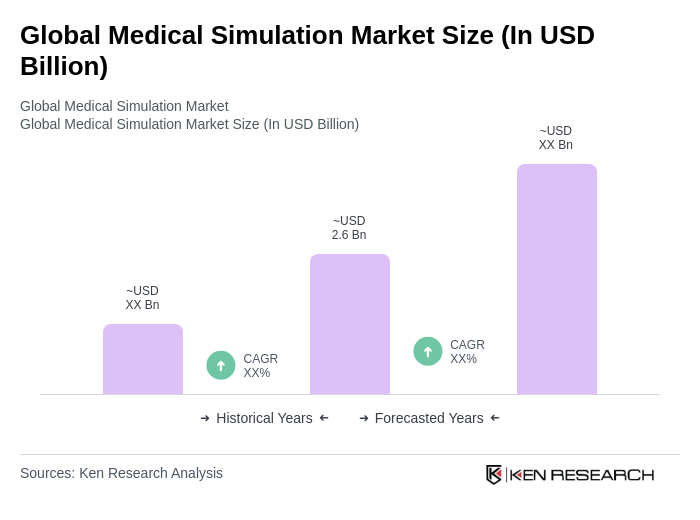
- The Global Medical Simulation Market is valued at USD 2.6 billion, based on a five-year historical analysis. Adoption is being propelled by stronger emphasis on patient safety, standardized clinical training, and wider integration of high-fidelity manikins, procedure simulators, and immersive technologies in medical education and hospital training programs .
- The United States, Germany, and the United Kingdom remain leading markets supported by advanced healthcare infrastructure, higher simulation budgets in academic centers and health systems, and the presence of major vendors and simulation networks; North America holds the largest regional share, while Europe has dense academic simulation adoption across Germany and the UK .
- In 2023, the U.S. did not implement a federal regulation mandating simulation-based training across all medical education programs. Instead, adoption is driven by accreditation standards and program requirements (e.g., ACGME milestones, specialty boards) and significant grant funding and institutional policies; targeted initiatives and grants have expanded simulation access rather than a nationwide mandate .
Global Medical Simulation Market Segmentation
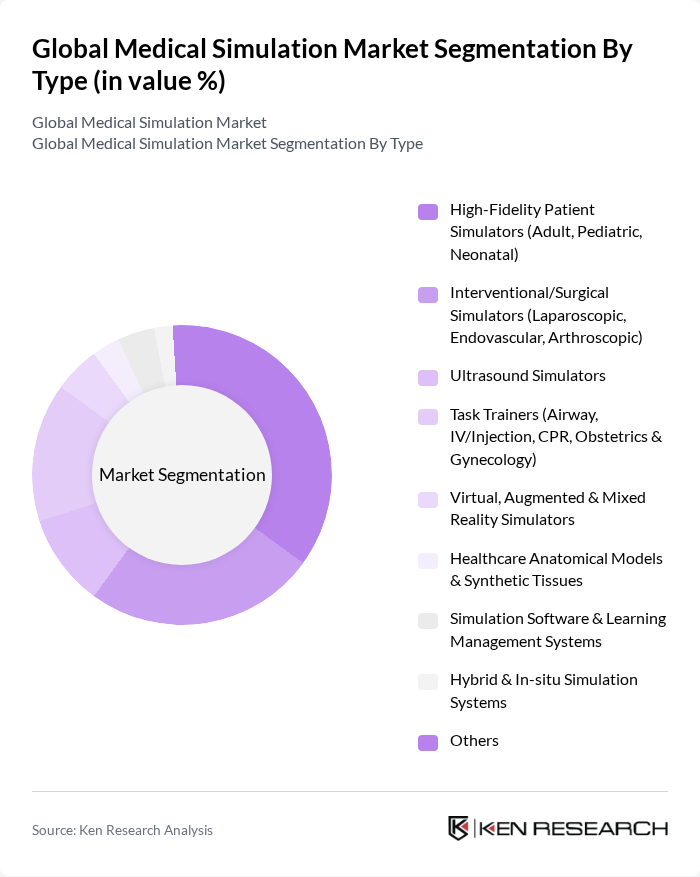
By Type:The market is segmented into various types of medical simulation technologies, including high-fidelity patient simulators, interventional/surgical simulators, ultrasound simulators, task trainers, virtual/augmented/mixed reality simulators, healthcare anatomical models, simulation software, hybrid systems, and others. Among these, high-fidelity patient simulators are leading the market due to their realistic representation of human physiology and ability to provide immersive training experiences. The demand for these simulators is driven by their effectiveness in enhancing clinical skills and decision-making abilities among healthcare professionals. Recent growth catalysts include expanded use of VR/AR for procedural rehearsal, increased demand for minimally invasive surgery training, and broader LMS/analytics integration into simulation centers in hospitals and academic institutions .
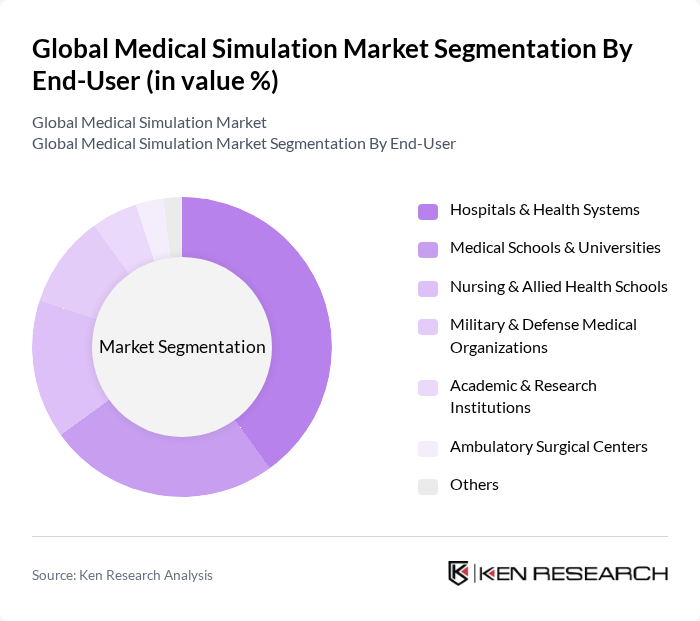
By End-User:The end-user segmentation includes hospitals and health systems, medical schools and universities, nursing and allied health schools, military and defense medical organizations, academic and research institutions, ambulatory surgical centers, and others. Hospitals and health systems are the leading end-users, driven by the need for continuous training and skill enhancement of healthcare staff. The increasing focus on patient safety and quality of care in these institutions further propels the demand for medical simulation technologies. Growth is reinforced by academic program expansions and government/charitable grants that extend simulation to rural and community settings .
Global Medical Simulation Market Competitive Landscape
The Global Medical Simulation Market is characterized by a dynamic mix of regional and international players. Leading participants such as Laerdal Medical AS, CAE Healthcare (CAE Inc.), Gaumard Scientific Company, Inc., 3D Systems, Inc. (Simbionix/Surgical AR/VR), Limbs & Things Ltd., Simulab Corporation, SynDaver Labs, Mentice AB, VirtaMed AG, Intelligent Ultrasound Group plc, InSimo SAS, Kyoto Kagaku Co., Ltd., Adam,Rouilly Ltd., MedVision Group, B-Line Medical (AdvSim; a CAE company) contribute to innovation, geographic expansion, and service delivery in this space.
Global Medical Simulation Market Industry Analysis
Growth Drivers
- Increasing Demand for Healthcare Professionals:The global healthcare workforce is projected to reach 40 million in the future, driven by an aging population and rising chronic diseases. The World Health Organization estimates a shortage of 10 million healthcare workers, emphasizing the need for effective training solutions. Medical simulation provides a hands-on approach to training, enabling healthcare professionals to gain practical experience without risking patient safety, thus addressing this critical demand.
- Advancements in Simulation Technology:The medical simulation technology market is expected to grow significantly, with investments in high-fidelity simulators projected to exceed $1.5 billion in the future. Innovations such as augmented reality (AR) and virtual reality (VR) are enhancing training experiences, allowing for immersive learning environments. These technologies enable realistic scenarios that improve skill acquisition and retention, making them essential tools in modern medical education and training.
- Rising Focus on Patient Safety and Quality of Care:In the future, healthcare organizations are expected to allocate over $2 billion towards initiatives aimed at improving patient safety. The Joint Commission emphasizes that simulation training can reduce medical errors by up to 50%. As healthcare providers increasingly prioritize quality care, the adoption of simulation-based training is becoming a vital strategy to enhance clinical skills and ensure better patient outcomes.
Market Challenges
- High Initial Investment Costs:The upfront costs for implementing medical simulation programs can exceed $500,000, which poses a significant barrier for many healthcare institutions. This financial hurdle is particularly challenging for smaller facilities and those in developing regions, where budgets are constrained. As a result, the high initial investment can limit the widespread adoption of advanced simulation technologies, hindering overall market growth.
- Limited Awareness Among Healthcare Institutions:A significant number of healthcare institutions remain unaware of the benefits of medical simulation, with studies indicating that over 40% of hospitals have not integrated simulation into their training programs. This lack of awareness can stall the adoption of innovative training methods, as institutions may continue relying on traditional training approaches, which may not adequately prepare healthcare professionals for real-world challenges.
Global Medical Simulation Market Future Outlook
The future of the medical simulation market appears promising, driven by technological advancements and an increasing emphasis on quality healthcare. As healthcare systems worldwide continue to evolve, the integration of simulation training into curricula is expected to become standard practice. Additionally, the growing recognition of the importance of interprofessional education will further enhance collaboration among healthcare professionals, ultimately leading to improved patient care and safety outcomes in the future.
Market Opportunities
- Expansion in Emerging Markets:Emerging markets, particularly in Asia and Africa, are projected to see a surge in healthcare investments, with spending expected to reach $1 trillion in the future. This growth presents significant opportunities for medical simulation providers to establish partnerships and expand their offerings, catering to the increasing demand for skilled healthcare professionals in these regions.
- Integration of Virtual Reality in Training:The virtual reality segment of the medical simulation market is anticipated to grow rapidly, with investments expected to surpass $500 million in the future. This technology offers immersive training experiences that can significantly enhance learning outcomes. By leveraging VR, medical institutions can provide realistic simulations that prepare healthcare professionals for complex clinical scenarios, thus improving overall training effectiveness.
Scope of the Report
| Segment | Sub-Segments |
|---|---|
| By Type | High-Fidelity Patient Simulators (Adult, Pediatric, Neonatal) Interventional/Surgical Simulators (Laparoscopic, Endovascular, Arthroscopic) Ultrasound Simulators Task Trainers (Airway, IV/Injection, CPR, Obstetrics & Gynecology) Virtual, Augmented & Mixed Reality Simulators Healthcare Anatomical Models & Synthetic Tissues Simulation Software & Learning Management Systems Hybrid & In-situ Simulation Systems Others |
| By End-User | Hospitals & Health Systems Medical Schools & Universities Nursing & Allied Health Schools Military & Defense Medical Organizations Academic & Research Institutions Ambulatory Surgical Centers Others |
| By Application | Medical Training & Education Surgical & Interventional Training Emergency & Trauma Response Team Training & Interprofessional Education Patient Safety & Risk Management Others |
| By Component | Hardware (Manikins, Sensors, Haptics) Software (Authoring, Scenario Management, Analytics) Services (Installation, Training, Simulation-as-a-Service) |
| By Sales Channel | Direct Sales to Institutions Value-Added Distributors/Resellers Online & E-Procurement Others |
| By Delivery Mode | On-Premise Simulation Centers Web-Based & Cloud-Delivered Simulation Mobile & In-situ Simulation |
| By Price Range | Entry-Level Mid-Range Premium Others |
Key Target Audience
Investors and Venture Capitalist Firms
Government and Regulatory Bodies (e.g., U.S. Food and Drug Administration, European Medicines Agency)
Healthcare Providers and Hospitals
Medical Device Manufacturers
Simulation Technology Developers
Healthcare Training Organizations
Insurance Companies
Pharmaceutical Companies
Players Mentioned in the Report:
Laerdal Medical AS
CAE Healthcare (CAE Inc.)
Gaumard Scientific Company, Inc.
3D Systems, Inc. (Simbionix/Surgical AR/VR)
Limbs & Things Ltd.
Simulab Corporation
SynDaver Labs
Mentice AB
VirtaMed AG
Intelligent Ultrasound Group plc
InSimo SAS
Kyoto Kagaku Co., Ltd.
Adam,Rouilly Ltd.
MedVision Group
B-Line Medical (AdvSim; a CAE company)
Table of Contents
Market Assessment Phase
1. Executive Summary and Approach
2. Global Medical Simulation Market Overview
2.1 Key Insights and Strategic Recommendations
2.2 Global Medical Simulation Market Overview
2.3 Definition and Scope
2.4 Evolution of Market Ecosystem
2.5 Timeline of Key Regulatory Milestones
2.6 Value Chain & Stakeholder Mapping
2.7 Business Cycle Analysis
2.8 Policy & Incentive Landscape
3. Global Medical Simulation Market Analysis
3.1 Growth Drivers
3.1.1 Increasing demand for healthcare professionals
3.1.2 Advancements in simulation technology
3.1.3 Rising focus on patient safety and quality of care
3.1.4 Growing adoption of e-learning in medical education
3.2 Market Challenges
3.2.1 High initial investment costs
3.2.2 Limited awareness among healthcare institutions
3.2.3 Regulatory hurdles in product approvals
3.2.4 Competition from traditional training methods
3.3 Market Opportunities
3.3.1 Expansion in emerging markets
3.3.2 Integration of virtual reality in training
3.3.3 Development of customized simulation solutions
3.3.4 Partnerships with educational institutions
3.4 Market Trends
3.4.1 Increasing use of mobile simulation units
3.4.2 Growth of telemedicine and remote training
3.4.3 Emphasis on interprofessional education
3.4.4 Rise of gamification in medical training
3.5 Government Regulation
3.5.1 Standards for medical simulation equipment
3.5.2 Certification requirements for training programs
3.5.3 Funding initiatives for healthcare training
3.5.4 Data protection regulations in medical training
4. SWOT Analysis
5. Stakeholder Analysis
6. Porter's Five Forces Analysis
7. Global Medical Simulation Market Market Size, 2019-2024
7.1 By Value
7.2 By Volume
7.3 By Average Selling Price
8. Global Medical Simulation Market Segmentation
8.1 By Type
8.1.1 High-Fidelity Patient Simulators (Adult, Pediatric, Neonatal)
8.1.2 Interventional/Surgical Simulators (Laparoscopic, Endovascular, Arthroscopic)
8.1.3 Ultrasound Simulators
8.1.4 Task Trainers (Airway, IV/Injection, CPR, Obstetrics & Gynecology)
8.1.5 Virtual, Augmented & Mixed Reality Simulators
8.1.6 Healthcare Anatomical Models & Synthetic Tissues
8.1.7 Simulation Software & Learning Management Systems
8.1.8 Hybrid & In-situ Simulation Systems
8.1.9 Others
8.2 By End-User
8.2.1 Hospitals & Health Systems
8.2.2 Medical Schools & Universities
8.2.3 Nursing & Allied Health Schools
8.2.4 Military & Defense Medical Organizations
8.2.5 Academic & Research Institutions
8.2.6 Ambulatory Surgical Centers
8.2.7 Others
8.3 By Application
8.3.1 Medical Training & Education
8.3.2 Surgical & Interventional Training
8.3.3 Emergency & Trauma Response
8.3.4 Team Training & Interprofessional Education
8.3.5 Patient Safety & Risk Management
8.3.6 Others
8.4 By Component
8.4.1 Hardware (Manikins, Sensors, Haptics)
8.4.2 Software (Authoring, Scenario Management, Analytics)
8.4.3 Services (Installation, Training, Simulation-as-a-Service)
8.5 By Sales Channel
8.5.1 Direct Sales to Institutions
8.5.2 Value-Added Distributors/Resellers
8.5.3 Online & E-Procurement
8.5.4 Others
8.6 By Delivery Mode
8.6.1 On-Premise Simulation Centers
8.6.2 Web-Based & Cloud-Delivered Simulation
8.6.3 Mobile & In-situ Simulation
8.7 By Price Range
8.7.1 Entry-Level
8.7.2 Mid-Range
8.7.3 Premium
8.7.4 Others
9. Global Medical Simulation Market Competitive Analysis
9.1 Market Share of Key Players
9.2 Cross Comparison of Key Players
9.2.1 Company Name
9.2.2 Group Size (Large, Medium, or Small as per industry convention)
9.2.3 Revenue Growth Rate (YoY, overall and simulation segment)
9.2.4 Installed Base (simulation centers/sites, units deployed)
9.2.5 Geographic Footprint (regions served, direct offices vs distributors)
9.2.6 Product Breadth (manikins, VR/AR, task trainers, ultrasound, software)
9.2.7 R&D Intensity (R&D as % of revenue, patents, new launches)
9.2.8 Average Deal Size and Win Rate in Tenders
9.2.9 Customer Retention/Recurring Revenue (service, software, SaaS)
9.2.10 Pricing Positioning (entry, mid, premium; list vs street price)
9.2.11 Partnerships & Integrations (OEMs, universities, EHR/LMS)
9.2.12 Training & Services Capacity (educators, service network, uptime SLAs)
9.2.13 Compliance & Certifications (AHA/ACLS alignment, CE, FDA, ISO)
9.2.14 ESG & Supply Chain Resilience (lead times, regional assembly)
9.3 SWOT Analysis of Top Players
9.4 Pricing Analysis
9.5 Detailed Profile of Major Companies
9.5.1 Laerdal Medical AS
9.5.2 CAE Healthcare (CAE Inc.)
9.5.3 Gaumard Scientific Company, Inc.
9.5.4 3D Systems, Inc. (Simbionix/Surgical AR/VR)
9.5.5 Limbs & Things Ltd.
9.5.6 Simulab Corporation
9.5.7 SynDaver Labs
9.5.8 Mentice AB
9.5.9 VirtaMed AG
9.5.10 Intelligent Ultrasound Group plc
9.5.11 InSimo SAS
9.5.12 Kyoto Kagaku Co., Ltd.
9.5.13 Adam,Rouilly Ltd.
9.5.14 MedVision Group
9.5.15 B-Line Medical (AdvSim; a CAE company)
10. Global Medical Simulation Market End-User Analysis
10.1 Procurement Behavior of Key Ministries
10.1.1 Budget Allocation for Medical Training
10.1.2 Decision-Making Process
10.1.3 Evaluation Criteria for Simulation Products
10.1.4 Procurement Timelines
10.2 Corporate Spend on Infrastructure & Energy
10.2.1 Investment in Training Facilities
10.2.2 Spending on Simulation Technologies
10.2.3 Budget for Continuous Education
10.3 Pain Point Analysis by End-User Category
10.3.1 Need for Realistic Training Environments
10.3.2 Challenges in Skill Assessment
10.3.3 Limitations of Traditional Training Methods
10.4 User Readiness for Adoption
10.4.1 Awareness of Simulation Benefits
10.4.2 Training Needs Assessment
10.4.3 Barriers to Adoption
10.5 Post-Deployment ROI and Use Case Expansion
10.5.1 Measurement of Training Effectiveness
10.5.2 Expansion of Simulation Use Cases
10.5.3 Long-term Cost Savings
11. Global Medical Simulation Market Future Size, 2025-2030
11.1 By Value
11.2 By Volume
11.3 By Average Selling Price
Go-To-Market Strategy Phase
1. Whitespace Analysis + Business Model Canvas
1.1 Market Gaps Identification
1.2 Business Model Development
2. Marketing and Positioning Recommendations
2.1 Branding Strategies
2.2 Product USPs
3. Distribution Plan
3.1 Urban Retail Strategies
3.2 Rural NGO Tie-ups
4. Channel & Pricing Gaps
4.1 Underserved Routes
4.2 Pricing Bands
5. Unmet Demand & Latent Needs
5.1 Category Gaps
5.2 Consumer Segments
6. Customer Relationship
6.1 Loyalty Programs
6.2 After-sales Service
7. Value Proposition
7.1 Sustainability
7.2 Integrated Supply Chains
8. Key Activities
8.1 Regulatory Compliance
8.2 Branding
8.3 Distribution Setup
9. Entry Strategy Evaluation
9.1 Domestic Market Entry Strategy
9.1.1 Product Mix
9.1.2 Pricing Band
9.1.3 Packaging
9.2 Export Entry Strategy
9.2.1 Target Countries
9.2.2 Compliance Roadmap
10. Entry Mode Assessment
10.1 Joint Ventures
10.2 Greenfield Investments
10.3 Mergers & Acquisitions
10.4 Distributor Model
11. Capital and Timeline Estimation
11.1 Capital Requirements
11.2 Timelines
12. Control vs Risk Trade-Off
12.1 Ownership vs Partnerships
13. Profitability Outlook
13.1 Breakeven Analysis
13.2 Long-term Sustainability
14. Potential Partner List
14.1 Distributors
14.2 Joint Ventures
14.3 Acquisition Targets
15. Execution Roadmap
15.1 Phased Plan for Market Entry
15.1.1 Market Setup
15.1.2 Market Entry
15.1.3 Growth Acceleration
15.1.4 Scale & Stabilize
15.2 Key Activities and Milestones
15.2.1 Activity Planning
15.2.2 Milestone Tracking
Research Methodology
Phase 1: Approach1
Desk Research
- Analysis of industry reports from medical simulation associations and healthcare organizations
- Review of academic journals and publications focusing on medical training and simulation technologies
- Examination of market trends and forecasts from reputable market research firms
Primary Research
- Interviews with key opinion leaders in medical education and simulation technology
- Surveys conducted with healthcare professionals and educators utilizing simulation tools
- Field interviews with administrators from medical schools and training institutions
Validation & Triangulation
- Cross-validation of findings through multiple data sources including industry reports and expert insights
- Triangulation of data from primary interviews and secondary research to ensure consistency
- Sanity checks through expert panel reviews to validate market assumptions and projections
Phase 2: Market Size Estimation1
Top-down Assessment
- Estimation of market size based on global healthcare expenditure and training budgets
- Segmentation of the market by product type, application, and geographical region
- Incorporation of trends in telemedicine and remote training impacting simulation demand
Bottom-up Modeling
- Collection of sales data from leading medical simulation manufacturers and distributors
- Estimation of unit sales based on training program enrollments and healthcare facility needs
- Cost analysis of simulation products and services to derive revenue projections
Forecasting & Scenario Analysis
- Multi-factor regression analysis considering factors such as technological advancements and regulatory changes
- Scenario modeling based on varying levels of healthcare investment and training adoption rates
- Development of baseline, optimistic, and pessimistic forecasts through 2030
Phase 3: CATI Sample Composition1
| Scope Item/Segment | Sample Size | Target Respondent Profiles |
|---|---|---|
| Medical Schools and Training Institutions | 120 | Deans, Curriculum Directors, Simulation Coordinators |
| Healthcare Providers and Hospitals | 110 | Chief Medical Officers, Training Managers, Nursing Educators |
| Medical Simulation Technology Manufacturers | 80 | Product Managers, Sales Directors, R&D Heads |
| Regulatory Bodies and Accreditation Organizations | 50 | Policy Makers, Accreditation Officers, Compliance Managers |
| Healthcare Simulation Research Institutions | 70 | Research Directors, Academic Researchers, Grant Managers |
Frequently Asked Questions
What is the current value of the Global Medical Simulation Market?
The Global Medical Simulation Market is valued at approximately USD 2.6 billion, driven by the increasing emphasis on patient safety, standardized clinical training, and the integration of advanced simulation technologies in medical education and hospital training programs.
Which regions are leading in the Global Medical Simulation Market?
What types of medical simulation technologies are available?
Who are the primary end-users of medical simulation technologies?
Other Regional/Country Reports
Indonesia Medical Simulation Market
Malaysia Medical Simulation Market
APAC Medical Simulation Market
Why Buy From Us?

What makes us stand out is that our consultants follow Robust, Refine and Result (RRR) methodology. Robust for clear definitions, approaches and sanity checking, Refine for differentiating respondents' facts and opinions, and Result for presenting data with story.

We have set a benchmark in the industry by offering our clients with syndicated and customized market research reports featuring coverage of entire market as well as meticulous research and analyst insights.

While we don't replace traditional research, we flip the method upside down. Our dual approach of Top Bottom & Bottom Top ensures quality deliverable by not just verifying company fundamentals but also looking at the sector and macroeconomic factors.

With one step in the future, our research team constantly tries to show you the bigger picture. We help with some of the tough questions you may encounter along the way: How is the industry positioned? Best marketing channel? KPI's of competitors? By aligning every element, we help maximize success.

Our report gives you instant access to the answers and sources that other companies might choose to hide. We elaborate each steps of research methodology we have used and showcase you the sample size to earn your trust.

If you need any support, we are here! We pride ourselves on universe strength, data quality, and quick, friendly, and professional service.