Global Mems Market

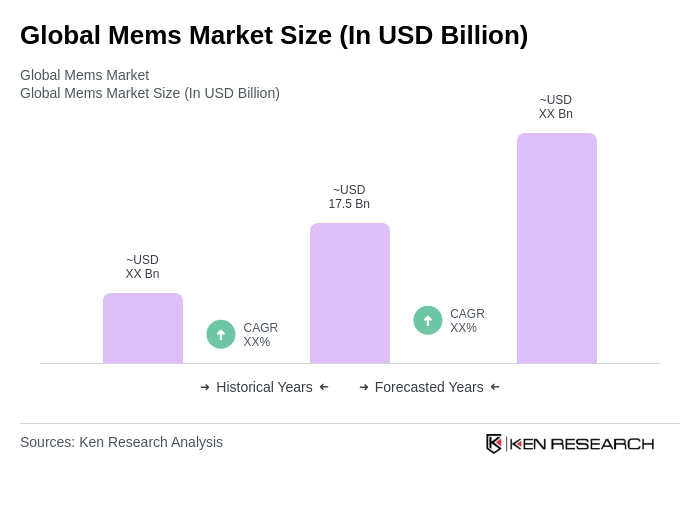
Global MEMS market, valued at USD 17.5 billion, is growing due to IoT proliferation, automotive safety regulations, and advancements in sensor technology across industries.

Region:Global

Author(s):Dev

Product Code:KRAA1548

Pages:83

Published On:August 2025
About the Report

Base Year 2024

Global Mems Market Overview

  • The Global MEMS market is valued at USD 17.5 billion, based on a five-year historical analysis. This growth is primarily driven by the increasing demand for miniaturized sensors and actuators across various industries, including automotive, consumer electronics, and healthcare. The proliferation of IoT devices and advancements in technology have further fueled the market's expansion, as companies seek to integrate MEMS technology into their products for enhanced functionality and efficiency.
  • Key players in this market include the United States, Germany, Japan, and South Korea, supported by deep semiconductor/MEMS manufacturing ecosystems, leading OEMs, and sustained R&D investment; Asia-Pacific (notably including Japan and South Korea) holds the largest regional revenue share due to its fabrication base and electronics production, while the United States and Germany anchor innovation and automotive demand.
  • The European Union’s recent safety regulations require that all new cars come equipped with a suite of advanced driver-assistance systems (e.g., intelligent speed assistance, lane keeping, emergency braking), which are typically enabled by sensors such as accelerometers, gyroscopes, pressure and microphones; these mandates have been phased in under the EU General Safety Regulation for new vehicle types and all new vehicles, catalyzing MEMS demand in automotive safety content.
Global Mems Market Size

Global Mems Market Segmentation

By Type:The MEMS market can be segmented into various types, including accelerometers, gyroscopes, pressure sensors, microphones, optical MEMS, RF MEMS, inertial measurement units (IMUs), microfluidic MEMS, thermal and infrared sensors, ultrasonic MEMS, timing MEMS, and others. Among these, accelerometers and gyroscopes are leading the market due to their extensive applications in consumer electronics and automotive sectors. The increasing demand for smartphones and wearables has significantly boosted the adoption of these MEMS devices.
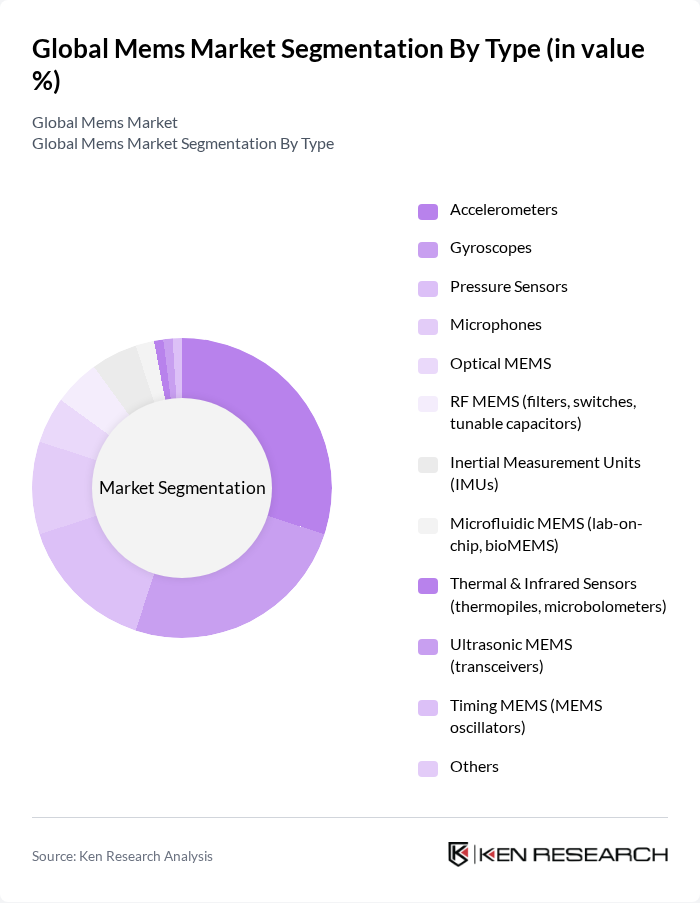
Global Mems Market segmentation by Type.

By End-User:The MEMS market is also segmented by end-user applications, including automotive, consumer electronics, healthcare and medical, industrial and manufacturing, aerospace and defense, telecommunications and 5G, smart home and IoT, and others. The automotive sector is the leading end-user, driven by the increasing integration of MEMS sensors in advanced driver-assistance systems (ADAS) and safety features. Consumer electronics, particularly smartphones and wearables, also represent a significant portion of the market. Recent data indicate consumer electronics is a top revenue contributor, while automotive content is expanding with mandated safety systems and electrification.
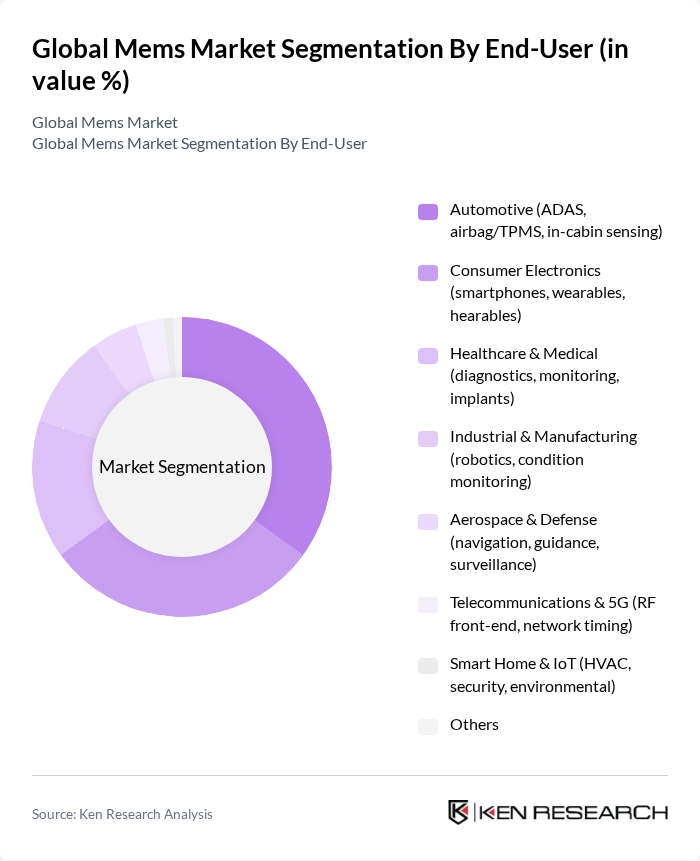
Global Mems Market segmentation by End-User.

Global Mems Market Competitive Landscape

The Global MEMS market is characterized by a dynamic mix of regional and international players. Leading participants such as Bosch Sensortec (Robert Bosch GmbH), STMicroelectronics N.V., Analog Devices, Inc., Texas Instruments Incorporated, Honeywell International Inc., TDK Corporation (including InvenSense, Inc.), NXP Semiconductors N.V., Qualcomm Technologies, Inc. (RF MEMS/timing ecosystem), MEMSIC, Inc., Infineon Technologies AG, Omron Corporation, Microchip Technology Inc. (MEMS timing via SiTime partnership/channel), SiTime Corporation, Seiko Epson Corporation, Silicon Microstructures, Inc. (a subsidiary of Elmos Semiconductor SE), Murata Manufacturing Co., Ltd., Panasonic Holdings Corporation, AAC Technologies Holdings Inc., Goertek Inc., ams-OSRAM AG contribute to innovation, geographic expansion, and service delivery in this space.

Bosch Sensortec

2005

Germany

STMicroelectronics N.V.

1987

Switzerland

Analog Devices, Inc.

1965

United States

Texas Instruments Incorporated

1930

United States

Honeywell International Inc.

1906

United States

Company

Establishment Year

Headquarters

MEMS Revenue (USD) and YoY Growth

Product Portfolio Breadth (sensors, actuators, RF, timing, microfluidics)

End-Market Mix (% consumer, auto, industrial, medical, telecom)

Design Wins/Content per Device (e.g., sensors per smartphone/vehicle)

R&D Intensity (% of revenue) and Patent Filings

Manufacturing Footprint (200/300 mm capacity, in-house vs foundry)

Global Mems Market Industry Analysis

Growth Drivers

  • Increasing Demand for Miniaturization in Electronics:The global trend towards miniaturization in electronics is driving the MEMS market significantly. In future, the consumer electronics sector is projected to reach $1.5 trillion, with MEMS devices playing a crucial role in enhancing functionality while reducing size. The demand for compact devices, such as smartphones and wearables, is expected to increase by 20% annually, further propelling MEMS adoption in various applications, including sensors and actuators.
  • Advancements in MEMS Technology:Continuous advancements in MEMS technology are fostering innovation and expanding applications. In future, R&D investments in MEMS are anticipated to exceed $6 billion, focusing on improving performance and reducing costs. Innovations such as advanced MEMS fabrication techniques and integration with nanoscale processes are expected to enhance device capabilities, making them more attractive for industries like automotive and healthcare, where precision and reliability are paramount.
  • Rising Applications in Automotive and Healthcare Sectors:The automotive and healthcare sectors are increasingly adopting MEMS technology, driven by the need for advanced functionalities. In future, the automotive MEMS market is projected to reach $4 billion, fueled by the integration of MEMS sensors in safety and navigation systems. Similarly, the healthcare sector is expected to invest over $3 billion in MEMS devices for applications such as diagnostics and monitoring, highlighting the technology's critical role in these industries.

Market Challenges

  • High Manufacturing Costs:One of the significant challenges facing the MEMS market is the high manufacturing costs associated with producing these devices. In future, the average cost of MEMS fabrication is estimated to be around $2 billion per facility, which can deter new entrants and limit scalability. This financial barrier impacts pricing strategies and profitability, particularly for small to medium-sized enterprises looking to innovate in this space.
  • Technical Complexities in Design and Production:The technical complexities involved in the design and production of MEMS devices pose a considerable challenge. In future, approximately 35% of MEMS projects are expected to face delays due to design intricacies and integration issues. These complexities require specialized knowledge and advanced manufacturing techniques, which can lead to increased development times and costs, ultimately affecting market competitiveness.

Global Mems Market Future Outlook

The MEMS market is poised for significant growth, driven by technological advancements and increasing demand across various sectors. As industries continue to embrace IoT and smart technologies, the integration of MEMS devices will become more prevalent. In future, the focus on energy-efficient solutions and the shift towards wireless MEMS devices will likely reshape the market landscape, fostering innovation and collaboration among key players to meet evolving consumer needs and regulatory standards.

Market Opportunities

  • Expansion in Emerging Markets:Emerging markets present substantial opportunities for MEMS growth, with an expected increase in demand for consumer electronics and automotive applications. In future, regions like Asia-Pacific are projected to contribute over $3 billion to the MEMS market, driven by rising disposable incomes and urbanization, creating a favorable environment for MEMS adoption.
  • Increasing Adoption of IoT Devices:The proliferation of IoT devices is a significant opportunity for MEMS technology. In future, the global IoT market is expected to reach $1.5 trillion, with MEMS sensors playing a critical role in data collection and analysis. This trend will drive demand for innovative MEMS solutions, enhancing their integration into smart homes, industrial automation, and healthcare applications.

Scope of the Report

SegmentSub-Segments
By Type

Accelerometers

Gyroscopes

Pressure Sensors

Microphones

Optical MEMS

RF MEMS (filters, switches, tunable capacitors)

Inertial Measurement Units (IMUs)

Microfluidic MEMS (lab-on-chip, bioMEMS)

Thermal & Infrared Sensors (thermopiles, microbolometers)

Ultrasonic MEMS (transceivers)

Timing MEMS (MEMS oscillators)

Others

By End-User

Automotive (ADAS, airbag/TPMS, in-cabin sensing)

Consumer Electronics (smartphones, wearables, hearables)

Healthcare & Medical (diagnostics, monitoring, implants)

Industrial & Manufacturing (robotics, condition monitoring)

Aerospace & Defense (navigation, guidance, surveillance)

Telecommunications & 5G (RF front-end, network timing)

Smart Home & IoT (HVAC, security, environmental)

Others

By Application

Smartphones & Mobile Devices

Automotive Safety & Powertrain

Industrial Automation & Robotics

Medical Diagnostics & Patient Monitoring

Environmental & Structural Monitoring

AR/VR, Drones & Gaming

Smart Wearables & Hearables

Others

By Component

Sensors

Actuators (micromirrors, microvalves, micro-pumps)

Control ICs & ASICs

Packaging & Test

Others

By Sales Channel

Direct Sales (OEMs, Tier-1s)

Distributors

Online Sales

Foundry/OSAT Partnerships

Others

By Distribution Mode

Offline Distribution

Online Distribution

Hybrid Distribution

By Price Range

Low Price Range

Mid Price Range

High Price Range

Key Target Audience

Investors and Venture Capitalist Firms

Government and Regulatory Bodies (e.g., National Institute of Standards and Technology, Federal Communications Commission)

Manufacturers and Producers

Distributors and Retailers

Technology Providers

Industry Associations (e.g., MEMS Industry Group)

Financial Institutions

Original Equipment Manufacturers (OEMs)

Players Mentioned in the Report:

Bosch Sensortec (Robert Bosch GmbH)

STMicroelectronics N.V.

Analog Devices, Inc.

Texas Instruments Incorporated

Honeywell International Inc.

TDK Corporation (including InvenSense, Inc.)

NXP Semiconductors N.V.

Qualcomm Technologies, Inc. (RF MEMS/timing ecosystem)

MEMSIC, Inc.

Infineon Technologies AG

Omron Corporation

Microchip Technology Inc. (MEMS timing via SiTime partnership/channel)

SiTime Corporation

Seiko Epson Corporation

Silicon Microstructures, Inc. (a subsidiary of Elmos Semiconductor SE)

Murata Manufacturing Co., Ltd.

Panasonic Holdings Corporation

AAC Technologies Holdings Inc.

Goertek Inc.

ams-OSRAM AG

Table of Contents

Market Assessment Phase

1. Executive Summary and Approach


2. Global Mems Market Overview

2.1 Key Insights and Strategic Recommendations

2.2 Global Mems Market Overview

2.3 Definition and Scope

2.4 Evolution of Market Ecosystem

2.5 Timeline of Key Regulatory Milestones

2.6 Value Chain & Stakeholder Mapping

2.7 Business Cycle Analysis

2.8 Policy & Incentive Landscape


3. Global Mems Market Analysis

3.1 Growth Drivers

3.1.1 Increasing demand for miniaturization in electronics
3.1.2 Advancements in MEMS technology
3.1.3 Rising applications in automotive and healthcare sectors
3.1.4 Growth in consumer electronics

3.2 Market Challenges

3.2.1 High manufacturing costs
3.2.2 Technical complexities in design and production
3.2.3 Intense competition among key players
3.2.4 Regulatory hurdles in different regions

3.3 Market Opportunities

3.3.1 Expansion in emerging markets
3.3.2 Increasing adoption of IoT devices
3.3.3 Development of smart sensors
3.3.4 Collaborations and partnerships for innovation

3.4 Market Trends

3.4.1 Growing integration of MEMS in smartphones
3.4.2 Shift towards wireless MEMS devices
3.4.3 Rising focus on energy-efficient MEMS solutions
3.4.4 Increasing use of MEMS in industrial automation

3.5 Government Regulation

3.5.1 Compliance with international safety standards
3.5.2 Environmental regulations impacting manufacturing
3.5.3 Incentives for R&D in MEMS technology
3.5.4 Trade policies affecting MEMS exports

4. SWOT Analysis


5. Stakeholder Analysis


6. Porter's Five Forces Analysis


7. Global Mems Market Market Size, 2019-2024

7.1 By Value

7.2 By Volume

7.3 By Average Selling Price


8. Global Mems Market Segmentation

8.1 By Type

8.1.1 Accelerometers
8.1.2 Gyroscopes
8.1.3 Pressure Sensors
8.1.4 Microphones
8.1.5 Optical MEMS
8.1.6 RF MEMS (filters, switches, tunable capacitors)
8.1.7 Inertial Measurement Units (IMUs)
8.1.8 Microfluidic MEMS (lab-on-chip, bioMEMS)
8.1.9 Thermal & Infrared Sensors (thermopiles, microbolometers)
8.1.10 Ultrasonic MEMS (transceivers)
8.1.11 Timing MEMS (MEMS oscillators)
8.1.12 Others

8.2 By End-User

8.2.1 Automotive (ADAS, airbag/TPMS, in-cabin sensing)
8.2.2 Consumer Electronics (smartphones, wearables, hearables)
8.2.3 Healthcare & Medical (diagnostics, monitoring, implants)
8.2.4 Industrial & Manufacturing (robotics, condition monitoring)
8.2.5 Aerospace & Defense (navigation, guidance, surveillance)
8.2.6 Telecommunications & 5G (RF front-end, network timing)
8.2.7 Smart Home & IoT (HVAC, security, environmental)
8.2.8 Others

8.3 By Application

8.3.1 Smartphones & Mobile Devices
8.3.2 Automotive Safety & Powertrain
8.3.3 Industrial Automation & Robotics
8.3.4 Medical Diagnostics & Patient Monitoring
8.3.5 Environmental & Structural Monitoring
8.3.6 AR/VR, Drones & Gaming
8.3.7 Smart Wearables & Hearables
8.3.8 Others

8.4 By Component

8.4.1 Sensors
8.4.2 Actuators (micromirrors, microvalves, micro-pumps)
8.4.3 Control ICs & ASICs
8.4.4 Packaging & Test
8.4.5 Others

8.5 By Sales Channel

8.5.1 Direct Sales (OEMs, Tier-1s)
8.5.2 Distributors
8.5.3 Online Sales
8.5.4 Foundry/OSAT Partnerships
8.5.5 Others

8.6 By Distribution Mode

8.6.1 Offline Distribution
8.6.2 Online Distribution
8.6.3 Hybrid Distribution

8.7 By Price Range

8.7.1 Low Price Range
8.7.2 Mid Price Range
8.7.3 High Price Range

9. Global Mems Market Competitive Analysis

9.1 Market Share of Key Players

9.2 Cross Comparison of Key Players

9.2.1 Company Name
9.2.2 MEMS Revenue (USD) and YoY Growth
9.2.3 Product Portfolio Breadth (sensors, actuators, RF, timing, microfluidics)
9.2.4 End-Market Mix (% consumer, auto, industrial, medical, telecom)
9.2.5 Design Wins/Content per Device (e.g., sensors per smartphone/vehicle)
9.2.6 R&D Intensity (% of revenue) and Patent Filings
9.2.7 Manufacturing Footprint (200/300 mm capacity, in-house vs foundry)
9.2.8 Packaging & Test Capability (WLP, TSV, 3D stacking)
9.2.9 Supply Chain Resilience (multi-sourcing, geographic diversification)
9.2.10 ASP Trend and Gross Margin
9.2.11 Quality & Reliability Metrics (PPM, AEC-Q100/ISO 26262 readiness)
9.2.12 Customer Concentration and Top OEM/Tier-1 Accounts

9.3 SWOT Analysis of Top Players

9.4 Pricing Analysis

9.5 Detailed Profile of Major Companies

9.5.1 Bosch Sensortec (Robert Bosch GmbH)
9.5.2 STMicroelectronics N.V.
9.5.3 Analog Devices, Inc.
9.5.4 Texas Instruments Incorporated
9.5.5 Honeywell International Inc.
9.5.6 TDK Corporation (including InvenSense, Inc.)
9.5.7 NXP Semiconductors N.V.
9.5.8 Qualcomm Technologies, Inc. (RF MEMS/timing ecosystem)
9.5.9 MEMSIC, Inc.
9.5.10 Infineon Technologies AG
9.5.11 Omron Corporation
9.5.12 Microchip Technology Inc. (MEMS timing via SiTime partnership/channel)
9.5.13 SiTime Corporation
9.5.14 Seiko Epson Corporation
9.5.15 Silicon Microstructures, Inc. (a subsidiary of Elmos Semiconductor SE)
9.5.16 Murata Manufacturing Co., Ltd.
9.5.17 Panasonic Holdings Corporation
9.5.18 AAC Technologies Holdings Inc.
9.5.19 Goertek Inc.
9.5.20 ams-OSRAM AG

10. Global Mems Market End-User Analysis

10.1 Procurement Behavior of Key Ministries

10.1.1 Government contracts for MEMS devices
10.1.2 Budget allocation for technology upgrades
10.1.3 Collaboration with private sector
10.1.4 Compliance with procurement regulations

10.2 Corporate Spend on Infrastructure & Energy

10.2.1 Investment in MEMS for energy efficiency
10.2.2 Budgeting for smart infrastructure
10.2.3 Funding for research and development

10.3 Pain Point Analysis by End-User Category

10.3.1 Challenges in integration of MEMS
10.3.2 Cost concerns for small businesses
10.3.3 Technical support and maintenance issues

10.4 User Readiness for Adoption

10.4.1 Awareness of MEMS technology benefits
10.4.2 Training and support for end-users
10.4.3 Infrastructure readiness for MEMS integration

10.5 Post-Deployment ROI and Use Case Expansion

10.5.1 Measurement of performance improvements
10.5.2 Case studies of successful MEMS applications
10.5.3 Strategies for scaling MEMS solutions

11. Global Mems Market Future Size, 2025-2030

11.1 By Value

11.2 By Volume

11.3 By Average Selling Price


Go-To-Market Strategy Phase

1. Whitespace Analysis + Business Model Canvas

1.1 Market gaps and opportunities

1.2 Business model evaluation


2. Marketing and Positioning Recommendations

2.1 Branding strategies

2.2 Product USPs


3. Distribution Plan

3.1 Urban retail vs rural NGO tie-ups


4. Channel & Pricing Gaps

4.1 Underserved routes

4.2 Pricing bands


5. Unmet Demand & Latent Needs

5.1 Category gaps

5.2 Consumer segments


6. Customer Relationship

6.1 Loyalty programs

6.2 After-sales service


7. Value Proposition

7.1 Sustainability

7.2 Integrated supply chains


8. Key Activities

8.1 Regulatory compliance

8.2 Branding

8.3 Distribution setup


9. Entry Strategy Evaluation

9.1 Domestic Market Entry Strategy

9.1.1 Product mix
9.1.2 Pricing band
9.1.3 Packaging

9.2 Export Entry Strategy

9.2.1 Target countries
9.2.2 Compliance roadmap

10. Entry Mode Assessment

10.1 JV

10.2 Greenfield

10.3 M&A

10.4 Distributor Model


11. Capital and Timeline Estimation

11.1 Capital requirements

11.2 Timelines


12. Control vs Risk Trade-Off

12.1 Ownership vs Partnerships


13. Profitability Outlook

13.1 Breakeven analysis

13.2 Long-term sustainability


14. Potential Partner List

14.1 Distributors

14.2 JVs

14.3 Acquisition targets


15. Execution Roadmap

15.1 Phased Plan for Market Entry

15.1.1 Market Setup
15.1.2 Market Entry
15.1.3 Growth Acceleration
15.1.4 Scale & Stabilize

15.2 Key Activities and Milestones

15.2.1 Milestone tracking
15.2.2 Activity scheduling

Research Methodology

ApproachModellingSample

Phase 1: Approach1

Desk Research

  • Industry reports from MEMS trade associations and market research firms
  • Analysis of published market data from government agencies and industry publications
  • Review of academic journals and white papers on MEMS technology advancements

Primary Research

  • Interviews with R&D heads at leading MEMS manufacturers
  • Surveys with industry analysts and market experts in MEMS applications
  • Field interviews with engineers involved in MEMS design and production

Validation & Triangulation

  • Cross-validation of data from multiple sources including trade publications and expert interviews
  • Triangulation of market trends with historical data and future projections
  • Sanity checks through expert panel discussions and feedback sessions

Phase 2: Market Size Estimation1

Top-down Assessment

  • Estimation of global MEMS market size based on semiconductor industry growth
  • Segmentation by application areas such as automotive, consumer electronics, and healthcare
  • Incorporation of regional market dynamics and technological adoption rates

Bottom-up Modeling

  • Volume estimates based on production data from key MEMS manufacturers
  • Cost analysis derived from component pricing and manufacturing expenses
  • Application-specific revenue generation models based on market demand

Forecasting & Scenario Analysis

  • Multi-variable regression analysis incorporating economic indicators and technology trends
  • Scenario modeling based on varying rates of MEMS adoption across industries
  • Baseline, optimistic, and pessimistic forecasts through 2030

Phase 3: CATI Sample Composition1

Scope Item/SegmentSample SizeTarget Respondent Profiles
Automotive MEMS Applications100Automotive Engineers, Product Managers
Consumer Electronics MEMS Devices80Product Development Managers, Electronics Engineers
Healthcare MEMS Technologies70Biomedical Engineers, Healthcare Product Managers
Industrial MEMS Sensors60Manufacturing Engineers, Operations Managers
Telecommunications MEMS Solutions90Network Engineers, Telecom Product Managers

Frequently Asked Questions

What is the current value of the Global MEMS market?

The Global MEMS market is valued at approximately USD 17.5 billion, driven by the increasing demand for miniaturized sensors and actuators across various industries, including automotive, consumer electronics, and healthcare.

Which regions dominate the Global MEMS market?

What are the main applications of MEMS technology?

What types of MEMS devices are most prevalent?

Other Regional/Country Reports

UAE Mems MarketKSA Mems Market

Indonesia Mems Market

Malaysia Mems Market

APAC Mems Market

SEA Mems Market

Why Buy From Us?

Refine Robust Result (RRR) Framework

What makes us stand out is that our consultants follow Robust, Refine and Result (RRR) methodology. Robust for clear definitions, approaches and sanity checking, Refine for differentiating respondents' facts and opinions, and Result for presenting data with story.

Our Reach Is Unmatched

We have set a benchmark in the industry by offering our clients with syndicated and customized market research reports featuring coverage of entire market as well as meticulous research and analyst insights.

Shifting the Research Paradigm

While we don't replace traditional research, we flip the method upside down. Our dual approach of Top Bottom & Bottom Top ensures quality deliverable by not just verifying company fundamentals but also looking at the sector and macroeconomic factors.

More Insights-Better Decisions

With one step in the future, our research team constantly tries to show you the bigger picture. We help with some of the tough questions you may encounter along the way: How is the industry positioned? Best marketing channel? KPI's of competitors? By aligning every element, we help maximize success.

Transparency and Trust

Our report gives you instant access to the answers and sources that other companies might choose to hide. We elaborate each steps of research methodology we have used and showcase you the sample size to earn your trust.

Round the Clock Support

If you need any support, we are here! We pride ourselves on universe strength, data quality, and quick, friendly, and professional service.

Why Clients Choose Us?

400000+
Reports in repository
150+
Consulting projects a year
100+
Analysts
8000+
Client Queries in 2022








