Ken Research Logo

Global Mems Microphones Market

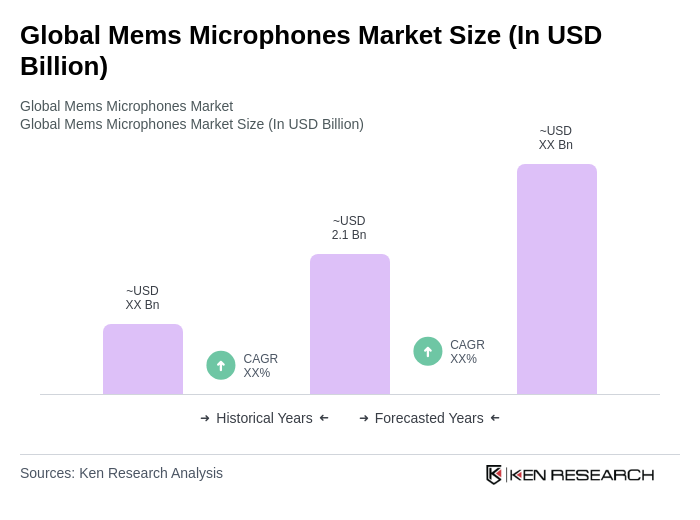
The global MEMS microphones market, valued at USD 2.1 billion, is growing due to rising adoption in smartphones, smart devices, and automotive applications, fueled by IoT proliferation.

Region:Global

Author(s):Shubham

Product Code:KRAC0762

Pages:92

Published On:August 2025
About the Report

Base Year 2024

Global Mems Microphones Market Overview

  • The Global MEMS Microphones Market is valued at USD 2.1 billion, based on a five?year historical analysis. This growth is primarily driven by the increasing demand for high-quality audio in consumer electronics, automotive applications, and smart home devices. The rise in the adoption of voice recognition technologies and the proliferation of Internet of Things (IoT) devices have further fueled the market's expansion.
  • Key players in this market include the United States, Japan, and Germany, which dominate due to their advanced technological infrastructure, strong manufacturing capabilities, and significant investments in research and development. The presence of major electronics manufacturers and a robust supply chain in these regions also contribute to their market leadership.
  • In 2023, the European Union implemented regulations aimed at enhancing the environmental sustainability of electronic components, including MEMS microphones. This regulation mandates that all electronic devices must comply with eco-design requirements, promoting energy efficiency and reducing waste, thereby influencing manufacturers to innovate and adapt their products accordingly.
Global Mems Microphones Market Size

Global Mems Microphones Market Segmentation

By Type:The MEMS microphones market can be segmented into various types, including Analog MEMS Microphones, Digital MEMS Microphones, Capacitive MEMS Microphones, Piezoelectric MEMS Microphones, and Multi-mic Arrays and Beamforming Modules. Among these, Digital MEMS Microphones are currently leading the market due to their superior performance in terms of sound quality and integration capabilities in modern devices. The increasing demand for digital audio processing in smartphones and smart speakers has significantly contributed to the growth of this segment.
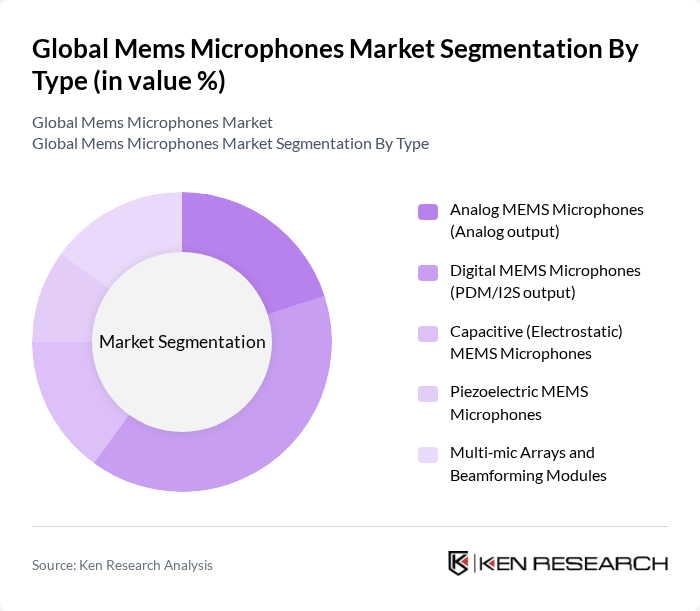
Global Mems Microphones Market segmentation by Type.

By End-User:The end-user segmentation includes Consumer Electronics, Automotive, Industrial & IoT, Healthcare & Hearing, and Enterprise & Communications. The Consumer Electronics segment is the most dominant, driven by the rapid growth of smartphones, tablets, and smart speakers. The increasing consumer preference for high-quality audio experiences and the integration of voice assistants in everyday devices have propelled this segment's growth significantly.
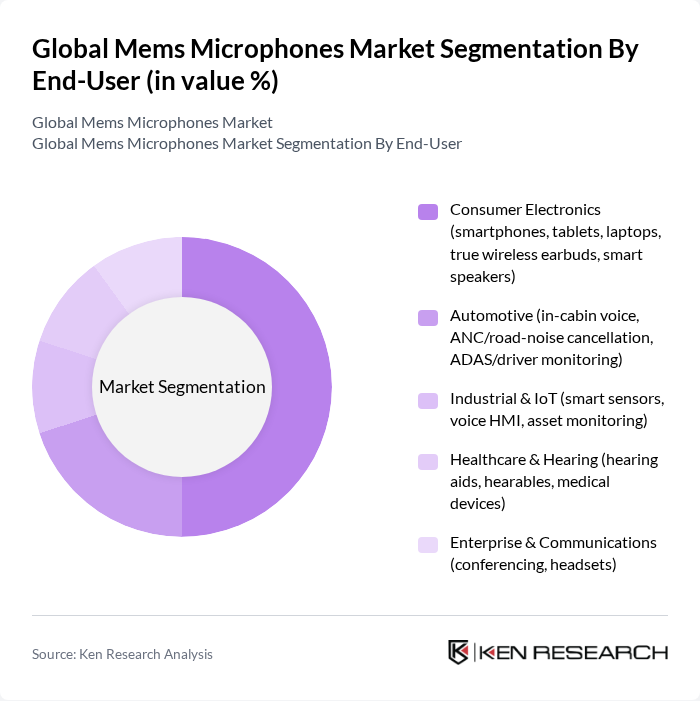
Global Mems Microphones Market segmentation by End-User.

Global Mems Microphones Market Competitive Landscape

The Global MEMS Microphones Market is characterized by a dynamic mix of regional and international players. Leading participants such as Knowles Corporation, STMicroelectronics, TDK Corporation (including InvenSense), Bosch Sensortec GmbH, Cirrus Logic, Inc., AAC Technologies Holdings Inc., ON Semiconductor Corporation (onsemi), Analog Devices, Inc., NXP Semiconductors N.V., Microchip Technology Inc., Infineon Technologies AG, Qualcomm Technologies, Inc., Texas Instruments Incorporated, Goertek Inc., BSE (BEST) Inc. contribute to innovation, geographic expansion, and service delivery in this space.

Knowles Corporation

1946

Itasca, Illinois, USA

STMicroelectronics

1987

Geneva, Switzerland

TDK Corporation

1935

Tokyo, Japan

Bosch Sensortec GmbH

2005

Reutlingen, Germany

Cirrus Logic, Inc.

1984

Austin, Texas, USA

Company

Establishment Year

Headquarters

Group Size (share of MEMS microphone market: Large >10%, Medium 3–10%, Small <3%)

MEMS Microphone Revenue and YoY Growth (%)

Product Mix (Analog vs. Digital; Capacitive vs. Piezo share)

SNR Portfolio Coverage (share of >65 dB SKUs)

Automotive/Medical Qualification (AEC?Q100, medical certifications)

Design Wins with Top OEMs (smartphones, TWS, smart speakers, automotive)

Global Mems Microphones Market Industry Analysis

Growth Drivers

  • Increasing Demand for Compact Audio Solutions:The global trend towards miniaturization in electronics has led to a significant rise in demand for compact audio solutions. In future, the consumer electronics sector is projected to reach $1.6 trillion, with MEMS microphones playing a crucial role in devices like smartphones and wearables. The need for high-quality audio in smaller form factors is driving manufacturers to adopt MEMS technology, which offers superior performance in limited spaces, thus enhancing overall product appeal.
  • Rising Adoption in Consumer Electronics:The consumer electronics market is expected to grow by approximately $210 billion in future, fueled by the increasing integration of MEMS microphones in smartphones, tablets, and smart home devices. With over 1.6 billion smartphones projected to be sold globally, the demand for high-performance audio solutions is surging. This trend is further supported by the growing consumer preference for devices that offer enhanced audio capabilities, driving manufacturers to innovate and incorporate MEMS technology.
  • Advancements in MEMS Technology:Continuous advancements in MEMS technology are propelling the market forward. In future, the global investment in MEMS research and development is expected to exceed $1.2 billion, leading to improved sound quality and reduced power consumption. These innovations are critical as they enable manufacturers to produce more efficient and reliable microphones, which are essential for applications in various sectors, including automotive and IoT, thereby expanding the market's reach and potential.

Market Challenges

  • High Competition and Price Pressure:The MEMS microphone market is characterized by intense competition, with over 55 key players vying for market share. This competitive landscape has resulted in significant price pressure, with average selling prices declining by approximately 9% annually. As companies strive to maintain profitability while offering competitive pricing, this challenge can hinder investment in innovation and quality improvements, ultimately affecting market growth and sustainability.
  • Technical Limitations in Sound Quality:Despite advancements, MEMS microphones still face technical limitations regarding sound quality, particularly in high-frequency response and dynamic range. In future, approximately 28% of consumers report dissatisfaction with the audio quality of MEMS microphones in certain applications. This challenge necessitates ongoing research and development to enhance performance, as failure to address these issues may lead to reduced consumer trust and slower adoption rates in critical markets.

Global Mems Microphones Market Future Outlook

The future of the MEMS microphones market appears promising, driven by technological advancements and evolving consumer preferences. As the demand for wireless audio solutions continues to rise, manufacturers are likely to focus on enhancing the integration of MEMS microphones with AI and smart technologies. Additionally, the growing trend towards sustainability will push companies to develop eco-friendly products, ensuring compliance with environmental regulations while meeting consumer expectations for responsible manufacturing practices.

Market Opportunities

  • Expansion in Emerging Markets:Emerging markets, particularly in Asia-Pacific, are witnessing rapid urbanization and increased disposable income. In future, the Asia-Pacific consumer electronics market is expected to grow by $110 billion, presenting significant opportunities for MEMS microphone manufacturers to expand their presence and cater to the rising demand for advanced audio solutions in these regions.
  • Integration with AI and Smart Technologies:The integration of MEMS microphones with AI and smart technologies is creating new avenues for growth. In future, the global AI market is projected to reach $520 billion, with voice-activated devices becoming increasingly prevalent. This trend offers MEMS microphone manufacturers the chance to innovate and develop products that enhance user experience, driving further adoption in various applications.

Scope of the Report

SegmentSub-Segments
By Type

Analog MEMS Microphones (Analog output)

Digital MEMS Microphones (PDM/I2S output)

Capacitive (Electrostatic) MEMS Microphones

Piezoelectric MEMS Microphones

Multi?mic Arrays and Beamforming Modules

By End-User

Consumer Electronics (smartphones, tablets, laptops, true wireless earbuds, smart speakers)

Automotive (in-cabin voice, ANC/road-noise cancellation, ADAS/driver monitoring)

Industrial & IoT (smart sensors, voice HMI, asset monitoring)

Healthcare & Hearing (hearing aids, hearables, medical devices)

Enterprise & Communications (conferencing, headsets)

By Application

Mobile Phones & Tablets

True Wireless Stereo (TWS) and Wearables

Smart Home & Voice Assistants (smart speakers, hubs, appliances)

Automotive Systems (ANC, hands-free, voice assistants)

AR/VR/MR Devices and Gaming

Hearing Aids and Hearables

By Distribution Channel

Direct Sales to OEMs/ODMs

Authorized Distributors

Online Components Marketplaces

Design Houses/Module Integrators

Others

By Region

North America

Europe

Asia-Pacific

Latin America

Middle East & Africa

By Price Range

Entry (Sub-$0.20)

Mid (US$0.20–$0.60)

Premium (Above US$0.60)

Automotive/Medical-Grade

By Technology

Signal-to-Noise Ratio (SNR) Class: <60 dB, 60–65 dB, >65 dB

Directionality: Omnidirectional vs. Directional (beamforming arrays)

Acoustic Performance: Low-Noise, High AOP, Wide Dynamic Range

Interface & Power: Analog, PDM, I2S; ultra?low power/always?on voice

Key Target Audience

Investors and Venture Capitalist Firms

Government and Regulatory Bodies (e.g., Federal Communications Commission, National Institute of Standards and Technology)

Manufacturers and Producers

Distributors and Retailers

Telecommunications Companies

Consumer Electronics Companies

Automotive Manufacturers

Healthcare Technology Firms

Players Mentioned in the Report:

Knowles Corporation

STMicroelectronics

TDK Corporation (including InvenSense)

Bosch Sensortec GmbH

Cirrus Logic, Inc.

AAC Technologies Holdings Inc.

ON Semiconductor Corporation (onsemi)

Analog Devices, Inc.

NXP Semiconductors N.V.

Microchip Technology Inc.

Infineon Technologies AG

Qualcomm Technologies, Inc.

Texas Instruments Incorporated

Goertek Inc.

BSE (BEST) Inc.

Table of Contents

Market Assessment Phase

1. Executive Summary and Approach


2. Global Mems Microphones Market Overview

2.1 Key Insights and Strategic Recommendations

2.2 Global Mems Microphones Market Overview

2.3 Definition and Scope

2.4 Evolution of Market Ecosystem

2.5 Timeline of Key Regulatory Milestones

2.6 Value Chain & Stakeholder Mapping

2.7 Business Cycle Analysis

2.8 Policy & Incentive Landscape


3. Global Mems Microphones Market Analysis

3.1 Growth Drivers

3.1.1 Increasing demand for compact audio solutions
3.1.2 Rising adoption in consumer electronics
3.1.3 Advancements in MEMS technology
3.1.4 Growing applications in automotive and IoT devices

3.2 Market Challenges

3.2.1 High competition and price pressure
3.2.2 Technical limitations in sound quality
3.2.3 Supply chain disruptions
3.2.4 Regulatory compliance issues

3.3 Market Opportunities

3.3.1 Expansion in emerging markets
3.3.2 Integration with AI and smart technologies
3.3.3 Development of new applications in healthcare
3.3.4 Collaborations with tech startups

3.4 Market Trends

3.4.1 Shift towards wireless audio solutions
3.4.2 Increasing focus on sustainability
3.4.3 Growth of voice-activated devices
3.4.4 Enhanced user experience through advanced features

3.5 Government Regulation

3.5.1 Compliance with environmental standards
3.5.2 Regulations on electronic waste management
3.5.3 Safety standards for consumer electronics
3.5.4 Import/export regulations affecting MEMS components

4. SWOT Analysis


5. Stakeholder Analysis


6. Porter's Five Forces Analysis


7. Global Mems Microphones Market Market Size, 2019-2024

7.1 By Value

7.2 By Volume

7.3 By Average Selling Price


8. Global Mems Microphones Market Segmentation

8.1 By Type

8.1.1 Analog MEMS Microphones (Analog output)
8.1.2 Digital MEMS Microphones (PDM/I2S output)
8.1.3 Capacitive (Electrostatic) MEMS Microphones
8.1.4 Piezoelectric MEMS Microphones
8.1.5 Multi?mic Arrays and Beamforming Modules

8.2 By End-User

8.2.1 Consumer Electronics (smartphones, tablets, laptops, true wireless earbuds, smart speakers)
8.2.2 Automotive (in-cabin voice, ANC/road-noise cancellation, ADAS/driver monitoring)
8.2.3 Industrial & IoT (smart sensors, voice HMI, asset monitoring)
8.2.4 Healthcare & Hearing (hearing aids, hearables, medical devices)
8.2.5 Enterprise & Communications (conferencing, headsets)

8.3 By Application

8.3.1 Mobile Phones & Tablets
8.3.2 True Wireless Stereo (TWS) and Wearables
8.3.3 Smart Home & Voice Assistants (smart speakers, hubs, appliances)
8.3.4 Automotive Systems (ANC, hands-free, voice assistants)
8.3.5 AR/VR/MR Devices and Gaming
8.3.6 Hearing Aids and Hearables

8.4 By Distribution Channel

8.4.1 Direct Sales to OEMs/ODMs
8.4.2 Authorized Distributors
8.4.3 Online Components Marketplaces
8.4.4 Design Houses/Module Integrators
8.4.5 Others

8.5 By Region

8.5.1 North America
8.5.2 Europe
8.5.3 Asia-Pacific
8.5.4 Latin America
8.5.5 Middle East & Africa

8.6 By Price Range

8.6.1 Entry (Sub-$0.20)
8.6.2 Mid (US$0.20–$0.60)
8.6.3 Premium (Above US$0.60)
8.6.4 Automotive/Medical-Grade

8.7 By Technology

8.7.1 Signal-to-Noise Ratio (SNR) Class: <60 dB, 60–65 dB, >65 dB
8.7.2 Directionality: Omnidirectional vs. Directional (beamforming arrays)
8.7.3 Acoustic Performance: Low-Noise, High AOP, Wide Dynamic Range
8.7.4 Interface & Power: Analog, PDM, I2S; ultra?low power/always?on voice

9. Global Mems Microphones Market Competitive Analysis

9.1 Market Share of Key Players

9.2 Cross Comparison of Key Players

9.2.1 Company Name
9.2.2 Group Size (share of MEMS microphone market: Large >10%, Medium 3–10%, Small <3%)
9.2.3 MEMS Microphone Revenue and YoY Growth (%)
9.2.4 Product Mix (Analog vs. Digital; Capacitive vs. Piezo share)
9.2.5 SNR Portfolio Coverage (share of >65 dB SKUs)
9.2.6 Automotive/Medical Qualification (AEC?Q100, medical certifications)
9.2.7 Design Wins with Top OEMs (smartphones, TWS, smart speakers, automotive)
9.2.8 Average Selling Price (ASP) and Pricing Strategy
9.2.9 Gross Margin on MEMS Microphones (%)
9.2.10 R&D Intensity (% of revenue) and New Product Launches per year
9.2.11 Supply Chain Footprint (fab/source: captive vs. foundry; regional diversification)
9.2.12 Channel Reach (direct vs. distributor revenue share)
9.2.13 Quality & Reliability KPIs (field failure rate, PPB, warranty returns)
9.2.14 ESG & Compliance (RoHS, REACH, conflict minerals, recyclability)

9.3 SWOT Analysis of Top Players

9.4 Pricing Analysis

9.5 Detailed Profile of Major Companies

9.5.1 Knowles Corporation
9.5.2 STMicroelectronics
9.5.3 TDK Corporation (including InvenSense)
9.5.4 Bosch Sensortec GmbH
9.5.5 Cirrus Logic, Inc.
9.5.6 AAC Technologies Holdings Inc.
9.5.7 ON Semiconductor Corporation (onsemi)
9.5.8 Analog Devices, Inc.
9.5.9 NXP Semiconductors N.V.
9.5.10 Microchip Technology Inc.
9.5.11 Infineon Technologies AG
9.5.12 Qualcomm Technologies, Inc.
9.5.13 Texas Instruments Incorporated
9.5.14 Goertek Inc.
9.5.15 BSE (BEST) Inc.

10. Global Mems Microphones Market End-User Analysis

10.1 Procurement Behavior of Key Ministries

10.1.1 Government procurement policies
10.1.2 Budget allocation for technology
10.1.3 Evaluation criteria for suppliers

10.2 Corporate Spend on Infrastructure & Energy

10.2.1 Investment in audio technology
10.2.2 Budget trends in electronics
10.2.3 Corporate partnerships for innovation

10.3 Pain Point Analysis by End-User Category

10.3.1 Quality and reliability issues
10.3.2 Cost constraints
10.3.3 Integration challenges with existing systems

10.4 User Readiness for Adoption

10.4.1 Awareness of MEMS technology benefits
10.4.2 Training and support requirements
10.4.3 Adoption barriers in various sectors

10.5 Post-Deployment ROI and Use Case Expansion

10.5.1 Measurement of performance improvements
10.5.2 Expansion into new applications
10.5.3 Long-term cost savings analysis

11. Global Mems Microphones Market Future Size, 2025-2030

11.1 By Value

11.2 By Volume

11.3 By Average Selling Price


Go-To-Market Strategy Phase

1. Whitespace Analysis + Business Model Canvas

1.1 Market gaps identification

1.2 Value proposition development

1.3 Revenue model exploration

1.4 Customer segmentation analysis

1.5 Competitive landscape overview

1.6 Key partnerships and alliances

1.7 Risk assessment and mitigation


2. Marketing and Positioning Recommendations

2.1 Branding strategies

2.2 Product USPs

2.3 Target audience identification

2.4 Communication strategies

2.5 Digital marketing initiatives

2.6 Customer engagement tactics


3. Distribution Plan

3.1 Urban retail strategies

3.2 Rural NGO tie-ups

3.3 E-commerce platforms

3.4 Direct-to-consumer models

3.5 Distribution partnerships


4. Channel & Pricing Gaps

4.1 Underserved routes

4.2 Pricing bands analysis

4.3 Competitor pricing strategies

4.4 Value-based pricing recommendations


5. Unmet Demand & Latent Needs

5.1 Category gaps identification

5.2 Consumer segments analysis

5.3 Emerging trends and needs

5.4 Product development opportunities


6. Customer Relationship

6.1 Loyalty programs

6.2 After-sales service enhancements

6.3 Customer feedback mechanisms

6.4 Community building initiatives


7. Value Proposition

7.1 Sustainability initiatives

7.2 Integrated supply chains

7.3 Unique selling points

7.4 Customer-centric innovations


8. Key Activities

8.1 Regulatory compliance

8.2 Branding efforts

8.3 Distribution setup

8.4 Market research and analysis


9. Entry Strategy Evaluation

9.1 Domestic Market Entry Strategy

9.1.1 Product mix considerations
9.1.2 Pricing band strategies
9.1.3 Packaging innovations

9.2 Export Entry Strategy

9.2.1 Target countries analysis
9.2.2 Compliance roadmap development

10. Entry Mode Assessment

10.1 Joint Ventures

10.2 Greenfield investments

10.3 Mergers & Acquisitions

10.4 Distributor Model evaluation


11. Capital and Timeline Estimation

11.1 Capital requirements analysis

11.2 Timelines for market entry


12. Control vs Risk Trade-Off

12.1 Ownership considerations

12.2 Partnerships evaluation


13. Profitability Outlook

13.1 Breakeven analysis

13.2 Long-term sustainability strategies


14. Potential Partner List

14.1 Distributors

14.2 Joint Ventures

14.3 Acquisition targets


15. Execution Roadmap

15.1 Phased Plan for Market Entry

15.1.1 Market Setup
15.1.2 Market Entry
15.1.3 Growth Acceleration
15.1.4 Scale & Stabilize

15.2 Key Activities and Milestones

15.2.1 Milestone tracking
15.2.2 Activity scheduling

Research Methodology

ApproachModellingSample

Phase 1: Approach1

Desk Research

  • Industry reports from market research firms focusing on MEMS technology trends
  • Technical papers and publications from leading universities and research institutions
  • Market data from trade associations and industry bodies related to audio technology

Primary Research

  • Interviews with product managers at leading MEMS microphone manufacturers
  • Surveys with audio engineers and sound design professionals
  • Field interviews with end-users in consumer electronics and automotive sectors

Validation & Triangulation

  • Cross-validation of findings through multiple expert interviews
  • Triangulation of data from sales reports, market trends, and technological advancements
  • Sanity checks through feedback from industry panels and focus groups

Phase 2: Market Size Estimation1

Top-down Assessment

  • Analysis of global MEMS microphone sales data segmented by application areas
  • Estimation of market share based on regional demand and technological adoption
  • Incorporation of growth rates from related sectors such as consumer electronics and automotive

Bottom-up Modeling

  • Volume estimates based on production capacities of key manufacturers
  • Cost analysis derived from component pricing and manufacturing expenses
  • Market size calculated through unit sales multiplied by average selling price

Forecasting & Scenario Analysis

  • Multi-variable forecasting using historical growth patterns and emerging trends
  • Scenario analysis based on technological advancements and market disruptions
  • Projections for market growth under different economic conditions through 2030

Phase 3: CATI Sample Composition1

Scope Item/SegmentSample SizeTarget Respondent Profiles
Consumer Electronics Manufacturers120Product Development Managers, Audio Engineers
Automotive Industry Applications90R&D Engineers, Procurement Managers
Healthcare Device Manufacturers60Quality Assurance Managers, Regulatory Affairs Specialists
Smart Home Technology Developers50Technical Leads, Product Managers
Telecommunications Equipment Providers70Network Engineers, Product Strategy Directors

Frequently Asked Questions

What is the current value of the Global MEMS Microphones Market?

The Global MEMS Microphones Market is valued at approximately USD 2.1 billion, driven by the increasing demand for high-quality audio in consumer electronics, automotive applications, and smart home devices.

What factors are driving the growth of the MEMS Microphones Market?

Which regions dominate the MEMS Microphones Market?

What are the main types of MEMS microphones available in the market?

Other Regional/Country Reports

Indonesia Global Mems Microphones Market

Malaysia Global Mems Microphones Market

KSA Global Mems Microphones Market

APAC Global Mems Microphones Market

SEA Global Mems Microphones Market

Vietnam Global Mems Microphones Market

Why Buy From Us?

Refine Robust Result (RRR) Framework

What makes us stand out is that our consultants follow Robust, Refine and Result (RRR) methodology. Robust for clear definitions, approaches and sanity checking, Refine for differentiating respondents' facts and opinions, and Result for presenting data with story.

Our Reach Is Unmatched

We have set a benchmark in the industry by offering our clients with syndicated and customized market research reports featuring coverage of entire market as well as meticulous research and analyst insights.

Shifting the Research Paradigm

While we don't replace traditional research, we flip the method upside down. Our dual approach of Top Bottom & Bottom Top ensures quality deliverable by not just verifying company fundamentals but also looking at the sector and macroeconomic factors.

More Insights-Better Decisions

With one step in the future, our research team constantly tries to show you the bigger picture. We help with some of the tough questions you may encounter along the way: How is the industry positioned? Best marketing channel? KPI's of competitors? By aligning every element, we help maximize success.

Transparency and Trust

Our report gives you instant access to the answers and sources that other companies might choose to hide. We elaborate each steps of research methodology we have used and showcase you the sample size to earn your trust.

Round the Clock Support

If you need any support, we are here! We pride ourselves on universe strength, data quality, and quick, friendly, and professional service.

Why Clients Choose Us?

400000+
Reports in repository
150+
Consulting projects a year
100+
Analysts
8000+
Client Queries in 2022








