About the Report
Base Year 2024Global Metal Magnesium Market Overview
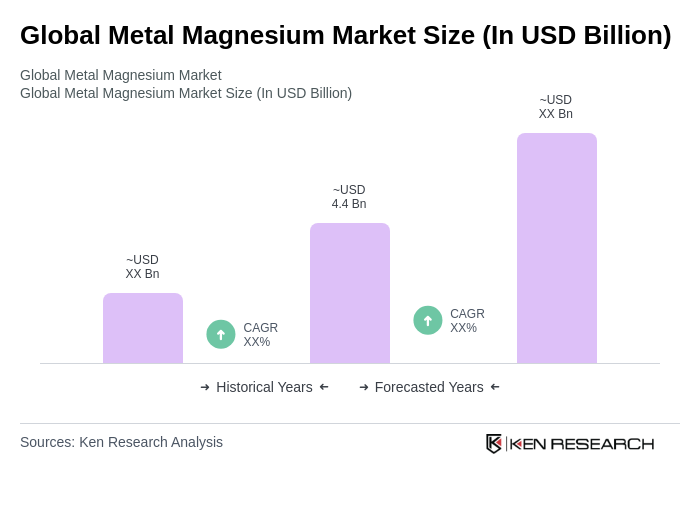
- The Global Metal Magnesium Market is valued at USD 4.4 billion, based on a five-year historical analysis. This is supported by multiple industry reports placing market size near this level, with Asia-Pacific as the largest revenue contributor and automotive die-casting as a primary demand driver . The growth is primarily driven by the increasing demand for lightweight materials in the automotive and aerospace industries, as well as the rising adoption of magnesium alloys in powertrain and structural components to improve fuel efficiency and reduce emissions . The market is also supported by advances in extraction and processing—particularly optimization of the Pidgeon process in China and improvements in electrolytic routes—along with broader scrap recovery and recycling developments that enhance production efficiency and help lower costs .
- Key producing and consuming countries include China, the United States, and Germany. China dominates primary magnesium production capacity and output, underpinning its leading market position; the United States and Germany are key demand centers tied to advanced automotive and aerospace manufacturing and aluminum alloying consumption of magnesium .
- In the United States, policy pressure on industrial decarbonization and recyclability is rising, but there is no federal mandate that “all magnesium producers adopt cleaner technologies” in a single 2024 regulation. Instead, relevant measures include tightened greenhouse gas and energy-efficiency standards across heavy industry, recycling initiatives, and state-level clean manufacturing programs that influence magnesium producers’ energy use and emissions strategies rather than prescribing a single technology path .
Global Metal Magnesium Market Segmentation
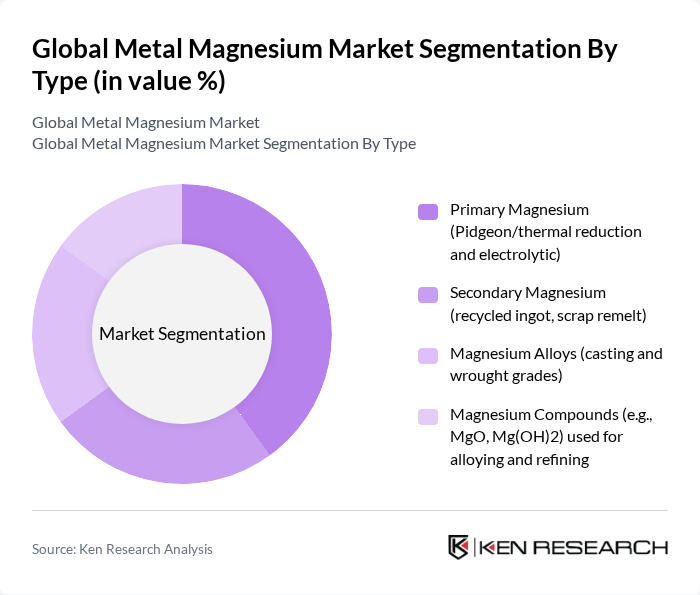
By Type:The market is segmented into four main types: Primary Magnesium, Secondary Magnesium, Magnesium Alloys, and Magnesium Compounds. Each of these subsegments plays a crucial role in the overall market dynamics, with varying applications and demand drivers. Primary magnesium is largely produced via the Pidgeon/thermal reduction route in China and electrolytic routes elsewhere and is consumed in die casting and aluminum alloying; secondary magnesium reflects recycled ingot and remelt from fabrication and end-of-life scrap; magnesium alloys encompass casting and wrought grades for transportation, electronics, and defense; magnesium compounds (e.g., MgO, Mg(OH)2) are used in refractories, desulfurization, and environmental applications and are adjacent to, but distinct from, metallic magnesium value chains .
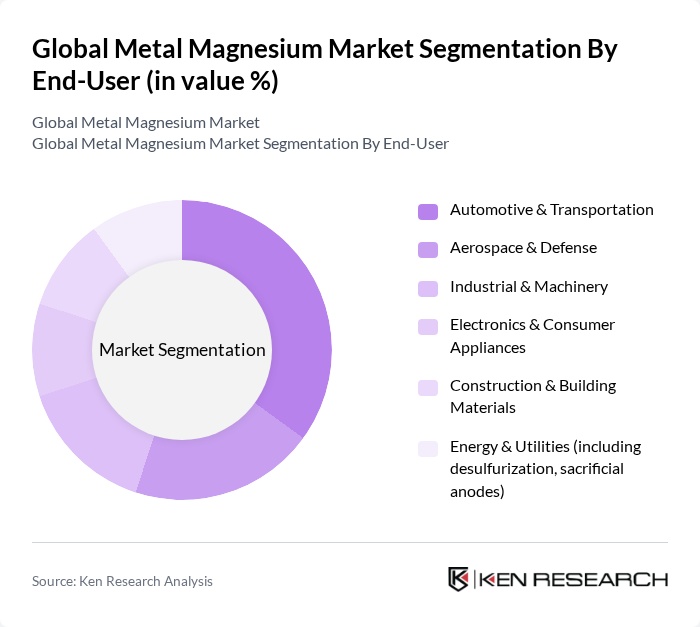
By End-User:The end-user segmentation includes Automotive & Transportation, Aerospace & Defense, Industrial & Machinery, Electronics & Consumer Appliances, Construction & Building Materials, and Energy & Utilities. Each sector has distinct requirements and growth potential, influencing the overall market landscape. Automotive and transportation remain the largest end-use owing to die-cast parts (e.g., transmission cases, steering components), followed by aerospace/defense where high strength-to-weight and electromagnetic shielding are valued; industrial/machinery, electronics, and energy applications leverage magnesium for alloying with aluminum, desulfurization in steelmaking, sacrificial anodes, and EMI shielding .
Global Metal Magnesium Market Competitive Landscape
The Global Metal Magnesium Market is characterized by a dynamic mix of regional and international players. Leading participants such as US Magnesium LLC, Dead Sea Magnesium Ltd., POSCO Magnesium (POSCO Group), Luxfer MEL Technologies (formerly Magnesium Elektron), Tianjin Magnesium International Co., Ltd., China Magnesium Corporation Limited, Shanxi Yinguang Huasheng Magnesium Co., Ltd., Meridian Lightweight Technologies Inc., Nanjing Yunhai Special Metals Co., Ltd., MagPro Group (Magnesium Products of America, Inc.), Rima Industrial S.A., Nippon Kinzoku Co., Ltd., Norsk Hydro ASA (Magnesium Recycling/Alloying operations), Tasmanian Electro Metallurgical Company (TEMCO) Magnesium Projects, and Latrobe Magnesium Limited contribute to innovation, geographic expansion, and service delivery in this space.
Global Metal Magnesium Market Industry Analysis
Growth Drivers
- Increasing Demand in Automotive Industry:The automotive sector is a significant driver for magnesium demand, with over 1.5 million tons consumed in future. The lightweight properties of magnesium alloys contribute to fuel efficiency, aligning with the global push for reduced emissions. The International Energy Agency reported that the automotive industry aims to cut CO2 emissions by 50% by future, further boosting magnesium's appeal as a lightweight material in vehicle manufacturing.
- Rising Use in Aerospace Applications:The aerospace industry is projected to consume approximately 350,000 tons of magnesium in future, driven by its lightweight and high-strength characteristics. The Federal Aviation Administration (FAA) emphasizes the need for materials that enhance fuel efficiency and reduce operational costs. As airlines seek to lower their carbon footprints, magnesium's role in aircraft components is becoming increasingly vital, supporting the industry's sustainability goals.
- Growth in Construction Sector:The construction sector is expected to utilize around 600,000 tons of magnesium in future, primarily for structural applications and lightweight components. According to the World Bank, global construction output is projected to reach $12 trillion in future, driven by urbanization and infrastructure development. Magnesium's corrosion resistance and strength make it an attractive option for construction materials, enhancing durability and reducing maintenance costs.
Market Challenges
- Fluctuating Raw Material Prices:The volatility in raw material prices poses a significant challenge for the magnesium market. In future, the price of primary magnesium fluctuated between $2,800 and $3,500 per ton, influenced by geopolitical tensions and supply chain disruptions. This unpredictability affects manufacturers' cost structures and profitability, leading to cautious investment in magnesium-based products and technologies.
- Environmental Regulations:Stricter environmental regulations are impacting magnesium production processes. The European Union's Green Deal aims to reduce greenhouse gas emissions by at least 60% by future, which may impose additional compliance costs on magnesium producers. As companies adapt to these regulations, they may face increased operational costs, potentially hindering market growth and innovation in sustainable magnesium production methods.
Global Metal Magnesium Market Future Outlook
The future of the magnesium market appears promising, driven by technological advancements and increasing applications across various industries. The focus on lightweight materials and sustainable manufacturing practices is expected to enhance magnesium's market position. Additionally, investments in research and development are likely to lead to innovative magnesium alloys and recycling technologies, further expanding its applications and market reach in the coming years.
Market Opportunities
- Expansion in Emerging Markets:Emerging markets, particularly in Asia-Pacific, are projected to see a surge in magnesium demand, with an estimated growth of 18% annually. This growth is driven by rapid industrialization and infrastructure development, presenting significant opportunities for magnesium producers to establish a foothold in these regions.
- Innovations in Recycling Technologies:The development of advanced recycling technologies for magnesium is expected to create new market opportunities. With recycling rates currently at 35%, improving these processes could significantly reduce production costs and environmental impact, making magnesium more competitive against alternative materials in various applications.
Scope of the Report
| Segment | Sub-Segments |
|---|---|
| By Type | Primary Magnesium (Pidgeon/thermal reduction and electrolytic) Secondary Magnesium (recycled ingot, scrap remelt) Magnesium Alloys (casting and wrought grades) Magnesium Compounds (e.g., MgO, Mg(OH)2) used for alloying and refining |
| By End-User | Automotive & Transportation Aerospace & Defense Industrial & Machinery Electronics & Consumer Appliances Construction & Building Materials Energy & Utilities (including desulfurization, sacrificial anodes) |
| By Application | Die Casting (e.g., AZ91, AM60) Wrought Products (extrusions, sheets, forgings) Alloying Additive for Aluminum & Titanium Desulfurization in Steelmaking Sacrificial Anodes & Chemical Uses |
| By Distribution Channel | Direct Sales to OEMs Distributors/Traders Long-term Offtake/Contracts Spot & Online Metals Platforms |
| By Region | North America Europe Asia-Pacific Latin America Middle East & Africa |
| By Price Range | Primary Magnesium Ingot (99.8% min) Alloy Ingot (common casting grades) Wrought/Extrusion Products Scrap & Recycled Feed |
| By Policy Support | Emissions & Energy Policies (carbon/EU ETS, power tariffs) Trade Measures (tariffs, anti-dumping, quotas) Mining & Permitting/Environmental Regulations Recycling & Circular Economy Incentives |
Key Target Audience
Investors and Venture Capitalist Firms
Government and Regulatory Bodies (e.g., U.S. Department of Energy, European Commission)
Manufacturers and Producers
Distributors and Retailers
Automotive Industry Stakeholders
Aerospace Industry Stakeholders
Construction and Building Material Companies
Financial Institutions
Players Mentioned in the Report:
US Magnesium LLC
Dead Sea Magnesium Ltd.
POSCO Magnesium (POSCO Group)
Luxfer MEL Technologies (formerly Magnesium Elektron)
Tianjin Magnesium International Co., Ltd.
China Magnesium Corporation Limited
Shanxi Yinguang Huasheng Magnesium Co., Ltd.
Meridian Lightweight Technologies Inc.
Nanjing Yunhai Special Metals Co., Ltd.
MagPro Group (Magnesium Products of America, Inc.)
Rima Industrial S.A.
Nippon Kinzoku Co., Ltd.
Norsk Hydro ASA (Magnesium Recycling/Alloying operations)
Tasmanian Electro Metallurgical Company (TEMCO) Magnesium Projects
Latrobe Magnesium Limited
Table of Contents
Market Assessment Phase
1. Executive Summary and Approach
2. Global Metal Magnesium Market Overview
2.1 Key Insights and Strategic Recommendations
2.2 Global Metal Magnesium Market Overview
2.3 Definition and Scope
2.4 Evolution of Market Ecosystem
2.5 Timeline of Key Regulatory Milestones
2.6 Value Chain & Stakeholder Mapping
2.7 Business Cycle Analysis
2.8 Policy & Incentive Landscape
3. Global Metal Magnesium Market Analysis
3.1 Growth Drivers
3.1.1 Increasing Demand in Automotive Industry
3.1.2 Rising Use in Aerospace Applications
3.1.3 Growth in Construction Sector
3.1.4 Advancements in Magnesium Alloys
3.2 Market Challenges
3.2.1 Fluctuating Raw Material Prices
3.2.2 Environmental Regulations
3.2.3 Competition from Alternative Materials
3.2.4 Supply Chain Disruptions
3.3 Market Opportunities
3.3.1 Expansion in Emerging Markets
3.3.2 Innovations in Recycling Technologies
3.3.3 Increasing Applications in Electronics
3.3.4 Strategic Partnerships and Collaborations
3.4 Market Trends
3.4.1 Growing Focus on Lightweight Materials
3.4.2 Rise of Sustainable Manufacturing Practices
3.4.3 Increasing Investment in R&D
3.4.4 Adoption of Advanced Production Techniques
3.5 Government Regulation
3.5.1 Emission Standards for Manufacturing
3.5.2 Import Tariffs on Magnesium Products
3.5.3 Safety Regulations in Handling Magnesium
3.5.4 Incentives for Sustainable Practices
4. SWOT Analysis
5. Stakeholder Analysis
6. Porter's Five Forces Analysis
7. Global Metal Magnesium Market Market Size, 2019-2024
7.1 By Value
7.2 By Volume
7.3 By Average Selling Price
8. Global Metal Magnesium Market Segmentation
8.1 By Type
8.1.1 Primary Magnesium (Pidgeon/thermal reduction and electrolytic)
8.1.2 Secondary Magnesium (recycled ingot, scrap remelt)
8.1.3 Magnesium Alloys (casting and wrought grades)
8.1.4 Magnesium Compounds (e.g., MgO, Mg(OH)2) used for alloying and refining
8.2 By End-User
8.2.1 Automotive & Transportation
8.2.2 Aerospace & Defense
8.2.3 Industrial & Machinery
8.2.4 Electronics & Consumer Appliances
8.2.5 Construction & Building Materials
8.2.6 Energy & Utilities (including desulfurization, sacrificial anodes)
8.3 By Application
8.3.1 Die Casting (e.g., AZ91, AM60)
8.3.2 Wrought Products (extrusions, sheets, forgings)
8.3.3 Alloying Additive for Aluminum & Titanium
8.3.4 Desulfurization in Steelmaking
8.3.5 Sacrificial Anodes & Chemical Uses
8.4 By Distribution Channel
8.4.1 Direct Sales to OEMs
8.4.2 Distributors/Traders
8.4.3 Long-term Offtake/Contracts
8.4.4 Spot & Online Metals Platforms
8.5 By Region
8.5.1 North America
8.5.2 Europe
8.5.3 Asia-Pacific
8.5.4 Latin America
8.5.5 Middle East & Africa
8.6 By Price Range
8.6.1 Primary Magnesium Ingot (99.8% min)
8.6.2 Alloy Ingot (common casting grades)
8.6.3 Wrought/Extrusion Products
8.6.4 Scrap & Recycled Feed
8.7 By Policy Support
8.7.1 Emissions & Energy Policies (carbon/EU ETS, power tariffs)
8.7.2 Trade Measures (tariffs, anti-dumping, quotas)
8.7.3 Mining & Permitting/Environmental Regulations
8.7.4 Recycling & Circular Economy Incentives
9. Global Metal Magnesium Market Competitive Analysis
9.1 Market Share of Key Players
9.2 Cross Comparison of Key Players
9.2.1 Company Name
9.2.2 Production Capacity (ktpa of primary/secondary magnesium)
9.2.3 Capacity Utilization (%)
9.2.4 Revenue from Magnesium (USD, latest fiscal year)
9.2.5 EBITDA Margin (%) for Magnesium operations
9.2.6 Cost Position (electricity intensity, ferrosilicon/coal costs)
9.2.7 Product Mix (primary ingot vs. alloys vs. wrought)
9.2.8 Geographic Footprint (plants, key export markets)
9.2.9 Raw Material Integration (dolomite, carnallite, recycling)
9.2.10 Technology Route (Pidgeon vs. electrolytic vs. recycling)
9.2.11 Innovation Rate (new alloy qualifications, LCA improvements)
9.2.12 Supply Chain Resilience (contract coverage, logistics, redundancy)
9.3 SWOT Analysis of Top Players
9.4 Pricing Analysis
9.5 Detailed Profile of Major Companies
9.5.1 US Magnesium LLC
9.5.2 Dead Sea Magnesium Ltd.
9.5.3 POSCO Magnesium (POSCO Group)
9.5.4 Luxfer MEL Technologies (formerly Magnesium Elektron)
9.5.5 Tianjin Magnesium International Co., Ltd.
9.5.6 China Magnesium Corporation Limited
9.5.7 Shanxi Yinguang Huasheng Magnesium Co., Ltd.
9.5.8 Meridian Lightweight Technologies Inc.
9.5.9 Nanjing Yunhai Special Metals Co., Ltd.
9.5.10 MagPro Group (Magnesium Products of America, Inc.)
9.5.11 Rima Industrial S.A.
9.5.12 Nippon Kinzoku Co., Ltd.
9.5.13 Norsk Hydro ASA (Magnesium Recycling/Alloying operations)
9.5.14 Tasmanian Electro Metallurgical Company (TEMCO) Magnesium Projects
9.5.15 Latrobe Magnesium Limited
10. Global Metal Magnesium Market End-User Analysis
10.1 Procurement Behavior of Key Ministries
10.1.1 Government Procurement Policies
10.1.2 Budget Allocations for Magnesium Products
10.1.3 Supplier Selection Criteria
10.2 Corporate Spend on Infrastructure & Energy
10.2.1 Investment Trends in Infrastructure
10.2.2 Energy Efficiency Initiatives
10.2.3 Corporate Sustainability Goals
10.3 Pain Point Analysis by End-User Category
10.3.1 Cost Management Challenges
10.3.2 Quality Assurance Issues
10.3.3 Supply Chain Reliability
10.4 User Readiness for Adoption
10.4.1 Awareness of Magnesium Benefits
10.4.2 Training and Support Needs
10.4.3 Adoption Barriers
10.5 Post-Deployment ROI and Use Case Expansion
10.5.1 Measurement of ROI
10.5.2 Case Studies of Successful Implementations
10.5.3 Future Use Case Opportunities
11. Global Metal Magnesium Market Future Size, 2025-2030
11.1 By Value
11.2 By Volume
11.3 By Average Selling Price
Go-To-Market Strategy Phase
1. Whitespace Analysis + Business Model Canvas
1.1 Market Gaps Identification
1.2 Business Model Framework
2. Marketing and Positioning Recommendations
2.1 Branding Strategies
2.2 Product USPs
3. Distribution Plan
3.1 Urban Retail Strategies
3.2 Rural NGO Tie-ups
4. Channel & Pricing Gaps
4.1 Underserved Routes
4.2 Pricing Bands
5. Unmet Demand & Latent Needs
5.1 Category Gaps
5.2 Consumer Segments
6. Customer Relationship
6.1 Loyalty Programs
6.2 After-sales Service
7. Value Proposition
7.1 Sustainability Initiatives
7.2 Integrated Supply Chains
8. Key Activities
8.1 Regulatory Compliance
8.2 Branding Efforts
8.3 Distribution Setup
9. Entry Strategy Evaluation
9.1 Domestic Market Entry Strategy
9.1.1 Product Mix
9.1.2 Pricing Band
9.1.3 Packaging Considerations
9.2 Export Entry Strategy
9.2.1 Target Countries
9.2.2 Compliance Roadmap
10. Entry Mode Assessment
10.1 Joint Ventures
10.2 Greenfield Investments
10.3 Mergers & Acquisitions
10.4 Distributor Model
11. Capital and Timeline Estimation
11.1 Capital Requirements
11.2 Timelines for Implementation
12. Control vs Risk Trade-Off
12.1 Ownership Considerations
12.2 Partnerships Evaluation
13. Profitability Outlook
13.1 Breakeven Analysis
13.2 Long-term Sustainability
14. Potential Partner List
14.1 Distributors
14.2 Joint Ventures
14.3 Acquisition Targets
15. Execution Roadmap
15.1 Phased Plan for Market Entry
15.1.1 Market Setup
15.1.2 Market Entry
15.1.3 Growth Acceleration
15.1.4 Scale & Stabilize
15.2 Key Activities and Milestones
15.2.1 Milestone Planning
15.2.2 Activity Tracking
Research Methodology
Phase 1: Approach1
Desk Research
- Industry reports from the International Magnesium Association and relevant trade organizations
- Market analysis from government publications and statistical agencies
- Academic journals and publications focusing on magnesium applications and innovations
Primary Research
- Interviews with industry experts, including metallurgists and material scientists
- Surveys with procurement managers in automotive and aerospace sectors
- Field interviews with executives from magnesium production facilities
Validation & Triangulation
- Cross-validation of data through multiple industry sources and expert opinions
- Triangulation of market trends using historical data and current market dynamics
- Sanity checks through feedback from a panel of industry veterans
Phase 2: Market Size Estimation1
Top-down Assessment
- Analysis of global magnesium production statistics and consumption patterns
- Segmentation by end-use industries such as automotive, aerospace, and electronics
- Incorporation of macroeconomic indicators influencing demand for magnesium
Bottom-up Modeling
- Volume estimates based on production capacities of leading magnesium manufacturers
- Cost analysis derived from raw material prices and production processes
- Estimation of market share based on sales data from key players
Forecasting & Scenario Analysis
- Multi-variable forecasting models considering technological advancements and regulatory impacts
- Scenario planning based on potential shifts in global supply chains and trade policies
- Development of baseline, optimistic, and pessimistic market forecasts through 2030
Phase 3: CATI Sample Composition1
| Scope Item/Segment | Sample Size | Target Respondent Profiles |
|---|---|---|
| Automotive Magnesium Applications | 120 | Product Engineers, Procurement Managers |
| Aerospace Magnesium Usage | 90 | Material Scientists, Quality Assurance Managers |
| Magnesium in Electronics Manufacturing | 80 | Manufacturing Engineers, Supply Chain Analysts |
| Construction Industry Magnesium Demand | 60 | Project Managers, Construction Material Suppliers |
| Magnesium Recycling Initiatives | 50 | Sustainability Officers, Recycling Facility Managers |
Frequently Asked Questions
What is the current value of the Global Metal Magnesium Market?
The Global Metal Magnesium Market is valued at approximately USD 4.4 billion, based on a five-year historical analysis. This valuation reflects the market's growth driven by demand in various industries, particularly automotive and aerospace.
Which regions are the largest contributors to the Metal Magnesium Market?
What are the primary applications of magnesium in the automotive industry?
How is magnesium used in the aerospace sector?
Other Regional/Country Reports
Indonesia Metal Magnesium Market
Malaysia Metal Magnesium Market
APAC Metal Magnesium Market
Why Buy From Us?

What makes us stand out is that our consultants follow Robust, Refine and Result (RRR) methodology. Robust for clear definitions, approaches and sanity checking, Refine for differentiating respondents' facts and opinions, and Result for presenting data with story.

We have set a benchmark in the industry by offering our clients with syndicated and customized market research reports featuring coverage of entire market as well as meticulous research and analyst insights.

While we don't replace traditional research, we flip the method upside down. Our dual approach of Top Bottom & Bottom Top ensures quality deliverable by not just verifying company fundamentals but also looking at the sector and macroeconomic factors.

With one step in the future, our research team constantly tries to show you the bigger picture. We help with some of the tough questions you may encounter along the way: How is the industry positioned? Best marketing channel? KPI's of competitors? By aligning every element, we help maximize success.

Our report gives you instant access to the answers and sources that other companies might choose to hide. We elaborate each steps of research methodology we have used and showcase you the sample size to earn your trust.

If you need any support, we are here! We pride ourselves on universe strength, data quality, and quick, friendly, and professional service.