About the Report
Base Year 2024Global Military Aviation Maintenance Repair And Overhaul Market Overview
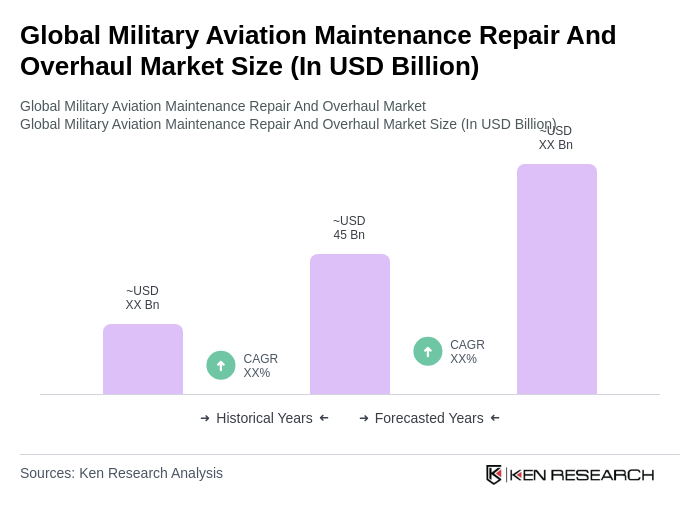
- The Global Military Aviation Maintenance Repair and Overhaul Market is valued at USD 45 billion, based on a five-year historical analysis. This growth is primarily driven by increasing defense budgets across various nations, the need for modernization of aging aircraft fleets, and the rising complexity of military aviation systems that require specialized maintenance and repair services.
- Key players in this market include the United States, China, and Russia, driven by large active fleets, high operational tempos, and sustained defense outlays; the United States leads with the largest global military aviation fleet and a mature ecosystem of prime contractors and depots that underpin MRO capacity and technology depth.
- In 2023, the U.S. National Defense Authorization Act was enacted, authorizing defense funding that included aircraft sustainment and readiness accounts; NDAA authorizations support aviation maintenance, depot operations, and readiness initiatives rather than imposing a stand?alone mandate specific only to aviation MRO.
Global Military Aviation Maintenance Repair And Overhaul Market Segmentation
By Type:
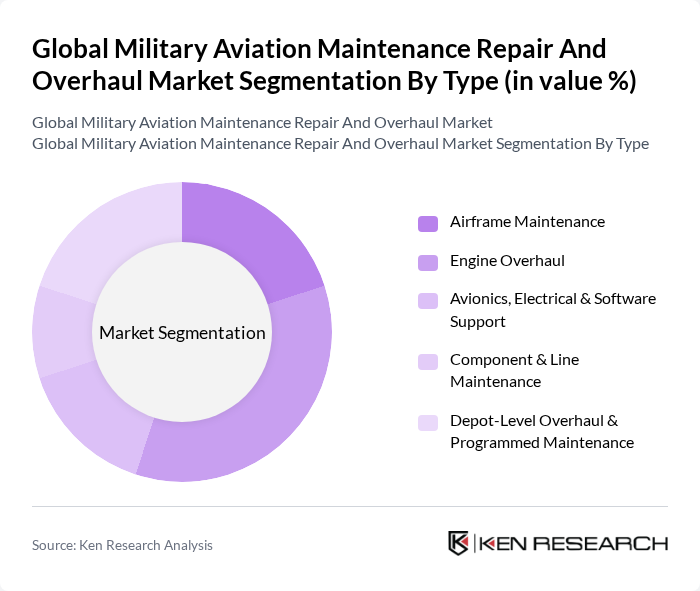
The subsegments under this category include Airframe Maintenance, Engine Overhaul, Avionics, Electrical & Software Support, Component & Line Maintenance, and Depot-Level Overhaul & Programmed Maintenance. Among these, Engine Overhaul is currently dominating the market due to higher lifecycle costs and inspection intensity of modern military propulsion systems, including sustainment demands for advanced fighters and rotorcraft engines; increased flight hours in certain theaters and the complexity of next?gen powerplants reinforce engine shop loads and specialized overhaul requirements.
By End-User:
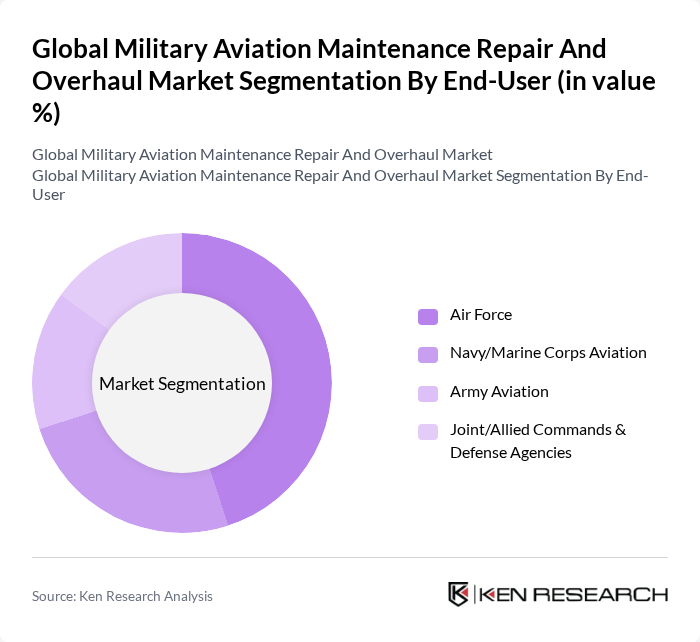
This category includes Air Force, Navy/Marine Corps Aviation, Army Aviation, and Joint/Allied Commands & Defense Agencies. The Air Force segment is leading the market, reflecting the size and complexity of fixed?wing combat and mobility fleets that demand recurring phase inspections, structural life-extension, engine overhauls, and software sustainment to maintain mission readiness.
Global Military Aviation Maintenance Repair And Overhaul Market Competitive Landscape
The Global Military Aviation Maintenance Repair And Overhaul Market is characterized by a dynamic mix of regional and international players. Leading participants such as Lockheed Martin Corporation, Boeing Defense, Space & Security, Northrop Grumman Corporation, RTX Corporation (Collins Aerospace & Pratt & Whitney Military Engines), BAE Systems plc, AAR CORP., Rolls-Royce plc (Defense), Safran Aircraft Engines & Safran Helicopter Engines, Thales Group, Leonardo S.p.A., L3Harris Technologies, Inc., Textron Inc. (Bell Textron), Honeywell International Inc. (Defense & Space), Elbit Systems Ltd., Airbus Defence and Space, Korean Air Aerospace Division (KAL-ASD), ST Engineering Aerospace Ltd., HENSOLDT AG, RUAG MRO International, Israel Aerospace Industries (IAI) – Bedek contribute to innovation, geographic expansion, and service delivery in this space.
- Notes on growth drivers and trends (validated):Rising adoption of advanced, software-intensive aircraft (e.g., fifth?generation fighters) is increasing sustainment complexity and cost; global active military fleets exceed 45,000 aircraft, supporting steady maintenance demand across depots and industry partners.
Global Military Aviation Maintenance Repair And Overhaul Market Industry Analysis
Growth Drivers
- Increasing Defense Budgets:Global defense spending reached approximately $2.1 trillion in 2023, with countries like the U.S. allocating $877 billion. This trend is expected to continue, as geopolitical tensions rise, prompting nations to enhance their military capabilities. Increased budgets directly correlate with higher investments in military aviation maintenance, repair, and overhaul (MRO) services, ensuring operational readiness and extending aircraft lifespans. Such financial commitments are crucial for sustaining advanced military aviation fleets.
- Technological Advancements in Aviation:The military aviation sector is witnessing rapid technological advancements, with global military aircraft spending projected to reach $100 billion by 2024. Innovations such as advanced avionics, enhanced propulsion systems, and improved materials are driving the need for specialized MRO services. These technologies not only enhance aircraft performance but also necessitate regular upgrades and maintenance, thereby increasing demand for MRO services across various military branches.
- Rising Demand for Aircraft Upgrades:As military aircraft age, the demand for upgrades is surging, with the U.S. Air Force alone planning to invest $1.5 billion in modernization programs by 2024. Upgrades improve operational capabilities and extend the service life of existing fleets, necessitating comprehensive MRO services. This trend is particularly evident in legacy aircraft, where modernization efforts are critical to maintaining competitive advantages in military operations.
Market Challenges
- High Maintenance Costs:The average cost of military aircraft maintenance can exceed $1 million annually per aircraft, significantly impacting defense budgets. These high costs are driven by the complexity of modern aircraft systems and the need for specialized parts and skilled labor. As defense budgets tighten, military organizations face challenges in balancing operational readiness with financial constraints, leading to potential delays in necessary MRO activities.
- Regulatory Compliance Issues:Compliance with international aviation standards and safety regulations is a significant challenge for MRO providers. The Federal Aviation Administration (FAA) and European Union Aviation Safety Agency (EASA) impose stringent regulations that can complicate maintenance processes. Non-compliance can result in costly penalties and operational delays, making it essential for MRO providers to stay updated on evolving regulations and ensure adherence to maintain their operational licenses.
Global Military Aviation Maintenance Repair And Overhaul Market Future Outlook
The future of the military aviation MRO market is poised for significant transformation, driven by digitalization and the integration of advanced technologies. As military organizations increasingly adopt predictive maintenance and data analytics, operational efficiency is expected to improve. Additionally, the focus on sustainability will likely lead to the development of eco-friendly MRO practices, aligning with global environmental goals. These trends will shape the market landscape, fostering innovation and enhancing service delivery in the coming years.
Market Opportunities
- Expansion in Emerging Markets:Emerging markets, particularly in Asia-Pacific and the Middle East, are increasing defense spending, projected to reach $500 billion by 2024. This growth presents significant opportunities for MRO providers to establish operations and partnerships, catering to the rising demand for military aviation services in these regions.
- Adoption of Predictive Maintenance Technologies:The global predictive maintenance market is expected to grow to $12 billion by 2024. Military aviation MRO can leverage these technologies to enhance operational efficiency, reduce downtime, and lower maintenance costs. Implementing predictive analytics will enable proactive maintenance strategies, ultimately improving aircraft availability and mission readiness.
Scope of the Report
| Segment | Sub-Segments |
|---|---|
| By Type | Airframe Maintenance Engine Overhaul Avionics, Electrical & Software Support Component & Line Maintenance Depot-Level Overhaul & Programmed Maintenance |
| By End-User | Air Force Navy/Marine Corps Aviation Army Aviation Joint/Allied Commands & Defense Agencies |
| By Service Type | Scheduled/Phase Maintenance Unscheduled/Corrective Maintenance Modifications, Retrofits & Upgrades (MLU/SLEP) Performance-Based Logistics (PBL) & Contractor Logistics Support (CLS) |
| By Aircraft Type | Fixed-Wing Combat (Fighters/Attack) Fixed-Wing Transport/Tanker/ISR Rotary-Wing (Helicopters/Tiltrotor) Unmanned Aerial Systems (Group 1–5) |
| By Region | North America Europe Asia-Pacific Middle East & Africa Latin America |
| By Contracting Model | In-House (Organic) Military MRO OEM MRO Services Independent MRO Providers Public-Private Partnerships & Joint Ventures |
| By Maintenance Strategy | Condition-Based & Predictive Maintenance Preventive/Time-Based Maintenance Corrective/Run-to-Failure Maintenance Reliability-Centered Maintenance (RCM) |
Key Target Audience
Investors and Venture Capitalist Firms
Government and Regulatory Bodies (e.g., Department of Defense, Federal Aviation Administration)
Military Aviation Contractors
Original Equipment Manufacturers (OEMs)
Aerospace and Defense Industry Associations
Maintenance, Repair, and Overhaul (MRO) Service Providers
Defense Procurement Agencies
Financial Institutions and Investment Banks
Players Mentioned in the Report:
Lockheed Martin Corporation
Boeing Defense, Space & Security
Northrop Grumman Corporation
RTX Corporation (Collins Aerospace & Pratt & Whitney Military Engines)
BAE Systems plc
AAR CORP.
Rolls-Royce plc (Defense)
Safran Aircraft Engines & Safran Helicopter Engines
Thales Group
Leonardo S.p.A.
L3Harris Technologies, Inc.
Textron Inc. (Bell Textron)
Honeywell International Inc. (Defense & Space)
Elbit Systems Ltd.
Airbus Defence and Space
Korean Air Aerospace Division (KAL-ASD)
ST Engineering Aerospace Ltd.
HENSOLDT AG
RUAG MRO International
Israel Aerospace Industries (IAI) Bedek
Table of Contents
Market Assessment Phase
1. Executive Summary and Approach
2. Global Military Aviation Maintenance Repair And Overhaul Market Overview
2.1 Key Insights and Strategic Recommendations
2.2 Global Military Aviation Maintenance Repair And Overhaul Market Overview
2.3 Definition and Scope
2.4 Evolution of Market Ecosystem
2.5 Timeline of Key Regulatory Milestones
2.6 Value Chain & Stakeholder Mapping
2.7 Business Cycle Analysis
2.8 Policy & Incentive Landscape
3. Global Military Aviation Maintenance Repair And Overhaul Market Analysis
3.1 Growth Drivers
3.1.1 Increasing Defense Budgets
3.1.2 Technological Advancements in Aviation
3.1.3 Rising Demand for Aircraft Upgrades
3.1.4 Growing Focus on Operational Readiness
3.2 Market Challenges
3.2.1 High Maintenance Costs
3.2.2 Regulatory Compliance Issues
3.2.3 Skilled Labor Shortages
3.2.4 Supply Chain Disruptions
3.3 Market Opportunities
3.3.1 Expansion in Emerging Markets
3.3.2 Adoption of Predictive Maintenance Technologies
3.3.3 Partnerships with Private Sector
3.3.4 Increased Focus on Sustainability
3.4 Market Trends
3.4.1 Digital Transformation in MRO Services
3.4.2 Integration of AI and Machine Learning
3.4.3 Shift Towards Modular Maintenance Solutions
3.4.4 Emphasis on Cybersecurity in Aviation
3.5 Government Regulation
3.5.1 Compliance with International Aviation Standards
3.5.2 Environmental Regulations on Emissions
3.5.3 Safety Regulations for Aircraft Maintenance
3.5.4 Export Control Regulations
4. SWOT Analysis
5. Stakeholder Analysis
6. Porter's Five Forces Analysis
7. Global Military Aviation Maintenance Repair And Overhaul Market Market Size, 2019-2024
7.1 By Value
7.2 By Volume
7.3 By Average Selling Price
8. Global Military Aviation Maintenance Repair And Overhaul Market Segmentation
8.1 By Type
8.1.1 Airframe Maintenance
8.1.2 Engine Overhaul
8.1.3 Avionics, Electrical & Software Support
8.1.4 Component & Line Maintenance
8.1.5 Depot-Level Overhaul & Programmed Maintenance
8.2 By End-User
8.2.1 Air Force
8.2.2 Navy/Marine Corps Aviation
8.2.3 Army Aviation
8.2.4 Joint/Allied Commands & Defense Agencies
8.3 By Service Type
8.3.1 Scheduled/Phase Maintenance
8.3.2 Unscheduled/Corrective Maintenance
8.3.3 Modifications, Retrofits & Upgrades (MLU/SLEP)
8.3.4 Performance-Based Logistics (PBL) & Contractor Logistics Support (CLS)
8.4 By Aircraft Type
8.4.1 Fixed-Wing Combat (Fighters/Attack)
8.4.2 Fixed-Wing Transport/Tanker/ISR
8.4.3 Rotary-Wing (Helicopters/Tiltrotor)
8.4.4 Unmanned Aerial Systems (Group 1–5)
8.5 By Region
8.5.1 North America
8.5.2 Europe
8.5.3 Asia-Pacific
8.5.4 Middle East & Africa
8.5.5 Latin America
8.6 By Contracting Model
8.6.1 In-House (Organic) Military MRO
8.6.2 OEM MRO Services
8.6.3 Independent MRO Providers
8.6.4 Public-Private Partnerships & Joint Ventures
8.7 By Maintenance Strategy
8.7.1 Condition-Based & Predictive Maintenance
8.7.2 Preventive/Time-Based Maintenance
8.7.3 Corrective/Run-to-Failure Maintenance
8.7.4 Reliability-Centered Maintenance (RCM)
9. Global Military Aviation Maintenance Repair And Overhaul Market Competitive Analysis
9.1 Market Share of Key Players
9.2 Cross Comparison of Key Players
9.2.1 Company Name
9.2.2 Scale (Prime OEM, Tier-1 MRO, Independent MRO)
9.2.3 Military Aviation MRO Revenue (USD, latest FY)
9.2.4 Engine Shop Capacity (annual overhauls) and TAT (days)
9.2.5 Fleet Under Contract (aircraft/engines supported)
9.2.6 On-Time Delivery/Availability Rate (%)
9.2.7 Contract Backlog and Average Contract Tenor (years)
9.2.8 PBL/CLS Exposure (% of revenue)
9.2.9 Sustainment Cost per Flight Hour (where disclosed)
9.2.10 STC/Upgrade Certifications and Cybersecurity Accreditations (e.g., CMMC/NIST)
9.3 SWOT Analysis of Top Players
9.4 Pricing Analysis
9.5 Detailed Profile of Major Companies
9.5.1 Lockheed Martin Corporation
9.5.2 Boeing Defense, Space & Security
9.5.3 Northrop Grumman Corporation
9.5.4 RTX Corporation (Collins Aerospace & Pratt & Whitney Military Engines)
9.5.5 BAE Systems plc
9.5.6 AAR CORP.
9.5.7 Rolls-Royce plc (Defense)
9.5.8 Safran Aircraft Engines & Safran Helicopter Engines
9.5.9 Thales Group
9.5.10 Leonardo S.p.A.
9.5.11 L3Harris Technologies, Inc.
9.5.12 Textron Inc. (Bell Textron)
9.5.13 Honeywell International Inc. (Defense & Space)
9.5.14 Elbit Systems Ltd.
9.5.15 Airbus Defence and Space
9.5.16 Korean Air Aerospace Division (KAL-ASD)
9.5.17 ST Engineering Aerospace Ltd.
9.5.18 HENSOLDT AG
9.5.19 RUAG MRO International
9.5.20 Israel Aerospace Industries (IAI) – Bedek
10. Global Military Aviation Maintenance Repair And Overhaul Market End-User Analysis
10.1 Procurement Behavior of Key Ministries
10.1.1 Budget Allocation Trends
10.1.2 Decision-Making Processes
10.1.3 Supplier Selection Criteria
10.1.4 Contracting Practices
10.2 Corporate Spend on Infrastructure & Energy
10.2.1 Investment Trends in Aviation Infrastructure
10.2.2 Spending on Energy Efficiency
10.2.3 Budgeting for Maintenance Services
10.3 Pain Point Analysis by End-User Category
10.3.1 Challenges in Maintenance Scheduling
10.3.2 Issues with Supplier Reliability
10.3.3 Cost Management Concerns
10.4 User Readiness for Adoption
10.4.1 Training and Skill Development Needs
10.4.2 Technology Adoption Barriers
10.4.3 Change Management Strategies
10.5 Post-Deployment ROI and Use Case Expansion
10.5.1 Measurement of Maintenance Effectiveness
10.5.2 Expansion into New Use Cases
10.5.3 Long-Term Value Realization
11. Global Military Aviation Maintenance Repair And Overhaul Market Future Size, 2025-2030
11.1 By Value
11.2 By Volume
11.3 By Average Selling Price
Go-To-Market Strategy Phase
1. Whitespace Analysis + Business Model Canvas
1.1 Market Gaps Identification
1.2 Business Model Framework
2. Marketing and Positioning Recommendations
2.1 Branding Strategies
2.2 Product USPs
3. Distribution Plan
3.1 Urban Retail Strategies
3.2 Rural NGO Tie-Ups
4. Channel & Pricing Gaps
4.1 Underserved Routes
4.2 Pricing Bands Analysis
5. Unmet Demand & Latent Needs
5.1 Category Gaps
5.2 Consumer Segments
6. Customer Relationship
6.1 Loyalty Programs
6.2 After-Sales Service
7. Value Proposition
7.1 Sustainability Initiatives
7.2 Integrated Supply Chains
8. Key Activities
8.1 Regulatory Compliance
8.2 Branding Efforts
8.3 Distribution Setup
9. Entry Strategy Evaluation
9.1 Domestic Market Entry Strategy
9.1.1 Product Mix Considerations
9.1.2 Pricing Band Strategy
9.1.3 Packaging Approaches
9.2 Export Entry Strategy
9.2.1 Target Countries Identification
9.2.2 Compliance Roadmap Development
10. Entry Mode Assessment
10.1 Joint Ventures
10.2 Greenfield Investments
10.3 Mergers & Acquisitions
10.4 Distributor Model Evaluation
11. Capital and Timeline Estimation
11.1 Capital Requirements Analysis
11.2 Timelines for Implementation
12. Control vs Risk Trade-Off
12.1 Ownership Considerations
12.2 Partnerships Evaluation
13. Profitability Outlook
13.1 Breakeven Analysis
13.2 Long-Term Sustainability Strategies
14. Potential Partner List
14.1 Distributors Identification
14.2 Joint Ventures Opportunities
14.3 Acquisition Targets
15. Execution Roadmap
15.1 Phased Plan for Market Entry
15.1.1 Market Setup Activities
15.1.2 Market Entry Steps
15.1.3 Growth Acceleration Tactics
15.1.4 Scale & Stabilize Actions
15.2 Key Activities and Milestones
15.2.1 Milestone Planning
15.2.2 Activity Tracking
Research Methodology
Phase 1: Approach1
Desk Research
- Analysis of military aviation maintenance reports from defense ministries and agencies
- Review of industry publications and white papers on MRO trends and technologies
- Examination of market reports from aviation regulatory bodies and trade associations
Primary Research
- Interviews with senior executives from military aviation MRO service providers
- Surveys with military procurement officers and logistics managers
- Field interviews with maintenance personnel and technical experts in military aviation
Validation & Triangulation
- Cross-validation of data through multiple industry sources and expert opinions
- Triangulation of findings from desk research and primary interviews
- Sanity checks conducted through expert panel discussions and feedback sessions
Phase 2: Market Size Estimation1
Top-down Assessment
- Estimation of total military aviation spending and allocation for MRO services
- Segmentation of the market by aircraft type, service type, and geographical region
- Incorporation of defense budget forecasts and military modernization initiatives
Bottom-up Modeling
- Collection of operational data from leading MRO providers and military contracts
- Estimation of service pricing based on historical contract values and service scopes
- Volume x cost analysis for various MRO services across different aircraft categories
Forecasting & Scenario Analysis
- Multi-factor regression analysis incorporating defense spending trends and geopolitical factors
- Scenario modeling based on potential changes in military budgets and technological advancements
- Baseline, optimistic, and pessimistic forecasts through 2035
Phase 3: CATI Sample Composition1
| Scope Item/Segment | Sample Size | Target Respondent Profiles |
|---|---|---|
| Military Aircraft MRO Services | 120 | MRO Managers, Defense Procurement Officers |
| Helicopter Maintenance Operations | 90 | Maintenance Supervisors, Technical Directors |
| Unmanned Aerial Vehicle (UAV) MRO | 60 | UAV Program Managers, Engineering Leads |
| Avionics and Systems Overhaul | 70 | Avionics Technicians, Systems Engineers |
| Logistics and Supply Chain for MRO | 80 | Logistics Coordinators, Supply Chain Analysts |
Frequently Asked Questions
What is the current value of the Global Military Aviation Maintenance Repair and Overhaul Market?
The Global Military Aviation Maintenance Repair and Overhaul Market is valued at approximately USD 45 billion, driven by increasing defense budgets, the modernization of aging aircraft fleets, and the complexity of military aviation systems requiring specialized maintenance services.
Which countries are the key players in the military aviation MRO market?
What are the main types of services offered in military aviation MRO?
How does the U.S. National Defense Authorization Act impact military aviation MRO?
Other Regional/Country Reports
Indonesia Military Aviation Maintenance Repair And Overhaul Market
Malaysia Military Aviation Maintenance Repair And Overhaul Market
APAC Military Aviation Maintenance Repair And Overhaul Market
SEA Military Aviation Maintenance Repair And Overhaul Market
Why Buy From Us?

What makes us stand out is that our consultants follow Robust, Refine and Result (RRR) methodology. Robust for clear definitions, approaches and sanity checking, Refine for differentiating respondents' facts and opinions, and Result for presenting data with story.

We have set a benchmark in the industry by offering our clients with syndicated and customized market research reports featuring coverage of entire market as well as meticulous research and analyst insights.

While we don't replace traditional research, we flip the method upside down. Our dual approach of Top Bottom & Bottom Top ensures quality deliverable by not just verifying company fundamentals but also looking at the sector and macroeconomic factors.

With one step in the future, our research team constantly tries to show you the bigger picture. We help with some of the tough questions you may encounter along the way: How is the industry positioned? Best marketing channel? KPI's of competitors? By aligning every element, we help maximize success.

Our report gives you instant access to the answers and sources that other companies might choose to hide. We elaborate each steps of research methodology we have used and showcase you the sample size to earn your trust.

If you need any support, we are here! We pride ourselves on universe strength, data quality, and quick, friendly, and professional service.