Global Military Frigates Market

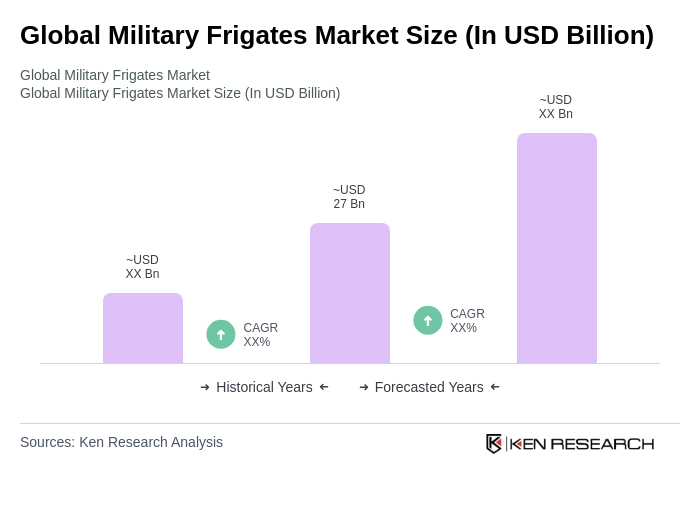
Global military frigates market, valued at USD 27 billion, is growing due to increased defense spending and maritime security needs, dominated by multi-role frigates and naval forces.

Region:Global

Author(s):Dev

Product Code:KRAA2216

Pages:84

Published On:August 2025
About the Report

Base Year 2024

Global Military Frigates Market Overview

  • The Global Military Frigates Market is valued at approximatelyUSD 27 billion, based on a five-year historical analysis. This growth is primarily driven by increasing defense budgets across various nations, rapid advancements in naval warfare technology, and the rising need for maritime security amid persistent geopolitical tensions. The demand for advanced frigates equipped with integrated combat systems, stealth features, and multi-mission capabilities has surged, reflecting the strategic importance of naval modernization in national defense priorities.
  • Key players in this market include the United States, China, and India, which dominate due to their significant investments in naval modernization and expansion of maritime forces. The U.S. leads with its advanced naval technology and extensive fleet, while China and India are rapidly enhancing their naval capabilities to assert influence in regional waters. These countries' strategic initiatives, such as indigenous shipbuilding programs and increased procurement of next-generation frigates, further bolster their positions in the global market.
  • In 2023, the U.S. government implemented the National Defense Authorization Act (NDAA), which allocatesUSD 800 billionfor defense spending, including provisions for the procurement of advanced naval vessels. The NDAA 2023, enacted by the U.S. Congress, mandates enhanced operational readiness for the U.S. Navy, supporting the acquisition and development of next-generation frigates and ensuring continued U.S. maritime superiority.
Global Military Frigates Market Size

Global Military Frigates Market Segmentation

By Type:The market is segmented into various types of frigates, including Anti-Submarine Warfare Frigates, Air Defense Frigates, Multi-Role Frigates, Guided Missile Frigates, General Purpose Frigates, Offshore Patrol Frigates, and Others. Among these,Multi-Role Frigatesare currently dominating the market due to their versatility and capability to perform various missions, such as anti-surface, anti-air, and anti-submarine warfare. The increasing demand for adaptable naval platforms that can operate in diverse environments, integrate advanced sensor suites, and support modular mission payloads is driving the growth of this segment.
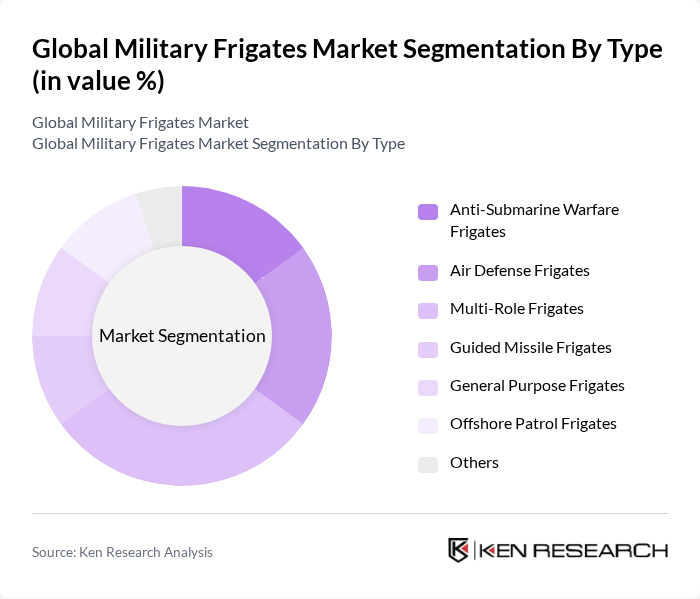
Global Military Frigates Market segmentation by Type.

By End-User:The end-user segmentation includes Naval Forces, Coast Guards, Government Defense Agencies, and International Military Alliances. TheNaval Forcessegment is the leading end-user, driven by the increasing need for advanced naval capabilities to protect national interests and ensure maritime security. Countries are investing heavily in their naval forces to enhance deterrence and response capabilities against potential threats, which is propelling the growth of this segment.
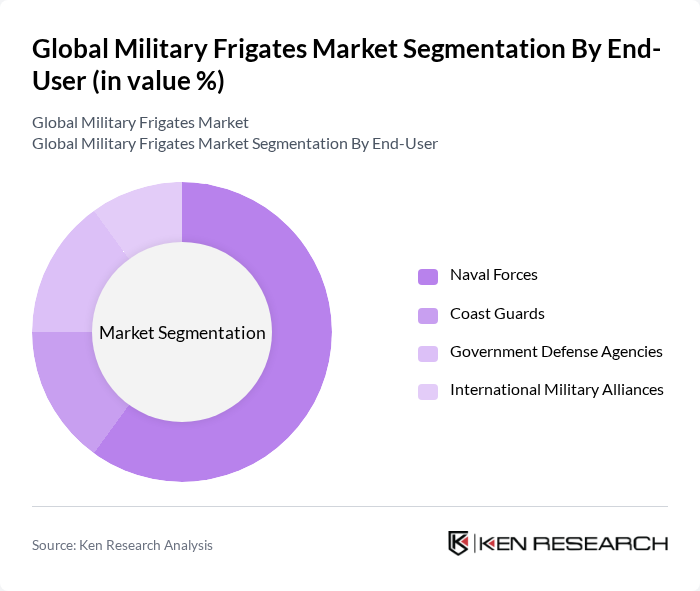
Global Military Frigates Market segmentation by End-User.

Global Military Frigates Market Competitive Landscape

The Global Military Frigates Market is characterized by a dynamic mix of regional and international players. Leading participants such as BAE Systems plc, Lockheed Martin Corporation, Naval Group, ThyssenKrupp Marine Systems GmbH, Fincantieri S.p.A., Huntington Ingalls Industries, Inc., Damen Shipyards Group, Saab AB, General Dynamics Corporation, Mitsubishi Heavy Industries, Ltd., Navantia S.A., Kongsberg Gruppen ASA, Rheinmetall AG, Northrop Grumman Corporation, Thales Group, Austal Limited, and United Shipbuilding Corporation contribute to innovation, geographic expansion, and service delivery in this space.

BAE Systems plc

1999

London, UK

Lockheed Martin Corporation

1995

Bethesda, Maryland, USA

Naval Group

2003

Paris, France

ThyssenKrupp Marine Systems GmbH

2005

Hamburg, Germany

Fincantieri S.p.A.

1959

Trieste, Italy

Company

Establishment Year

Headquarters

Group Size (Large, Medium, or Small as per industry convention)

Revenue from Frigate Segment

Order Book Value for Frigates

Number of Frigates Delivered (Last 5 Years)

Market Penetration by Region

R&D Expenditure on Naval Platforms

Global Military Frigates Market Industry Analysis

Growth Drivers

  • Increasing Defense Budgets:Global defense spending reached approximately $2.2 trillion in future, with countries like the U.S. allocating $877 billion. This trend is expected to continue, as nations prioritize military readiness amid rising geopolitical tensions. For instance, NATO members aim to meet the 2% GDP defense spending guideline, driving demand for advanced military frigates. This increased funding directly supports the procurement and modernization of naval fleets, enhancing operational capabilities and technological advancements.
  • Technological Advancements in Naval Warfare:The integration of cutting-edge technologies, such as advanced radar systems and missile defense capabilities, is transforming naval warfare. In future, global military expenditure on naval technology is projected to exceed $120 billion. This investment is crucial for developing next-generation frigates equipped with AI and automation, enhancing situational awareness and operational efficiency. As nations seek to maintain maritime superiority, the demand for technologically advanced frigates is expected to surge significantly.
  • Rising Geopolitical Tensions:Heightened geopolitical tensions, particularly in regions like the South China Sea and Eastern Europe, have led to increased naval deployments. In future, military confrontations in these areas prompted countries to bolster their naval capabilities. For example, the U.S. Navy's presence in the Indo-Pacific region has increased by 25% since 2020. This strategic focus on naval power is driving demand for modern frigates, as nations aim to secure their maritime interests and deter potential threats.

Market Challenges

  • High Development and Maintenance Costs:The development of advanced military frigates involves substantial financial investment, often exceeding $600 million per vessel. Additionally, ongoing maintenance costs can reach up to 12% of the initial procurement price annually. These high costs pose significant challenges for navies, particularly in developing countries, which may struggle to allocate sufficient budgets for modernization and upkeep of their fleets, potentially hindering operational readiness.
  • Stringent Regulatory Compliance:The military frigate industry faces rigorous regulatory frameworks, including export control regulations and environmental compliance standards. For instance, compliance with the International Maritime Organization's (IMO) regulations can increase project timelines and costs by up to 20%. These stringent requirements can deter investment and slow down the procurement process, impacting the timely delivery of new frigates to meet emerging security needs.

Global Military Frigates Market Future Outlook

The future of the military frigates market is poised for significant transformation, driven by technological advancements and evolving defense strategies. As nations increasingly prioritize naval modernization, the integration of AI and automation will enhance operational capabilities. Furthermore, the focus on multi-role frigates will enable navies to adapt to diverse mission requirements. Collaborative efforts between governments and defense contractors will also foster innovation, ensuring that military fleets remain competitive in an ever-changing geopolitical landscape.

Market Opportunities

  • Expansion into Emerging Markets:Emerging economies, particularly in Asia and Africa, are ramping up their naval capabilities. Countries like India and Brazil are projected to increase their defense budgets by 12% in future, creating opportunities for military frigate manufacturers to enter these markets. This expansion can lead to strategic partnerships and increased sales, bolstering the global presence of established defense firms.
  • Collaboration with Defense Contractors:Strategic collaborations between military organizations and defense contractors can drive innovation in frigate design and technology. Joint ventures are expected to increase by 20% in future, facilitating knowledge transfer and resource sharing. This collaboration can enhance the development of advanced frigate systems, ensuring that naval forces are equipped with state-of-the-art capabilities to address emerging threats effectively.

Scope of the Report

SegmentSub-Segments
By Type

Anti-Submarine Warfare Frigates

Air Defense Frigates

Multi-Role Frigates

Guided Missile Frigates

General Purpose Frigates

Offshore Patrol Frigates

Others

By End-User

Naval Forces

Coast Guards

Government Defense Agencies

International Military Alliances

By Region

North America

Europe

Asia-Pacific

Middle East & Africa

Latin America

By Technology

Stealth Technologies

Integrated Combat Systems

Advanced Propulsion Systems

Surveillance and Reconnaissance Technologies

Automation & AI-Enabled Systems

Others

By Application

Naval Warfare

Maritime Security Operations

Humanitarian Assistance

Anti-Piracy Operations

Others

By Investment Source

Government Funding

Private Investments

International Aid

By Policy Support

Defense Procurement Policies

Subsidies for Domestic Production

Tax Incentives for R&D

Others

Key Target Audience

Investors and Venture Capitalist Firms

Government and Regulatory Bodies (e.g., Department of Defense, Ministry of Defence)

Military Procurement Agencies

Naval Shipbuilding Companies

Defense Contractors

Maritime Security Agencies

International Defense Organizations (e.g., NATO)

Supply Chain and Logistics Providers

Players Mentioned in the Report:

BAE Systems plc

Lockheed Martin Corporation

Naval Group

ThyssenKrupp Marine Systems GmbH

Fincantieri S.p.A.

Huntington Ingalls Industries, Inc.

Damen Shipyards Group

Saab AB

General Dynamics Corporation

Mitsubishi Heavy Industries, Ltd.

Navantia S.A.

Kongsberg Gruppen ASA

Rheinmetall AG

Northrop Grumman Corporation

Thales Group

Austal Limited

United Shipbuilding Corporation

Table of Contents

Market Assessment Phase

1. Executive Summary and Approach


2. Global Military Frigates Market Overview

2.1 Key Insights and Strategic Recommendations

2.2 Global Military Frigates Market Overview

2.3 Definition and Scope

2.4 Evolution of Market Ecosystem

2.5 Timeline of Key Regulatory Milestones

2.6 Value Chain & Stakeholder Mapping

2.7 Business Cycle Analysis

2.8 Policy & Incentive Landscape


3. Global Military Frigates Market Analysis

3.1 Growth Drivers

3.1.1 Increasing Defense Budgets
3.1.2 Technological Advancements in Naval Warfare
3.1.3 Rising Geopolitical Tensions
3.1.4 Demand for Modernization of Naval Fleets

3.2 Market Challenges

3.2.1 High Development and Maintenance Costs
3.2.2 Stringent Regulatory Compliance
3.2.3 Supply Chain Disruptions
3.2.4 Competition from Alternative Naval Vessels

3.3 Market Opportunities

3.3.1 Expansion into Emerging Markets
3.3.2 Collaboration with Defense Contractors
3.3.3 Investment in R&D for Advanced Frigate Technologies
3.3.4 Integration of AI and Automation in Frigates

3.4 Market Trends

3.4.1 Shift Towards Multi-Role Frigates
3.4.2 Increased Focus on Cybersecurity Measures
3.4.3 Adoption of Green Technologies
3.4.4 Enhanced Naval Partnerships and Alliances

3.5 Government Regulation

3.5.1 Export Control Regulations
3.5.2 Environmental Compliance Standards
3.5.3 Defense Procurement Policies
3.5.4 Safety and Operational Standards

4. SWOT Analysis


5. Stakeholder Analysis


6. Porter's Five Forces Analysis


7. Global Military Frigates Market Market Size, 2019-2024

7.1 By Value

7.2 By Volume

7.3 By Average Selling Price


8. Global Military Frigates Market Segmentation

8.1 By Type

8.1.1 Anti-Submarine Warfare Frigates
8.1.2 Air Defense Frigates
8.1.3 Multi-Role Frigates
8.1.4 Guided Missile Frigates
8.1.5 General Purpose Frigates
8.1.6 Offshore Patrol Frigates
8.1.7 Others

8.2 By End-User

8.2.1 Naval Forces
8.2.2 Coast Guards
8.2.3 Government Defense Agencies
8.2.4 International Military Alliances

8.3 By Region

8.3.1 North America
8.3.2 Europe
8.3.3 Asia-Pacific
8.3.4 Middle East & Africa
8.3.5 Latin America

8.4 By Technology

8.4.1 Stealth Technologies
8.4.2 Integrated Combat Systems
8.4.3 Advanced Propulsion Systems
8.4.4 Surveillance and Reconnaissance Technologies
8.4.5 Automation & AI-Enabled Systems
8.4.6 Others

8.5 By Application

8.5.1 Naval Warfare
8.5.2 Maritime Security Operations
8.5.3 Humanitarian Assistance
8.5.4 Anti-Piracy Operations
8.5.5 Others

8.6 By Investment Source

8.6.1 Government Funding
8.6.2 Private Investments
8.6.3 International Aid

8.7 By Policy Support

8.7.1 Defense Procurement Policies
8.7.2 Subsidies for Domestic Production
8.7.3 Tax Incentives for R&D
8.7.4 Others

9. Global Military Frigates Market Competitive Analysis

9.1 Market Share of Key Players

9.2 Cross Comparison of Key Players

9.2.1 Company Name
9.2.2 Group Size (Large, Medium, or Small as per industry convention)
9.2.3 Revenue from Frigate Segment
9.2.4 Order Book Value for Frigates
9.2.5 Number of Frigates Delivered (Last 5 Years)
9.2.6 Market Penetration by Region
9.2.7 R&D Expenditure on Naval Platforms
9.2.8 Average Delivery Lead Time
9.2.9 Operational Availability Rate
9.2.10 Export Share of Frigate Sales
9.2.11 Strategic Partnerships & Collaborations

9.3 SWOT Analysis of Top Players

9.4 Pricing Analysis

9.5 Detailed Profile of Major Companies

9.5.1 BAE Systems plc
9.5.2 Lockheed Martin Corporation
9.5.3 Naval Group
9.5.4 ThyssenKrupp Marine Systems GmbH
9.5.5 Fincantieri S.p.A.
9.5.6 Huntington Ingalls Industries, Inc.
9.5.7 Damen Shipyards Group
9.5.8 Saab AB
9.5.9 General Dynamics Corporation
9.5.10 Mitsubishi Heavy Industries, Ltd.
9.5.11 Navantia S.A.
9.5.12 Kongsberg Gruppen ASA
9.5.13 Rheinmetall AG
9.5.14 Northrop Grumman Corporation
9.5.15 Thales Group
9.5.16 Austal Limited
9.5.17 United Shipbuilding Corporation

10. Global Military Frigates Market End-User Analysis

10.1 Procurement Behavior of Key Ministries

10.1.1 Defense Ministry Procurement Strategies
10.1.2 Budget Allocation Trends
10.1.3 Decision-Making Processes

10.2 Corporate Spend on Infrastructure & Energy

10.2.1 Investment in Naval Infrastructure
10.2.2 Spending on Maintenance and Upgrades
10.2.3 Budgeting for New Technologies

10.3 Pain Point Analysis by End-User Category

10.3.1 Budget Constraints
10.3.2 Technological Gaps
10.3.3 Operational Limitations

10.4 User Readiness for Adoption

10.4.1 Training and Skill Development Needs
10.4.2 Infrastructure Readiness
10.4.3 Acceptance of New Technologies

10.5 Post-Deployment ROI and Use Case Expansion

10.5.1 Performance Metrics Evaluation
10.5.2 Long-term Cost Savings
10.5.3 Opportunities for Upgrades

11. Global Military Frigates Market Future Size, 2025-2030

11.1 By Value

11.2 By Volume

11.3 By Average Selling Price


Go-To-Market Strategy Phase

1. Whitespace Analysis + Business Model Canvas

1.1 Market Gaps Identification

1.2 Value Proposition Development

1.3 Revenue Streams Analysis

1.4 Cost Structure Evaluation

1.5 Key Partnerships Exploration

1.6 Customer Segmentation

1.7 Channels of Distribution


2. Marketing and Positioning Recommendations

2.1 Branding Strategies

2.2 Product USPs

2.3 Target Market Identification

2.4 Communication Strategies

2.5 Digital Marketing Approaches


3. Distribution Plan

3.1 Urban Retail Strategies

3.2 Rural NGO Tie-ups

3.3 Direct Sales Channels

3.4 Online Distribution Platforms


4. Channel & Pricing Gaps

4.1 Underserved Routes

4.2 Pricing Bands Analysis

4.3 Competitor Pricing Strategies


5. Unmet Demand & Latent Needs

5.1 Category Gaps Identification

5.2 Consumer Segments Analysis

5.3 Emerging Trends Exploration


6. Customer Relationship

6.1 Loyalty Programs Development

6.2 After-sales Service Strategies

6.3 Customer Feedback Mechanisms


7. Value Proposition

7.1 Sustainability Initiatives

7.2 Integrated Supply Chains

7.3 Competitive Advantages


8. Key Activities

8.1 Regulatory Compliance

8.2 Branding Initiatives

8.3 Distribution Setup


9. Entry Strategy Evaluation

9.1 Domestic Market Entry Strategy

9.1.1 Product Mix Considerations
9.1.2 Pricing Band Strategies
9.1.3 Packaging Approaches

9.2 Export Entry Strategy

9.2.1 Target Countries Identification
9.2.2 Compliance Roadmap Development

10. Entry Mode Assessment

10.1 Joint Ventures

10.2 Greenfield Investments

10.3 Mergers & Acquisitions

10.4 Distributor Model Evaluation


11. Capital and Timeline Estimation

11.1 Capital Requirements Analysis

11.2 Timelines for Implementation


12. Control vs Risk Trade-Off

12.1 Ownership vs Partnerships

12.2 Risk Management Strategies


13. Profitability Outlook

13.1 Breakeven Analysis

13.2 Long-term Sustainability Strategies


14. Potential Partner List

14.1 Distributors Identification

14.2 Joint Ventures Opportunities

14.3 Acquisition Targets


15. Execution Roadmap

15.1 Phased Plan for Market Entry

15.1.1 Market Setup
15.1.2 Market Entry
15.1.3 Growth Acceleration
15.1.4 Scale & Stabilize

15.2 Key Activities and Milestones

15.2.1 Milestone Planning
15.2.2 Activity Tracking

Research Methodology

ApproachModellingSample

Phase 1: Approach1

Desk Research

  • Analysis of global military frigate procurement reports from defense ministries
  • Review of industry publications and white papers on naval defense trends
  • Examination of market reports from defense analysts and think tanks

Primary Research

  • Interviews with naval defense procurement officers from various countries
  • Surveys with industry experts and analysts specializing in military maritime technology
  • Field interviews with shipbuilders and defense contractors involved in frigate production

Validation & Triangulation

  • Cross-validation of data through multiple sources including government and industry reports
  • Triangulation of findings from primary interviews and secondary data sources
  • Sanity checks conducted through expert panel discussions and feedback sessions

Phase 2: Market Size Estimation1

Top-down Assessment

  • Estimation of total defense budgets allocated to naval forces across key regions
  • Analysis of historical frigate procurement trends and future projections
  • Incorporation of geopolitical factors influencing naval spending and frigate demand

Bottom-up Modeling

  • Volume estimates based on current frigate orders and production capacities of shipyards
  • Cost analysis of frigate construction, including materials and labor inputs
  • Assessment of aftermarket services and maintenance contracts related to frigates

Forecasting & Scenario Analysis

  • Multi-factor regression analysis incorporating defense spending growth and technological advancements
  • Scenario modeling based on potential shifts in military alliances and conflicts
  • Baseline, optimistic, and pessimistic forecasts through 2035 based on strategic insights

Phase 3: CATI Sample Composition1

Scope Item/SegmentSample SizeTarget Respondent Profiles
Frigate Procurement Strategies100Defense Procurement Officers, Naval Strategists
Shipbuilding Industry Insights60Shipyard Managers, Engineering Leads
Naval Technology Trends50Defense Technology Analysts, R&D Managers
International Defense Collaborations40Policy Makers, Defense Attachés
Frigate Maintenance and Upgrades70Maintenance Managers, Logistics Coordinators

Frequently Asked Questions

What is the current value of the Global Military Frigates Market?

The Global Military Frigates Market is valued at approximately USD 27 billion, driven by increasing defense budgets, advancements in naval warfare technology, and the need for enhanced maritime security amid geopolitical tensions.

Which countries are the key players in the military frigates market?

What are the main types of frigates in the market?

What drives the growth of the Global Military Frigates Market?

Other Regional/Country Reports

Indonesia Global Military Frigates Market

Malaysia Global Military Frigates Market

KSA Global Military Frigates Market

APAC Global Military Frigates Market

SEA Global Military Frigates Market

Vietnam Global Military Frigates Market

Why Buy From Us?

Refine Robust Result (RRR) Framework

What makes us stand out is that our consultants follow Robust, Refine and Result (RRR) methodology. Robust for clear definitions, approaches and sanity checking, Refine for differentiating respondents' facts and opinions, and Result for presenting data with story.

Our Reach Is Unmatched

We have set a benchmark in the industry by offering our clients with syndicated and customized market research reports featuring coverage of entire market as well as meticulous research and analyst insights.

Shifting the Research Paradigm

While we don't replace traditional research, we flip the method upside down. Our dual approach of Top Bottom & Bottom Top ensures quality deliverable by not just verifying company fundamentals but also looking at the sector and macroeconomic factors.

More Insights-Better Decisions

With one step in the future, our research team constantly tries to show you the bigger picture. We help with some of the tough questions you may encounter along the way: How is the industry positioned? Best marketing channel? KPI's of competitors? By aligning every element, we help maximize success.

Transparency and Trust

Our report gives you instant access to the answers and sources that other companies might choose to hide. We elaborate each steps of research methodology we have used and showcase you the sample size to earn your trust.

Round the Clock Support

If you need any support, we are here! We pride ourselves on universe strength, data quality, and quick, friendly, and professional service.

Why Clients Choose Us?

400000+
Reports in repository
150+
Consulting projects a year
100+
Analysts
8000+
Client Queries in 2022








