About the Report
Base Year 2024Global Monosodium Glutamate Msg Market Overview
- The Global Monosodium Glutamate (MSG) market is valued at USD 5.5 billion, based on a five-year historical analysis. This growth is primarily driven by the increasing demand for flavor enhancers in the food and beverage industry, coupled with the rising popularity of processed foods. The expansion of the foodservice sector and the growing trend of international cuisines have further fueled the market's growth.
- Key players in this market include countries like China, Japan, and the United States, which dominate due to their advanced food processing industries and high consumption rates of MSG. Asia-Pacific, particularly China and Japan, has traditionally accounted for the largest consumption and production base for MSG, supported by extensive fermentation capacity and strong demand from snacks, soups, sauces, and ready-to-eat foods.
- The U.S. Food and Drug Administration (FDA) classifies MSG as “generally recognized as safe” (GRAS) when used as intended in foods, which supports adoption by manufacturers; FDA’s position has remained consistent in recent updates to consumer guidance on MSG safety and labeling. This regulatory stance has bolstered consumer confidence and encouraged manufacturers to incorporate MSG in their products.

Global Monosodium Glutamate Msg Market Segmentation
By Type:
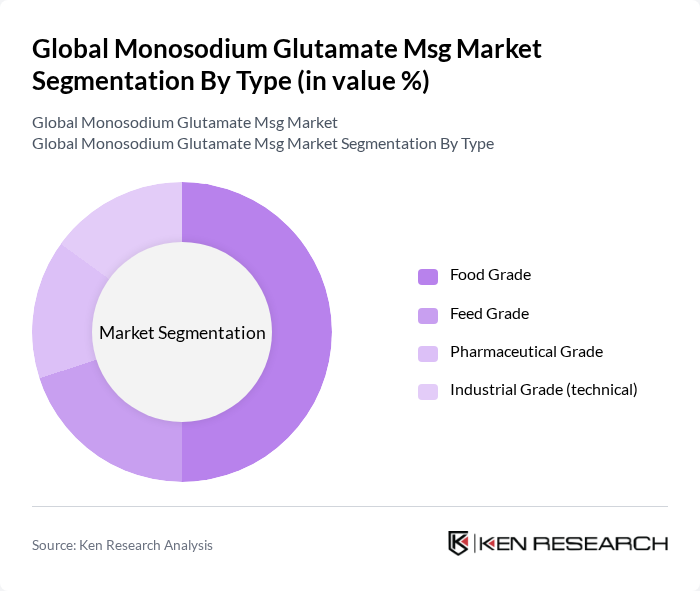
The market is segmented into four types: Food Grade, Feed Grade, Pharmaceutical Grade, and Industrial Grade (technical). Among these, Food Grade MSG is the leading subsegment, driven by its extensive use in the food and beverage industry. Industry analyses indicate food grade dominates usage for seasonings, snacks, soups, sauces, and ready-to-eat meals as manufacturers seek to enhance umami while maintaining cost efficiency. The increasing consumer preference for umami flavors in various cuisines has led to a surge in demand for Food Grade MSG, with Asia’s culinary influence expanding globally. Additionally, the growing trend of home cooking and the rise of gourmet and convenience food products have further solidified its dominance in the market.
By Application:
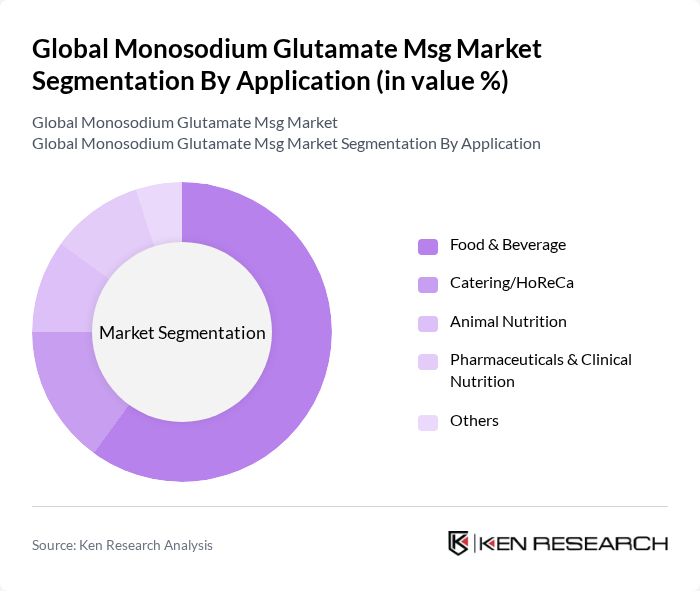
The market is segmented into five applications: Food & Beverage, Catering/HoReCa, Animal Nutrition, Pharmaceuticals & Clinical Nutrition, and Others. The Food & Beverage application dominates the market, accounting for a significant share due to the widespread use of MSG in seasonings, snacks, soups, and sauces. The increasing demand for ready-to-eat meals and convenience foods has further propelled the growth of this segment, as manufacturers seek to enhance flavor profiles and meet consumer preferences.
Global Monosodium Glutamate Msg Market Competitive Landscape
The Global Monosodium Glutamate Msg Market is characterized by a dynamic mix of regional and international players. Leading participants such as Ajinomoto Co., Inc., Meihua Holdings Group Co., Ltd., Fufeng Group Co., Ltd., Ningxia Eppen Biotech Co., Ltd., Shandong Xinle Monosodium Glutamate Co., Ltd., Vedan International (Holdings) Limited, Henan Lotus Flower Gourmet Powder Co., Ltd. (Lotus MSG), Shandong Qilu Biotechnology Group Co., Ltd., Shandong Shuntian MSG Co., Ltd., Fujian Wuyi Monosodium Glutamate Co., Ltd., Global Bio-Chem Technology Group Company Limited, Linghua Group Limited, COFCO Biochemical (Anhui) Co., Ltd., CJ CheilJedang Corp., Tate & Lyle PLC contribute to innovation, geographic expansion, and service delivery in this space.
Global Monosodium Glutamate Msg Market Industry Analysis
Growth Drivers
- Increasing Demand for Flavor Enhancers:The global flavor enhancer market is projected to reach twenty billion dollars by 2024, driven by the rising consumer preference for enhanced taste in food products. The demand for monosodium glutamate (MSG) is particularly strong in regions like Asia, where MSG is a staple in culinary practices. The growing trend of flavor enhancement in processed foods, which accounted for one point five trillion dollars in 2023, further supports MSG's market growth, as manufacturers seek to improve taste profiles without increasing costs.
- Growth in Processed Food Industry:The processed food industry is expected to grow significantly, with a market value projected to reach four trillion dollars by 2024. This growth is fueled by urbanization and changing lifestyles, leading to increased consumption of ready-to-eat meals. MSG plays a crucial role in this sector, as it enhances flavor while maintaining cost-effectiveness. In 2023, the processed food segment utilizing MSG was valued at approximately one point two billion dollars, indicating a robust demand for flavor enhancers in this market.
- Rising Consumer Preference for Umami Taste:The umami flavor, often associated with MSG, is gaining traction among consumers, particularly in Western markets. Research indicates that sixty percent of consumers are actively seeking umami-rich products, which has led to a surge in MSG usage in various food applications. The global umami seasoning market is projected to reach ten billion dollars by 2024, highlighting the increasing acceptance and demand for MSG as a key ingredient in enhancing savory flavors across diverse cuisines.
Market Challenges
- Health Concerns Related to MSG Consumption:Despite its widespread use, MSG faces scrutiny due to health concerns, including reports of headaches and allergic reactions. A 2023 study indicated that thirty percent of consumers are wary of MSG, impacting its acceptance in certain markets. This skepticism poses a challenge for manufacturers, as they must navigate consumer perceptions while ensuring product safety and transparency, which can hinder MSG's growth potential in health-conscious demographics.
- Stringent Regulatory Frameworks:Regulatory bodies, including the FDA and EFSA, impose strict guidelines on food additives, including MSG. In 2023, the FDA reported over two hundred compliance checks related to MSG labeling and usage. These regulations can complicate market entry for new products and increase operational costs for existing manufacturers. Compliance with these frameworks is essential, yet it can limit innovation and flexibility in product development, posing a significant challenge for MSG producers.
Global Monosodium Glutamate Msg Market Future Outlook
The future of the monosodium glutamate market appears promising, driven by evolving consumer preferences and innovations in food technology. As the demand for flavor enhancers continues to rise, particularly in emerging markets, MSG is likely to see increased adoption in various food applications. Additionally, the trend towards clean label products and sustainable sourcing will shape the market landscape, encouraging manufacturers to explore new formulations and marketing strategies that align with consumer values and health trends.
Market Opportunities
- Emerging Markets Growth:Emerging markets, particularly in Asia and Africa, present significant growth opportunities for MSG. With a combined population exceeding three billion, these regions are experiencing rising disposable incomes and changing dietary habits, leading to increased demand for flavor enhancers. The processed food sector in these markets is projected to grow by five hundred billion dollars by 2024, creating a favorable environment for MSG adoption.
- Innovations in Food Processing Techniques:Advances in food processing technologies are opening new avenues for MSG applications. Techniques such as encapsulation and microencapsulation are enhancing MSG's stability and flavor release, making it more appealing to manufacturers. As the food industry invests in innovative processing methods, the demand for MSG is expected to rise, particularly in high-quality, gourmet food products, which are projected to grow by fifteen percent annually through 2024.
Scope of the Report
| Segment | Sub-Segments |
|---|---|
| By Type | Food Grade Feed Grade Pharmaceutical Grade Industrial Grade (technical) |
| By Application | Food & Beverage: seasonings, snacks, soups, sauces, RTE meals Catering/HoReCa (foodservice) Animal Nutrition (feed) Pharmaceuticals & Clinical Nutrition (excipients, parenteral nutrition) Others (industrial/process use) |
| By End-User | Food & Snack Manufacturers Seasoning/Condiment Blenders Restaurants, QSRs, and Institutional Catering Retail/Household Consumers Pharmaceutical & Nutritional Formulators |
| By Distribution Channel | Direct/B2B (manufacturers to industrial buyers) Distributors/Wholesalers Modern Trade (supermarkets/hypermarkets) Online/E-commerce Traditional Trade (convenience & grocery) |
| By Packaging Type | Bulk (25 kg bags, FIBCs) Foodservice Packs (1–5 kg) Retail Packs (100 g–1 kg) Others (custom/industrial) |
| By Region | North America Europe Asia-Pacific Latin America Middle East & Africa |
| By Price Range | Economy Mid-Range Premium |
Key Target Audience
Investors and Venture Capitalist Firms
Government and Regulatory Bodies (e.g., Food and Drug Administration, European Food Safety Authority)
Manufacturers and Producers
Distributors and Retailers
Food and Beverage Companies
Flavoring and Seasoning Companies
Industry Associations (e.g., International Food Additives Council)
Financial Institutions
Players Mentioned in the Report:
Ajinomoto Co., Inc.
Meihua Holdings Group Co., Ltd.
Fufeng Group Co., Ltd.
Ningxia Eppen Biotech Co., Ltd.
Shandong Xinle Monosodium Glutamate Co., Ltd.
Vedan International (Holdings) Limited
Henan Lotus Flower Gourmet Powder Co., Ltd. (Lotus MSG)
Shandong Qilu Biotechnology Group Co., Ltd.
Shandong Shuntian MSG Co., Ltd.
Fujian Wuyi Monosodium Glutamate Co., Ltd.
Global Bio-Chem Technology Group Company Limited
Linghua Group Limited
COFCO Biochemical (Anhui) Co., Ltd.
CJ CheilJedang Corp.
Tate & Lyle PLC (note: participates via ingredient solutions; limited direct MSG production)
Table of Contents
Market Assessment Phase
1. Executive Summary and Approach
2. Global Monosodium Glutamate Msg Market Overview
2.1 Key Insights and Strategic Recommendations
2.2 Global Monosodium Glutamate Msg Market Overview
2.3 Definition and Scope
2.4 Evolution of Market Ecosystem
2.5 Timeline of Key Regulatory Milestones
2.6 Value Chain & Stakeholder Mapping
2.7 Business Cycle Analysis
2.8 Policy & Incentive Landscape
3. Global Monosodium Glutamate Msg Market Analysis
3.1 Growth Drivers
3.1.1 Increasing Demand for Flavor Enhancers
3.1.2 Growth in Processed Food Industry
3.1.3 Rising Consumer Preference for Umami Taste
3.1.4 Expansion of Food Service Sector
3.2 Market Challenges
3.2.1 Health Concerns Related to MSG Consumption
3.2.2 Stringent Regulatory Frameworks
3.2.3 Competition from Natural Flavor Enhancers
3.2.4 Price Volatility of Raw Materials
3.3 Market Opportunities
3.3.1 Emerging Markets Growth
3.3.2 Innovations in Food Processing Techniques
3.3.3 Increasing Use in Vegan and Vegetarian Products
3.3.4 Expansion in E-commerce Distribution Channels
3.4 Market Trends
3.4.1 Shift Towards Clean Label Products
3.4.2 Rising Popularity of Asian Cuisine
3.4.3 Increased Focus on Sustainable Sourcing
3.4.4 Growth of Organic and Non-GMO Products
3.5 Government Regulation
3.5.1 FDA Guidelines on MSG Usage
3.5.2 EU Regulations on Food Additives
3.5.3 Labeling Requirements for MSG
3.5.4 Import Tariffs on MSG Products
4. SWOT Analysis
5. Stakeholder Analysis
6. Porter's Five Forces Analysis
7. Global Monosodium Glutamate Msg Market Market Size, 2019-2024
7.1 By Value
7.2 By Volume
7.3 By Average Selling Price
8. Global Monosodium Glutamate Msg Market Segmentation
8.1 By Type
8.1.1 Food Grade
8.1.2 Feed Grade
8.1.3 Pharmaceutical Grade
8.1.4 Industrial Grade (technical)
8.2 By Application
8.2.1 Food & Beverage: seasonings, snacks, soups, sauces, RTE meals
8.2.2 Catering/HoReCa (foodservice)
8.2.3 Animal Nutrition (feed)
8.2.4 Pharmaceuticals & Clinical Nutrition (excipients, parenteral nutrition)
8.2.5 Others (industrial/process use)
8.3 By End-User
8.3.1 Food & Snack Manufacturers
8.3.2 Seasoning/Condiment Blenders
8.3.3 Restaurants, QSRs, and Institutional Catering
8.3.4 Retail/Household Consumers
8.3.5 Pharmaceutical & Nutritional Formulators
8.4 By Distribution Channel
8.4.1 Direct/B2B (manufacturers to industrial buyers)
8.4.2 Distributors/Wholesalers
8.4.3 Modern Trade (supermarkets/hypermarkets)
8.4.4 Online/E-commerce
8.4.5 Traditional Trade (convenience & grocery)
8.5 By Packaging Type
8.5.1 Bulk (25 kg bags, FIBCs)
8.5.2 Foodservice Packs (1–5 kg)
8.5.3 Retail Packs (100 g–1 kg)
8.5.4 Others (custom/industrial)
8.6 By Region
8.6.1 North America
8.6.2 Europe
8.6.3 Asia-Pacific
8.6.4 Latin America
8.6.5 Middle East & Africa
8.7 By Price Range
8.7.1 Economy
8.7.2 Mid-Range
8.7.3 Premium
9. Global Monosodium Glutamate Msg Market Competitive Analysis
9.1 Market Share of Key Players
9.2 Cross Comparison of Key Players
9.2.1 Company Name (manufacturer/brand owner)
9.2.2 Production Capacity (ktpa) and Capacity Utilization (%)
9.2.3 Revenue from MSG and Amino Acid Derivatives (latest fiscal, USD)
9.2.4 Geographic Revenue Mix (% APAC/EMEA/AMER)
9.2.5 ASP per tonne (FOB benchmark, USD/tonne)
9.2.6 EBITDA Margin (%) for MSG segment
9.2.7 Feedstock/Source Mix (% fermentation vs chemical synthesis)
9.2.8 Product Portfolio Breadth (crystal/powder/liquid; grades; pack sizes)
9.2.9 Supply Chain Footprint (no. of plants, countries, export share %)
9.2.10 R&D and Process Efficiency KPIs (fermentation yield %, energy per tonne, water intensity)
9.2.11 Compliance & Quality Certifications (FSSC 22000, ISO 9001/14001, Halal, Kosher)
9.2.12 Brand Penetration in Foodservice & Retail (distribution reach, key QSR contracts)
9.3 SWOT Analysis of Top Players
9.4 Pricing Analysis
9.5 Detailed Profile of Major Companies
9.5.1 Ajinomoto Co., Inc.
9.5.2 Meihua Holdings Group Co., Ltd.
9.5.3 Fufeng Group Co., Ltd.
9.5.4 Ningxia Eppen Biotech Co., Ltd.
9.5.5 Shandong Xinle Monosodium Glutamate Co., Ltd.
9.5.6 Vedan International (Holdings) Limited
9.5.7 Henan Lotus Flower Gourmet Powder Co., Ltd. (Lotus MSG)
9.5.8 Shandong Qilu Biotechnology Group Co., Ltd.
9.5.9 Shandong Shuntian MSG Co., Ltd.
9.5.10 Fujian Wuyi Monosodium Glutamate Co., Ltd.
9.5.11 Global Bio-Chem Technology Group Company Limited
9.5.12 Linghua Group Limited
9.5.13 COFCO Biochemical (Anhui) Co., Ltd.
9.5.14 CJ CheilJedang Corp.
9.5.15 Tate & Lyle PLC (note: participates via ingredient solutions; limited direct MSG production)
10. Global Monosodium Glutamate Msg Market End-User Analysis
10.1 Procurement Behavior of Key Ministries
10.1.1 Government Procurement Policies
10.1.2 Budget Allocations for Food Products
10.1.3 Supplier Selection Criteria
10.2 Corporate Spend on Infrastructure & Energy
10.2.1 Investment in Food Processing Facilities
10.2.2 Expenditure on Quality Control Systems
10.2.3 Budget for Research and Development
10.3 Pain Point Analysis by End-User Category
10.3.1 Quality Assurance Issues
10.3.2 Supply Chain Disruptions
10.3.3 Cost Management Challenges
10.4 User Readiness for Adoption
10.4.1 Awareness of MSG Benefits
10.4.2 Training and Support Needs
10.4.3 Adoption Barriers
10.5 Post-Deployment ROI and Use Case Expansion
10.5.1 Measurement of ROI Metrics
10.5.2 Case Studies of Successful Implementations
10.5.3 Future Use Case Opportunities
11. Global Monosodium Glutamate Msg Market Future Size, 2025-2030
11.1 By Value
11.2 By Volume
11.3 By Average Selling Price
Go-To-Market Strategy Phase
1. Whitespace Analysis + Business Model Canvas
1.1 Market Gaps Identification
1.2 Business Model Framework
2. Marketing and Positioning Recommendations
2.1 Branding Strategies
2.2 Product USPs
3. Distribution Plan
3.1 Urban Retail vs Rural NGO Tie-ups
4. Channel & Pricing Gaps
4.1 Underserved Routes
4.2 Pricing Bands
5. Unmet Demand & Latent Needs
5.1 Category Gaps
5.2 Consumer Segments
6. Customer Relationship
6.1 Loyalty Programs
6.2 After-sales Service
7. Value Proposition
7.1 Sustainability
7.2 Integrated Supply Chains
8. Key Activities
8.1 Regulatory Compliance
8.2 Branding
8.3 Distribution Setup
9. Entry Strategy Evaluation
9.1 Domestic Market Entry Strategy
9.1.1 Product Mix
9.1.2 Pricing Band
9.1.3 Packaging
9.2 Export Entry Strategy
9.2.1 Target Countries
9.2.2 Compliance Roadmap
10. Entry Mode Assessment
10.1 JV
10.2 Greenfield
10.3 M&A
10.4 Distributor Model
11. Capital and Timeline Estimation
11.1 Capital Requirements
11.2 Timelines
12. Control vs Risk Trade-Off
12.1 Ownership vs Partnerships
13. Profitability Outlook
13.1 Breakeven Analysis
13.2 Long-term Sustainability
14. Potential Partner List
14.1 Distributors
14.2 JVs
14.3 Acquisition Targets
15. Execution Roadmap
15.1 Phased Plan for Market Entry
15.1.1 Market Setup
15.1.2 Market Entry
15.1.3 Growth Acceleration
15.1.4 Scale & Stabilize
15.2 Key Activities and Milestones
15.2.1 Milestone Planning
15.2.2 Activity Tracking
Research Methodology
Phase 1: Approach1
Desk Research
- Industry reports from food and beverage associations and market research firms
- Analysis of trade statistics from global trade databases and customs data
- Review of academic journals and publications on monosodium glutamate applications
Primary Research
- Interviews with food product developers and flavoring specialists
- Surveys with distributors and wholesalers in the food industry
- Field interviews with chefs and culinary experts regarding MSG usage
Validation & Triangulation
- Cross-validation of findings through multiple industry sources and expert opinions
- Triangulation of data from trade associations, market reports, and regulatory bodies
- Sanity checks through feedback from a panel of industry experts
Phase 2: Market Size Estimation1
Top-down Assessment
- Analysis of global food and beverage market size to estimate MSG market share
- Segmentation by application areas such as snacks, sauces, and processed foods
- Incorporation of trends in consumer preferences and health regulations
Bottom-up Modeling
- Volume estimates based on production data from leading MSG manufacturers
- Cost analysis derived from pricing models of MSG in various regions
- Estimation of consumption patterns across different food sectors
Forecasting & Scenario Analysis
- Multi-variable forecasting using historical growth rates and market drivers
- Scenario analysis based on potential regulatory changes and health trends
- Development of baseline, optimistic, and pessimistic market projections through 2030
Phase 3: CATI Sample Composition1
| Scope Item/Segment | Sample Size | Target Respondent Profiles |
|---|---|---|
| Food Manufacturing Sector | 120 | Production Managers, Quality Control Specialists |
| Food Retail Sector | 100 | Category Managers, Purchasing Agents |
| Food Service Industry | 80 | Restaurant Owners, Executive Chefs |
| Health and Nutrition Experts | 60 | Dietitians, Food Scientists |
| Regulatory Bodies | 40 | Food Safety Inspectors, Policy Makers |
Frequently Asked Questions
What is the current value of the Global Monosodium Glutamate (MSG) market?
The Global Monosodium Glutamate (MSG) market is valued at approximately USD 5.5 billion, driven by the increasing demand for flavor enhancers in the food and beverage industry, particularly in processed foods and international cuisines.
Which regions are the largest consumers of MSG?
What are the main applications of MSG?
How does the FDA classify MSG?
Other Regional/Country Reports
Indonesia Monosodium Glutamate Msg Market
Malaysia Monosodium Glutamate Msg Market
APAC Monosodium Glutamate Msg Market
SEA Monosodium Glutamate Msg Market
Why Buy From Us?

What makes us stand out is that our consultants follow Robust, Refine and Result (RRR) methodology. Robust for clear definitions, approaches and sanity checking, Refine for differentiating respondents' facts and opinions, and Result for presenting data with story.

We have set a benchmark in the industry by offering our clients with syndicated and customized market research reports featuring coverage of entire market as well as meticulous research and analyst insights.

While we don't replace traditional research, we flip the method upside down. Our dual approach of Top Bottom & Bottom Top ensures quality deliverable by not just verifying company fundamentals but also looking at the sector and macroeconomic factors.

With one step in the future, our research team constantly tries to show you the bigger picture. We help with some of the tough questions you may encounter along the way: How is the industry positioned? Best marketing channel? KPI's of competitors? By aligning every element, we help maximize success.

Our report gives you instant access to the answers and sources that other companies might choose to hide. We elaborate each steps of research methodology we have used and showcase you the sample size to earn your trust.

If you need any support, we are here! We pride ourselves on universe strength, data quality, and quick, friendly, and professional service.