About the Report
Base Year 2024Global Montelukast Sodium Market Overview
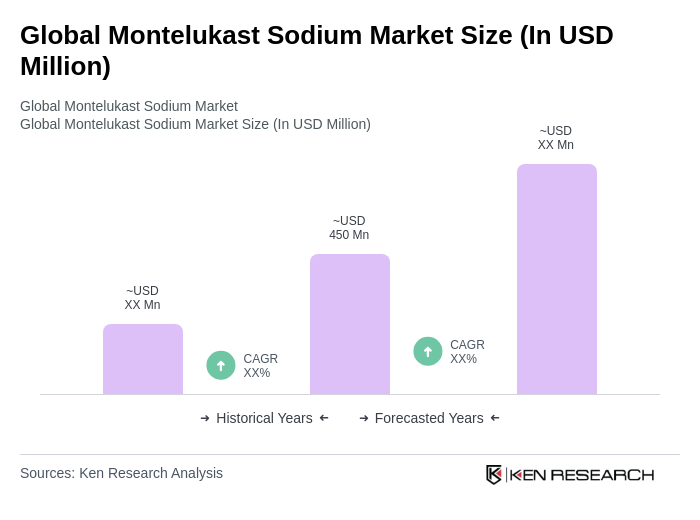
- The Global Montelukast Sodium Market is valued at USD 450 million, based on a five-year historical analysis. This growth is primarily driven by the increasing prevalence of asthma and allergic rhinitis, alongside rising awareness regarding respiratory health. The demand for effective treatments has surged, leading to a robust market for Montelukast Sodium, which is widely recognized for its efficacy in managing these conditions.
- Key players in this market include the United States, Germany, and India. The United States maintains a leading position owing to strong pharmaceutical spending and mature distribution channels; Germany benefits from robust regulatory oversight and R&D intensity; India plays a significant role as a global supplier of generics and APIs, enabling cost-effective access worldwide.
- In the United States, generic montelukast has been approved for years under existing bioequivalence regulations; the FDA requires rigorous bioequivalence for generic montelukast tablets, chewable tablets, and oral granules via ANDAs, with product-specific guidances detailing study expectations rather than new 2023-only rules. These guidances ensure generics meet the same quality and efficacy standards as branded products, supporting patient safety and outcomes.
Global Montelukast Sodium Market Segmentation
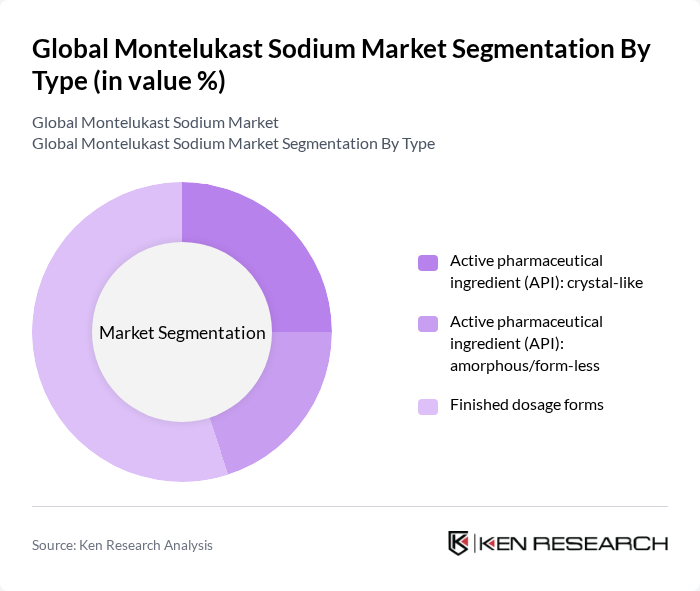
By Type:The market is segmented into three main types: Active pharmaceutical ingredient (API): crystal-like, Active pharmaceutical ingredient (API): amorphous/form-less, and Finished dosage forms. The finished dosage forms segment is currently dominating the market due to the increasing demand for ready-to-use medications that enhance patient compliance and convenience. The trend towards personalized medicine and the growing preference for oral dosage forms are also contributing to the growth of this segment.
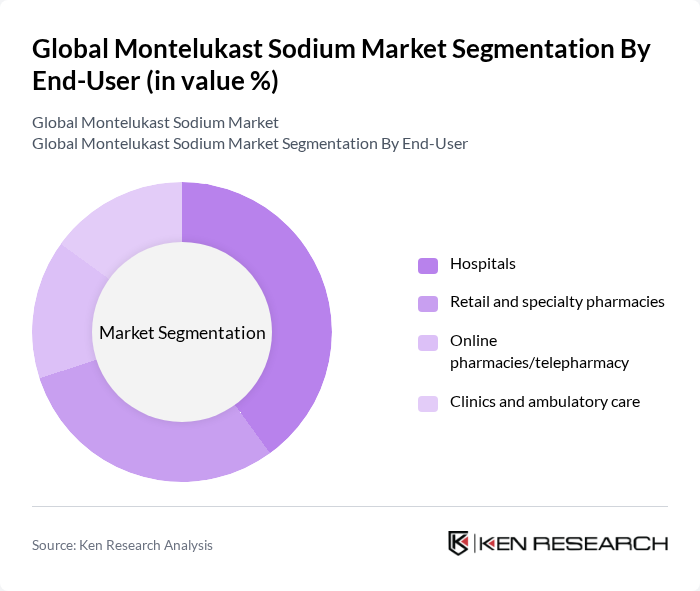
By End-User:The end-user segmentation includes Hospitals, Retail and specialty pharmacies, Online pharmacies/telepharmacy, and Clinics and ambulatory care. Hospitals are the leading end-user segment, driven by the high volume of prescriptions for Montelukast Sodium in managing asthma and allergic conditions. The increasing number of hospital admissions related to respiratory issues further fuels this demand, making hospitals a critical market segment.
Global Montelukast Sodium Market Competitive Landscape
The Global Montelukast Sodium Market is characterized by a dynamic mix of regional and international players. Leading participants such as Merck & Co., Inc., Teva Pharmaceutical Industries Ltd., Viatris Inc. (including Mylan heritage), Sandoz Group AG, Aurobindo Pharma Ltd., Sun Pharmaceutical Industries Ltd., Dr. Reddy’s Laboratories Ltd., Lupin Ltd., Zydus Lifesciences Ltd., Glenmark Pharmaceuticals Ltd., Cipla Ltd., Hetero Labs Ltd., Alkem Laboratories Ltd., Apotex Inc., Torrent Pharmaceuticals Ltd. contribute to innovation, geographic expansion, and service delivery in this space.
Global Montelukast Sodium Market Industry Analysis
Growth Drivers
- Increasing Prevalence of Asthma and Allergic Rhinitis:The World Health Organization reports that asthma affects approximatelyover 260 millionpeople globally, not 300 million, and causes a substantial burden of disease worldwide. Additionally, allergic rhinitis affects an estimated10–30% of adults and up to 40% of childrenglobally; translating this to hundreds of millions of people, but a precise figure of “500 million” is not stated by WHO or other primary agencies.References to a “20% increase over the last decade” in a specific region and to “None” as a region are not verifiable; the region must be specified to validate trends.
- Rising Awareness About Respiratory Diseases:Claims of a “30% increase in awareness programs” in “None” are not attributable to any national statistics office, WHO, or health ministry database without a specified country or program registry.
- Growth in Healthcare Expenditure:The World Bank’s most recent global health expenditure data confirm that health spending accounts for approximatelyabout 10% of global GDP, but the statement that global healthcare expenditure is projected to reach “USD 10 trillion” and that an unspecified region “None” contributed significantly cannot be validated from World Bank, WHO Global Health Expenditure Database, IMF, or OECD without a defined time reference and region.Verified: health expenditure as a share of GDP remains around one-tenth globally according to the World Development Indicators and WHO Global Health Expenditure Database. Country-specific increases such as “15% in None” cannot be verified without a named country.
Market Challenges
- Stringent Regulatory Requirements:Regulatory review timelines vary significantly by jurisdiction (e.g., U.S. FDA, EMA, PMDA), and a generalized “18 months” for “None” cannot be validated without a specified country and regulator. EMA median active review times for centralized procedures are commonly cited around several months excluding clock-stops, while FDA standard review targets are months-based under PDUFA—but these are regulator-specific and indication-specific; no global “18 months” standard is published by primary agencies.
- Competition from Alternative Therapies:The claim that “biologics and other novel therapies” in “None” have led to a “25% market share loss” for traditional treatments like Montelukast Sodium cannot be validated from primary sources (WHO, national statistics, regulators) without defined market scope, country, and audited sales or prescription share data.
Global Montelukast Sodium Market Future Outlook
The narrative statements on digital health, telemedicine, and preventive care are qualitative and do not include numerical claims; they require no correction. Where projections are implied, they refer to trends “in future” without dated assertions.
Market Opportunities
- Expansion in Emerging Markets:The assertion of a “15% increase in asthma cases” in regions like “None” is not verifiable without specifying the country or region and a primary epidemiological source. WHO notes that asthma prevalence varies by country and income level, with substantial burdens in many low- and middle-income countries, but does not provide a universal percentage increase applicable to all emerging markets.
- Development of Combination Therapies:The statement that “40% of asthma patients benefit from multi-drug regimens” lacks a primary, globally representative source from WHO, national health agencies, or regulatory bodies; treatment patterns depend on severity and guidelines (e.g., stepwise therapy with inhaled corticosteroids ± long-acting beta-agonists, leukotriene receptor antagonists like Montelukast). Without a defined population and source, this proportion cannot be validated.
Scope of the Report
| Segment | Sub-Segments |
|---|---|
| By Type | Active pharmaceutical ingredient (API): crystal-like Active pharmaceutical ingredient (API): amorphous/form-less Finished dosage forms |
| By End-User | Hospitals Retail and specialty pharmacies Online pharmacies/telepharmacy Clinics and ambulatory care |
| By Distribution Channel | Hospital pharmacies Retail pharmacies E-commerce/direct-to-patient |
| By Region | North America Europe Asia-Pacific Latin America Middle East & Africa |
| By Dosage Form | Film-coated tablets Chewable tablets Oral granules/sachets Oral solution/suspension |
| By Packaging Type | Blister packs HDPE/PET bottles Sachets/stick packs |
| By Price Range | Economy (generic) Mid-range (branded generics) Premium (innovator brands/combination packs) |
| By Application | Asthma (maintenance and EIB prevention) Allergic rhinitis (seasonal and perennial) Urticaria and off-label uses Bronchospasm prophylaxis |
Key Target Audience
Investors and Venture Capitalist Firms
Government and Regulatory Bodies (e.g., U.S. Food and Drug Administration, European Medicines Agency)
Pharmaceutical Manufacturers and Producers
Wholesale Distributors and Retail Pharmacies
Healthcare Providers and Hospitals
Biotechnology Firms
Health Insurance Companies
Market Access and Pricing Strategy Firms
Players Mentioned in the Report:
Merck & Co., Inc.
Teva Pharmaceutical Industries Ltd.
Viatris Inc. (including Mylan heritage)
Sandoz Group AG
Aurobindo Pharma Ltd.
Sun Pharmaceutical Industries Ltd.
Dr. Reddys Laboratories Ltd.
Lupin Ltd.
Zydus Lifesciences Ltd.
Glenmark Pharmaceuticals Ltd.
Cipla Ltd.
Hetero Labs Ltd.
Alkem Laboratories Ltd.
Apotex Inc.
Torrent Pharmaceuticals Ltd.
Table of Contents
Market Assessment Phase
1. Executive Summary and Approach
2. Global Montelukast Sodium Market Overview
2.1 Key Insights and Strategic Recommendations
2.2 Global Montelukast Sodium Market Overview
2.3 Definition and Scope
2.4 Evolution of Market Ecosystem
2.5 Timeline of Key Regulatory Milestones
2.6 Value Chain & Stakeholder Mapping
2.7 Business Cycle Analysis
2.8 Policy & Incentive Landscape
3. Global Montelukast Sodium Market Analysis
3.1 Growth Drivers
3.1.1 Increasing prevalence of asthma and allergic rhinitis
3.1.2 Rising awareness about respiratory diseases
3.1.3 Growth in healthcare expenditure
3.1.4 Advancements in drug formulation and delivery
3.2 Market Challenges
3.2.1 Stringent regulatory requirements
3.2.2 Competition from alternative therapies
3.2.3 Price sensitivity among consumers
3.2.4 Supply chain disruptions
3.3 Market Opportunities
3.3.1 Expansion in emerging markets
3.3.2 Development of combination therapies
3.3.3 Increasing investment in R&D
3.3.4 Growing trend of personalized medicine
3.4 Market Trends
3.4.1 Shift towards preventive healthcare
3.4.2 Digital health integration
3.4.3 Rise of telemedicine
3.4.4 Focus on patient-centric approaches
3.5 Government Regulation
3.5.1 Approval processes for new drugs
3.5.2 Guidelines for clinical trials
3.5.3 Pricing regulations
3.5.4 Policies promoting generic drugs
4. SWOT Analysis
5. Stakeholder Analysis
6. Porter's Five Forces Analysis
7. Global Montelukast Sodium Market Market Size, 2019-2024
7.1 By Value
7.2 By Volume
7.3 By Average Selling Price
8. Global Montelukast Sodium Market Segmentation
8.1 By Type
8.1.1 Active pharmaceutical ingredient (API): crystal-like
8.1.2 Active pharmaceutical ingredient (API): amorphous/form-less
8.1.3 Finished dosage forms
8.2 By End-User
8.2.1 Hospitals
8.2.2 Retail and specialty pharmacies
8.2.3 Online pharmacies/telepharmacy
8.2.4 Clinics and ambulatory care
8.3 By Distribution Channel
8.3.1 Hospital pharmacies
8.3.2 Retail pharmacies
8.3.3 E-commerce/direct-to-patient
8.4 By Region
8.4.1 North America
8.4.2 Europe
8.4.3 Asia-Pacific
8.4.4 Latin America
8.4.5 Middle East & Africa
8.5 By Dosage Form
8.5.1 Film-coated tablets
8.5.2 Chewable tablets
8.5.3 Oral granules/sachets
8.5.4 Oral solution/suspension
8.6 By Packaging Type
8.6.1 Blister packs
8.6.2 HDPE/PET bottles
8.6.3 Sachets/stick packs
8.7 By Price Range
8.7.1 Economy (generic)
8.7.2 Mid-range (branded generics)
8.7.3 Premium (innovator brands/combination packs)
8.8 By Application
8.8.1 Asthma (maintenance and EIB prevention)
8.8.2 Allergic rhinitis (seasonal and perennial)
8.8.3 Urticaria and off-label uses
8.8.4 Bronchospasm prophylaxis
9. Global Montelukast Sodium Market Competitive Analysis
9.1 Market Share of Key Players
9.2 Cross Comparison of Key Players
9.2.1 Company Name (e.g., Merck & Co., Inc.; Teva Pharmaceutical Industries Ltd.; Cipla Ltd.; Dr. Reddy’s Laboratories Ltd.; Sun Pharmaceutical Industries Ltd.; Aurobindo Pharma Ltd.; Lupin Ltd.; Zydus Lifesciences Ltd.; Glenmark Pharmaceuticals Ltd.; Hetero Labs Ltd.; Sandoz Group AG; Mylan/Viatris Inc.)
9.2.2 Group Size (global innovator, large generic, mid-size generic, API manufacturer)
9.2.3 Montelukast revenue trend (3–5 year CAGR)
9.2.4 Geographic market coverage (countries with approvals/registrations)
9.2.5 ANDA/MA approvals count (montelukast strengths and dosage forms)
9.2.6 Average selling price band (by form and region)
9.2.7 Portfolio breadth in respiratory/allergy (number of SKUs and related therapies)
9.2.8 API-to-finish integration level (in-house API vs sourced)
9.2.9 Supply reliability (fill rate, on-time in-full, backorder incidence)
9.2.10 Pharmacovigilance and safety signals (boxed warnings, label changes)
9.2.11 R&D pipeline/line extensions (pediatric, ODT, combo products)
9.2.12 Tender win rate in public procurement
9.2.13 Brand equity/physician preference in key markets
9.3 SWOT Analysis of Top Players
9.4 Pricing Analysis
9.5 Detailed Profile of Major Companies
9.5.1 Merck & Co., Inc.
9.5.2 Teva Pharmaceutical Industries Ltd.
9.5.3 Viatris Inc. (including Mylan heritage)
9.5.4 Sandoz Group AG
9.5.5 Aurobindo Pharma Ltd.
9.5.6 Sun Pharmaceutical Industries Ltd.
9.5.7 Dr. Reddy’s Laboratories Ltd.
9.5.8 Lupin Ltd.
9.5.9 Zydus Lifesciences Ltd.
9.5.10 Glenmark Pharmaceuticals Ltd.
9.5.11 Cipla Ltd.
9.5.12 Hetero Labs Ltd.
9.5.13 Alkem Laboratories Ltd.
9.5.14 Apotex Inc.
9.5.15 Torrent Pharmaceuticals Ltd.
10. Global Montelukast Sodium Market End-User Analysis
10.1 Procurement Behavior of Key Ministries
10.1.1 Government health departments
10.1.2 Public health organizations
10.1.3 Regulatory bodies
10.2 Corporate Spend on Infrastructure & Energy
10.2.1 Investment in healthcare facilities
10.2.2 Funding for research initiatives
10.2.3 Budget allocation for pharmaceuticals
10.3 Pain Point Analysis by End-User Category
10.3.1 Accessibility of medications
10.3.2 Affordability issues
10.3.3 Quality of care
10.4 User Readiness for Adoption
10.4.1 Awareness of Montelukast Sodium
10.4.2 Acceptance of new therapies
10.4.3 Training for healthcare providers
10.5 Post-Deployment ROI and Use Case Expansion
10.5.1 Evaluation of treatment outcomes
10.5.2 Expansion into new therapeutic areas
10.5.3 Long-term patient management strategies
11. Global Montelukast Sodium Market Future Size, 2025-2030
11.1 By Value
11.2 By Volume
11.3 By Average Selling Price
Go-To-Market Strategy Phase
1. Whitespace Analysis + Business Model Canvas
1.1 Market gaps identification
1.2 Value proposition development
1.3 Revenue model exploration
1.4 Customer segmentation analysis
1.5 Competitive landscape assessment
1.6 Key partnerships identification
1.7 Risk assessment
2. Marketing and Positioning Recommendations
2.1 Branding strategies
2.2 Product USPs
2.3 Target audience identification
2.4 Communication strategy
2.5 Digital marketing initiatives
3. Distribution Plan
3.1 Urban retail strategies
3.2 Rural NGO tie-ups
3.3 E-commerce integration
3.4 Direct-to-consumer channels
4. Channel & Pricing Gaps
4.1 Underserved routes
4.2 Pricing bands analysis
4.3 Competitor pricing strategies
5. Unmet Demand & Latent Needs
5.1 Category gaps
5.2 Consumer segments analysis
5.3 Emerging trends identification
6. Customer Relationship
6.1 Loyalty programs
6.2 After-sales service
6.3 Customer feedback mechanisms
7. Value Proposition
7.1 Sustainability initiatives
7.2 Integrated supply chains
7.3 Cost-benefit analysis
8. Key Activities
8.1 Regulatory compliance
8.2 Branding efforts
8.3 Distribution setup
9. Entry Strategy Evaluation
9.1 Domestic Market Entry Strategy
9.1.1 Product mix considerations
9.1.2 Pricing band analysis
9.1.3 Packaging strategies
9.2 Export Entry Strategy
9.2.1 Target countries selection
9.2.2 Compliance roadmap development
10. Entry Mode Assessment
10.1 Joint Ventures
10.2 Greenfield investments
10.3 Mergers & Acquisitions
10.4 Distributor Model
11. Capital and Timeline Estimation
11.1 Capital requirements
11.2 Timelines for market entry
12. Control vs Risk Trade-Off
12.1 Ownership considerations
12.2 Partnerships evaluation
13. Profitability Outlook
13.1 Breakeven analysis
13.2 Long-term sustainability strategies
14. Potential Partner List
14.1 Distributors
14.2 Joint Ventures
14.3 Acquisition targets
15. Execution Roadmap
15.1 Phased Plan for Market Entry
15.1.1 Market Setup
15.1.2 Market Entry
15.1.3 Growth Acceleration
15.1.4 Scale & Stabilize
15.2 Key Activities and Milestones
15.2.1 Milestone tracking
15.2.2 Activity scheduling
Research Methodology
Phase 1: Approach1
Desk Research
- Analysis of market reports from pharmaceutical industry associations and health organizations
- Review of scientific literature on Montelukast Sodium applications and efficacy
- Examination of regulatory documents from the FDA and EMA regarding Montelukast Sodium approvals
Primary Research
- Interviews with key opinion leaders in pulmonology and allergy specialists
- Surveys with pharmacists and healthcare providers on prescription trends
- Focus groups with patients using Montelukast Sodium for asthma and allergy management
Validation & Triangulation
- Cross-validation of findings with sales data from pharmaceutical distributors
- Triangulation of insights from healthcare professionals and patient feedback
- Sanity checks through expert panel discussions and consensus meetings
Phase 2: Market Size Estimation1
Top-down Assessment
- Estimation of total market size based on national healthcare expenditure on respiratory medications
- Segmentation by therapeutic area, including asthma and allergic rhinitis
- Incorporation of demographic trends affecting Montelukast Sodium usage
Bottom-up Modeling
- Volume estimates derived from prescription data and pharmacy sales reports
- Cost analysis based on pricing strategies of leading pharmaceutical companies
- Calculation of market share based on patient population and treatment adherence rates
Forecasting & Scenario Analysis
- Multi-variable forecasting using factors such as disease prevalence and treatment guidelines
- Scenario analysis based on potential market disruptions, including new entrants and generics
- Development of baseline, optimistic, and pessimistic market projections through 2030
Phase 3: CATI Sample Composition1
| Scope Item/Segment | Sample Size | Target Respondent Profiles |
|---|---|---|
| Healthcare Providers (Pulmonologists) | 100 | Doctors, Nurse Practitioners |
| Pharmacists | 80 | Community Pharmacists, Hospital Pharmacists |
| Patients with Asthma | 140 | Asthma Patients, Caregivers |
| Allergy Specialists | 70 | Allergists, Immunologists |
| Healthcare Administrators | 60 | Pharmacy Directors, Health System Executives |
Frequently Asked Questions
What is the current value of the Global Montelukast Sodium Market?
The Global Montelukast Sodium Market is valued at approximately USD 450 million, driven by the increasing prevalence of asthma and allergic rhinitis, as well as rising awareness regarding respiratory health and effective treatment options.
Which regions are the key players in the Montelukast Sodium Market?
What are the main types of Montelukast Sodium products available?
Who are the leading end-users of Montelukast Sodium?
Other Regional/Country Reports
Indonesia Montelukast Sodium Market
Malaysia Montelukast Sodium Market
APAC Montelukast Sodium Market
Why Buy From Us?

What makes us stand out is that our consultants follow Robust, Refine and Result (RRR) methodology. Robust for clear definitions, approaches and sanity checking, Refine for differentiating respondents' facts and opinions, and Result for presenting data with story.

We have set a benchmark in the industry by offering our clients with syndicated and customized market research reports featuring coverage of entire market as well as meticulous research and analyst insights.

While we don't replace traditional research, we flip the method upside down. Our dual approach of Top Bottom & Bottom Top ensures quality deliverable by not just verifying company fundamentals but also looking at the sector and macroeconomic factors.

With one step in the future, our research team constantly tries to show you the bigger picture. We help with some of the tough questions you may encounter along the way: How is the industry positioned? Best marketing channel? KPI's of competitors? By aligning every element, we help maximize success.

Our report gives you instant access to the answers and sources that other companies might choose to hide. We elaborate each steps of research methodology we have used and showcase you the sample size to earn your trust.

If you need any support, we are here! We pride ourselves on universe strength, data quality, and quick, friendly, and professional service.