About the Report
Base Year 2024Listen to the audio summary
Global Music Publishing Market Overview
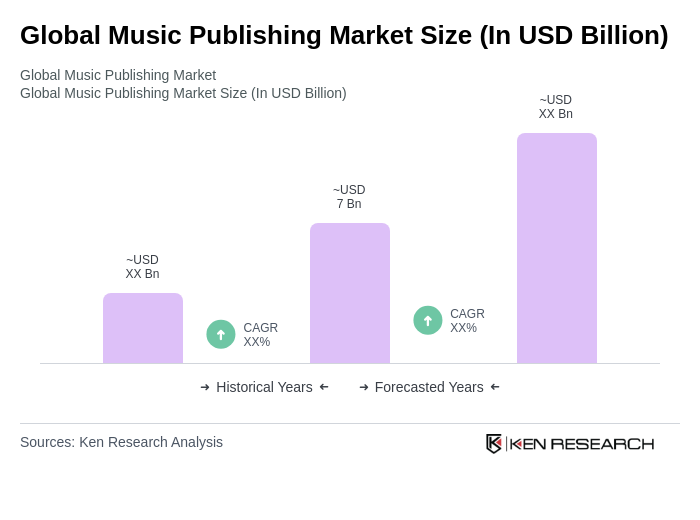
- The Global Music Publishing Market is valued at USD 7 billion, based on a five-year historical analysis. This valuation aligns with multiple industry analyses that place recent annual market size in the range of USD 7–8 billion, and is consistent with sector-wide findings that publishing income across major markets exceeds USD 11 billion when including both publishers’ direct revenues and distributions via collective management organizations.
- Key players in this market include the United States, the United Kingdom, and Germany, which dominate due to their established music industries, large consumer bases, and advanced rights management ecosystems. These countries are consistently ranked among the largest music markets, underpinned by robust copyright frameworks and strong publisher and CMO infrastructures that support licensing and royalty collections.
- The U.S. Music Modernization Act created the statutory framework for blanket mechanical licensing for interactive streaming and downloads via the Mechanical Licensing Collective and modernized rate-setting—key measures to ensure fairer compensation to songwriters and publishers in the digital era; it was enacted in 2018 with core provisions taking effect subsequently, not in 2023.
Global Music Publishing Market Segmentation
By Type:The market can be segmented into various types, including Performance Rights, Mechanical Rights, Synchronization Rights, Print Rights, Digital Licensing, and Others. Each of these segments plays a crucial role in the overall revenue generation of the music publishing industry.

The Performance Rights segment is currently dominating the market due to the increasing number of public uses of music across broadcast, digital, and venue environments, coupled with growing collections by CMOs and publishers from streaming and broadcast performance. Ongoing expansion of digital platforms and international collections has strengthened performance royalty streams for songwriters and publishers.
By End-User:The market can also be segmented by end-users, including Record Labels, Film and Television, Advertising & Brands, Gaming & Interactive Media, Streaming Platforms & DSPs, Live Events & Venues, and Others. Each of these segments utilizes music publishing in unique ways, contributing to the overall market dynamics.

The Streaming Platforms & DSPs segment is leading the market due to sustained growth in interactive streaming usage and subscriptions, which generate both mechanical and performance royalties administered by publishers and CMOs; increased sync demand from digital-first media and short-form video further supports publisher revenues.
Global Music Publishing Market Competitive Landscape
The Global Music Publishing Market is characterized by a dynamic mix of regional and international players. Leading participants such as Universal Music Publishing Group (UMPG), Sony Music Publishing, Warner Chappell Music, BMG Rights Management, Kobalt Music Group, Concord Music Publishing, Downtown Music Publishing, peermusic, Spirit Music Group, Primary Wave Music, Reservoir Media, Hipgnosis Songs Fund, Round Hill Music, Anthem Entertainment (formerly ole), Big Machine Music contribute to innovation, geographic expansion, and service delivery in this space.
Global Music Publishing Market Industry Analysis
Growth Drivers
- Increasing Digital Consumption of Music:The global digital music consumption reached approximately 1.2 billion users in future, with projections indicating a rise to 1.5 billion by future. This surge is driven by the proliferation of smartphones and internet access, particularly in developing regions. The World Bank reported that global internet penetration is expected to exceed 70% in future, facilitating easier access to digital music platforms and driving revenue growth in music publishing.
- Rise of Streaming Platforms:Streaming services generated over $20 billion in revenue in future, with expectations to surpass $25 billion in future. Major platforms like Spotify and Apple Music have expanded their user bases significantly, with Spotify alone reporting 500 million active users. This growth is fostering a robust environment for music publishing, as more artists and songwriters seek to monetize their work through these platforms, enhancing overall market dynamics.
- Globalization of Music Distribution:The globalization of music distribution has led to a 15% increase in international music sales, reaching $6 billion in future. This trend is supported by advancements in technology and logistics, allowing artists to reach global audiences more effectively. The International Federation of the Phonographic Industry (IFPI) noted that emerging markets, particularly in Asia and Africa, are contributing significantly to this growth, creating new opportunities for music publishers.
Market Challenges
- Copyright Infringement Issues:Copyright infringement remains a significant challenge, with the global music industry losing an estimated $4 billion annually due to piracy and unauthorized distribution. The rise of digital platforms has made it easier for unauthorized content to circulate, complicating enforcement efforts. The World Intellectual Property Organization (WIPO) emphasizes the need for stronger international cooperation to combat these issues effectively, which continues to hinder market growth.
- Complex Licensing Processes:The licensing landscape in music publishing is notoriously complex, with over 50 different rights organizations globally. This complexity can lead to delays and increased costs for artists and publishers alike. According to the U.S. Copyright Office, the average time to secure a license can exceed 30 days, which can stifle creativity and revenue generation, posing a significant barrier to market entry for new artists and smaller publishers.
Global Music Publishing Market Future Outlook
The future of the music publishing industry is poised for transformation, driven by technological advancements and evolving consumer preferences. As subscription-based models gain traction, artists will increasingly benefit from stable revenue streams. Additionally, the integration of artificial intelligence in music creation is expected to enhance production efficiency and creativity. These trends, coupled with a focus on artist development, will likely reshape the competitive landscape, fostering innovation and collaboration within the industry.
Market Opportunities
- Growth in Emerging Markets:Emerging markets are projected to contribute an additional $2 billion to the global music publishing sector by future. Countries like India and Brazil are experiencing rapid growth in digital music consumption, driven by increasing smartphone penetration and internet access. This presents a significant opportunity for publishers to expand their reach and tap into new audiences, enhancing overall market potential.
- Technological Advancements in Music Distribution:Innovations in music distribution technology, such as blockchain, are set to revolutionize the industry. By future, blockchain technology could streamline royalty payments, reducing transaction times from weeks to minutes. This efficiency will attract more artists to the publishing sector, creating a more transparent and equitable revenue-sharing model, ultimately benefiting the entire ecosystem.
Scope of the Report
| Segment | Sub-Segments |
|---|---|
| By Type | Performance Rights Mechanical Rights Synchronization Rights Print Rights Digital Licensing Others |
| By End-User | Record Labels Film and Television Advertising & Brands Gaming & Interactive Media Streaming Platforms & DSPs Live Events & Venues Others |
| By Distribution/Administration Channel | Direct Publisher Licensing Performing Rights Organizations (PROs) & Collective Management Organizations (CMOs) Administration Platforms & Aggregators Sub-publishing/Joint Ventures Others |
| By Region | North America Europe Asia-Pacific Latin America Middle East & Africa |
| By Revenue Source | Performance Revenue Mechanical Revenue Synchronization (Sync) Revenue Print Revenue Digital Revenue Others |
| By Content/Genre Type | Pop Rock Hip-Hop/Rap Classical Jazz Latin & Regional Others |
| By Licensing Type | Exclusive Licenses Non-Exclusive Licenses Blanket & Compulsory Licenses Others |
Key Target Audience
Investors and Venture Capitalist Firms
Government and Regulatory Bodies (e.g., U.S. Copyright Office, European Commission)
Music Publishers and Rights Management Organizations
Record Labels and Music Production Companies
Digital Streaming Platforms
Performance Rights Organizations
Music Licensing Agencies
Advertising and Marketing Agencies
Players Mentioned in the Report:
Universal Music Publishing Group (UMPG)
Sony Music Publishing
Warner Chappell Music
BMG Rights Management
Kobalt Music Group
Concord Music Publishing
Downtown Music Publishing
peermusic
Spirit Music Group
Primary Wave Music
Reservoir Media
Hipgnosis Songs Fund
Round Hill Music
Anthem Entertainment (formerly ole)
Big Machine Music
Table of Contents
Market Assessment Phase
1. Executive Summary and Approach
2. Global Music Publishing Market Overview
2.1 Key Insights and Strategic Recommendations
2.2 Global Music Publishing Market Overview
2.3 Definition and Scope
2.4 Evolution of Market Ecosystem
2.5 Timeline of Key Regulatory Milestones
2.6 Value Chain & Stakeholder Mapping
2.7 Business Cycle Analysis
2.8 Policy & Incentive Landscape
3. Global Music Publishing Market Analysis
3.1 Growth Drivers
3.1.1 Increasing Digital Consumption of Music
3.1.2 Rise of Streaming Platforms
3.1.3 Globalization of Music Distribution
3.1.4 Expansion of Licensing Opportunities
3.2 Market Challenges
3.2.1 Copyright Infringement Issues
3.2.2 Complex Licensing Processes
3.2.3 Competition from Independent Artists
3.2.4 Fluctuating Revenue Models
3.3 Market Opportunities
3.3.1 Growth in Emerging Markets
3.3.2 Technological Advancements in Music Distribution
3.3.3 Increased Collaboration with Brands
3.3.4 Development of New Revenue Streams
3.4 Market Trends
3.4.1 Shift Towards Subscription-Based Models
3.4.2 Integration of AI in Music Creation
3.4.3 Focus on Artist Development and Support
3.4.4 Emphasis on Data Analytics for Market Insights
3.5 Government Regulation
3.5.1 Copyright Law Revisions
3.5.2 Fair Pay Legislation for Artists
3.5.3 International Treaties on Music Rights
3.5.4 Regulations on Streaming Royalties
4. SWOT Analysis
5. Stakeholder Analysis
6. Porter's Five Forces Analysis
7. Global Music Publishing Market Market Size, 2019-2024
7.1 By Value
7.2 By Volume
7.3 By Average Selling Price
8. Global Music Publishing Market Segmentation
8.1 By Type
8.1.1 Performance Rights
8.1.2 Mechanical Rights
8.1.3 Synchronization Rights
8.1.4 Print Rights
8.1.5 Digital Licensing
8.1.6 Others
8.2 By End-User
8.2.1 Record Labels
8.2.2 Film and Television
8.2.3 Advertising & Brands
8.2.4 Gaming & Interactive Media
8.2.5 Streaming Platforms & DSPs
8.2.6 Live Events & Venues
8.2.7 Others
8.3 By Distribution/Administration Channel
8.3.1 Direct Publisher Licensing
8.3.2 Performing Rights Organizations (PROs) & Collective Management Organizations (CMOs)
8.3.3 Administration Platforms & Aggregators
8.3.4 Sub-publishing/Joint Ventures
8.3.5 Others
8.4 By Region
8.4.1 North America
8.4.2 Europe
8.4.3 Asia-Pacific
8.4.4 Latin America
8.4.5 Middle East & Africa
8.5 By Revenue Source
8.5.1 Performance Revenue
8.5.2 Mechanical Revenue
8.5.3 Synchronization (Sync) Revenue
8.5.4 Print Revenue
8.5.5 Digital Revenue
8.5.6 Others
8.6 By Content/Genre Type
8.6.1 Pop
8.6.2 Rock
8.6.3 Hip-Hop/Rap
8.6.4 Classical
8.6.5 Jazz
8.6.6 Latin & Regional
8.6.7 Others
8.7 By Licensing Type
8.7.1 Exclusive Licenses
8.7.2 Non-Exclusive Licenses
8.7.3 Blanket & Compulsory Licenses
8.7.4 Others
9. Global Music Publishing Market Competitive Analysis
9.1 Market Share of Key Players
9.2 Cross Comparison of Key Players
9.2.1 Company Name
9.2.2 Scale (Global, Regional, or Independent Network)
9.2.3 Music Publishing Revenue (latest FY)
9.2.4 3-Year CAGR of Publishing Revenue
9.2.5 Catalog Size (number of works/songs controlled)
9.2.6 Share of Digital/Streaming Revenue
9.2.7 Sync Licensing Revenue Share
9.2.8 Writer/Composer Roster Size
9.2.9 Average Royalty Payout Cycle Time
9.2.10 Royalty Collection Coverage (countries/PROs)
9.2.11 Administration Deal Mix (admin-only vs. full publishing)
9.2.12 Sub-publishing Footprint (territories)
9.2.13 Rights Management Tech Capabilities (fingerprinting, portals, data matching)
9.2.14 Operating Margin (Publishing Segment)
9.2.15 Net Publisher’s Share (NPS) Trend
9.3 SWOT Analysis of Top Players
9.4 Pricing Analysis
9.5 Detailed Profile of Major Companies
9.5.1 Universal Music Publishing Group (UMPG)
9.5.2 Sony Music Publishing
9.5.3 Warner Chappell Music
9.5.4 BMG Rights Management
9.5.5 Kobalt Music Group
9.5.6 Concord Music Publishing
9.5.7 Downtown Music Publishing
9.5.8 peermusic
9.5.9 Spirit Music Group
9.5.10 Primary Wave Music
9.5.11 Reservoir Media
9.5.12 Hipgnosis Songs Fund
9.5.13 Round Hill Music
9.5.14 Anthem Entertainment (formerly ole)
9.5.15 Big Machine Music
10. Global Music Publishing Market End-User Analysis
10.1 Procurement Behavior of Key Ministries
10.1.1 Government Funding for Arts
10.1.2 Licensing Requirements for Public Events
10.1.3 Support for Local Artists
10.2 Corporate Spend on Infrastructure & Energy
10.2.1 Investment in Music Venues
10.2.2 Sponsorship of Music Festivals
10.2.3 Partnerships with Music Platforms
10.3 Pain Point Analysis by End-User Category
10.3.1 Difficulty in Licensing
10.3.2 Revenue Sharing Disputes
10.3.3 Access to Quality Content
10.4 User Readiness for Adoption
10.4.1 Familiarity with Digital Platforms
10.4.2 Willingness to Pay for Quality
10.4.3 Interest in New Music Formats
10.5 Post-Deployment ROI and Use Case Expansion
10.5.1 Measurement of Engagement Metrics
10.5.2 Expansion into New Markets
10.5.3 Diversification of Revenue Streams
11. Global Music Publishing Market Future Size, 2025-2030
11.1 By Value
11.2 By Volume
11.3 By Average Selling Price
Go-To-Market Strategy Phase
1. Whitespace Analysis + Business Model Canvas
1.1 Market Gaps Identification
1.2 Value Proposition Development
1.3 Revenue Model Exploration
1.4 Customer Segmentation Analysis
1.5 Competitive Landscape Overview
1.6 Key Partnerships Identification
1.7 Risk Assessment
2. Marketing and Positioning Recommendations
2.1 Branding Strategies
2.2 Product USPs
2.3 Target Audience Definition
2.4 Communication Strategy
2.5 Digital Marketing Tactics
2.6 Performance Metrics
3. Distribution Plan
3.1 Urban Retail Strategies
3.2 Rural NGO Tie-Ups
3.3 Online Distribution Channels
3.4 Partnerships with Streaming Services
3.5 Direct-to-Consumer Approaches
4. Channel & Pricing Gaps
4.1 Underserved Routes
4.2 Pricing Bands Analysis
4.3 Competitor Pricing Strategies
4.4 Consumer Price Sensitivity
4.5 Recommendations for Pricing Adjustments
5. Unmet Demand & Latent Needs
5.1 Category Gaps Identification
5.2 Consumer Segments Analysis
5.3 Emerging Trends Exploration
5.4 Recommendations for Product Development
6. Customer Relationship
6.1 Loyalty Programs
6.2 After-Sales Service Enhancements
6.3 Customer Feedback Mechanisms
6.4 Community Engagement Strategies
7. Value Proposition
7.1 Sustainability Initiatives
7.2 Integrated Supply Chains
7.3 Unique Selling Points
7.4 Customer-Centric Innovations
8. Key Activities
8.1 Regulatory Compliance
8.2 Branding Initiatives
8.3 Distribution Setup
8.4 Market Research Activities
9. Entry Strategy Evaluation
9.1 Domestic Market Entry Strategy
9.1.1 Product Mix Considerations
9.1.2 Pricing Band Analysis
9.1.3 Packaging Strategies
9.2 Export Entry Strategy
9.2.1 Target Countries Identification
9.2.2 Compliance Roadmap Development
10. Entry Mode Assessment
10.1 Joint Ventures
10.2 Greenfield Investments
10.3 Mergers & Acquisitions
10.4 Distributor Model Evaluation
11. Capital and Timeline Estimation
11.1 Capital Requirements Analysis
11.2 Timelines for Market Entry
12. Control vs Risk Trade-Off
12.1 Ownership vs Partnerships
13. Profitability Outlook
13.1 Breakeven Analysis
13.2 Long-Term Sustainability Strategies
14. Potential Partner List
14.1 Distributors
14.2 Joint Ventures
14.3 Acquisition Targets
15. Execution Roadmap
15.1 Phased Plan for Market Entry
15.1.1 Market Setup
15.1.2 Market Entry
15.1.3 Growth Acceleration
15.1.4 Scale & Stabilize
15.2 Key Activities and Milestones
15.2.1 Milestone Planning
15.2.2 Activity Tracking
Research Methodology
Phase 1: Approach1
Desk Research
- Analysis of industry reports from global music publishing associations and market research firms
- Review of financial statements and annual reports from leading music publishing companies
- Examination of regulatory frameworks and copyright laws impacting the music publishing sector
Primary Research
- Interviews with executives from major music publishing firms and independent publishers
- Surveys targeting songwriters, composers, and music rights organizations
- Focus groups with industry experts, including music producers and legal advisors
Validation & Triangulation
- Cross-validation of findings through multiple data sources, including trade publications and market analytics
- Triangulation of insights from primary interviews with secondary data trends
- Sanity checks conducted through expert panel reviews and feedback sessions
Phase 2: Market Size Estimation1
Top-down Assessment
- Estimation of global music publishing revenues based on recorded music sales and streaming data
- Segmentation of the market by geographical regions and music genres
- Incorporation of growth trends in digital music consumption and licensing revenues
Bottom-up Modeling
- Analysis of revenue streams from performance rights, mechanical royalties, and synchronization licenses
- Estimation of market share based on the number of active songwriters and compositions registered
- Volume x average royalty rates for different music formats and distribution channels
Forecasting & Scenario Analysis
- Multi-factor regression analysis incorporating streaming growth, copyright reforms, and market dynamics
- Scenario modeling based on potential shifts in consumer behavior and technological advancements
- Baseline, optimistic, and pessimistic projections for the music publishing market through 2030
Phase 3: CATI Sample Composition1
| Scope Item/Segment | Sample Size | Target Respondent Profiles |
|---|---|---|
| Major Music Publishing Firms | 60 | CEOs, CFOs, Business Development Managers |
| Independent Music Publishers | 80 | Founders, Rights Managers, Licensing Executives |
| Songwriters and Composers | 120 | Professional Songwriters, Independent Artists |
| Music Rights Organizations | 70 | Policy Advisors, Membership Coordinators |
| Digital Music Platforms | 90 | Product Managers, Licensing Specialists |
Frequently Asked Questions
What is the current value of the Global Music Publishing Market?
The Global Music Publishing Market is valued at approximately USD 7 billion, based on a five-year historical analysis. This valuation aligns with industry analyses that indicate the market size ranges between USD 78 billion annually.
Which countries dominate the Global Music Publishing Market?
What is the impact of the U.S. Music Modernization Act on music publishing?
What are the main segments of the Global Music Publishing Market?
Other Regional/Country Reports
Indonesia Music Publishing Market
Malaysia Music Publishing Market
APAC Music Publishing Market
SEA Music Publishing Market
Why Buy From Us?

What makes us stand out is that our consultants follow Robust, Refine and Result (RRR) methodology. Robust for clear definitions, approaches and sanity checking, Refine for differentiating respondents' facts and opinions, and Result for presenting data with story.

We have set a benchmark in the industry by offering our clients with syndicated and customized market research reports featuring coverage of entire market as well as meticulous research and analyst insights.

While we don't replace traditional research, we flip the method upside down. Our dual approach of Top Bottom & Bottom Top ensures quality deliverable by not just verifying company fundamentals but also looking at the sector and macroeconomic factors.

With one step in the future, our research team constantly tries to show you the bigger picture. We help with some of the tough questions you may encounter along the way: How is the industry positioned? Best marketing channel? KPI's of competitors? By aligning every element, we help maximize success.

Our report gives you instant access to the answers and sources that other companies might choose to hide. We elaborate each steps of research methodology we have used and showcase you the sample size to earn your trust.

If you need any support, we are here! We pride ourselves on universe strength, data quality, and quick, friendly, and professional service.