About the Report
Base Year 2024Global Nano And Micro Satellite Market Overview
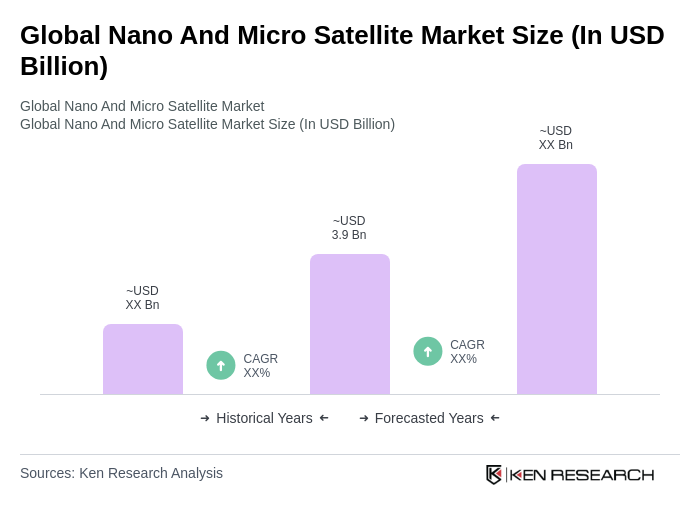
- The Global Nano and Micro Satellite Market is valued at USD 3.9 billion, based on a five-year historical analysis. This growth is primarily driven by increasing demand for satellite-based Earth observation and communications services, advancements in miniaturization and standardized smallsat platforms (e.g., CubeSat buses), and rising deployment of proliferated constellations supporting commercial, civil, and defense missions.
- Key players in this market include the United States, China, and India, which dominate due to their robust space programs, significant investments in satellite technology, and a growing number of private sector participants. These countries have established themselves as leaders in satellite manufacturing and deployment, contributing to their market dominance.
- In 2023, the U.S. government’s space policy framework continued to prioritize small satellites for national security and commercial applications through established directives and regulatory streamlining (e.g., National Space Policy and Space Policy Directive-3 lineage; FCC smallsat streamlined licensing), reinforcing industry competitiveness and innovation incentives.
Global Nano And Micro Satellite Market Segmentation
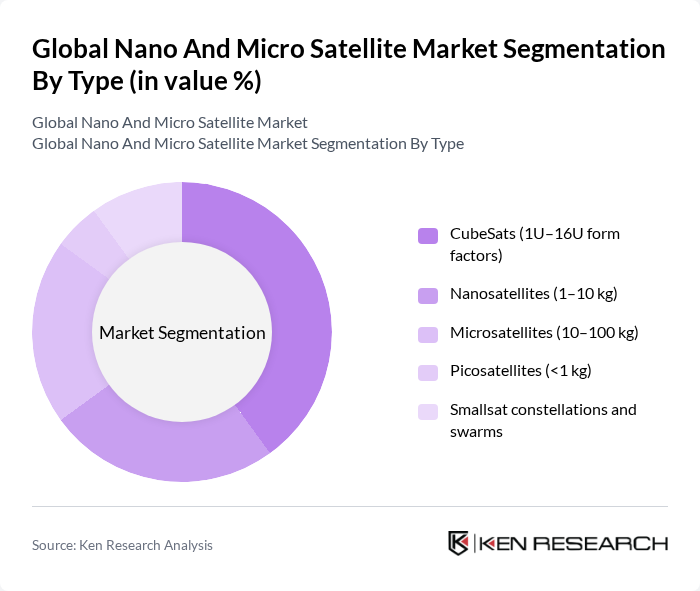
By Type:The market is segmented into various types, including CubeSats, Nanosatellites, Microsatellites, Picosatellites, and Smallsat constellations and swarms. CubeSats remain popular due to standardized form factors and lower build/launch costs that support rapid iteration for education, commercial imaging, weather, AIS/ADS-B, and IoT payloads. Nanosatellites and microsatellites continue to gain traction in Earth observation, communications, and RF sensing, aided by improved onboard processing, modular buses, and commercial rideshare access. The growing deployment of constellations for broadband, IoT, and persistent monitoring further boosts smallsat demand through higher launch cadence and replenishment cycles.
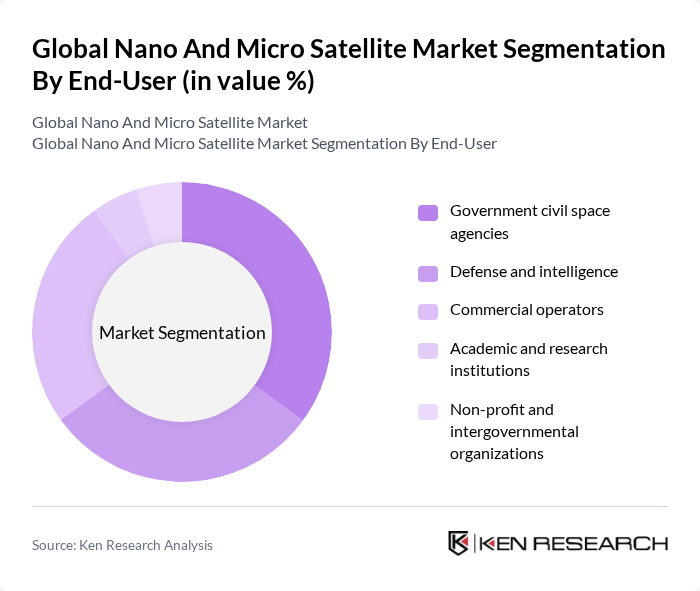
By End-User:The end-user segmentation includes government civil space agencies, defense and intelligence, commercial operators, academic and research institutions, and non-profit and intergovernmental organizations. Government civil users lead for Earth observation, climate and disaster monitoring, and scientific missions; defense demand is significant for tactical ISR, PNT augmentation, and space domain awareness; commercial operators are expanding quickly on the back of imagery/analytics, weather, maritime/aviation tracking, and IoT services. Broader access via rideshare launches, standardized licensing, and commercial ground networks supports adoption across academia and NGOs.
Global Nano And Micro Satellite Market Competitive Landscape
The Global Nano And Micro Satellite Market is characterized by a dynamic mix of regional and international players. Leading participants such as Planet Labs PBC, Spire Global, Inc., Kongsberg NanoAvionics, Tyvak Nano-Satellite Systems (Terran Orbital), Surrey Satellite Technology Ltd. (SSTL), AAC Clyde Space AB, GomSpace A/S, Blue Canyon Technologies LLC (Raytheon), ISISPACE Group (Innovative Solutions In Space), Kepler Communications Inc., Rocket Lab USA, Inc., Northrop Grumman Space Systems, Airbus Defence and Space, Lockheed Martin Corporation, The Boeing Company, Sateliot, Fleet Space Technologies, Pixxel, Exolaunch GmbH, EnduroSat contribute to innovation, geographic expansion, and service delivery in this space.
Global Nano And Micro Satellite Market Industry Analysis
Growth Drivers
- Increasing Demand for Earth Observation:The global demand for earth observation data is projected to reach $5.8 billion in future, driven by applications in agriculture, forestry, and disaster management. The rise in climate change awareness and the need for real-time data analytics are significant contributors. For instance, the World Bank reported that satellite data can enhance agricultural productivity by up to 25%, highlighting the critical role of nano and micro satellites in providing essential insights for sustainable development.
- Advancements in Miniaturization Technology:The miniaturization of satellite technology has led to a reduction in size and cost, making satellite deployment more accessible. In future, the average cost of launching a nano satellite is expected to drop to approximately $1.5 million, down from $2 million in 2020. This trend is supported by innovations in materials and manufacturing processes, enabling the production of smaller, lighter satellites that maintain high functionality, thus expanding their use in various sectors.
- Rising Investments in Space Exploration:Global investments in space exploration are anticipated to exceed $35 billion in future, with significant contributions from both government and private sectors. Notably, NASA's budget for satellite missions is projected to increase by 12% to $8.8 billion, reflecting a growing commitment to space technology. This influx of capital is fostering the development of nano and micro satellites, which are crucial for innovative space missions and scientific research.
Market Challenges
- High Development Costs:Despite the decreasing launch costs, the development of nano and micro satellites remains expensive, with average costs ranging from $600,000 to $1.2 million per unit. This financial barrier can deter smaller companies and startups from entering the market. According to the European Space Agency, approximately 45% of satellite projects face budget overruns, which can lead to project cancellations and hinder innovation in the sector.
- Regulatory Hurdles:The regulatory landscape for satellite launches is complex and varies significantly across regions. In future, it is estimated that over 65 countries will have established satellite regulations, complicating international collaborations. Compliance with international treaties and national security regulations can delay project timelines, with an average approval process taking up to 20 months. This regulatory environment poses a significant challenge for companies looking to innovate and expand their satellite offerings.
Global Nano And Micro Satellite Market Future Outlook
The future of the nano and micro satellite market appears promising, driven by technological advancements and increasing global demand for satellite services. As the Internet of Things (IoT) expands, the integration of satellite technology will become crucial for data collection and connectivity. Additionally, the focus on sustainability in space missions will likely lead to innovative designs and materials, enhancing the efficiency and environmental impact of satellite operations. Collaborative efforts between public and private sectors will further accelerate growth in this dynamic market.
Market Opportunities
- Expansion of Internet of Things (IoT):The IoT market is projected to reach $1.3 trillion in future, creating significant opportunities for nano and micro satellites to provide connectivity and data services. These satellites can facilitate real-time monitoring and data transmission for various applications, including smart cities and agriculture, enhancing operational efficiency and decision-making processes.
- Collaborations with Private Sector:Partnerships between government agencies and private companies are expected to increase, with over 60 collaborative projects anticipated in future. These collaborations can leverage private sector innovation and funding, driving advancements in satellite technology and expanding market reach. Such synergies will enhance the development of cost-effective solutions and foster a competitive landscape.
Scope of the Report
| Segment | Sub-Segments |
|---|---|
| By Type | CubeSats (1U–16U form factors) Nanosatellites (1–10 kg) Microsatellites (10–100 kg) Picosatellites (<1 kg) Smallsat constellations and swarms |
| By End-User | Government civil space agencies Defense and intelligence Commercial operators Academic and research institutions Non-profit and intergovernmental organizations |
| By Application | Earth observation and remote sensing Communications (IoT/NTN, AIS/ADS-B, broadband) Scientific research and exploration Technology demonstration and on-orbit services Space situational awareness (SSA) and space weather |
| By Launch Method | Dedicated small launch vehicles Rideshare missions Secondary payload/adapters & dispensers ISS/Kibo deployment and orbital transfer vehicles |
| By Orbit Type | Low Earth Orbit (LEO) Sun-synchronous and polar orbits Medium Earth Orbit (MEO) Highly Elliptical and cislunar orbits |
| By Payload Class | Imagers and hyperspectral payloads Communications payloads (S/L/Ku/Ka-band) Navigation and tracking payloads (AIS/ADS-B) Scientific instruments and tech demonstrators |
| By Region | North America Europe Asia-Pacific Latin America Middle East & Africa |
Key Target Audience
Investors and Venture Capitalist Firms
Government and Regulatory Bodies (e.g., NASA, European Space Agency)
Satellite Manufacturers and Producers
Launch Service Providers
Telecommunications Companies
Aerospace and Defense Contractors
Space Research Organizations
Insurance Companies Specializing in Space Assets
Players Mentioned in the Report:
Planet Labs PBC
Spire Global, Inc.
Kongsberg NanoAvionics
Tyvak Nano-Satellite Systems (Terran Orbital)
Surrey Satellite Technology Ltd. (SSTL)
AAC Clyde Space AB
GomSpace A/S
Blue Canyon Technologies LLC (Raytheon)
ISISPACE Group (Innovative Solutions In Space)
Kepler Communications Inc.
Rocket Lab USA, Inc.
Northrop Grumman Space Systems
Airbus Defence and Space
Lockheed Martin Corporation
The Boeing Company
Sateliot
Fleet Space Technologies
Pixxel
Exolaunch GmbH
EnduroSat
Table of Contents
Market Assessment Phase
1. Executive Summary and Approach
2. Global Nano And Micro Satellite Market Overview
2.1 Key Insights and Strategic Recommendations
2.2 Global Nano And Micro Satellite Market Overview
2.3 Definition and Scope
2.4 Evolution of Market Ecosystem
2.5 Timeline of Key Regulatory Milestones
2.6 Value Chain & Stakeholder Mapping
2.7 Business Cycle Analysis
2.8 Policy & Incentive Landscape
3. Global Nano And Micro Satellite Market Analysis
3.1 Growth Drivers
3.1.1 Increasing Demand for Earth Observation
3.1.2 Advancements in Miniaturization Technology
3.1.3 Rising Investments in Space Exploration
3.1.4 Growing Commercial Applications
3.2 Market Challenges
3.2.1 High Development Costs
3.2.2 Regulatory Hurdles
3.2.3 Limited Launch Opportunities
3.2.4 Data Security Concerns
3.3 Market Opportunities
3.3.1 Expansion of Internet of Things (IoT)
3.3.2 Collaborations with Private Sector
3.3.3 Emerging Markets Adoption
3.3.4 Technological Innovations in Satellite Design
3.4 Market Trends
3.4.1 Increased Miniaturization of Satellites
3.4.2 Growth of CubeSats
3.4.3 Enhanced Data Analytics Capabilities
3.4.4 Focus on Sustainability in Space Missions
3.5 Government Regulation
3.5.1 International Space Treaties Compliance
3.5.2 National Security Regulations
3.5.3 Licensing for Satellite Launches
3.5.4 Frequency Spectrum Management
4. SWOT Analysis
5. Stakeholder Analysis
6. Porter's Five Forces Analysis
7. Global Nano And Micro Satellite Market Market Size, 2019-2024
7.1 By Value
7.2 By Volume
7.3 By Average Selling Price
8. Global Nano And Micro Satellite Market Segmentation
8.1 By Type
8.1.1 CubeSats (1U–16U form factors)
8.1.2 Nanosatellites (1–10 kg)
8.1.3 Microsatellites (10–100 kg)
8.1.4 Picosatellites (<1 kg)
8.1.5 Smallsat constellations and swarms
8.2 By End-User
8.2.1 Government civil space agencies
8.2.2 Defense and intelligence
8.2.3 Commercial operators
8.2.4 Academic and research institutions
8.2.5 Non-profit and intergovernmental organizations
8.3 By Application
8.3.1 Earth observation and remote sensing
8.3.2 Communications (IoT/NTN, AIS/ADS-B, broadband)
8.3.3 Scientific research and exploration
8.3.4 Technology demonstration and on-orbit services
8.3.5 Space situational awareness (SSA) and space weather
8.4 By Launch Method
8.4.1 Dedicated small launch vehicles
8.4.2 Rideshare missions
8.4.3 Secondary payload/adapters & dispensers
8.4.4 ISS/Kibo deployment and orbital transfer vehicles
8.5 By Orbit Type
8.5.1 Low Earth Orbit (LEO)
8.5.2 Sun-synchronous and polar orbits
8.5.3 Medium Earth Orbit (MEO)
8.5.4 Highly Elliptical and cislunar orbits
8.6 By Payload Class
8.6.1 Imagers and hyperspectral payloads
8.6.2 Communications payloads (S/L/Ku/Ka-band)
8.6.3 Navigation and tracking payloads (AIS/ADS-B)
8.6.4 Scientific instruments and tech demonstrators
8.7 By Region
8.7.1 North America
8.7.2 Europe
8.7.3 Asia-Pacific
8.7.4 Latin America
8.7.5 Middle East & Africa
9. Global Nano And Micro Satellite Market Competitive Analysis
9.1 Market Share of Key Players
9.2 Cross Comparison of Key Players
9.2.1 Company name and primary smallsat focus (EO, IoT/NTN, SSA, etc.)
9.2.2 Group size (Large prime / Mid-tier / Small-cap)
9.2.3 Smallsat revenue and growth (YoY, latest fiscal)
9.2.4 Constellation size in orbit and backlog (units)
9.2.5 Launch cadence and rideshare access (annual launches/slots)
9.2.6 Average revenue per satellite or per payload
9.2.7 Cost per satellite (build & integration) benchmark
9.2.8 Contract wins (gov/commercial) and average contract value
9.2.9 Data/services ARPU and churn (for downstream operators)
9.2.10 Time-to-orbit (PD to launch) and on-orbit reliability
9.2.11 Capital efficiency (cash burn, runway) and EBITDA margin
9.2.12 Technology readiness level (TRL) and in-house vs. OEM content
9.3 SWOT Analysis of Top Players
9.4 Pricing Analysis
9.5 Detailed Profile of Major Companies
9.5.1 Planet Labs PBC
9.5.2 Spire Global, Inc.
9.5.3 Kongsberg NanoAvionics
9.5.4 Tyvak Nano-Satellite Systems (Terran Orbital)
9.5.5 Surrey Satellite Technology Ltd. (SSTL)
9.5.6 AAC Clyde Space AB
9.5.7 GomSpace A/S
9.5.8 Blue Canyon Technologies LLC (Raytheon)
9.5.9 ISISPACE Group (Innovative Solutions In Space)
9.5.10 Kepler Communications Inc.
9.5.11 Rocket Lab USA, Inc.
9.5.12 Northrop Grumman Space Systems
9.5.13 Airbus Defence and Space
9.5.14 Lockheed Martin Corporation
9.5.15 The Boeing Company
9.5.16 Sateliot
9.5.17 Fleet Space Technologies
9.5.18 Pixxel
9.5.19 Exolaunch GmbH
9.5.20 EnduroSat
10. Global Nano And Micro Satellite Market End-User Analysis
10.1 Procurement Behavior of Key Ministries
10.1.1 Government Space Agencies
10.1.2 Defense Ministries
10.1.3 Research Institutions
10.2 Corporate Spend on Infrastructure & Energy
10.2.1 Investment in Satellite Infrastructure
10.2.2 Budget Allocation for R&D
10.2.3 Expenditure on Launch Services
10.3 Pain Point Analysis by End-User Category
10.3.1 Budget Constraints
10.3.2 Technical Expertise Shortage
10.3.3 Regulatory Compliance Issues
10.4 User Readiness for Adoption
10.4.1 Awareness of Satellite Capabilities
10.4.2 Training and Support Needs
10.4.3 Integration with Existing Systems
10.5 Post-Deployment ROI and Use Case Expansion
10.5.1 Performance Metrics Evaluation
10.5.2 Scalability of Applications
10.5.3 Long-term Cost Savings
11. Global Nano And Micro Satellite Market Future Size, 2025-2030
11.1 By Value
11.2 By Volume
11.3 By Average Selling Price
Go-To-Market Strategy Phase
1. Whitespace Analysis + Business Model Canvas
1.1 Market Gaps Identification
1.2 Value Proposition Development
1.3 Revenue Streams Analysis
1.4 Cost Structure Evaluation
1.5 Key Partnerships Exploration
1.6 Customer Segmentation
1.7 Channels to Market
2. Marketing and Positioning Recommendations
2.1 Branding Strategies
2.2 Product USPs
2.3 Target Audience Identification
2.4 Communication Strategy
2.5 Digital Marketing Tactics
3. Distribution Plan
3.1 Urban Retail Strategies
3.2 Rural NGO Tie-ups
3.3 Online Distribution Channels
3.4 Direct Sales Approaches
4. Channel & Pricing Gaps
4.1 Underserved Routes
4.2 Pricing Bands Analysis
4.3 Competitor Pricing Comparison
5. Unmet Demand & Latent Needs
5.1 Category Gaps Identification
5.2 Consumer Segments Analysis
5.3 Emerging Trends Exploration
6. Customer Relationship
6.1 Loyalty Programs
6.2 After-sales Service
6.3 Customer Feedback Mechanisms
7. Value Proposition
7.1 Sustainability Initiatives
7.2 Integrated Supply Chains
7.3 Competitive Advantages
8. Key Activities
8.1 Regulatory Compliance
8.2 Branding Efforts
8.3 Distribution Setup
9. Entry Strategy Evaluation
9.1 Domestic Market Entry Strategy
9.1.1 Product Mix Considerations
9.1.2 Pricing Band Strategy
9.1.3 Packaging Solutions
9.2 Export Entry Strategy
9.2.1 Target Countries Selection
9.2.2 Compliance Roadmap Development
10. Entry Mode Assessment
10.1 Joint Ventures
10.2 Greenfield Investments
10.3 Mergers & Acquisitions
10.4 Distributor Model Evaluation
11. Capital and Timeline Estimation
11.1 Capital Requirements Analysis
11.2 Timelines for Implementation
12. Control vs Risk Trade-Off
12.1 Ownership vs Partnerships
13. Profitability Outlook
13.1 Breakeven Analysis
13.2 Long-term Sustainability Strategies
14. Potential Partner List
14.1 Distributors
14.2 Joint Ventures
14.3 Acquisition Targets
15. Execution Roadmap
15.1 Phased Plan for Market Entry
15.1.1 Market Setup
15.1.2 Market Entry
15.1.3 Growth Acceleration
15.1.4 Scale & Stabilize
15.2 Key Activities and Milestones
15.2.1 Milestone Planning
15.2.2 Activity Tracking
Research Methodology
Phase 1: Approach1
Desk Research
- Analysis of industry reports from space agencies and satellite manufacturers
- Review of academic publications and white papers on nano and micro satellite technologies
- Examination of market trends and forecasts from aerospace industry associations
Primary Research
- Interviews with satellite engineers and project managers in leading aerospace firms
- Surveys with government space program officials and regulatory bodies
- Field interviews with researchers in universities focusing on satellite technology
Validation & Triangulation
- Cross-validation of data from multiple industry sources and expert opinions
- Triangulation of market size estimates using historical growth rates and current trends
- Sanity checks through expert panel discussions and feedback sessions
Phase 2: Market Size Estimation1
Top-down Assessment
- Estimation of market size based on global space expenditure and satellite launches
- Segmentation by application areas such as Earth observation, communication, and scientific research
- Incorporation of government and private sector investment trends in satellite technology
Bottom-up Modeling
- Volume estimates based on the number of satellites launched and operational
- Cost analysis derived from average pricing of nano and micro satellites
- Assessment of revenue generation from satellite services and data analytics
Forecasting & Scenario Analysis
- Multi-factor regression analysis considering technological advancements and market demand
- Scenario modeling based on potential regulatory changes and international collaborations
- Development of baseline, optimistic, and pessimistic forecasts through 2030
Phase 3: CATI Sample Composition1
| Scope Item/Segment | Sample Size | Target Respondent Profiles |
|---|---|---|
| Commercial Satellite Applications | 100 | Business Development Managers, Product Managers |
| Government Space Programs | 80 | Policy Makers, Program Directors |
| Academic Research in Satellite Technology | 60 | Research Scientists, University Professors |
| Satellite Manufacturing Sector | 70 | Manufacturing Engineers, Quality Assurance Managers |
| Data Analytics from Satellite Imagery | 90 | Data Analysts, GIS Specialists |
Frequently Asked Questions
What is the current value of the Global Nano and Micro Satellite Market?
The Global Nano and Micro Satellite Market is valued at approximately USD 3.9 billion, driven by increasing demand for satellite-based Earth observation and communications services, advancements in miniaturization, and the deployment of proliferated constellations for various missions.
What are the main types of nano and micro satellites?
Who are the key players in the Global Nano and Micro Satellite Market?
What are the growth drivers for the nano and micro satellite market?
Other Regional/Country Reports
Indonesia Nano And Micro Satellite Market
Malaysia Nano And Micro Satellite Market
APAC Nano And Micro Satellite Market
SEA Nano And Micro Satellite Market
Why Buy From Us?

What makes us stand out is that our consultants follow Robust, Refine and Result (RRR) methodology. Robust for clear definitions, approaches and sanity checking, Refine for differentiating respondents' facts and opinions, and Result for presenting data with story.

We have set a benchmark in the industry by offering our clients with syndicated and customized market research reports featuring coverage of entire market as well as meticulous research and analyst insights.

While we don't replace traditional research, we flip the method upside down. Our dual approach of Top Bottom & Bottom Top ensures quality deliverable by not just verifying company fundamentals but also looking at the sector and macroeconomic factors.

With one step in the future, our research team constantly tries to show you the bigger picture. We help with some of the tough questions you may encounter along the way: How is the industry positioned? Best marketing channel? KPI's of competitors? By aligning every element, we help maximize success.

Our report gives you instant access to the answers and sources that other companies might choose to hide. We elaborate each steps of research methodology we have used and showcase you the sample size to earn your trust.

If you need any support, we are here! We pride ourselves on universe strength, data quality, and quick, friendly, and professional service.