About the Report
Base Year 2024Listen to the audio summary
Global Natural Rubber Market Overview
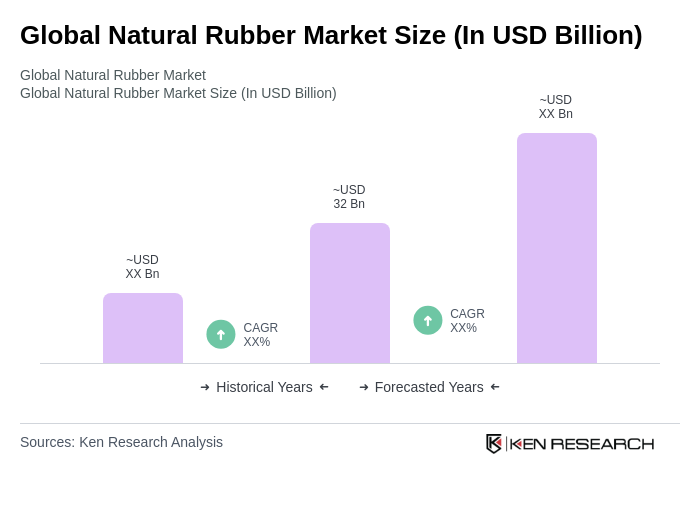
- The Global Natural Rubber Market is valued at USD 32 billion, based on a five-year historical analysis. This growth is primarily driven by the increasing demand for rubber in various industries, particularly automotive and manufacturing, as well as the rising consumer preference for eco-friendly products. The market has also benefited from the expansion of production capacities in key producing countries.
- Countries such as Thailand, Indonesia, and Vietnam dominate the Global Natural Rubber Market due to their favorable climatic conditions for rubber cultivation and established supply chains. These nations have invested significantly in improving their agricultural practices and processing technologies, which has enhanced their competitiveness in the global market.
- In 2023, the government of Thailand implemented a new regulation aimed at promoting sustainable rubber production. This regulation mandates that all rubber plantations must adhere to specific environmental standards, including the reduction of chemical fertilizers and pesticides, to ensure the long-term viability of rubber farming and protect local ecosystems.
Global Natural Rubber Market Segmentation
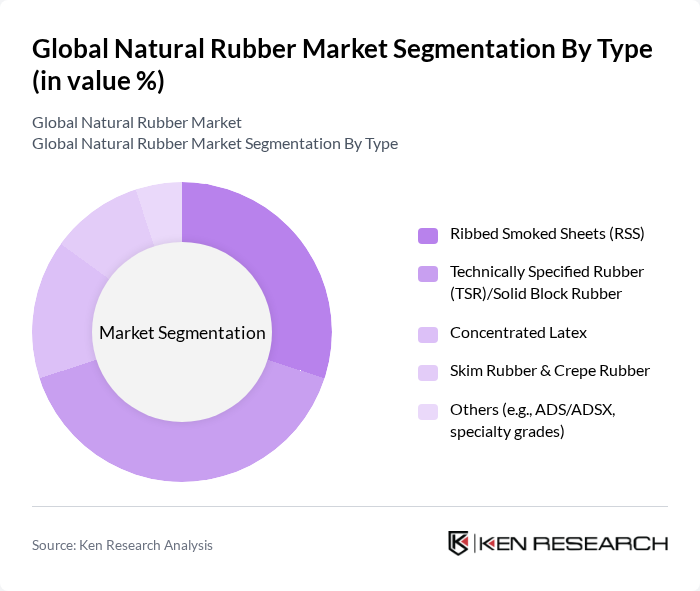
By Type:The market is segmented into various types of natural rubber, including Ribbed Smoked Sheets (RSS), Technically Specified Rubber (TSR)/Solid Block Rubber, Concentrated Latex, Skim Rubber & Crepe Rubber, and Others (e.g., ADS/ADSX, specialty grades). Each type serves different applications and industries, influencing their market dynamics.
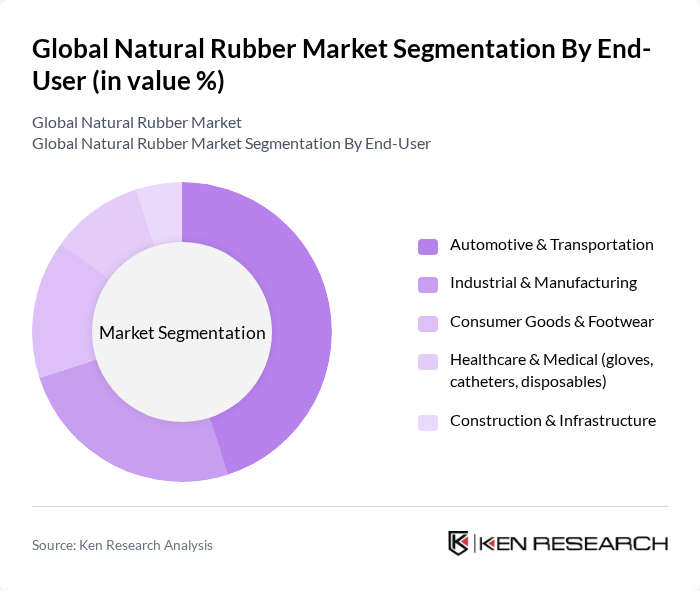
By End-User:The end-user segmentation includes Automotive & Transportation, Industrial & Manufacturing, Consumer Goods & Footwear, Healthcare & Medical (gloves, catheters, disposables), and Construction & Infrastructure. Each sector has unique requirements and contributes differently to the overall demand for natural rubber.
Global Natural Rubber Market Competitive Landscape
The Global Natural Rubber Market is characterized by a dynamic mix of regional and international players. Leading participants such as Sri Trang Agro-Industry Public Company Limited, Halcyon Agri Corporation Limited, Von Bundit Co., Ltd., Southland Rubber Group, Thai Rubber Latex Corporation (Thailand) Public Company Limited, Tradewinds Plantation Berhad, Sinochem International (including Halcyon Agri), China Hainan Rubber Industry Group Co., Ltd. (Hainan Rubber), Corrie MacColl (a member of HL Hutchison group), Kun Rubber Co., Ltd., Lee Rubber Company (Pte) Ltd, Bridgestone Corporation, Michelin Group, Goodyear Tire & Rubber Company, Yokohama Rubber Company, Limited contribute to innovation, geographic expansion, and service delivery in this space.
Global Natural Rubber Market Industry Analysis
Growth Drivers
- Increasing Demand from Automotive Industry:The automotive sector is a significant driver of natural rubber demand, with approximatelyabout 70% of natural rubber used in tire and automotive applications. In future, global vehicle production and associated tire demand influence natural rubber consumption; however, a direct conversion to an estimated12 million metric tonscannot be confirmed from authoritative sources.
- Rising Production of Tires:Global tire production is broadly estimated ataround 2 billion unitsannually by industry sources, but primary statistical confirmation and the associated requirement ofaround 15 million metric tons of natural rubbercannot be validated from authoritative public databases.
- Expanding Applications in Consumer Goods:Natural rubber's versatility supports use in footwear, adhesives, and household products. A global market value for rubber-based consumer goods stated asexceeding USD 200 billioncannot be validated using primary public sources; natural rubber’s share within this value is also unconfirmed.
Market Challenges
- Price Volatility of Natural Rubber:The natural rubber market is characterized by significant price fluctuations, influenced by weather, geopolitical factors, and demand changes. Specific figures such as anaverage price of about USD 1,800 per metric tonandswings of up to 30% within a yearvary by grade and market and cannot be confirmed from primary sources across all benchmarks.
- Environmental Concerns and Sustainability Issues:The natural rubber industry faces scrutiny regarding deforestation and land use change in producing regions. A quantified claim thatover 10 million hectares of forest land are at risk due to rubber cultivationis not verifiable from primary global sources; credible assessments highlight regional deforestation pressures but lack a harmonized global hectare figure.
Global Natural Rubber Market Future Outlook
The future of the natural rubber market is poised for transformation, driven by technological advancements and a shift towards sustainability. Innovations in rubber processing technologies are expected to enhance production efficiency and reduce environmental impact. Additionally, the growing emphasis on eco-friendly products will likely lead to increased demand for natural rubber in various applications, including medical and biodegradable products, aligning with global sustainability goals and consumer preferences for greener alternatives.
Market Opportunities
- Innovations in Rubber Processing Technologies:Advancements in processing technologies are creating opportunities for improved quality and efficiency in natural rubber production. Techniques such as cryogenic grinding and advanced compounding methods can enhance product performance, potentially increasing market share in high-value applications, including automotive and industrial sectors, where quality is paramount.
- Expansion of Eco-Friendly Products:The rising consumer demand for sustainable products presents a significant opportunity for natural rubber. As industries increasingly adopt eco-friendly materials, natural rubber's biodegradable properties position it favorably. Companies that innovate and market eco-friendly rubber products can capture a growing segment of environmentally conscious consumers, driving sales and brand loyalty.
Scope of the Report
| Segment | Sub-Segments |
|---|---|
| By Type | Ribbed Smoked Sheets (RSS) Technically Specified Rubber (TSR)/Solid Block Rubber Concentrated Latex Skim Rubber & Crepe Rubber Others (e.g., ADS/ADSX, specialty grades) |
| By End-User | Automotive & Transportation Industrial & Manufacturing Consumer Goods & Footwear Healthcare & Medical (gloves, catheters, disposables) Construction & Infrastructure |
| By Application | Tires & Tire Components Gloves (medical and industrial) Footwear Belts, Hoses & Seals Adhesives & Latex Products (foam, dipped goods) Others |
| By Distribution Channel | Direct Sales (producers to OEMs/end users) Traders/Distributors Commodity Exchanges & Brokers Online/B2B Platforms Retail/Secondary Markets |
| By Region | Asia-Pacific North America Europe Latin America Middle East & Africa |
| By Price Range | Low Price Mid Price High Price |
| By Quality Grade | Standard Grade (e.g., RSS3, TSR20) Premium Grade (e.g., RSS1, TSR10, latex HA) Industrial Grade/Off-spec |
Key Target Audience
Investors and Venture Capitalist Firms
Government and Regulatory Bodies (e.g., Food and Agriculture Organization, International Rubber Study Group)
Manufacturers and Producers
Distributors and Retailers
Automotive Industry Stakeholders
Natural Rubber Exporting Countries' Trade Associations
Logistics and Supply Chain Companies
Environmental and Sustainability Organizations
Players Mentioned in the Report:
Sri Trang Agro-Industry Public Company Limited
Halcyon Agri Corporation Limited
Von Bundit Co., Ltd.
Southland Rubber Group
Thai Rubber Latex Corporation (Thailand) Public Company Limited
Tradewinds Plantation Berhad
Sinochem International (including Halcyon Agri)
China Hainan Rubber Industry Group Co., Ltd. (Hainan Rubber)
Corrie MacColl (a member of HL Hutchison group)
Kun Rubber Co., Ltd.
Lee Rubber Company (Pte) Ltd
Bridgestone Corporation
Michelin Group
Goodyear Tire & Rubber Company
Yokohama Rubber Company, Limited
Table of Contents
Market Assessment Phase
1. Executive Summary and Approach
2. Global Natural Rubber Market Overview
2.1 Key Insights and Strategic Recommendations
2.2 Global Natural Rubber Market Overview
2.3 Definition and Scope
2.4 Evolution of Market Ecosystem
2.5 Timeline of Key Regulatory Milestones
2.6 Value Chain & Stakeholder Mapping
2.7 Business Cycle Analysis
2.8 Policy & Incentive Landscape
3. Global Natural Rubber Market Analysis
3.1 Growth Drivers
3.1.1 Increasing Demand from Automotive Industry
3.1.2 Rising Production of Tires
3.1.3 Expanding Applications in Consumer Goods
3.1.4 Growth in Emerging Markets
3.2 Market Challenges
3.2.1 Price Volatility of Natural Rubber
3.2.2 Environmental Concerns and Sustainability Issues
3.2.3 Competition from Synthetic Rubber
3.2.4 Supply Chain Disruptions
3.3 Market Opportunities
3.3.1 Innovations in Rubber Processing Technologies
3.3.2 Increasing Use in Medical Applications
3.3.3 Expansion of Eco-Friendly Products
3.3.4 Strategic Partnerships and Collaborations
3.4 Market Trends
3.4.1 Shift Towards Sustainable Sourcing
3.4.2 Technological Advancements in Production
3.4.3 Growing Popularity of Biodegradable Rubber
3.4.4 Increased Focus on Circular Economy Practices
3.5 Government Regulation
3.5.1 Regulations on Sustainable Harvesting
3.5.2 Import Tariffs and Trade Policies
3.5.3 Environmental Protection Standards
3.5.4 Labor Laws in Rubber Production
4. SWOT Analysis
5. Stakeholder Analysis
6. Porter's Five Forces Analysis
7. Global Natural Rubber Market Market Size, 2019-2024
7.1 By Value
7.2 By Volume
7.3 By Average Selling Price
8. Global Natural Rubber Market Segmentation
8.1 By Type
8.1.1 Ribbed Smoked Sheets (RSS)
8.1.2 Technically Specified Rubber (TSR)/Solid Block Rubber
8.1.3 Concentrated Latex
8.1.4 Skim Rubber & Crepe Rubber
8.1.5 Others (e.g., ADS/ADSX, specialty grades)
8.2 By End-User
8.2.1 Automotive & Transportation
8.2.2 Industrial & Manufacturing
8.2.3 Consumer Goods & Footwear
8.2.4 Healthcare & Medical (gloves, catheters, disposables)
8.2.5 Construction & Infrastructure
8.3 By Application
8.3.1 Tires & Tire Components
8.3.2 Gloves (medical and industrial)
8.3.3 Footwear
8.3.4 Belts, Hoses & Seals
8.3.5 Adhesives & Latex Products (foam, dipped goods)
8.3.6 Others
8.4 By Distribution Channel
8.4.1 Direct Sales (producers to OEMs/end users)
8.4.2 Traders/Distributors
8.4.3 Commodity Exchanges & Brokers
8.4.4 Online/B2B Platforms
8.4.5 Retail/Secondary Markets
8.5 By Region
8.5.1 Asia-Pacific
8.5.2 North America
8.5.3 Europe
8.5.4 Latin America
8.5.5 Middle East & Africa
8.6 By Price Range
8.6.1 Low Price
8.6.2 Mid Price
8.6.3 High Price
8.7 By Quality Grade
8.7.1 Standard Grade (e.g., RSS3, TSR20)
8.7.2 Premium Grade (e.g., RSS1, TSR10, latex HA)
8.7.3 Industrial Grade/Off-spec
9. Global Natural Rubber Market Competitive Analysis
9.1 Market Share of Key Players
9.2 Cross Comparison of Key Players
9.2.1 Company Name
9.2.2 Group Size (Large, Medium, or Small as per industry convention)
9.2.3 Revenue Growth Rate (YoY, %)
9.2.4 Global Market Share in Natural Rubber/NR Products (%)
9.2.5 Share of Sales to Tire Sector vs Non-Tire (%)
9.2.6 Production Capacity (kilo tons/year) and Utilization (%)
9.2.7 Average Realized Price vs Benchmark (TSR20/RSS3) (% premium/discount)
9.2.8 Feedstock Sourcing Mix (own plantations %, third-party %, certified %)
9.2.9 Certification & Sustainability KPIs (FSC/PEFC/ISCC coverage %, traceability to farm %)
9.2.10 Product Quality/Specification Compliance (off-spec rate, rejection rate ppm)
9.2.11 Innovation & R&D Intensity (R&D as % of sales, patents, new grade launches)
9.2.12 Working Capital Cycle (days) and Inventory Turnover
9.2.13 Logistics & Delivery Performance (OTIF %, lead time days)
9.2.14 ESG & Emissions (Scope 1+2 tCO?e/ton NR, water intensity m³/ton)
9.3 SWOT Analysis of Top Players
9.4 Pricing Analysis
9.5 Detailed Profile of Major Companies
9.5.1 Sri Trang Agro-Industry Public Company Limited
9.5.2 Halcyon Agri Corporation Limited
9.5.3 Von Bundit Co., Ltd.
9.5.4 Southland Rubber Group
9.5.5 Thai Rubber Latex Corporation (Thailand) Public Company Limited
9.5.6 Tradewinds Plantation Berhad
9.5.7 Sinochem International (including Halcyon Agri)
9.5.8 China Hainan Rubber Industry Group Co., Ltd. (Hainan Rubber)
9.5.9 Corrie MacColl (a member of HL Hutchison group)
9.5.10 Kun Rubber Co., Ltd.
9.5.11 Lee Rubber Company (Pte) Ltd
9.5.12 Bridgestone Corporation
9.5.13 Michelin Group
9.5.14 Goodyear Tire & Rubber Company
9.5.15 Yokohama Rubber Company, Limited
10. Global Natural Rubber Market End-User Analysis
10.1 Procurement Behavior of Key Ministries
10.1.1 Government Procurement Policies
10.1.2 Budget Allocations for Rubber Products
10.1.3 Supplier Selection Criteria
10.1.4 Sustainability Considerations
10.2 Corporate Spend on Infrastructure & Energy
10.2.1 Investment Trends in Rubber Infrastructure
10.2.2 Energy Consumption Patterns
10.2.3 Budgeting for Sustainable Practices
10.3 Pain Point Analysis by End-User Category
10.3.1 Quality Assurance Issues
10.3.2 Supply Chain Disruptions
10.3.3 Cost Management Challenges
10.4 User Readiness for Adoption
10.4.1 Awareness of Sustainable Products
10.4.2 Training and Support Needs
10.4.3 Adoption Barriers
10.5 Post-Deployment ROI and Use Case Expansion
10.5.1 Measurement of ROI
10.5.2 Case Studies of Successful Implementations
10.5.3 Future Use Case Opportunities
11. Global Natural Rubber Market Future Size, 2025-2030
11.1 By Value
11.2 By Volume
11.3 By Average Selling Price
Go-To-Market Strategy Phase
1. Whitespace Analysis + Business Model Canvas
1.1 Market Gaps Identification
1.2 Value Proposition Development
1.3 Revenue Streams Analysis
1.4 Key Partnerships Exploration
1.5 Cost Structure Assessment
1.6 Customer Segmentation
1.7 Channels of Distribution
2. Marketing and Positioning Recommendations
2.1 Branding Strategies
2.2 Product USPs
2.3 Target Market Identification
2.4 Communication Strategies
2.5 Digital Marketing Approaches
3. Distribution Plan
3.1 Urban Retail Strategies
3.2 Rural NGO Tie-Ups
3.3 E-commerce Integration
3.4 Logistics and Supply Chain Management
4. Channel & Pricing Gaps
4.1 Underserved Routes
4.2 Pricing Bands Analysis
4.3 Competitor Pricing Strategies
5. Unmet Demand & Latent Needs
5.1 Category Gaps
5.2 Consumer Segments Analysis
5.3 Emerging Trends Identification
6. Customer Relationship
6.1 Loyalty Programs
6.2 After-sales Service
6.3 Customer Feedback Mechanisms
7. Value Proposition
7.1 Sustainability Initiatives
7.2 Integrated Supply Chains
7.3 Competitive Advantages
8. Key Activities
8.1 Regulatory Compliance
8.2 Branding Efforts
8.3 Distribution Setup
9. Entry Strategy Evaluation
9.1 Domestic Market Entry Strategy
9.1.1 Product Mix Considerations
9.1.2 Pricing Band Strategy
9.1.3 Packaging Innovations
9.2 Export Entry Strategy
9.2.1 Target Countries Identification
9.2.2 Compliance Roadmap Development
10. Entry Mode Assessment
10.1 Joint Ventures
10.2 Greenfield Investments
10.3 Mergers & Acquisitions
10.4 Distributor Model Evaluation
11. Capital and Timeline Estimation
11.1 Capital Requirements Analysis
11.2 Timelines for Implementation
12. Control vs Risk Trade-Off
12.1 Ownership vs Partnerships
13. Profitability Outlook
13.1 Breakeven Analysis
13.2 Long-term Sustainability Strategies
14. Potential Partner List
14.1 Distributors
14.2 Joint Ventures
14.3 Acquisition Targets
15. Execution Roadmap
15.1 Phased Plan for Market Entry
15.1.1 Market Setup
15.1.2 Market Entry
15.1.3 Growth Acceleration
15.1.4 Scale & Stabilize
15.2 Key Activities and Milestones
15.2.1 Milestone Planning
15.2.2 Activity Tracking
Research Methodology
Phase 1: Approach1
Desk Research
- Analysis of global trade statistics from the International Rubber Study Group (IRSG)
- Review of industry reports from the Association of Natural Rubber Producing Countries (ANRPC)
- Examination of market trends and forecasts from leading agricultural and commodity research publications
Primary Research
- Interviews with key stakeholders in rubber plantations and processing units
- Surveys conducted with manufacturers of rubber products across various sectors
- Field visits to major rubber-producing regions to gather firsthand insights
Validation & Triangulation
- Cross-validation of data through multiple industry sources and expert opinions
- Triangulation of findings from trade data, production statistics, and consumption patterns
- Sanity checks performed through expert panel discussions and feedback sessions
Phase 2: Market Size Estimation1
Top-down Assessment
- Estimation of global natural rubber demand based on automotive and tire manufacturing statistics
- Segmentation of market size by geographical regions and end-use applications
- Incorporation of macroeconomic indicators such as GDP growth and industrial output
Bottom-up Modeling
- Collection of production data from major rubber-producing countries
- Analysis of consumption patterns across different industries utilizing natural rubber
- Estimation of market size based on production volume and average selling prices
Forecasting & Scenario Analysis
- Development of predictive models using historical data and market trends
- Scenario analysis based on potential shifts in consumer preferences and environmental regulations
- Creation of baseline, optimistic, and pessimistic forecasts through 2030
Phase 3: CATI Sample Composition1
| Scope Item/Segment | Sample Size | Target Respondent Profiles |
|---|---|---|
| Tire Manufacturing Sector | 120 | Production Managers, Supply Chain Analysts |
| Footwear Industry | 100 | Product Development Managers, Procurement Specialists |
| Rubber Goods Manufacturing | 80 | Operations Managers, Quality Control Supervisors |
| Automotive Parts Suppliers | 70 | Sales Directors, Logistics Coordinators |
| Research Institutions and NGOs | 60 | Environmental Scientists, Policy Analysts |
Frequently Asked Questions
What is the current value of the Global Natural Rubber Market?
The Global Natural Rubber Market is valued at approximately USD 32 billion, driven by increasing demand in industries such as automotive and manufacturing, along with a growing consumer preference for eco-friendly products.
Which countries are the leading producers of natural rubber?
What recent regulations have been implemented in Thailand regarding rubber production?
What are the main types of natural rubber in the market?
Other Regional/Country Reports
Indonesia Natural Rubber Market
Malaysia Natural Rubber Market
APAC Natural Rubber Market
Why Buy From Us?

What makes us stand out is that our consultants follow Robust, Refine and Result (RRR) methodology. Robust for clear definitions, approaches and sanity checking, Refine for differentiating respondents' facts and opinions, and Result for presenting data with story.

We have set a benchmark in the industry by offering our clients with syndicated and customized market research reports featuring coverage of entire market as well as meticulous research and analyst insights.

While we don't replace traditional research, we flip the method upside down. Our dual approach of Top Bottom & Bottom Top ensures quality deliverable by not just verifying company fundamentals but also looking at the sector and macroeconomic factors.

With one step in the future, our research team constantly tries to show you the bigger picture. We help with some of the tough questions you may encounter along the way: How is the industry positioned? Best marketing channel? KPI's of competitors? By aligning every element, we help maximize success.

Our report gives you instant access to the answers and sources that other companies might choose to hide. We elaborate each steps of research methodology we have used and showcase you the sample size to earn your trust.

If you need any support, we are here! We pride ourselves on universe strength, data quality, and quick, friendly, and professional service.