Global Naval Navigation And Communication Systems Market

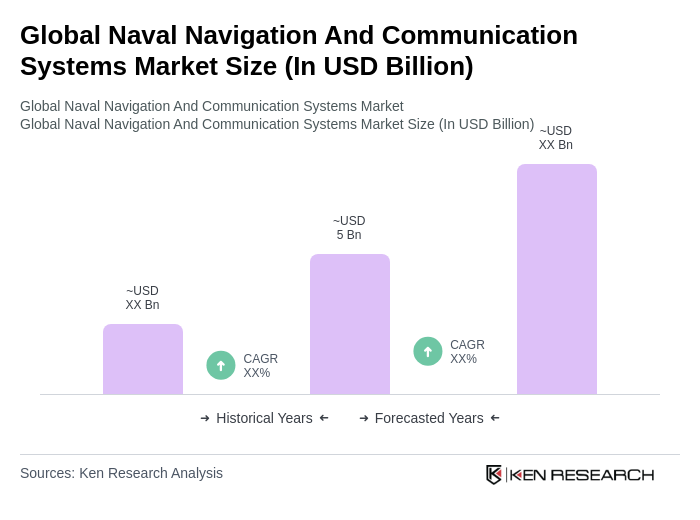
Global Naval Navigation and Communication Systems Market is worth USD 5 billion, fueled by rising defense spending, technological innovations, and maritime security needs.

Region:Global

Author(s):Shubham

Product Code:KRAD0741

Pages:84

Published On:August 2025
About the Report

Base Year 2024

Global Naval Navigation And Communication Systems Market Overview

  • The Global Naval Navigation and Communication Systems Market is valued at USD 5 billion, based on a five-year historical analysis. This growth is primarily driven by increasing defense budgets across various nations, advancements in technology, and the rising need for enhanced maritime security. The integration of sophisticated navigation and communication systems in naval operations has become essential for strategic defense and operational efficiency.
  • Key players in this market include the United States, China, and several European nations. The dominance of these countries is attributed to their significant investments in naval modernization programs, robust defense industries, and a strong focus on research and development. The U.S. Navy leads in adopting advanced technologies amid sustained fleet modernization priorities, while China is rapidly expanding its naval capabilities and shipbuilding to assert its presence in regional waters.
  • In 2023, the U.S. government implemented the National Defense Authorization Act (NDAA), which emphasizes the modernization of naval navigation and communication systems. This regulation directs continued funding for research, development, and procurement to sustain technological edge and operational readiness, including priorities for resilient SATCOM, cyber-hardened C2, and integrated sensors for the fleet.
Global Naval Navigation And Communication Systems Market Size

Global Naval Navigation And Communication Systems Market Segmentation

By Type:The market is segmented into various types, including Navigation Systems, Communication Systems, Sonar and Underwater Systems, Integrated Bridge and Combat Management Systems, Electronic Warfare and IFF Support Systems, and Others. Among these, Navigation Systems, which include ECDIS, GNSS/GPS, INS, Radar, and Gyrocompass, are leading the market due to their critical role in ensuring safe and efficient maritime operations.
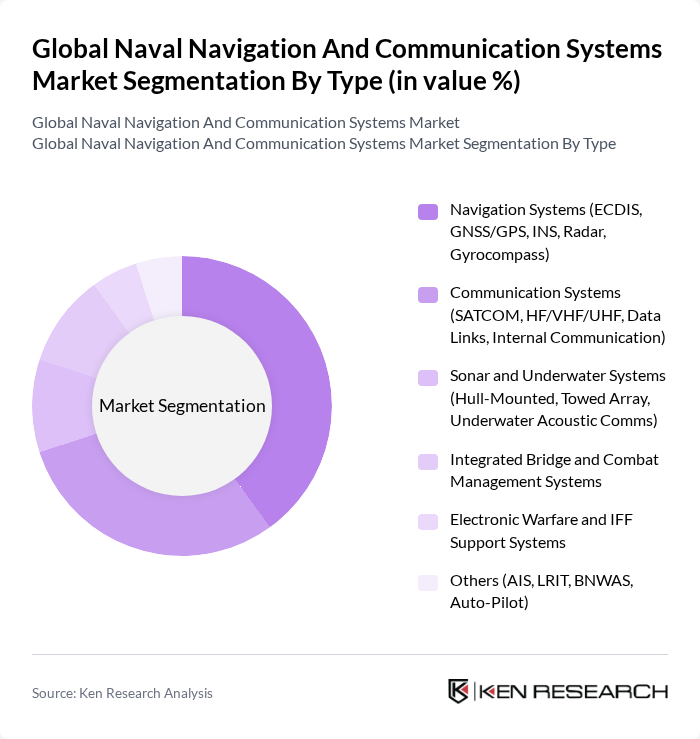
Global Naval Navigation And Communication Systems Market segmentation by Type.

By End-User:The end-user segmentation includes Naval Forces, Coast Guard and Maritime Security Agencies, Defense Shipyards and System Integrators, and Research and Hydrographic Institutions. The Naval Forces segment dominates the market, driven by the increasing need for advanced naval capabilities and the modernization of existing fleets to enhance operational effectiveness.
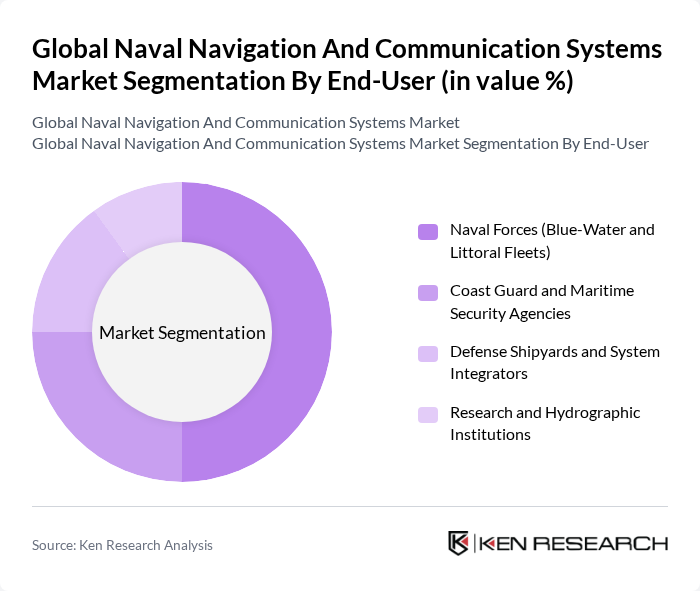
Global Naval Navigation And Communication Systems Market segmentation by End-User.

Global Naval Navigation And Communication Systems Market Competitive Landscape

The Global Naval Navigation And Communication Systems Market is characterized by a dynamic mix of regional and international players. Leading participants such as Thales Group, Raytheon Technologies (RTX) – including Raytheon Missiles & Defense, Northrop Grumman Corporation, BAE Systems plc, Lockheed Martin Corporation, L3Harris Technologies, Inc., Saab AB, Elbit Systems Ltd., Leonardo S.p.A., Kongsberg Gruppen ASA, General Dynamics Corporation, Ultra Electronics (Ultra Maritime), HENSOLDT AG, Mitsubishi Electric Corporation, Israel Aerospace Industries (IAI) – ELTA Systems, Rohde & Schwarz GmbH & Co. KG, Cobham Limited (including Cobham SATCOM), Teledyne Technologies Incorporated (Teledyne Marine), Indra Sistemas, S.A., Wärtsilä Voyage (including Transas ECDIS) contribute to innovation, geographic expansion, and service delivery in this space.

Thales Group

2000

Paris, France

Raytheon Technologies

2020

Arlington, Virginia, USA

Northrop Grumman Corporation

1939

Falls Church, Virginia, USA

BAE Systems plc

1999

London, United Kingdom

Lockheed Martin Corporation

1995

Bethesda, Maryland, USA

Company

Establishment Year

Headquarters

Naval NAV/COM Portfolio Breadth (Navigation, Communication, Sonar, Integrated Bridge)

Defense NAV/COM Revenue (USD, latest fiscal year)

Order Backlog/Book-to-Bill (Defense Maritime)

Installed Base on Active Fleets (number of vessels/platforms)

Win Rate in Recent Naval Programs (% of tenders won)

R&D Intensity (% of revenue, defense segment)

Global Naval Navigation And Communication Systems Market Industry Analysis

Growth Drivers

  • Increasing Defense Budgets:Global defense spending reached approximately $2.44 trillion, with countries like the U.S. allocating $916 billion. This trend is expected to continue, as nations prioritize military modernization and technological advancements. The U.S. and NATO countries are particularly focused on enhancing naval capabilities, which directly drives demand for advanced navigation and communication systems. This increased funding supports the development of sophisticated systems that improve operational efficiency and maritime security.
  • Technological Advancements in Navigation Systems:The naval navigation sector is witnessing rapid technological innovations, with investments in GPS, inertial navigation, and satellite communication systems. In future, the global market for GPS technology alone is projected to be valued at $50 billion, with projections indicating a growth trajectory fueled by advancements in accuracy and reliability. These innovations enhance situational awareness and operational effectiveness, making them essential for modern naval operations and driving market growth.
  • Rising Maritime Security Concerns:The global maritime security landscape is increasingly threatened by piracy, terrorism, and geopolitical tensions. In future, incidents of piracy are expected to increase by 20% in certain regions, prompting nations to bolster their naval capabilities. This heightened focus on maritime security drives demand for advanced navigation and communication systems, as they are critical for effective surveillance, reconnaissance, and response operations, ensuring the safety of maritime trade routes and national interests.

Market Challenges

  • High Development and Maintenance Costs:The development and maintenance of advanced naval navigation and communication systems require significant financial investment. For instance, the average cost of developing a new naval system can exceed $100 million, with ongoing maintenance costs reaching up to 10% of the initial investment annually. These high costs can deter smaller nations from upgrading their systems, limiting market growth and innovation in the sector.
  • Cybersecurity Threats:As naval systems become increasingly reliant on digital technologies, they face heightened cybersecurity threats. In future, cyberattacks on maritime infrastructure are expected to increase by 30%, leading to significant operational disruptions. The potential for data breaches and system failures poses a serious challenge to the integrity and reliability of navigation and communication systems, necessitating substantial investments in cybersecurity measures to protect sensitive information and maintain operational readiness.

Global Naval Navigation And Communication Systems Market Future Outlook

The future of the naval navigation and communication systems market is poised for significant transformation, driven by technological advancements and evolving security needs. The integration of artificial intelligence and machine learning will enhance system capabilities, enabling predictive analytics and improved decision-making. Additionally, the shift towards cloud-based solutions will facilitate real-time data sharing and collaboration among naval forces, enhancing operational efficiency. As nations continue to prioritize maritime security, the demand for innovative navigation systems will remain robust, fostering a dynamic market environment.

Market Opportunities

  • Expansion in Emerging Markets:Emerging economies are increasingly investing in naval capabilities, with countries like India and Brazil ramping up their defense budgets. In future, India allocated approximately $75 billion for defense, creating opportunities for advanced navigation systems. This trend presents a significant market opportunity for technology providers to cater to the growing demand for modern naval solutions in these regions.
  • Development of Autonomous Naval Systems:The rise of autonomous naval systems is reshaping the industry landscape. In future, investments in unmanned naval vehicles are projected to reach $3 billion, driven by their potential to enhance operational efficiency and reduce risks to personnel. This trend opens avenues for innovation in navigation and communication technologies, as autonomous systems require advanced capabilities to operate effectively in complex maritime environments.

Scope of the Report

SegmentSub-Segments
By Type

Navigation Systems (ECDIS, GNSS/GPS, INS, Radar, Gyrocompass)

Communication Systems (SATCOM, HF/VHF/UHF, Data Links, Internal Communication)

Sonar and Underwater Systems (Hull-Mounted, Towed Array, Underwater Acoustic Comms)

Integrated Bridge and Combat Management Systems

Electronic Warfare and IFF Support Systems

Others (AIS, LRIT, BNWAS, Auto-Pilot)

By End-User

Naval Forces (Blue-Water and Littoral Fleets)

Coast Guard and Maritime Security Agencies

Defense Shipyards and System Integrators

Research and Hydrographic Institutions

By Component

Hardware (Antennas, Transceivers, Displays, Sensors, Transducers)

Software and Firmware (Navigation, Data Fusion, Cybersecurity)

Services (Integration, MRO, Training, Upgrades)

By Application

Navigation and Ship Control

Tactical and Strategic Communications (C2, SATCOM, Data Links)

Surveillance and Situational Awareness (Radar, Sonar, ISR)

Search and Rescue and Safety-of-Life Services

By Platform

Surface Combatants (Frigates, Destroyers, Corvettes)

Submarines (SSK/SSN/SSBN)

Patrol and Auxiliary Vessels

Unmanned Surface and Underwater Vehicles (USV/UUV)

By Sales Channel

Direct Government Procurement (MoDs, Naval Procurement)

OEMs and Prime Integrators

Distributors/Value-Added Resellers

By Geography

North America (United States, Canada)

Europe (United Kingdom, France, Germany, Italy, Spain, Nordics, Rest of Europe)

Asia-Pacific (China, India, Japan, South Korea, Australia, Rest of APAC)

Middle East & Africa (Saudi Arabia, UAE, Israel, South Africa, Rest of MEA)

Latin America (Brazil, Mexico, Rest of LATAM)

Key Target Audience

Investors and Venture Capitalist Firms

Government and Regulatory Bodies (e.g., U.S. Department of Defense, NATO, European Defence Agency)

Naval Defense Contractors

Maritime Security Agencies

Shipbuilders and Shipyards

Telecommunications Providers

Defense Technology Innovators

International Maritime Organizations

Players Mentioned in the Report:

Thales Group

Raytheon Technologies (RTX) including Raytheon Missiles & Defense

Northrop Grumman Corporation

BAE Systems plc

Lockheed Martin Corporation

L3Harris Technologies, Inc.

Saab AB

Elbit Systems Ltd.

Leonardo S.p.A.

Kongsberg Gruppen ASA

General Dynamics Corporation

Ultra Electronics (Ultra Maritime)

HENSOLDT AG

Mitsubishi Electric Corporation

Israel Aerospace Industries (IAI) ELTA Systems

Rohde & Schwarz GmbH & Co. KG

Cobham Limited (including Cobham SATCOM)

Teledyne Technologies Incorporated (Teledyne Marine)

Indra Sistemas, S.A.

Wartsila Voyage (including Transas ECDIS)

Table of Contents

Market Assessment Phase

1. Executive Summary and Approach


2. Global Naval Navigation And Communication Systems Market Overview

2.1 Key Insights and Strategic Recommendations

2.2 Global Naval Navigation And Communication Systems Market Overview

2.3 Definition and Scope

2.4 Evolution of Market Ecosystem

2.5 Timeline of Key Regulatory Milestones

2.6 Value Chain & Stakeholder Mapping

2.7 Business Cycle Analysis

2.8 Policy & Incentive Landscape


3. Global Naval Navigation And Communication Systems Market Analysis

3.1 Growth Drivers

3.1.1 Increasing Defense Budgets
3.1.2 Technological Advancements in Navigation Systems
3.1.3 Rising Maritime Security Concerns
3.1.4 Demand for Enhanced Communication Systems

3.2 Market Challenges

3.2.1 High Development and Maintenance Costs
3.2.2 Rapid Technological Changes
3.2.3 Regulatory Compliance Issues
3.2.4 Cybersecurity Threats

3.3 Market Opportunities

3.3.1 Expansion in Emerging Markets
3.3.2 Integration of AI and Machine Learning
3.3.3 Development of Autonomous Naval Systems
3.3.4 Partnerships with Technology Providers

3.4 Market Trends

3.4.1 Shift Towards Integrated Systems
3.4.2 Increased Focus on Cybersecurity Solutions
3.4.3 Adoption of Cloud-Based Navigation Solutions
3.4.4 Growing Importance of Data Analytics

3.5 Government Regulation

3.5.1 International Maritime Organization (IMO) Guidelines
3.5.2 National Defense Authorization Acts
3.5.3 Export Control Regulations
3.5.4 Environmental Compliance Standards

4. SWOT Analysis


5. Stakeholder Analysis


6. Porter's Five Forces Analysis


7. Global Naval Navigation And Communication Systems Market Market Size, 2019-2024

7.1 By Value

7.2 By Volume

7.3 By Average Selling Price


8. Global Naval Navigation And Communication Systems Market Segmentation

8.1 By Type

8.1.1 Navigation Systems (ECDIS, GNSS/GPS, INS, Radar, Gyrocompass)
8.1.2 Communication Systems (SATCOM, HF/VHF/UHF, Data Links, Internal Communication)
8.1.3 Sonar and Underwater Systems (Hull-Mounted, Towed Array, Underwater Acoustic Comms)
8.1.4 Integrated Bridge and Combat Management Systems
8.1.5 Electronic Warfare and IFF Support Systems
8.1.6 Others (AIS, LRIT, BNWAS, Auto-Pilot)

8.2 By End-User

8.2.1 Naval Forces (Blue-Water and Littoral Fleets)
8.2.2 Coast Guard and Maritime Security Agencies
8.2.3 Defense Shipyards and System Integrators
8.2.4 Research and Hydrographic Institutions

8.3 By Component

8.3.1 Hardware (Antennas, Transceivers, Displays, Sensors, Transducers)
8.3.2 Software and Firmware (Navigation, Data Fusion, Cybersecurity)
8.3.3 Services (Integration, MRO, Training, Upgrades)

8.4 By Application

8.4.1 Navigation and Ship Control
8.4.2 Tactical and Strategic Communications (C2, SATCOM, Data Links)
8.4.3 Surveillance and Situational Awareness (Radar, Sonar, ISR)
8.4.4 Search and Rescue and Safety-of-Life Services

8.5 By Platform

8.5.1 Surface Combatants (Frigates, Destroyers, Corvettes)
8.5.2 Submarines (SSK/SSN/SSBN)
8.5.3 Patrol and Auxiliary Vessels
8.5.4 Unmanned Surface and Underwater Vehicles (USV/UUV)

8.6 By Sales Channel

8.6.1 Direct Government Procurement (MoDs, Naval Procurement)
8.6.2 OEMs and Prime Integrators
8.6.3 Distributors/Value-Added Resellers

8.7 By Geography

8.7.1 North America (United States, Canada)
8.7.2 Europe (United Kingdom, France, Germany, Italy, Spain, Nordics, Rest of Europe)
8.7.3 Asia-Pacific (China, India, Japan, South Korea, Australia, Rest of APAC)
8.7.4 Middle East & Africa (Saudi Arabia, UAE, Israel, South Africa, Rest of MEA)
8.7.5 Latin America (Brazil, Mexico, Rest of LATAM)

9. Global Naval Navigation And Communication Systems Market Competitive Analysis

9.1 Market Share of Key Players

9.2 Cross Comparison of Key Players

9.2.1 Company Name
9.2.2 Naval NAV/COM Portfolio Breadth (Navigation, Communication, Sonar, Integrated Bridge)
9.2.3 Defense NAV/COM Revenue (USD, latest fiscal year)
9.2.4 Order Backlog/Book-to-Bill (Defense Maritime)
9.2.5 Installed Base on Active Fleets (number of vessels/platforms)
9.2.6 Win Rate in Recent Naval Programs (% of tenders won)
9.2.7 R&D Intensity (% of revenue, defense segment)
9.2.8 Product Certification & Compliance (IMO, MIL-STD, STANAG count)
9.2.9 Interoperability/Architecture (OPEN architecture, NATO Link-11/16/22 support)
9.2.10 Cybersecurity Posture (STIG/Zero-Trust features, certifications)
9.2.11 Average Program Deal Size (USD, multi-year)
9.2.12 Aftermarket/MRO Share of Revenue (%)

9.3 SWOT Analysis of Top Players

9.4 Pricing Analysis

9.5 Detailed Profile of Major Companies

9.5.1 Thales Group
9.5.2 Raytheon Technologies (RTX) – including Raytheon Missiles & Defense
9.5.3 Northrop Grumman Corporation
9.5.4 BAE Systems plc
9.5.5 Lockheed Martin Corporation
9.5.6 L3Harris Technologies, Inc.
9.5.7 Saab AB
9.5.8 Elbit Systems Ltd.
9.5.9 Leonardo S.p.A.
9.5.10 Kongsberg Gruppen ASA
9.5.11 General Dynamics Corporation
9.5.12 Ultra Electronics (Ultra Maritime)
9.5.13 HENSOLDT AG
9.5.14 Mitsubishi Electric Corporation
9.5.15 Israel Aerospace Industries (IAI) – ELTA Systems
9.5.16 Rohde & Schwarz GmbH & Co. KG
9.5.17 Cobham Limited (including Cobham SATCOM)
9.5.18 Teledyne Technologies Incorporated (Teledyne Marine)
9.5.19 Indra Sistemas, S.A.
9.5.20 Wärtsilä Voyage (including Transas ECDIS)

10. Global Naval Navigation And Communication Systems Market End-User Analysis

10.1 Procurement Behavior of Key Ministries

10.1.1 Defense Ministries
10.1.2 Maritime Safety Authorities
10.1.3 Research and Development Agencies

10.2 Corporate Spend on Infrastructure & Energy

10.2.1 Investment in Naval Infrastructure
10.2.2 Budget Allocation for Communication Systems

10.3 Pain Point Analysis by End-User Category

10.3.1 Budget Constraints
10.3.2 Technological Integration Issues

10.4 User Readiness for Adoption

10.4.1 Training and Skill Development Needs
10.4.2 Infrastructure Readiness

10.5 Post-Deployment ROI and Use Case Expansion

10.5.1 Performance Metrics Evaluation
10.5.2 Future Use Case Development

11. Global Naval Navigation And Communication Systems Market Future Size, 2025-2030

11.1 By Value

11.2 By Volume

11.3 By Average Selling Price


Go-To-Market Strategy Phase

1. Whitespace Analysis + Business Model Canvas

1.1 Market Gaps Identification

1.2 Business Model Framework


2. Marketing and Positioning Recommendations

2.1 Branding Strategies

2.2 Product USPs


3. Distribution Plan

3.1 Urban Retail Strategies

3.2 Rural NGO Tie-Ups


4. Channel & Pricing Gaps

4.1 Underserved Routes

4.2 Pricing Bands Analysis


5. Unmet Demand & Latent Needs

5.1 Category Gaps

5.2 Consumer Segments


6. Customer Relationship

6.1 Loyalty Programs

6.2 After-Sales Service


7. Value Proposition

7.1 Sustainability Initiatives

7.2 Integrated Supply Chains


8. Key Activities

8.1 Regulatory Compliance

8.2 Branding Efforts

8.3 Distribution Setup


9. Entry Strategy Evaluation

9.1 Domestic Market Entry Strategy

9.1.1 Product Mix Considerations
9.1.2 Pricing Band Strategy
9.1.3 Packaging Solutions

9.2 Export Entry Strategy

9.2.1 Target Countries Identification
9.2.2 Compliance Roadmap Development

10. Entry Mode Assessment

10.1 Joint Ventures

10.2 Greenfield Investments

10.3 Mergers & Acquisitions

10.4 Distributor Model Evaluation


11. Capital and Timeline Estimation

11.1 Capital Requirements Analysis

11.2 Timelines for Implementation


12. Control vs Risk Trade-Off

12.1 Ownership Considerations

12.2 Partnerships Evaluation


13. Profitability Outlook

13.1 Breakeven Analysis

13.2 Long-Term Sustainability Strategies


14. Potential Partner List

14.1 Distributors

14.2 Joint Ventures

14.3 Acquisition Targets


15. Execution Roadmap

15.1 Phased Plan for Market Entry

15.1.1 Market Setup
15.1.2 Market Entry
15.1.3 Growth Acceleration
15.1.4 Scale & Stabilize

15.2 Key Activities and Milestones

15.2.1 Milestone Planning
15.2.2 Activity Tracking

Research Methodology

ApproachModellingSample

Phase 1: Approach1

Desk Research

  • Analysis of industry reports from maritime organizations and defense agencies
  • Review of market trends and forecasts from reputable maritime journals
  • Examination of regulatory frameworks and compliance documents related to naval navigation systems

Primary Research

  • Interviews with naval architects and engineers specializing in navigation systems
  • Surveys with military procurement officers and defense contractors
  • Field interviews with maritime operations managers and communication specialists

Validation & Triangulation

  • Cross-validation of findings through multiple expert interviews and industry reports
  • Triangulation of data from primary and secondary sources to ensure consistency
  • Sanity checks conducted through expert panel reviews and feedback sessions

Phase 2: Market Size Estimation1

Top-down Assessment

  • Estimation of market size based on global defense budgets allocated to naval systems
  • Segmentation of the market by naval vessel types and communication technologies
  • Incorporation of geopolitical factors influencing naval spending and technology adoption

Bottom-up Modeling

  • Collection of data on unit sales from leading manufacturers of navigation systems
  • Operational cost analysis based on technology deployment and maintenance expenses
  • Volume x cost calculations for various segments including commercial and military applications

Forecasting & Scenario Analysis

  • Multi-factor regression analysis incorporating technological advancements and defense spending trends
  • Scenario modeling based on potential shifts in naval warfare strategies and communication needs
  • Baseline, optimistic, and pessimistic projections through 2035

Phase 3: CATI Sample Composition1

Scope Item/SegmentSample SizeTarget Respondent Profiles
Military Naval Operations120Naval Officers, Defense Analysts
Commercial Shipping Navigation90Fleet Managers, Maritime Safety Officers
Research & Development in Navigation Tech60R&D Engineers, Technology Innovators
Government Regulatory Bodies50Policy Makers, Compliance Officers
Maritime Communication Systems70Communication Engineers, IT Managers

Frequently Asked Questions

What is the current value of the Global Naval Navigation and Communication Systems Market?

The Global Naval Navigation and Communication Systems Market is valued at approximately USD 5 billion, driven by increased defense budgets, technological advancements, and the need for enhanced maritime security.

What factors are driving the growth of the naval navigation and communication systems market?

Which countries are leading in the naval navigation and communication systems market?

What are the main types of systems included in the naval navigation and communication market?

Other Regional/Country Reports

UAE Naval Navigation And Communication Systems MarketKSA Naval Navigation And Communication Systems Market

Indonesia Naval Navigation And Communication Systems Market

Malaysia Naval Navigation And Communication Systems Market

APAC Naval Navigation And Communication Systems Market

SEA Naval Navigation And Communication Systems Market

Why Buy From Us?

Refine Robust Result (RRR) Framework

What makes us stand out is that our consultants follow Robust, Refine and Result (RRR) methodology. Robust for clear definitions, approaches and sanity checking, Refine for differentiating respondents' facts and opinions, and Result for presenting data with story.

Our Reach Is Unmatched

We have set a benchmark in the industry by offering our clients with syndicated and customized market research reports featuring coverage of entire market as well as meticulous research and analyst insights.

Shifting the Research Paradigm

While we don't replace traditional research, we flip the method upside down. Our dual approach of Top Bottom & Bottom Top ensures quality deliverable by not just verifying company fundamentals but also looking at the sector and macroeconomic factors.

More Insights-Better Decisions

With one step in the future, our research team constantly tries to show you the bigger picture. We help with some of the tough questions you may encounter along the way: How is the industry positioned? Best marketing channel? KPI's of competitors? By aligning every element, we help maximize success.

Transparency and Trust

Our report gives you instant access to the answers and sources that other companies might choose to hide. We elaborate each steps of research methodology we have used and showcase you the sample size to earn your trust.

Round the Clock Support

If you need any support, we are here! We pride ourselves on universe strength, data quality, and quick, friendly, and professional service.

Why Clients Choose Us?

400000+
Reports in repository
150+
Consulting projects a year
100+
Analysts
8000+
Client Queries in 2022








