About the Report
Base Year 2024Listen to the audio summary
Global Newspaper Industry Market Overview
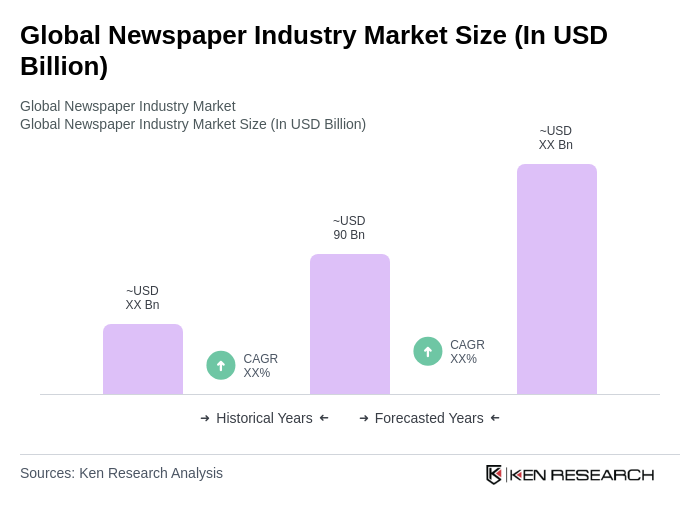
- The Global Newspaper Industry Market is valued at USD 90 billion, based on a five-year historical analysis, reflecting the continued decline in print revenues alongside growth in digital subscriptions and licensing. Recent industry sizing references place the market in the USD 80–90 billion range for newspaper publishing, while broader “printed and digital newspaper” or “newspaper and magazines publishers” categories report higher totals due to scope differences that include magazines and wider media activities .
- This market is primarily driven by the increasing demand for news and information delivered through digital platforms, with publishers shifting business models toward direct reader revenue (digital subscriptions, memberships) and first?party data solutions for advertisers. Industry analyses highlight the pivot from advertising?heavy print models to blended revenue with growing digital subscriptions and paywalled premium content as key growth drivers .
- Key players in this market include the United States, the United Kingdom, and Japan, which have established media ecosystems, high literacy, and substantial advertising markets, and host globally influential newspaper brands and publisher groups with significant digital subscription bases and international reach .
- The claim of a European Union regulation in 2023 mandating that all newspapers transition to eco?friendly printing by 2025 (recycled paper and sustainable inks) is not supported by official EU regulatory records or recognized industry reporting; while sustainability initiatives and guidance exist across European publishing, there is no EU?wide mandate with a 2025 deadline specific to newspapers .
Global Newspaper Industry Market Segmentation
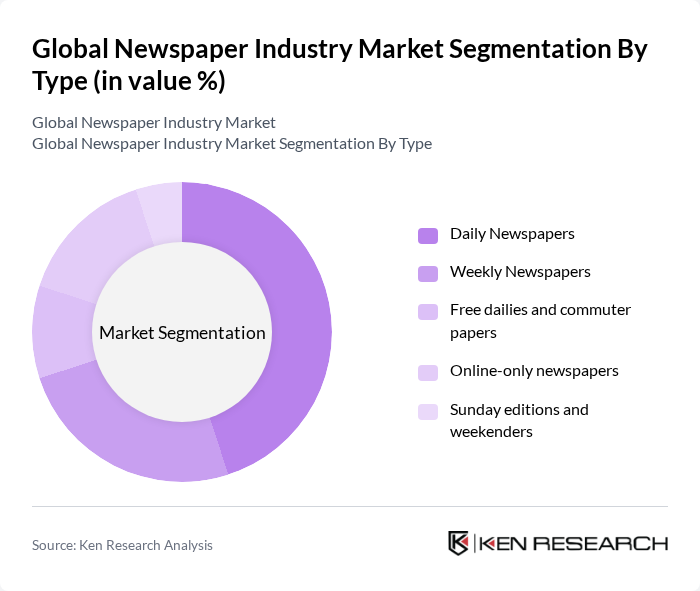
By Type:The newspaper industry is segmented into daily newspapers, weekly newspapers, free dailies and commuter papers, online-only newspapers, and Sunday editions and weekenders. Daily newspapers remain central to publisher operations in many markets, but audience time has shifted materially to digital formats. Online-only newspapers and digital editions continue to expand due to convenience, mobile access, and paywalled premium content strategies; free dailies/commuter titles have generally contracted alongside changing commuting patterns and print economics .
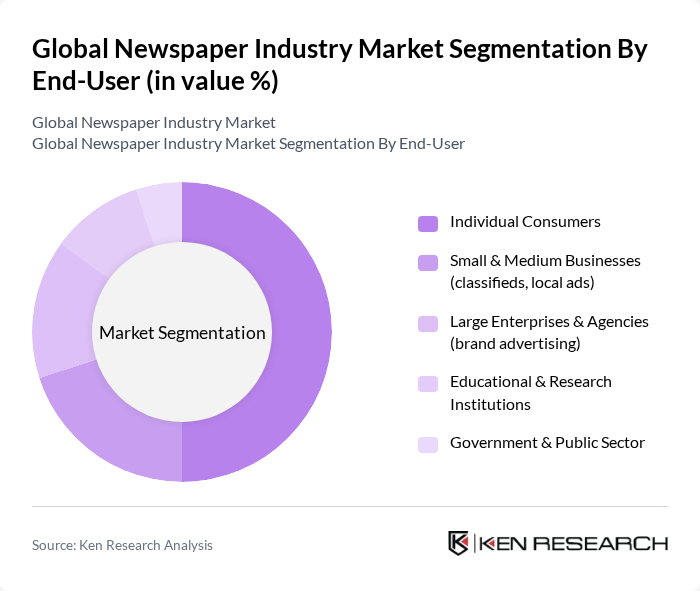
By End-User:The end-user segmentation of the newspaper industry includes individual consumers, small and medium businesses, large enterprises and agencies, educational and research institutions, and government and public sector entities. Individual consumers dominate through direct subscriptions and retail purchases. Small and medium businesses rely on newspapers (increasingly digital) for local and targeted advertising, while large enterprises focus on brand campaigns and sponsorships. Educational institutions use newspapers for research and curriculum content access, and government entities employ them for public notices and outreach, complemented by digital dissemination .
Global Newspaper Industry Market Competitive Landscape
The Global Newspaper Industry Market is characterized by a dynamic mix of regional and international players. Leading participants such as The New York Times Company, News Corp (Dow Jones, The Wall Street Journal, The Times), Gannett Co., Inc. (USA Today Network), Tribune Publishing Company (Chicago Tribune, others), Hearst Communications, Inc. (Houston Chronicle, San Francisco Chronicle), Axel Springer SE (Die Welt, Bild), Guardian Media Group (The Guardian, The Observer), The Washington Post (Nash Holdings), The McClatchy Company, Bonnier AB (Dagens Nyheter via Bonnier News), Mediahuis NV (The Independent, Irish Independent), Reach plc (The Mirror, Daily Express), Schibsted ASA (Aftenposten, VG), Nikkei Inc. (Financial Times, Nikkei), Grupo Clarín S.A. (Clarín) contribute to innovation, geographic expansion, and service delivery through digital subscription growth, first?party data advertising, and international content licensing .
Global Newspaper Industry Market Industry Analysis
Growth Drivers
- Digital Transformation in Publishing:The shift towards digital platforms has significantly influenced the newspaper industry, with over 1.5 billion people accessing news online daily. In future, digital ad spending is projected to reach $600 billion globally, indicating a robust market for digital content. This transformation allows newspapers to reach wider audiences, enhance engagement through multimedia content, and reduce operational costs associated with print production, thus driving growth in the sector.
- Increasing Demand for Local News:Local news consumption has surged, with 65% of adults in the U.S. expressing a preference for local news sources. This trend is supported by a forecast indicating that local news websites will attract over 120 million unique visitors monthly. As communities seek relevant and timely information, newspapers that focus on local reporting can capitalize on this demand, fostering subscriber loyalty and increasing advertising revenue from local businesses.
- Subscription-Based Revenue Models:The adoption of subscription models has become a key growth driver, with over 60 million digital subscriptions expected in the U.S. in future. This shift is supported by a 25% increase in revenue from subscriptions, as consumers are willing to pay for quality journalism. Newspapers that implement tiered subscription plans and exclusive content offerings can enhance their revenue streams, ensuring sustainability in a competitive market.
Market Challenges
- Declining Print Circulation:Print circulation has faced a dramatic decline, with an estimated drop of 12 million copies sold per week in the U.S. alone from 2020 to 2023. This trend is exacerbated by changing consumer preferences, as younger audiences increasingly favor digital formats. The loss of print revenue, which accounted for approximately $18 billion, poses a significant challenge for traditional newspapers struggling to adapt to the digital landscape.
- Ad Revenue Erosion:The newspaper industry has experienced a substantial decline in advertising revenue, with a reported loss of $12 billion from 2020 to 2023. This erosion is primarily due to competition from digital platforms, which capture over 65% of total ad spending. As advertisers shift their budgets towards online channels, newspapers must innovate their advertising strategies to retain clients and explore alternative revenue sources to mitigate this challenge.
Global Newspaper Industry Market Future Outlook
The future of the newspaper industry is poised for transformation, driven by technological advancements and evolving consumer preferences. As digital consumption continues to rise, newspapers will increasingly leverage data analytics to tailor content and enhance user engagement. Additionally, the integration of artificial intelligence in content creation and distribution will streamline operations, allowing for more personalized news experiences. This evolution will enable newspapers to adapt to market demands while exploring innovative revenue models that align with changing consumer behaviors.
Market Opportunities
- Expansion into Emerging Markets:Emerging markets present significant growth opportunities, with internet penetration expected to reach 75% in regions like Africa in future. Newspapers can tap into these markets by offering localized content and leveraging mobile platforms, potentially increasing their subscriber base and advertising revenue in these rapidly growing economies.
- Strategic Partnerships with Tech Firms:Collaborating with technology companies can enhance newspapers' digital capabilities. By forming partnerships, newspapers can access advanced analytics, improve user experience, and develop innovative advertising solutions. Such collaborations can lead to increased audience engagement and new revenue streams, positioning newspapers favorably in the competitive digital landscape.
Scope of the Report
| Segment | Sub-Segments |
|---|---|
| By Type | Daily Newspapers Weekly Newspapers Free dailies and commuter papers Online-only newspapers Sunday editions and weekenders |
| By End-User | Individual Consumers Small & Medium Businesses (classifieds, local ads) Large Enterprises & Agencies (brand advertising) Educational & Research Institutions Government & Public Sector |
| By Distribution Channel | Home delivery & direct sales Digital subscriptions & paywalls Retail outlets & supermarkets Newsstands & kiosks Aggregators & third-party platforms |
| By Content Type | General news & politics Business & finance Sports & entertainment Investigations & special reports Classifieds & notices |
| By Revenue Model | Subscription-based (print and digital) Advertising-based (display, programmatic, classifieds) Hybrid (bundled subs + ads + memberships) Licensing & syndication |
| By Format | Print (broadsheet, tabloid) Digital (web, app, e-paper) Mobile-first formats Audio & newsletters |
| By Geographic Reach | Local & regional newspapers National newspapers International & global titles Diaspora & language editions |
Key Target Audience
Investors and Venture Capitalist Firms
Government and Regulatory Bodies (e.g., Federal Communications Commission, National Newspaper Association)
Advertising Agencies
Print and Digital Distribution Companies
Media and Publishing Executives
Content Management System Providers
Industry Trade Associations
Financial Institutions and Investment Banks
Players Mentioned in the Report:
The New York Times Company
News Corp (Dow Jones, The Wall Street Journal, The Times)
Gannett Co., Inc. (USA Today Network)
Tribune Publishing Company (Chicago Tribune, others)
Hearst Communications, Inc. (Houston Chronicle, San Francisco Chronicle)
Axel Springer SE (Die Welt, Bild)
Guardian Media Group (The Guardian, The Observer)
The Washington Post (Nash Holdings)
The McClatchy Company
Bonnier AB (Dagens Nyheter via Bonnier News)
Mediahuis NV (The Independent, Irish Independent)
Reach plc (The Mirror, Daily Express)
Schibsted ASA (Aftenposten, VG)
Nikkei Inc. (Financial Times, Nikkei)
Grupo Clarin S.A. (Clarin)
Table of Contents
Market Assessment Phase
1. Executive Summary and Approach
2. Global Newspaper Industry Market Overview
2.1 Key Insights and Strategic Recommendations
2.2 Global Newspaper Industry Market Overview
2.3 Definition and Scope
2.4 Evolution of Market Ecosystem
2.5 Timeline of Key Regulatory Milestones
2.6 Value Chain & Stakeholder Mapping
2.7 Business Cycle Analysis
2.8 Policy & Incentive Landscape
3. Global Newspaper Industry Market Analysis
3.1 Growth Drivers
3.1.1 Digital Transformation in Publishing
3.1.2 Increasing Demand for Local News
3.1.3 Subscription-Based Revenue Models
3.1.4 Diversification of Content Offerings
3.2 Market Challenges
3.2.1 Declining Print Circulation
3.2.2 Competition from Digital Media
3.2.3 Ad Revenue Erosion
3.2.4 Regulatory Pressures
3.3 Market Opportunities
3.3.1 Expansion into Emerging Markets
3.3.2 Strategic Partnerships with Tech Firms
3.3.3 Enhanced Digital Advertising Solutions
3.3.4 Niche Content Creation
3.4 Market Trends
3.4.1 Rise of Mobile News Consumption
3.4.2 Integration of AI in Content Creation
3.4.3 Focus on Sustainability in Publishing
3.4.4 Growth of Subscription Models
3.5 Government Regulation
3.5.1 Copyright Laws and Intellectual Property
3.5.2 Advertising Standards and Regulations
3.5.3 Data Protection and Privacy Laws
3.5.4 Press Freedom and Censorship Issues
4. SWOT Analysis
5. Stakeholder Analysis
6. Porter's Five Forces Analysis
7. Global Newspaper Industry Market Market Size, 2019-2024
7.1 By Value
7.2 By Volume
7.3 By Average Selling Price
8. Global Newspaper Industry Market Segmentation
8.1 By Type
8.1.1 Daily Newspapers
8.1.2 Weekly Newspapers
8.1.3 Free dailies and commuter papers
8.1.4 Online-only newspapers
8.1.5 Sunday editions and weekenders
8.2 By End-User
8.2.1 Individual Consumers
8.2.2 Small & Medium Businesses (classifieds, local ads)
8.2.3 Large Enterprises & Agencies (brand advertising)
8.2.4 Educational & Research Institutions
8.2.5 Government & Public Sector
8.3 By Distribution Channel
8.3.1 Home delivery & direct sales
8.3.2 Digital subscriptions & paywalls
8.3.3 Retail outlets & supermarkets
8.3.4 Newsstands & kiosks
8.3.5 Aggregators & third-party platforms
8.4 By Content Type
8.4.1 General news & politics
8.4.2 Business & finance
8.4.3 Sports & entertainment
8.4.4 Investigations & special reports
8.4.5 Classifieds & notices
8.5 By Revenue Model
8.5.1 Subscription-based (print and digital)
8.5.2 Advertising-based (display, programmatic, classifieds)
8.5.3 Hybrid (bundled subs + ads + memberships)
8.5.4 Licensing & syndication
8.6 By Format
8.6.1 Print (broadsheet, tabloid)
8.6.2 Digital (web, app, e-paper)
8.6.3 Mobile-first formats
8.6.4 Audio & newsletters
8.7 By Geographic Reach
8.7.1 Local & regional newspapers
8.7.2 National newspapers
8.7.3 International & global titles
8.7.4 Diaspora & language editions
9. Global Newspaper Industry Market Competitive Analysis
9.1 Market Share of Key Players
9.2 Cross Comparison of Key Players
9.2.1 Company Name
9.2.2 Scale Tier (Global, Regional, Local)
9.2.3 Revenue Growth Rate (YoY, total)
9.2.4 Digital Subscription Growth (YoY, net adds)
9.2.5 Total Subscriptions (print + digital)
9.2.6 Average Revenue per User (ARPU) – digital
9.2.7 Digital Engagement (monthly active users, time spent)
9.2.8 Paywall Conversion Rate
9.2.9 Advertising Revenue Mix (print vs digital %)
9.2.10 CPM/eCPM Benchmarks (programmatic/display)
9.2.11 Churn Rate (monthly/annual)
9.2.12 Operating Margin (publishing segment)
9.2.13 Content Investment (newsroom spend, investigative share)
9.2.14 Geographic Penetration (top 5 markets)
9.2.15 Product Mix Breadth (newsletters, podcasts, apps)
9.3 SWOT Analysis of Top Players
9.4 Pricing Analysis
9.5 Detailed Profile of Major Companies
9.5.1 The New York Times Company
9.5.2 News Corp (Dow Jones, The Wall Street Journal, The Times)
9.5.3 Gannett Co., Inc. (USA Today Network)
9.5.4 Tribune Publishing Company (Chicago Tribune, others)
9.5.5 Hearst Communications, Inc. (Houston Chronicle, San Francisco Chronicle)
9.5.6 Axel Springer SE (Die Welt, Bild)
9.5.7 Guardian Media Group (The Guardian, The Observer)
9.5.8 The Washington Post (Nash Holdings)
9.5.9 The McClatchy Company
9.5.10 Bonnier AB (Dagens Nyheter via Bonnier News)
9.5.11 Mediahuis NV (The Independent, Irish Independent)
9.5.12 Reach plc (The Mirror, Daily Express)
9.5.13 Schibsted ASA (Aftenposten, VG)
9.5.14 Nikkei Inc. (Financial Times, Nikkei)
9.5.15 Grupo Clarín S.A. (Clarín)
10. Global Newspaper Industry Market End-User Analysis
10.1 Procurement Behavior of Key Ministries
10.1.1 Budget Allocation for Media
10.1.2 Preference for Local vs National Publications
10.1.3 Subscription Trends
10.1.4 Engagement with Digital Platforms
10.2 Corporate Spend on Infrastructure & Energy
10.2.1 Investment in Digital Infrastructure
10.2.2 Spending on Print Media
10.2.3 Advertising Budgets
10.2.4 Content Development Costs
10.3 Pain Point Analysis by End-User Category
10.3.1 Accessibility of Content
10.3.2 Quality of Reporting
10.3.3 Pricing Concerns
10.3.4 Trust in Media Sources
10.4 User Readiness for Adoption
10.4.1 Digital Literacy Levels
10.4.2 Subscription Willingness
10.4.3 Engagement with Social Media
10.4.4 Preference for News Formats
10.5 Post-Deployment ROI and Use Case Expansion
10.5.1 Measurement of Engagement Metrics
10.5.2 Analysis of Subscription Growth
10.5.3 Feedback Mechanisms
10.5.4 Content Performance Evaluation
11. Global Newspaper Industry Market Future Size, 2025-2030
11.1 By Value
11.2 By Volume
11.3 By Average Selling Price
Go-To-Market Strategy Phase
1. Whitespace Analysis + Business Model Canvas
1.1 Market Gaps Identification
1.2 Value Proposition Development
1.3 Revenue Streams Analysis
1.4 Customer Segmentation
1.5 Key Partnerships
1.6 Cost Structure
1.7 Channels of Distribution
2. Marketing and Positioning Recommendations
2.1 Branding Strategies
2.2 Product USPs
2.3 Target Audience Identification
2.4 Communication Strategies
2.5 Digital Marketing Approaches
3. Distribution Plan
3.1 Urban Retail Strategies
3.2 Rural NGO Tie-Ups
3.3 Online Distribution Channels
3.4 Partnerships with Local Vendors
4. Channel & Pricing Gaps
4.1 Underserved Routes
4.2 Pricing Bands Analysis
4.3 Competitor Pricing Strategies
4.4 Consumer Price Sensitivity
5. Unmet Demand & Latent Needs
5.1 Category Gaps
5.2 Consumer Segments Analysis
5.3 Emerging Trends Identification
5.4 Feedback from Current Users
6. Customer Relationship
6.1 Loyalty Programs
6.2 After-Sales Service
6.3 Customer Engagement Strategies
6.4 Feedback Mechanisms
7. Value Proposition
7.1 Sustainability Initiatives
7.2 Integrated Supply Chains
7.3 Unique Selling Points
7.4 Customer-Centric Approaches
8. Key Activities
8.1 Regulatory Compliance
8.2 Branding Efforts
8.3 Distribution Setup
8.4 Content Development
9. Entry Strategy Evaluation
9.1 Domestic Market Entry Strategy
9.1.1 Product Mix
9.1.2 Pricing Band
9.1.3 Packaging Strategies
9.2 Export Entry Strategy
9.2.1 Target Countries
9.2.2 Compliance Roadmap
10. Entry Mode Assessment
10.1 Joint Ventures
10.2 Greenfield Investments
10.3 Mergers & Acquisitions
10.4 Distributor Model
11. Capital and Timeline Estimation
11.1 Capital Requirements
11.2 Timelines for Implementation
12. Control vs Risk Trade-Off
12.1 Ownership vs Partnerships
12.2 Risk Management Strategies
13. Profitability Outlook
13.1 Breakeven Analysis
13.2 Long-Term Sustainability
14. Potential Partner List
14.1 Distributors
14.2 Joint Ventures
14.3 Acquisition Targets
15. Execution Roadmap
15.1 Phased Plan for Market Entry
15.1.1 Market Setup
15.1.2 Market Entry
15.1.3 Growth Acceleration
15.1.4 Scale & Stabilize
15.2 Key Activities and Milestones
15.2.1 Milestone Planning
15.2.2 Activity Tracking
Research Methodology
Phase 1: Approach1
Desk Research
- Analysis of industry reports from global newspaper associations and media research firms
- Review of financial statements and annual reports from leading newspaper publishers
- Examination of market trends and forecasts published by media analytics platforms
Primary Research
- Interviews with editorial directors and publishing executives from major newspapers
- Surveys conducted with advertising sales teams to understand revenue streams
- Focus groups with readers to gauge changing consumption patterns and preferences
Validation & Triangulation
- Cross-validation of findings through multiple data sources, including circulation and digital engagement metrics
- Triangulation of qualitative insights from interviews with quantitative data from surveys
- Sanity checks performed by industry experts to ensure data reliability and relevance
Phase 2: Market Size Estimation1
Top-down Assessment
- Estimation of total market size based on global advertising expenditure trends in print media
- Segmentation of market size by geographic regions and digital versus print revenue
- Incorporation of macroeconomic factors influencing newspaper circulation and advertising
Bottom-up Modeling
- Collection of circulation data from individual newspapers to establish baseline readership figures
- Analysis of advertising rates and revenue per page across different newspaper formats
- Volume x revenue calculations based on subscription models and single-copy sales
Forecasting & Scenario Analysis
- Multi-factor regression analysis incorporating digital transformation and consumer behavior shifts
- Scenario modeling based on potential impacts of economic downturns and technological advancements
- Development of baseline, optimistic, and pessimistic forecasts through 2030
Phase 3: CATI Sample Composition1
| Scope Item/Segment | Sample Size | Target Respondent Profiles |
|---|---|---|
| National Newspaper Publishers | 100 | CEOs, CFOs, and Editorial Heads |
| Local Newspaper Circulation Managers | 80 | Circulation Directors, Marketing Managers |
| Digital Advertising Executives | 75 | Digital Marketing Directors, Ad Sales Managers |
| Reader Engagement Specialists | 60 | Audience Development Managers, Content Strategists |
| Media Analysts and Researchers | 50 | Market Analysts, Research Directors |
Frequently Asked Questions
What is the current value of the Global Newspaper Industry Market?
The Global Newspaper Industry Market is valued at approximately USD 90 billion, reflecting a decline in print revenues while digital subscriptions and licensing are on the rise. The market is projected to remain within the USD 8090 billion range in the coming years.
What are the main drivers of growth in the newspaper industry?
How has digital transformation impacted the newspaper industry?
What challenges does the newspaper industry face?
Other Regional/Country Reports
Indonesia Newspaper Industry Market
Malaysia Newspaper Industry Market
APAC Newspaper Industry Market
SEA Newspaper Industry Market
Why Buy From Us?

What makes us stand out is that our consultants follow Robust, Refine and Result (RRR) methodology. Robust for clear definitions, approaches and sanity checking, Refine for differentiating respondents' facts and opinions, and Result for presenting data with story.

We have set a benchmark in the industry by offering our clients with syndicated and customized market research reports featuring coverage of entire market as well as meticulous research and analyst insights.

While we don't replace traditional research, we flip the method upside down. Our dual approach of Top Bottom & Bottom Top ensures quality deliverable by not just verifying company fundamentals but also looking at the sector and macroeconomic factors.

With one step in the future, our research team constantly tries to show you the bigger picture. We help with some of the tough questions you may encounter along the way: How is the industry positioned? Best marketing channel? KPI's of competitors? By aligning every element, we help maximize success.

Our report gives you instant access to the answers and sources that other companies might choose to hide. We elaborate each steps of research methodology we have used and showcase you the sample size to earn your trust.

If you need any support, we are here! We pride ourselves on universe strength, data quality, and quick, friendly, and professional service.