Region:Global
Author(s):Dev
Product Code:KRAB0393
Pages:89
Published On:August 2025
By Type:The market is segmented into various types of implants, including orthopedic, dental, cardiovascular, neuromodulation & neuro implants, ophthalmic, aesthetic & reconstructive implants, and smart/bioabsorbable implants. Among these, orthopedic implants are currently dominating the market due to the increasing incidence of orthopedic disorders and the growing demand for advanced surgical solutions. The trend towards minimally invasive surgeries and the adoption of 3D printing technology for custom implants are further driving the growth of this segment.

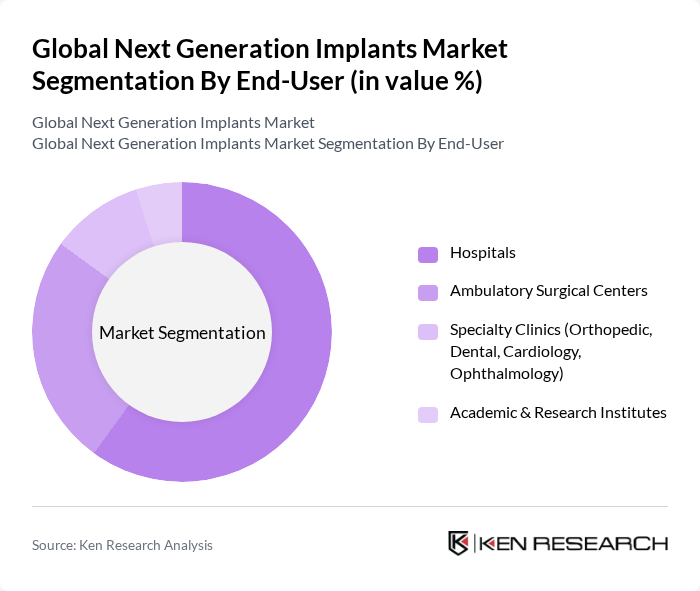
By End-User:The end-user segmentation includes hospitals, ambulatory surgical centers, specialty clinics, and academic & research institutes. Hospitals are the leading end-user segment, driven by the increasing number of surgical procedures and the demand for advanced medical technologies. The trend towards outpatient surgeries and the growing preference for specialized clinics are also contributing to the growth of ambulatory surgical centers.
The Global Next Generation Implants Market is characterized by a dynamic mix of regional and international players. Leading participants such as Medtronic plc, Johnson & Johnson (DePuy Synthes), Stryker Corporation, Zimmer Biomet Holdings, Inc., Boston Scientific Corporation, Abbott Laboratories, Smith & Nephew plc, NuVasive, Inc. (a Globus Medical company), B. Braun Melsungen AG (Aesculap), CONMED Corporation, Orthofix Medical Inc., Medacta Group SA, Exactech, Inc., Globus Medical, Inc., Biotronik SE & Co. KG contribute to innovation, geographic expansion, and service delivery in this space.
The future of the next-generation implants market appears promising, driven by technological advancements and demographic shifts. As the integration of artificial intelligence and machine learning in implant design becomes more prevalent, the customization of implants will enhance patient outcomes. Additionally, the growing emphasis on personalized medicine will lead to tailored solutions that address individual patient needs. These trends, combined with an expanding geriatric population, will likely create a robust environment for innovation and growth in future.
| Segment | Sub-Segments |
|---|---|
| By Type | Orthopedic Implants (e.g., 3D-printed joints, bioactive coatings, sensor-enabled) Dental Implants (e.g., zirconia/titanium, immediate-load, custom-milled) Cardiovascular Implants (e.g., TAVI/TAVR valves, next-gen stents, leadless pacemakers) Neuromodulation & Neuro Implants (e.g., DBS, SCS, cochlear/retinal implants) Ophthalmic Implants (e.g., premium IOLs, glaucoma drainage, corneal inlays) Aesthetic & Reconstructive Implants (e.g., breast, facial, patient-specific) Smart/Bioabsorbable Implants and Others |
| By End-User | Hospitals Ambulatory Surgical Centers Specialty Clinics (Orthopedic, Dental, Cardiology, Ophthalmology) Academic & Research Institutes |
| By Application | Trauma & Fracture Fixation Elective Joint & Spine Procedures Reconstructive & Regenerative Procedures Aesthetic & Dental Restorations |
| By Distribution Channel | Direct Sales Distributors Online/Procurement Platforms |
| By Material | Metals & Metal Alloys (Titanium, CoCr, Nitinol) Polymers & Biodegradable Composites Ceramics & Bioactive Glass Biologics & Tissue-Engineered Constructs |
| By Region | North America Europe Asia-Pacific Latin America Middle East & Africa |
| By Price Range | Low Price Range Mid Price Range High Price Range |
| Scope Item/Segment | Sample Size | Target Respondent Profiles |
|---|---|---|
| Orthopedic Implants | 140 | Orthopedic Surgeons, Hospital Administrators |
| Dental Implants | 100 | Dentists, Dental Clinic Managers |
| Cardiovascular Implants | 80 | Cardiologists, Cardiac Surgeons |
| Regulatory Compliance in Implants | 60 | Regulatory Affairs Specialists, Quality Assurance Managers |
| Emerging Technologies in Implants | 70 | Biomedical Engineers, R&D Managers |
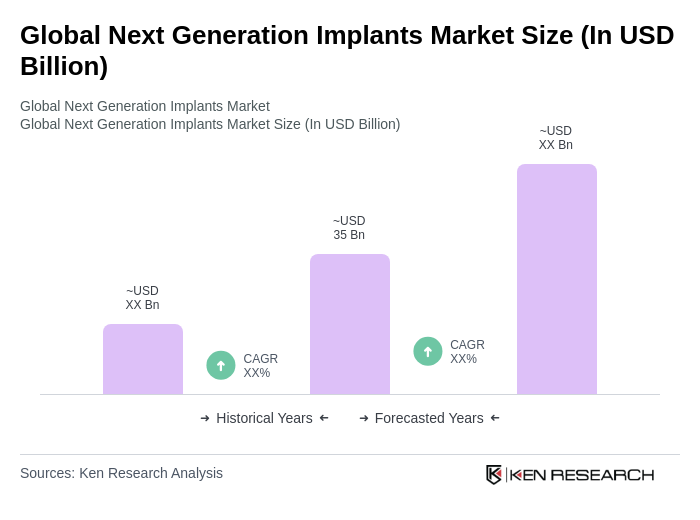
The Global Next Generation Implants Market is valued at approximately USD 35 billion, driven by technological advancements, the rising prevalence of chronic diseases, and an increasing geriatric population seeking innovative surgical solutions.

What makes us stand out is that our consultants follow Robust, Refine and Result (RRR) methodology. Robust for clear definitions, approaches and sanity checking, Refine for differentiating respondents' facts and opinions, and Result for presenting data with story.

We have set a benchmark in the industry by offering our clients with syndicated and customized market research reports featuring coverage of entire market as well as meticulous research and analyst insights.

While we don't replace traditional research, we flip the method upside down. Our dual approach of Top Bottom & Bottom Top ensures quality deliverable by not just verifying company fundamentals but also looking at the sector and macroeconomic factors.

With one step in the future, our research team constantly tries to show you the bigger picture. We help with some of the tough questions you may encounter along the way: How is the industry positioned? Best marketing channel? KPI's of competitors? By aligning every element, we help maximize success.

Our report gives you instant access to the answers and sources that other companies might choose to hide. We elaborate each steps of research methodology we have used and showcase you the sample size to earn your trust.

If you need any support, we are here! We pride ourselves on universe strength, data quality, and quick, friendly, and professional service.













