About the Report
Base Year 2024Listen to the audio summary
Global Nft Gaming Market Overview
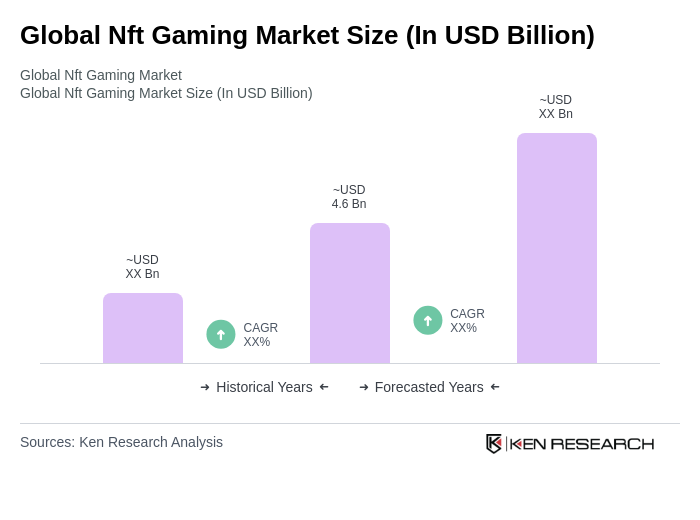
- The Global NFT Gaming Market is valued at USD 4.6 billion, based on a five-year historical analysis. This level reflects the scale of gaming-related NFT activity and aligns with recent industry assessments of the gaming NFT segment’s size within the broader NFT economy. Growth is primarily driven by increasing adoption of blockchain in games, the rise of play-to-earn and asset-ownership models, and surging interest in digital collectibles and in?game assets, which drew significant user engagement and investment during the pandemic as players sought experiences with transferable value.
- Key players in this market include the United States, South Korea, and Japan, which are prominent due to advanced infrastructure, high internet and mobile penetration, and strong gaming cultures. Asia-Pacific—anchored by markets such as South Korea and Japan—has emerged as a key growth hub for blockchain gaming, while North America, led by the United States, holds a large share of NFT gaming activity through developer ecosystems and marketplaces.
- In 2023, the European Union advanced a comprehensive crypto regulatory framework through the Markets in Crypto-Assets (MiCA) Regulation, which introduced rules enhancing consumer protection and transparency across crypto-asset services; while the application to NFTs is nuanced (case-by-case depending on fungibility and issuance), EU guidance and sustainability measures around crypto assets have pushed platforms to disclose clearer information, including environmental considerations tied to underlying blockchains, supporting responsible practices and trust in NFT-related markets.
Global Nft Gaming Market Segmentation
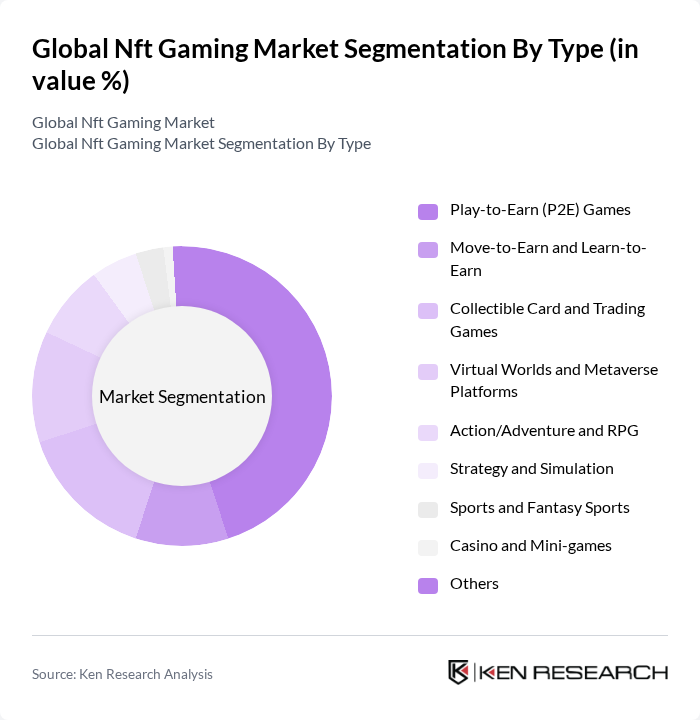
By Type:The NFT gaming market is segmented into various types, including Play-to-Earn (P2E) Games, Move-to-Earn and Learn-to-Earn, Collectible Card and Trading Games, Virtual Worlds and Metaverse Platforms, Action/Adventure and RPG, Strategy and Simulation, Sports and Fantasy Sports, Casino and Mini-games, and Others. Among these, Play-to-Earn (P2E) Games have emerged as a highly visible segment for user acquisition due to tokenized rewards and tradable assets, though the market has diversified toward sustainable “play-and-own” and collectible/trading experiences as publishers refine tokenomics and focus on gameplay quality.
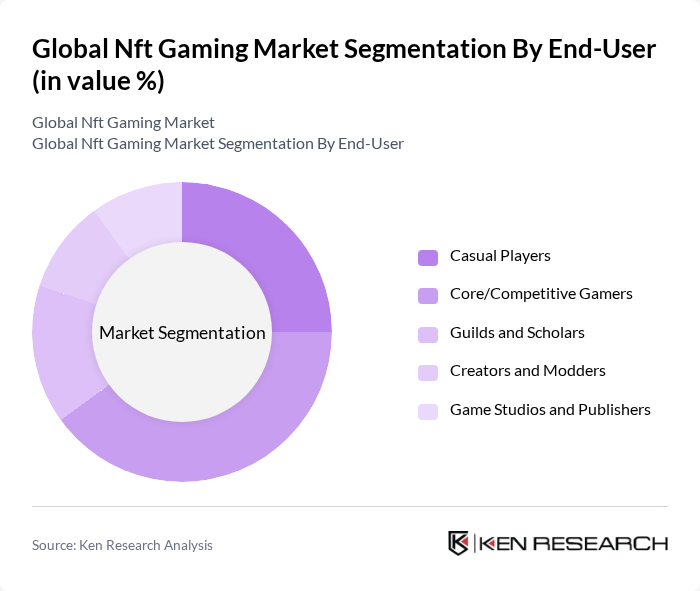
By End-User:The market is also segmented by end-user categories, including Casual Players, Core/Competitive Gamers, Guilds and Scholars, Creators and Modders, and Game Studios and Publishers. The segment of Core/Competitive Gamers is leading the market, driven by participation in higher-stakes gameplay loops, asset ownership for advantage or status, and strong community engagement; creator and guild participation further supports liquidity and secondary-market trading in NFT-centric titles.
Global Nft Gaming Market Competitive Landscape
The Global Nft Gaming Market is characterized by a dynamic mix of regional and international players. Leading participants such as Sky Mavis (Axie Infinity), Decentraland (Decentraland Foundation), The Sandbox (Animoca Brands), Enjin (Enjin Pte. Ltd.), Immutable (Immutable X; Immutable Ltd.), Gala Games (Gala), Sorare (Sorare SAS), Alien Worlds (Dacoco GmbH), My Neighbor Alice (Antler Interactive), Splinterlands (Splinterlands, Inc.), ZED RUN (Virtually Human Studio), Rarible (Rarible, Inc.), CryptoKitties (Dapper Labs), Upland (Uplandme, Inc.), Gods Unchained (Immutable), Illuvium (Illuvium Labs Ltd.), Big Time (Big Time Studios), Pixels (Pixels Online Ltd.), Star Atlas (Automata SA), Deadrop (Midnight Society) contribute to innovation, geographic expansion, and service delivery in this space.
Global Nft Gaming Market Industry Analysis
Growth Drivers
- Increasing Popularity of Blockchain Technology:The global blockchain technology market is projected to reach $163.24 billion by 2029, growing at a CAGR of 85.9% from 2022 to 2029 (Fortune Business Insights). This surge in blockchain adoption is driving the NFT gaming sector, as developers leverage decentralized systems for transparency and security. The integration of blockchain in gaming enhances user trust, with over 50% of gamers expressing interest in blockchain-based games, indicating a robust demand for NFT gaming experiences.
- Rise in Digital Collectibles and Ownership:The digital collectibles market is expected to surpass $400 billion by 2025 (Statista). This growth is fueled by the increasing consumer interest in owning unique digital assets, particularly among millennials and Gen Z. In future, approximately 30% of gamers reported purchasing digital collectibles, highlighting a shift towards valuing ownership in virtual environments. This trend is pivotal for NFT gaming, as it aligns with players' desires for exclusive in-game items and experiences.
- Integration of Play-to-Earn Models:The play-to-earn model has gained traction, with over 1.5 million daily active users in NFT games as of future (DappRadar). This model allows players to earn real-world value through gameplay, attracting a diverse audience. The success of games like Axie Infinity, which generated $1.3 billion in revenue in future, exemplifies the potential of this model. As more games adopt play-to-earn mechanics, the NFT gaming market is likely to expand significantly, appealing to both gamers and investors.
Market Challenges
- Regulatory Uncertainty:The NFT gaming sector faces significant regulatory challenges, with governments worldwide still formulating policies. For instance, the European Union is expected to introduce comprehensive regulations by future, which could impact NFT transactions and ownership rights. This uncertainty creates a risk for developers and investors, as compliance costs may rise, potentially stifling innovation and market growth. The lack of clear guidelines can deter new entrants, limiting competition and diversity in the market.
- High Entry Barriers for New Developers:The NFT gaming market requires substantial initial investment, with development costs for blockchain-based games averaging $500,000 to $1 million (GameDev.net). This financial barrier can hinder new developers from entering the market, leading to a concentration of power among established players. Additionally, the technical expertise required to create and maintain blockchain games further complicates entry, limiting innovation and the introduction of fresh ideas that could benefit the industry.
Global Nft Gaming Market Future Outlook
The NFT gaming market is poised for transformative growth, driven by technological advancements and evolving consumer preferences. As blockchain technology matures, we anticipate increased integration of virtual and augmented reality, enhancing user experiences. Furthermore, the rise of community-driven game development will empower players, fostering loyalty and engagement. These trends indicate a dynamic landscape where innovation and collaboration will shape the future of NFT gaming, creating new opportunities for developers and players alike.
Market Opportunities
- Growth of Cross-Platform Gaming:The cross-platform gaming trend is gaining momentum, with 70% of gamers expressing a preference for games that allow play across multiple devices (Newzoo). This presents an opportunity for NFT games to reach broader audiences, enhancing user engagement and retention. By developing interoperable NFTs that function across various platforms, developers can tap into this growing market, driving revenue and expanding their user base significantly.
- Partnerships with Traditional Gaming Companies:Collaborations between NFT gaming developers and established gaming companies can unlock new revenue streams. In future, partnerships led to a 40% increase in user acquisition for participating games (Gaming Industry Report). By leveraging traditional gaming companies' resources and expertise, NFT games can enhance their credibility and reach, attracting a wider audience and fostering mainstream acceptance of blockchain technology in gaming.
Scope of the Report
| Segment | Sub-Segments |
|---|---|
| By Type | Play-to-Earn (P2E) Games Move-to-Earn and Learn-to-Earn Collectible Card and Trading Games Virtual Worlds and Metaverse Platforms Action/Adventure and RPG Strategy and Simulation Sports and Fantasy Sports Casino and Mini?games Others |
| By End-User | Casual Players Core/Competitive Gamers Guilds and Scholars Creators and Modders Game Studios and Publishers |
| By Platform | Mobile PC/Desktop Console Web3 Browsers/Clients |
| By Revenue Model | NFT Primary Sales (Mints) Secondary Market Royalties In?Game Purchases and Microtransactions Subscriptions and Battle Passes Advertising and Sponsorship Token Emissions and Staking Rewards |
| By Game Genre | RPG Strategy Card/Board Adventure Sports/Racing Sandbox/Builder |
| By Distribution Channel | Native Launchers and Direct Download Web3 Game Launchpads Online Marketplaces (NFT/Item Markets) App Stores Third?Party PC Stores (e.g., Epic Games Store) |
| By User Demographics | Age Groups Gender Geographic Distribution Income Levels |
| By Blockchain/Infrastructure | Ethereum Layer?2s (Immutable, Polygon, Arbitrum, Optimism) Sidechains and App?chains Solana BNB Chain Flow Others |
Key Target Audience
Investors and Venture Capitalist Firms
Government and Regulatory Bodies (e.g., Financial Conduct Authority, Securities and Exchange Commission)
Game Developers and Publishers
Blockchain Technology Providers
Digital Asset Exchanges
Gaming Hardware Manufacturers
Content Creators and Influencers
Online Gaming Platforms
Players Mentioned in the Report:
Sky Mavis (Axie Infinity)
Decentraland (Decentraland Foundation)
The Sandbox (Animoca Brands)
Enjin (Enjin Pte. Ltd.)
Immutable (Immutable X; Immutable Ltd.)
Gala Games (Gala)
Sorare (Sorare SAS)
Alien Worlds (Dacoco GmbH)
My Neighbor Alice (Antler Interactive)
Splinterlands (Splinterlands, Inc.)
ZED RUN (Virtually Human Studio)
Rarible (Rarible, Inc.)
CryptoKitties (Dapper Labs)
Upland (Uplandme, Inc.)
Gods Unchained (Immutable)
Illuvium (Illuvium Labs Ltd.)
Big Time (Big Time Studios)
Pixels (Pixels Online Ltd.)
Star Atlas (Automata SA)
Deadrop (Midnight Society)
Table of Contents
Market Assessment Phase
1. Executive Summary and Approach
2. Global Nft Gaming Market Overview
2.1 Key Insights and Strategic Recommendations
2.2 Global Nft Gaming Market Overview
2.3 Definition and Scope
2.4 Evolution of Market Ecosystem
2.5 Timeline of Key Regulatory Milestones
2.6 Value Chain & Stakeholder Mapping
2.7 Business Cycle Analysis
2.8 Policy & Incentive Landscape
3. Global Nft Gaming Market Analysis
3.1 Growth Drivers
3.1.1 Increasing Popularity of Blockchain Technology
3.1.2 Rise in Digital Collectibles and Ownership
3.1.3 Expansion of Gaming Communities and Ecosystems
3.1.4 Integration of Play-to-Earn Models
3.2 Market Challenges
3.2.1 Regulatory Uncertainty
3.2.2 High Entry Barriers for New Developers
3.2.3 Market Volatility and Speculation Risks
3.2.4 Limited Consumer Understanding of NFTs
3.3 Market Opportunities
3.3.1 Growth of Cross-Platform Gaming
3.3.2 Partnerships with Traditional Gaming Companies
3.3.3 Development of Interoperable NFTs
3.3.4 Expansion into Emerging Markets
3.4 Market Trends
3.4.1 Increasing Investment in NFT Gaming Startups
3.4.2 Emergence of Virtual Reality and Augmented Reality Integration
3.4.3 Focus on Sustainable Gaming Practices
3.4.4 Growth of Community-Driven Game Development
3.5 Government Regulation
3.5.1 Implementation of NFT Taxation Policies
3.5.2 Development of Consumer Protection Laws
3.5.3 Regulation of Cryptocurrency Transactions
3.5.4 Guidelines for Digital Asset Ownership
4. SWOT Analysis
5. Stakeholder Analysis
6. Porter's Five Forces Analysis
7. Global Nft Gaming Market Market Size, 2019-2024
7.1 By Value
7.2 By Volume
7.3 By Average Selling Price
8. Global Nft Gaming Market Segmentation
8.1 By Type
8.1.1 Play-to-Earn (P2E) Games
8.1.2 Move-to-Earn and Learn-to-Earn
8.1.3 Collectible Card and Trading Games
8.1.4 Virtual Worlds and Metaverse Platforms
8.1.5 Action/Adventure and RPG
8.1.6 Strategy and Simulation
8.1.7 Sports and Fantasy Sports
8.1.8 Casino and Mini?games
8.1.9 Others
8.2 By End-User
8.2.1 Casual Players
8.2.2 Core/Competitive Gamers
8.2.3 Guilds and Scholars
8.2.4 Creators and Modders
8.2.5 Game Studios and Publishers
8.3 By Platform
8.3.1 Mobile
8.3.2 PC/Desktop
8.3.3 Console
8.3.4 Web3 Browsers/Clients
8.4 By Revenue Model
8.4.1 NFT Primary Sales (Mints)
8.4.2 Secondary Market Royalties
8.4.3 In?Game Purchases and Microtransactions
8.4.4 Subscriptions and Battle Passes
8.4.5 Advertising and Sponsorship
8.4.6 Token Emissions and Staking Rewards
8.5 By Game Genre
8.5.1 RPG
8.5.2 Strategy
8.5.3 Card/Board
8.5.4 Adventure
8.5.5 Sports/Racing
8.5.6 Sandbox/Builder
8.6 By Distribution Channel
8.6.1 Native Launchers and Direct Download
8.6.2 Web3 Game Launchpads
8.6.3 Online Marketplaces (NFT/Item Markets)
8.6.4 App Stores
8.6.5 Third?Party PC Stores (e.g., Epic Games Store)
8.7 By User Demographics
8.7.1 Age Groups
8.7.2 Gender
8.7.3 Geographic Distribution
8.7.4 Income Levels
8.8 By Blockchain/Infrastructure
8.8.1 Ethereum
8.8.2 Layer?2s (Immutable, Polygon, Arbitrum, Optimism)
8.8.3 Sidechains and App?chains
8.8.4 Solana
8.8.5 BNB Chain
8.8.6 Flow
8.8.7 Others
9. Global Nft Gaming Market Competitive Analysis
9.1 Market Share of Key Players
9.2 Cross Comparison of Key Players
9.2.1 Company/Title
9.2.2 Monthly Active Users (MAUs)
9.2.3 Daily Unique Active Wallets (DUAW)
9.2.4 Gross Merchandise Value (GMV) of NFT trades
9.2.5 In?game Transaction Volume and Take Rate
9.2.6 Average Revenue Per Paying User (ARPPU)
9.2.7 User Acquisition Cost (UAC/CAC)
9.2.8 90?Day Retention/Day?30 Cohort Retention
9.2.9 Token Market Cap and Circulating Supply
9.2.10 Secondary Royalty Revenue
9.2.11 Average Selling Price (ASP) per NFT
9.2.12 Cross?chain/Platform Coverage (chains, devices)
9.2.13 Compliance Incidents and Marketplace Delistings
9.3 SWOT Analysis of Top Players
9.4 Pricing Analysis
9.5 Detailed Profile of Major Companies
9.5.1 Sky Mavis (Axie Infinity)
9.5.2 Decentraland (Decentraland Foundation)
9.5.3 The Sandbox (Animoca Brands)
9.5.4 Enjin (Enjin Pte. Ltd.)
9.5.5 Immutable (Immutable X; Immutable Ltd.)
9.5.6 Gala Games (Gala)
9.5.7 Sorare (Sorare SAS)
9.5.8 Alien Worlds (Dacoco GmbH)
9.5.9 My Neighbor Alice (Antler Interactive)
9.5.10 Splinterlands (Splinterlands, Inc.)
9.5.11 ZED RUN (Virtually Human Studio)
9.5.12 Rarible (Rarible, Inc.)
9.5.13 CryptoKitties (Dapper Labs)
9.5.14 Upland (Uplandme, Inc.)
9.5.15 Gods Unchained (Immutable)
9.5.16 Illuvium (Illuvium Labs Ltd.)
9.5.17 Big Time (Big Time Studios)
9.5.18 Pixels (Pixels Online Ltd.)
9.5.19 Star Atlas (Automata SA)
9.5.20 Deadrop (Midnight Society)
10. Global Nft Gaming Market End-User Analysis
10.1 Procurement Behavior of Key Ministries
10.1.1 Engagement with Gaming Communities
10.1.2 Investment in Digital Infrastructure
10.1.3 Support for Game Development Initiatives
10.2 Corporate Spend on Infrastructure & Energy
10.2.1 Budget Allocation for Gaming Technologies
10.2.2 Investment in Blockchain Solutions
10.2.3 Funding for NFT Marketplaces
10.3 Pain Point Analysis by End-User Category
10.3.1 Technical Barriers to Entry
10.3.2 Lack of Consumer Awareness
10.3.3 High Transaction Fees
10.4 User Readiness for Adoption
10.4.1 Familiarity with Blockchain Technology
10.4.2 Willingness to Invest in NFTs
10.4.3 Understanding of Game Mechanics
10.5 Post-Deployment ROI and Use Case Expansion
10.5.1 Evaluation of Game Performance Metrics
10.5.2 User Engagement Levels
10.5.3 Opportunities for Game Expansion
11. Global Nft Gaming Market Future Size, 2025-2030
11.1 By Value
11.2 By Volume
11.3 By Average Selling Price
Go-To-Market Strategy Phase
1. Whitespace Analysis + Business Model Canvas
1.1 Identification of Market Gaps
1.2 Business Model Framework
2. Marketing and Positioning Recommendations
2.1 Branding Strategies
2.2 Product USPs
3. Distribution Plan
3.1 Urban Retail vs Rural NGO Tie-ups
4. Channel & Pricing Gaps
4.1 Underserved Routes
4.2 Pricing Bands
5. Unmet Demand & Latent Needs
5.1 Category Gaps
5.2 Consumer Segments
6. Customer Relationship
6.1 Loyalty Programs
6.2 After-sales Service
7. Value Proposition
7.1 Sustainability
7.2 Integrated Supply Chains
8. Key Activities
8.1 Regulatory Compliance
8.2 Branding
8.3 Distribution Setup
9. Entry Strategy Evaluation
9.1 Domestic Market Entry Strategy
9.1.1 Product Mix
9.1.2 Pricing Band
9.1.3 Packaging
9.2 Export Entry Strategy
9.2.1 Target Countries
9.2.2 Compliance Roadmap
10. Entry Mode Assessment
10.1 Joint Ventures
10.2 Greenfield Investments
10.3 Mergers & Acquisitions
10.4 Distributor Model
11. Capital and Timeline Estimation
11.1 Capital Requirements
11.2 Timelines
12. Control vs Risk Trade-Off
12.1 Ownership vs Partnerships
13. Profitability Outlook
13.1 Breakeven Analysis
13.2 Long-term Sustainability
14. Potential Partner List
14.1 Distributors
14.2 Joint Ventures
14.3 Acquisition Targets
15. Execution Roadmap
15.1 Phased Plan for Market Entry
15.1.1 Market Setup
15.1.2 Market Entry
15.1.3 Growth Acceleration
15.1.4 Scale & Stabilize
15.2 Key Activities and Milestones
15.2.1 Activity Planning
15.2.2 Milestone Tracking
Research Methodology
Phase 1: Approach1
Desk Research
- Analysis of industry reports from blockchain and gaming associations
- Review of market trends and forecasts from reputable financial publications
- Examination of white papers and case studies on NFT gaming platforms
Primary Research
- Interviews with game developers and NFT marketplace operators
- Surveys targeting gamers and NFT collectors to gauge market sentiment
- Focus groups with industry experts and analysts in the gaming sector
Validation & Triangulation
- Cross-validation of findings through multiple data sources and expert opinions
- Triangulation of market data with user engagement metrics from gaming platforms
- Sanity checks through feedback from a panel of NFT gaming specialists
Phase 2: Market Size Estimation1
Top-down Assessment
- Estimation of total market size based on global gaming revenue statistics
- Segmentation by geographic regions and gaming genres incorporating NFTs
- Inclusion of growth rates from emerging markets in the NFT gaming space
Bottom-up Modeling
- Data collection from leading NFT gaming platforms on user transactions
- Estimation of average revenue per user (ARPU) across different game types
- Volume analysis of NFT sales and trading activity within gaming ecosystems
Forecasting & Scenario Analysis
- Multi-variable forecasting based on blockchain adoption rates and gaming trends
- Scenario modeling considering regulatory impacts and technological advancements
- Development of baseline, optimistic, and pessimistic market growth projections
Phase 3: CATI Sample Composition1
| Scope Item/Segment | Sample Size | Target Respondent Profiles |
|---|---|---|
| Blockchain Game Developers | 90 | Game Designers, Technical Leads |
| NFT Marketplace Operators | 80 | Product Managers, Marketing Directors |
| Active NFT Gamers | 140 | Casual Gamers, Competitive Players |
| Investors in NFT Gaming | 70 | Venture Capitalists, Angel Investors |
| Industry Analysts and Experts | 60 | Market Researchers, Blockchain Consultants |
Frequently Asked Questions
What is the current value of the Global NFT Gaming Market?
The Global NFT Gaming Market is valued at approximately USD 4.6 billion, reflecting significant activity in gaming-related NFTs and aligning with broader industry assessments of the NFT economy.
What factors are driving the growth of the NFT gaming market?
Which regions are leading in the NFT gaming market?
How has the European Union impacted the NFT gaming market?
Other Regional/Country Reports
Indonesia NFT Gaming Market
Malaysia NFT Gaming Market
APAC NFT Gaming Market
SEA NFT Gaming Market
Why Buy From Us?

What makes us stand out is that our consultants follow Robust, Refine and Result (RRR) methodology. Robust for clear definitions, approaches and sanity checking, Refine for differentiating respondents' facts and opinions, and Result for presenting data with story.

We have set a benchmark in the industry by offering our clients with syndicated and customized market research reports featuring coverage of entire market as well as meticulous research and analyst insights.

While we don't replace traditional research, we flip the method upside down. Our dual approach of Top Bottom & Bottom Top ensures quality deliverable by not just verifying company fundamentals but also looking at the sector and macroeconomic factors.

With one step in the future, our research team constantly tries to show you the bigger picture. We help with some of the tough questions you may encounter along the way: How is the industry positioned? Best marketing channel? KPI's of competitors? By aligning every element, we help maximize success.

Our report gives you instant access to the answers and sources that other companies might choose to hide. We elaborate each steps of research methodology we have used and showcase you the sample size to earn your trust.

If you need any support, we are here! We pride ourselves on universe strength, data quality, and quick, friendly, and professional service.