About the Report
Base Year 2024Global Nuclear Medicine Radioisotopes Market Overview
- The Global Nuclear Medicine Radioisotopes Market is valued at USD 7.8 billion, based on a five-year historical analysis. This value aligns with recent industry estimates for the global market size and reflects sustained demand across diagnostic and therapeutic radioisotopes .
- Key players in this market include the United States, Germany, and Japan, which dominate due to advanced healthcare infrastructure, substantial radiopharmaceutical manufacturing and distribution networks, robust research and development ecosystems, and a high prevalence of chronic diseases. North America holds the largest regional share, supported by a dense network of PET/SPECT sites and commercial isotope producers, while Europe (notably Germany) and Japan serve as leading centers for nuclear medicine innovation and clinical adoption .
- In 2023, the U.S. advanced multiple regulatory measures to streamline development and access for radiopharmaceuticals, including the FDA’s establishment of the Radioactive Drug Research Committee program guidance framework and ongoing Center for Drug Evaluation and Research and Center for Devices and Radiological Health modernization efforts; FDA has also issued and updated guidances specific to PET drugs and radiopharmaceutical clinical trials to facilitate efficient review while maintaining safety and efficacy standards .

Global Nuclear Medicine Radioisotopes Market Segmentation
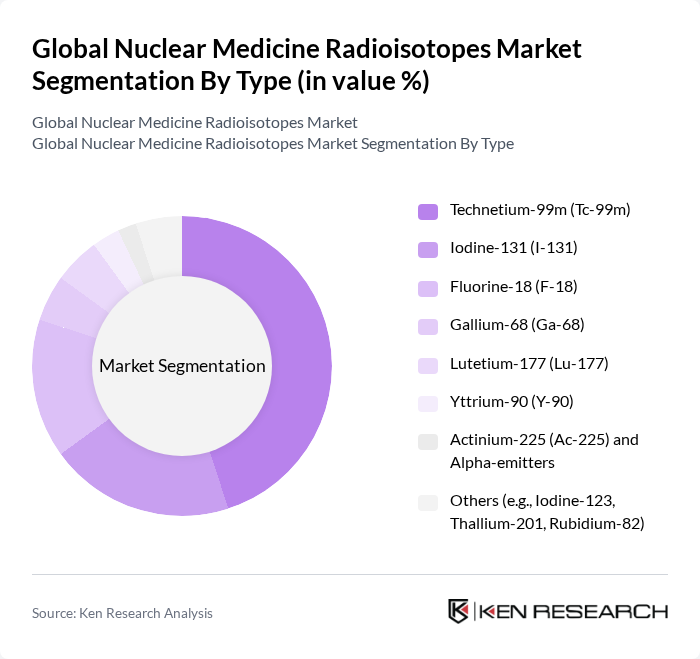
By Type:The market is segmented into various types of radioisotopes, each serving distinct purposes in diagnostics and therapeutics. The leading sub-segment is Technetium-99m (Tc-99m), widely used in diagnostic imaging due to favorable properties, including short half-life and broad generator-based availability across SPECT procedures. Other significant types include Iodine-131 (I-131) for thyroid ablation and therapy and Fluorine-18 (F-18) for PET imaging, especially in oncology. Gallium-68 (Ga-68) is growing for PET imaging of neuroendocrine tumors and prostate cancer targeting, while Lutetium-177 (Lu-177) is increasingly adopted for radioligand therapy. Yttrium-90 (Y-90) is used in selective internal radiation therapy for liver tumors, and emerging alpha-emitters such as Actinium-225 (Ac-225) are gaining attention for targeted alpha therapy. These usages and trends are consistent with expanding clinical evidence and production initiatives in nuclear medicine .
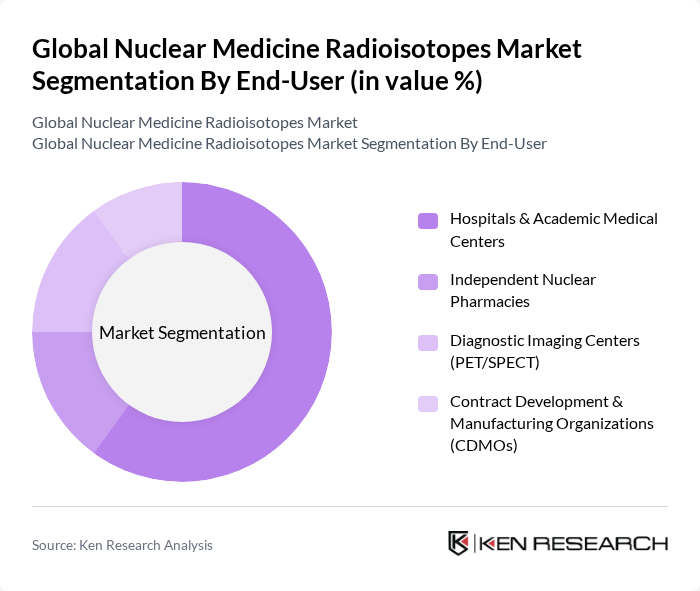
By End-User:The end-user segment includes hospitals, independent nuclear pharmacies, diagnostic imaging centers, and contract development and manufacturing organizations (CDMOs). Hospitals and academic medical centers are the leading end-users, driven by a high volume of PET/SPECT procedures and adoption of radioligand therapies. Independent nuclear pharmacies and cyclotron networks support timely distribution and unit-dose preparation, while diagnostic imaging centers continue to expand PET capacity. CDMOs are increasingly involved in GMP production and late-stage manufacturing for therapeutic isotopes, reflecting growing outsourcing in the radiopharmaceutical supply chain .
Global Nuclear Medicine Radioisotopes Market Competitive Landscape
The Global Nuclear Medicine Radioisotopes Market is characterized by a dynamic mix of regional and international players. Leading participants such as Curium, Lantheus Holdings, Inc., GE HealthCare, Siemens Healthineers, Cardinal Health, Inc. (Nuclear & Precision Health Solutions), NorthStar Medical Radioisotopes, LLC, Bracco Imaging S.p.A., Telix Pharmaceuticals Limited, Novartis AG (Advanced Accelerator Applications), IBA Radiopharma Solutions, Eckert & Ziegler Strahlen- und Medizintechnik AG, BWX Technologies, Inc., TerraPower Isotopes, LLC, ITM Isotope Technologies Munich SE, Norgine B.V. (formerly Mallinckrodt’s radiopharmaceutical brands) contribute to innovation, geographic expansion, and service delivery in this space.
Global Nuclear Medicine Radioisotopes Market Industry Analysis
Growth Drivers
- Increasing Prevalence of Cancer:The global cancer burden is projected to reachapproximately 28.4 millionnew cases in future, according to the International Agency for Research on Cancer of the World Health Organization. This rising incidence drives demand for nuclear medicine radioisotopes, which are crucial for diagnostic imaging and treatment. In future, an estimatedabout 2 millionnew cancer cases are expected in the United States alone, highlighting the urgent need for effective diagnostic tools and therapies, thereby propelling market growth in this sector.
- Advancements in Diagnostic Imaging Technologies:The nuclear medicine sector is witnessing rapid technological advancements, particularly in PET and SPECT imaging. The global market for PET scanners is projected to reach$2.5 billionin future, driven by innovations that enhance image quality and reduce radiation exposure. These advancements not only improve diagnostic accuracy but also expand the applications of radioisotopes, thereby increasing their demand in clinical settings and contributing to market growth.
- Rising Demand for Targeted Therapies:The global market for targeted cancer therapies is expected to reach$162 billionin future, driven by the need for more effective treatment options. Radioisotopes play a pivotal role in these therapies, particularly in delivering localized treatment with minimal side effects. As healthcare systems increasingly adopt personalized medicine approaches, the demand for radioisotope-based therapies is anticipated to rise, further fueling market expansion in the nuclear medicine sector.
Market Challenges
- High Costs of Radioisotope Production:The production of radioisotopes is capital-intensive, with costs often exceeding$1 millionfor small-scale facilities. This financial barrier limits the entry of new players into the market and constrains the supply of essential isotopes. Additionally, the high operational costs associated with maintaining safety standards and regulatory compliance further exacerbate the financial challenges faced by existing producers, hindering overall market growth.
- Stringent Regulatory Requirements:The nuclear medicine industry is subject to rigorous regulatory oversight, with compliance costs estimated at around$500,000annually for small manufacturers. These regulations, enforced by agencies such as the FDA and NRC, ensure safety but can delay product development and market entry. The complexity of navigating these regulations poses significant challenges for companies, potentially stifling innovation and limiting market opportunities in the sector.
Global Nuclear Medicine Radioisotopes Market Future Outlook
The future of the nuclear medicine radioisotopes market appears promising, driven by ongoing advancements in technology and increasing healthcare investments. As personalized medicine continues to gain traction, the integration of AI in diagnostic processes is expected to enhance the efficiency and accuracy of radioisotope applications. Furthermore, the expansion of the radiopharmaceuticals market will likely create new avenues for growth, positioning the sector for significant developments in the coming years.
Market Opportunities
- Growth in Emerging Markets:Emerging markets, particularly in Asia-Pacific, are projected to experience a surge in demand for nuclear medicine. With healthcare spending in these regions expected to increase by10%annually, the adoption of advanced diagnostic and therapeutic technologies will create substantial opportunities for radioisotope manufacturers to expand their market presence.
- Development of New Radioisotope Therapies:The ongoing research into novel radioisotope therapies presents significant market opportunities. With over50new radioisotope-based treatments currently in clinical trials, the potential for breakthroughs in cancer treatment and other diseases could lead to increased adoption and investment in nuclear medicine, driving market growth in the coming years.
Scope of the Report
| Segment | Sub-Segments |
|---|---|
| By Type | Technetium-99m (Tc-99m) Iodine-131 (I-131) Fluorine-18 (F-18) Gallium-68 (Ga-68) Lutetium-177 (Lu-177) Yttrium-90 (Y-90) Actinium-225 (Ac-225) and Alpha-emitters Others (e.g., Iodine-123, Thallium-201, Rubidium-82) |
| By End-User | Hospitals & Academic Medical Centers Independent Nuclear Pharmacies Diagnostic Imaging Centers (PET/SPECT) Contract Development & Manufacturing Organizations (CDMOs) |
| By Application | Diagnostic Imaging (SPECT) Diagnostic Imaging (PET) Targeted Radiotherapy (RLT/PRRT/PSMA) Endocrinology (e.g., thyroid disorders) Cardiology Neurology |
| By Distribution Channel | Direct Supply (from producers to sites) Nuclear Pharmacy Networks Hospital In-house Radiopharmacies |
| By Geography | North America Europe Asia-Pacific Latin America Middle East & Africa |
| By Production Method | Reactor-produced (e.g., Mo-99/Tc-99m) Cyclotron-produced (e.g., F-18, Ga-68) Generator-produced (e.g., Mo-99/Tc-99m, Ge-68/Ga-68) Accelerator/Linear Accelerator-produced (e.g., n.c.a. Lu-177, Ac-225) |
| By Therapeutic Modality | Beta-emitters Alpha-emitters Brachytherapy Sources |
Key Target Audience
Investors and Venture Capitalist Firms
Government and Regulatory Bodies (e.g., U.S. Nuclear Regulatory Commission, International Atomic Energy Agency)
Manufacturers and Producers of Radioisotopes
Healthcare Providers and Hospitals
Pharmaceutical Companies
Distributors and Suppliers of Medical Equipment
Industry Associations (e.g., Society of Nuclear Medicine and Molecular Imaging)
Financial Institutions and Investment Banks
Players Mentioned in the Report:
Curium
Lantheus Holdings, Inc.
GE HealthCare
Siemens Healthineers
Cardinal Health, Inc. (Nuclear & Precision Health Solutions)
NorthStar Medical Radioisotopes, LLC
Bracco Imaging S.p.A.
Telix Pharmaceuticals Limited
Novartis AG (Advanced Accelerator Applications)
IBA Radiopharma Solutions
Eckert & Ziegler Strahlen- und Medizintechnik AG
BWX Technologies, Inc.
TerraPower Isotopes, LLC
ITM Isotope Technologies Munich SE
Norgine B.V. (formerly Mallinckrodts radiopharmaceutical brands)
Table of Contents
Market Assessment Phase
1. Executive Summary and Approach
2. Global Nuclear Medicine Radioisotopes Market Overview
2.1 Key Insights and Strategic Recommendations
2.2 Global Nuclear Medicine Radioisotopes Market Overview
2.3 Definition and Scope
2.4 Evolution of Market Ecosystem
2.5 Timeline of Key Regulatory Milestones
2.6 Value Chain & Stakeholder Mapping
2.7 Business Cycle Analysis
2.8 Policy & Incentive Landscape
3. Global Nuclear Medicine Radioisotopes Market Analysis
3.1 Growth Drivers
3.1.1 Increasing prevalence of cancer
3.1.2 Advancements in diagnostic imaging technologies
3.1.3 Rising demand for targeted therapies
3.1.4 Expanding applications in cardiology
3.2 Market Challenges
3.2.1 High costs of radioisotope production
3.2.2 Stringent regulatory requirements
3.2.3 Limited availability of raw materials
3.2.4 Competition from alternative diagnostic methods
3.3 Market Opportunities
3.3.1 Growth in emerging markets
3.3.2 Development of new radioisotope therapies
3.3.3 Collaborations with research institutions
3.3.4 Increasing investment in nuclear medicine
3.4 Market Trends
3.4.1 Shift towards personalized medicine
3.4.2 Integration of AI in diagnostic processes
3.4.3 Expansion of radiopharmaceuticals market
3.4.4 Focus on sustainability in production
3.5 Government Regulation
3.5.1 Regulatory frameworks for radioisotope safety
3.5.2 Guidelines for clinical use of radioisotopes
3.5.3 International agreements on nuclear materials
3.5.4 Policies promoting research and development
4. SWOT Analysis
5. Stakeholder Analysis
6. Porter's Five Forces Analysis
7. Global Nuclear Medicine Radioisotopes Market Market Size, 2019-2024
7.1 By Value
7.2 By Volume
7.3 By Average Selling Price
8. Global Nuclear Medicine Radioisotopes Market Segmentation
8.1 By Type
8.1.1 Technetium-99m (Tc-99m)
8.1.2 Iodine-131 (I-131)
8.1.3 Fluorine-18 (F-18)
8.1.4 Gallium-68 (Ga-68)
8.1.5 Lutetium-177 (Lu-177)
8.1.6 Yttrium-90 (Y-90)
8.1.7 Actinium-225 (Ac-225) and Alpha-emitters
8.1.8 Others (e.g., Iodine-123, Thallium-201, Rubidium-82)
8.2 By End-User
8.2.1 Hospitals & Academic Medical Centers
8.2.2 Independent Nuclear Pharmacies
8.2.3 Diagnostic Imaging Centers (PET/SPECT)
8.2.4 Contract Development & Manufacturing Organizations (CDMOs)
8.3 By Application
8.3.1 Diagnostic Imaging (SPECT)
8.3.2 Diagnostic Imaging (PET)
8.3.3 Targeted Radiotherapy (RLT/PRRT/PSMA)
8.3.4 Endocrinology (e.g., thyroid disorders)
8.3.5 Cardiology
8.3.6 Neurology
8.4 By Distribution Channel
8.4.1 Direct Supply (from producers to sites)
8.4.2 Nuclear Pharmacy Networks
8.4.3 Hospital In-house Radiopharmacies
8.5 By Geography
8.5.1 North America
8.5.2 Europe
8.5.3 Asia-Pacific
8.5.4 Latin America
8.5.5 Middle East & Africa
8.6 By Production Method
8.6.1 Reactor-produced (e.g., Mo-99/Tc-99m)
8.6.2 Cyclotron-produced (e.g., F-18, Ga-68)
8.6.3 Generator-produced (e.g., Mo-99/Tc-99m, Ge-68/Ga-68)
8.6.4 Accelerator/Linear Accelerator-produced (e.g., n.c.a. Lu-177, Ac-225)
8.7 By Therapeutic Modality
8.7.1 Beta-emitters
8.7.2 Alpha-emitters
8.7.3 Brachytherapy Sources
9. Global Nuclear Medicine Radioisotopes Market Competitive Analysis
9.1 Market Share of Key Players
9.2 Cross Comparison of Key Players
9.2.1 Company Name (radioisotope/radiopharmaceutical producers, generators, and nuclear pharmacies)
9.2.2 Group Size (Large, Medium, Small by global radioisotope capacity/revenue)
9.2.3 Radioisotope Capacity (annual Ci or production runs; Mo-99/Tc-99m, F-18, Lu-177, Ga-68)
9.2.4 Geographic Footprint (production sites, cyclotron/research reactor access)
9.2.5 Supply Reliability (uptime, redundancy, outage history)
9.2.6 Product Portfolio Breadth (diagnostic vs therapeutic; PET, SPECT, RLT)
9.2.7 Regulatory Approvals (FDA/EMA/PMDA ANDAs/NDAs/MAAs; cGMP certifications)
9.2.8 CDMO Capacity & Services (isotope processing, labeling, fill-finish)
9.2.9 R&D Pipeline and Partnerships (PSMA/PRRT assets, academic/industry tie-ups)
9.2.10 Revenue Growth Rate (YoY) and Backlog
9.2.11 Pricing and Contracting (long-term supply, consignment, dose-based)
9.2.12 Distribution Reach (nuclear pharmacy network coverage, last-mile logistics)
9.3 SWOT Analysis of Top Players
9.4 Pricing Analysis
9.5 Detailed Profile of Major Companies
9.5.1 Curium
9.5.2 Lantheus Holdings, Inc.
9.5.3 GE HealthCare
9.5.4 Siemens Healthineers
9.5.5 Cardinal Health, Inc. (Nuclear & Precision Health Solutions)
9.5.6 NorthStar Medical Radioisotopes, LLC
9.5.7 Bracco Imaging S.p.A.
9.5.8 Telix Pharmaceuticals Limited
9.5.9 Novartis AG (Advanced Accelerator Applications)
9.5.10 IBA Radiopharma Solutions
9.5.11 Eckert & Ziegler Strahlen- und Medizintechnik AG
9.5.12 BWX Technologies, Inc.
9.5.13 TerraPower Isotopes, LLC
9.5.14 ITM Isotope Technologies Munich SE
9.5.15 Norgine B.V. (formerly Mallinckrodt’s radiopharmaceutical brands)
10. Global Nuclear Medicine Radioisotopes Market End-User Analysis
10.1 Procurement Behavior of Key Ministries
10.1.1 Government healthcare spending trends
10.1.2 Policy frameworks influencing procurement
10.1.3 Collaboration with private sector
10.2 Corporate Spend on Infrastructure & Energy
10.2.1 Investment in nuclear facilities
10.2.2 Budget allocation for medical technologies
10.2.3 Funding for research and development
10.3 Pain Point Analysis by End-User Category
10.3.1 Access to advanced diagnostic tools
10.3.2 Cost constraints in procurement
10.3.3 Need for training and education
10.4 User Readiness for Adoption
10.4.1 Awareness of nuclear medicine benefits
10.4.2 Infrastructure readiness
10.4.3 Regulatory compliance understanding
10.5 Post-Deployment ROI and Use Case Expansion10.5.1 Evaluation of treatment outcomes10.5.2 Cost-effectiveness analysis10.5.3 Opportunities for service expansion11. Global Nuclear Medicine Radioisotopes Market Future Size, 2025-203011.1 By Value11.2 By Volume11.3 By Average Selling PriceGo-To-Market Strategy Phase1. Whitespace Analysis + Business Model Canvas1.1 Market gaps identification1.2 Value proposition development1.3 Revenue model exploration1.4 Customer segmentation analysis1.5 Competitive landscape overview1.6 Key partnerships and alliances1.7 Risk assessment and mitigation2. Marketing and Positioning Recommendations2.1 Branding strategies2.2 Product USPs2.3 Target audience identification2.4 Communication channels2.5 Marketing budget allocation2.6 Performance metrics3. Distribution Plan3.1 Urban retail strategies3.2 Rural NGO tie-ups3.3 Online distribution channels3.4 Partnerships with healthcare providers3.5 Logistics and supply chain management4. Channel & Pricing Gaps4.1 Underserved routes4.2 Pricing bands analysis4.3 Competitor pricing strategies4.4 Customer willingness to pay4.5 Value-based pricing models5. Unmet Demand & Latent Needs5.1 Category gaps identification5.2 Consumer segments analysis5.3 Emerging trends and preferences5.4 Product development opportunities5.5 Market entry barriers6. Customer Relationship6.1 Loyalty programs6.2 After-sales service6.3 Customer feedback mechanisms6.4 Engagement strategies6.5 Relationship management tools7. Value Proposition7.1 Sustainability initiatives7.2 Integrated supply chains7.3 Customer-centric solutions7.4 Innovation in product offerings7.5 Competitive advantages8. Key Activities8.1 Regulatory compliance8.2 Branding efforts8.3 Distribution setup8.4 Training and development8.5 Market research and analysis9. Entry Strategy Evaluation9.1 Domestic Market Entry Strategy9.1.1 Product mix considerations9.1.2 Pricing band strategies9.1.3 Packaging innovations9.2 Export Entry Strategy9.2.1 Target countries analysis9.2.2 Compliance roadmap development10. Entry Mode Assessment10.1 Joint Ventures10.2 Greenfield investments10.3 Mergers & Acquisitions10.4 Distributor Model11. Capital and Timeline Estimation11.1 Capital requirements11.2 Timelines for market entry12. Control vs Risk Trade-Off12.1 Ownership considerations12.2 Partnerships evaluation13. Profitability Outlook13.1 Breakeven analysis13.2 Long-term sustainability strategies14. Potential Partner List14.1 Distributors14.2 Joint Ventures14.3 Acquisition targets15. Execution Roadmap15.1 Phased Plan for Market Entry15.1.1 Market Setup15.1.2 Market Entry15.1.3 Growth Acceleration15.1.4 Scale & Stabilize15.2 Key Activities and Milestones15.2.1 Activity timelines15.2.2 Milestone trackingDisclaimerContact Us
Research Methodology
Phase 1: Approach1
Desk Research
- Analysis of global nuclear medicine market reports and publications from industry associations
- Review of scientific literature and journals focusing on radioisotope applications and advancements
- Examination of regulatory frameworks and guidelines from health authorities and nuclear regulatory bodies
Primary Research
- Interviews with nuclear medicine department heads in hospitals and clinics
- Surveys with radiopharmaceutical manufacturers and suppliers
- Consultations with healthcare policy experts and industry analysts
Validation & Triangulation
- Cross-validation of findings through multiple data sources including market reports and expert opinions
- Triangulation of quantitative data with qualitative insights from industry stakeholders
- Sanity checks through expert panel reviews to ensure data accuracy and relevance
Phase 2: Market Size Estimation1
Top-down Assessment
- Estimation of market size based on global healthcare expenditure and nuclear medicine spending trends
- Segmentation of the market by application areas such as oncology, cardiology, and neurology
- Incorporation of demographic data and disease prevalence rates influencing radioisotope demand
Bottom-up Modeling
- Collection of sales data from leading radiopharmaceutical companies and distributors
- Estimation of production capacities and operational efficiencies of radioisotope manufacturers
- Volume and pricing analysis based on historical sales data and market trends
Forecasting & Scenario Analysis
- Multi-factor regression analysis incorporating technological advancements and market drivers
- Scenario modeling based on potential regulatory changes and healthcare funding shifts
- Development of baseline, optimistic, and pessimistic forecasts through 2030
Phase 3: CATI Sample Composition1
| Scope Item/Segment | Sample Size | Target Respondent Profiles |
|---|---|---|
| Hospital Nuclear Medicine Departments | 120 | Chief Radiologists, Nuclear Medicine Technologists |
| Radiopharmaceutical Manufacturers | 90 | Product Managers, Regulatory Affairs Specialists |
| Healthcare Policy Experts | 60 | Health Economists, Policy Advisors |
| Research Institutions in Nuclear Medicine | 50 | Research Scientists, Clinical Trial Coordinators |
| Medical Equipment Suppliers | 80 | Sales Directors, Technical Support Managers |
Frequently Asked Questions
What is the current value of the Global Nuclear Medicine Radioisotopes Market?
The Global Nuclear Medicine Radioisotopes Market is valued at approximately USD 7.8 billion, reflecting sustained demand for both diagnostic and therapeutic radioisotopes based on a five-year historical analysis.
Which countries are the key players in the Nuclear Medicine Radioisotopes Market?
What are the main types of radioisotopes used in nuclear medicine?
What are the growth drivers for the Nuclear Medicine Radioisotopes Market?
Other Regional/Country Reports
Indonesia Nuclear Medicine Radioisotopes Market
Malaysia Nuclear Medicine Radioisotopes Market
APAC Nuclear Medicine Radioisotopes Market
SEA Nuclear Medicine Radioisotopes Market
Why Buy From Us?

What makes us stand out is that our consultants follow Robust, Refine and Result (RRR) methodology. Robust for clear definitions, approaches and sanity checking, Refine for differentiating respondents' facts and opinions, and Result for presenting data with story.

We have set a benchmark in the industry by offering our clients with syndicated and customized market research reports featuring coverage of entire market as well as meticulous research and analyst insights.

While we don't replace traditional research, we flip the method upside down. Our dual approach of Top Bottom & Bottom Top ensures quality deliverable by not just verifying company fundamentals but also looking at the sector and macroeconomic factors.

With one step in the future, our research team constantly tries to show you the bigger picture. We help with some of the tough questions you may encounter along the way: How is the industry positioned? Best marketing channel? KPI's of competitors? By aligning every element, we help maximize success.

Our report gives you instant access to the answers and sources that other companies might choose to hide. We elaborate each steps of research methodology we have used and showcase you the sample size to earn your trust.

If you need any support, we are here! We pride ourselves on universe strength, data quality, and quick, friendly, and professional service.