Global Octane Improver Fuel Additives Market

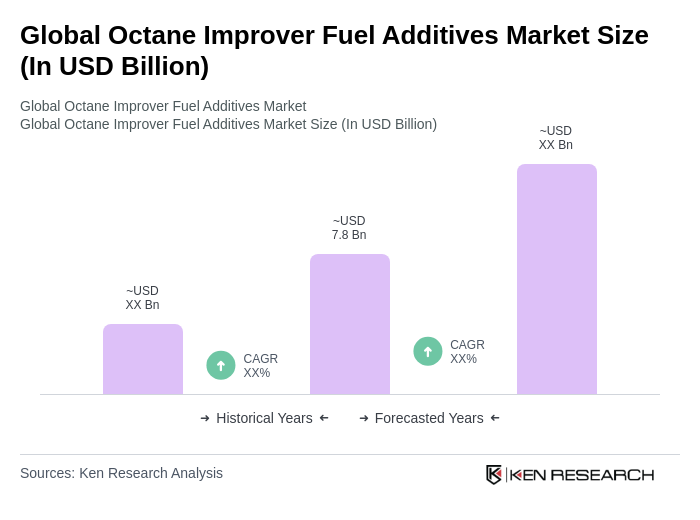
The global octane improver fuel additives market, valued at USD 7.8 billion, is driven by automotive demand, emission regulations, and trends in ethanol and bio-based additives.

Region:Global

Author(s):Shubham

Product Code:KRAC0825

Pages:85

Published On:August 2025
About the Report

Base Year 2024

Global Octane Improver Fuel Additives Market Overview

  • The Global Octane Improver Fuel Additives Market is valued at approximatelyUSD 7.8 billion, based on a five-year analysis. Growth is driven by the rising demand for high-performance fuels in automotive and aviation sectors, stricter emission standards, and the push for enhanced fuel efficiency. Emerging trends include the adoption of ethanol-blended fuels, increased investment in bio-based additives, and the expansion of fuel additive portfolios by leading manufacturers. The market is also influenced by the transition to cleaner fuels and the need to reduce greenhouse gas emissions, which continues to accelerate adoption rates of octane improver additives .
  • Key players in this market include the United States, Germany, and China. These regions dominate due to advanced automotive manufacturing, substantial investments in fuel technology, and the presence of major oil and chemical companies with robust distribution infrastructure. Asia Pacific, particularly China, is anticipated to hold the highest market share, reflecting rapid industrialization and urbanization .
  • The U.S. Environmental Protection Agency (EPA) enforces the "Tier 3 Motor Vehicle Emission and Fuel Standards," issued by the EPA in 2014, which mandates the reduction of sulfur content in gasoline to 10 ppm. This regulation, fully implemented in recent years, aims to improve air quality and reduce vehicle emissions, thereby increasing demand for octane improver fuel additives that comply with these standards. Companies must ensure their products meet the sulfur threshold and related compliance requirements for distribution in the U.S. market .
Global Octane Improver Fuel Additives Market Size

Global Octane Improver Fuel Additives Market Segmentation

By Type:The market is segmented into ethanol-based additives, aromatic hydrocarbons, oxygenates, alkyl nitrates, and bio-based octane improvers.Ethanol-based additivesremain the largest segment due to their renewable nature, compatibility with existing fuel infrastructure, and effectiveness in boosting octane ratings.Aromatic hydrocarbons(such as toluene and xylene) are widely used for their high octane enhancement capabilities.Oxygenates(including MTBE and ETBE) are favored for their ability to improve combustion and reduce emissions. The growing emphasis on sustainability is driving demand forbio-based octane improvers, which are expected to see robust growth as regulatory and consumer preferences shift toward cleaner alternatives .

Global Octane Improver Fuel Additives Market segmentation by Type.

By Application:The octane improver fuel additives market is segmented by application into automotive fuels, aviation fuels, marine fuels, and industrial fuels.Automotive fuelsaccount for the largest share, reflecting the high demand for gasoline engines requiring enhanced octane ratings for optimal performance.Aviation fuelsrepresent a significant segment due to the need for high-performance additives in commercial and military aircraft.Marine and industrial fuelsare experiencing growth as emission regulations and efficiency requirements become more stringent across global shipping and manufacturing industries .

Global Octane Improver Fuel Additives Market segmentation by Application.

Global Octane Improver Fuel Additives Market Competitive Landscape

The Global Octane Improver Fuel Additives Market is characterized by a dynamic mix of regional and international players. Leading participants such as Afton Chemical Corporation, BASF SE, Chevron Oronite Company LLC, Innospec Inc., Evonik Industries AG, TotalEnergies SE, Clariant AG, LyondellBasell Industries N.V., Huntsman Corporation, Shell Global Solutions International B.V., Croda International Plc, Valvoline Inc., Kraton Corporation, Eastman Chemical Company, Solvay S.A., Dorf Ketal Chemicals India Pvt. Ltd., Braskem S.A. contribute to innovation, geographic expansion, and service delivery in this space .

Afton Chemical Corporation

1920

Richmond, Virginia, USA

BASF SE

1865

Ludwigshafen, Germany

Chevron Oronite Company LLC

1926

San Ramon, California, USA

Innospec Inc.

1998

Englewood, Colorado, USA

Evonik Industries AG

2007

Essen, Germany

Company

Establishment Year

Headquarters

Group Size (Large, Medium, or Small as per industry convention)

Revenue Growth Rate (YoY %)

Market Share (%) in Global Octane Improver Fuel Additives Market

Geographic Footprint (Number of countries/regions served)

R&D Investment (% of revenue)

Product Portfolio Breadth (Number of octane improver products)

Global Octane Improver Fuel Additives Market Industry Analysis

Growth Drivers

  • Increasing Demand for High-Performance Fuels:The global automotive fuel consumption reached approximately 1.6 billion liters in future, with a significant portion attributed to high-performance fuels. This demand is driven by the automotive industry's shift towards performance-oriented vehicles, which require higher octane ratings. The International Energy Agency (IEA) projects that in future, the demand for high-octane fuels will increase by 4% annually, reflecting a growing consumer preference for enhanced engine performance and efficiency.
  • Stringent Emission Regulations:Governments worldwide are implementing stricter emission regulations to combat air pollution. For instance, the European Union's Euro 7 standards, set to be enforced in future, will require significant reductions in vehicle emissions. This regulatory environment is pushing fuel manufacturers to develop octane improvers that not only enhance performance but also reduce harmful emissions. The global market for fuel additives is expected to grow by $6 billion by future, largely driven by these regulatory changes.
  • Rising Automotive Production:The global automotive production reached 82 million units in future, with projections indicating a rise to 87 million units in future. This increase is primarily driven by emerging markets, particularly in Asia-Pacific, where vehicle ownership is surging. As automotive production rises, so does the demand for fuel additives, including octane improvers, to meet the performance needs of new vehicles. This trend is expected to significantly boost the market for octane improvers in the coming years.

Market Challenges

  • Fluctuating Raw Material Prices:The volatility in raw material prices poses a significant challenge for the octane improver fuel additives market. For instance, the price of toluene, a key ingredient in many fuel additives, has seen fluctuations of up to 25% in the past year due to supply chain disruptions and geopolitical tensions. Such price instability can lead to increased production costs, affecting profit margins for manufacturers and potentially leading to higher prices for consumers.
  • Competition from Alternative Fuel Sources:The rise of alternative fuel sources, such as electric and hydrogen fuels, presents a challenge to the traditional octane improver market. In future, electric vehicle sales surged to 12 million units globally, representing a 20% increase from the previous period. This shift towards electrification is expected to continue, potentially reducing the demand for conventional fuel additives. Manufacturers must adapt to this changing landscape to remain competitive and relevant in the market.

Global Octane Improver Fuel Additives Market Future Outlook

The future of the octane improver fuel additives market appears promising, driven by technological advancements and evolving consumer preferences. As the automotive industry increasingly focuses on sustainability, innovations in bio-based octane improvers are likely to gain traction. Additionally, strategic partnerships between fuel manufacturers and automotive companies will facilitate the development of advanced fuel formulations. These trends indicate a dynamic market landscape, where adaptability and innovation will be crucial for success in the coming years.

Market Opportunities

  • Expansion in Emerging Markets:Emerging markets, particularly in Asia and Africa, present significant growth opportunities for octane improver fuel additives. With rising disposable incomes and increasing vehicle ownership, the demand for high-performance fuels is expected to surge. In future, these regions could account for over 35% of global fuel consumption, making them critical markets for expansion and investment.
  • Development of Bio-Based Octane Improvers:The growing emphasis on sustainability is driving the development of bio-based octane improvers. These products not only meet performance standards but also align with environmental regulations. As consumer awareness of eco-friendly products increases, the market for bio-based additives is projected to grow significantly, offering manufacturers a lucrative opportunity to innovate and capture market share.

Scope of the Report

SegmentSub-Segments
By Type

Ethanol-based additives

Aromatic hydrocarbons (e.g., toluene, xylene)

Oxygenates (e.g., MTBE, ETBE)

Alkyl nitrates (e.g., methylcyclopentadienyl manganese tricarbonyl - MMT)

Bio-based octane improvers

By Application

Automotive fuels

Aviation fuels

Marine fuels

Industrial fuels

By End-User

Automotive manufacturers

Fuel distributors

Aviation companies

Industrial sectors

By Distribution Channel

Direct sales

Online sales

Retail outlets

Distributors

By Region

North America

Europe

Asia-Pacific

Latin America

Middle East & Africa

By Price Range

Low-cost additives

Mid-range additives

Premium additives

By Regulatory Compliance

EPA compliant additives

EU compliant additives

Others

Key Target Audience

Investors and Venture Capitalist Firms

Government and Regulatory Bodies (e.g., Environmental Protection Agency, Department of Energy)

Manufacturers and Producers of Fuel Additives

Distributors and Retailers of Automotive Products

Automotive OEMs (Original Equipment Manufacturers)

Fuel Refiners and Blenders

Industry Associations (e.g., American Fuel & Petrochemical Manufacturers)

Financial Institutions and Investment Banks

Players Mentioned in the Report:

Afton Chemical Corporation

BASF SE

Chevron Oronite Company LLC

Innospec Inc.

Evonik Industries AG

TotalEnergies SE

Clariant AG

LyondellBasell Industries N.V.

Huntsman Corporation

Shell Global Solutions International B.V.

Croda International Plc

Valvoline Inc.

Kraton Corporation

Eastman Chemical Company

Solvay S.A.

Dorf Ketal Chemicals India Pvt. Ltd.

Braskem S.A.

Table of Contents

Market Assessment Phase

1. Executive Summary and Approach


2. Global Octane Improver Fuel Additives Market Overview

2.1 Key Insights and Strategic Recommendations

2.2 Global Octane Improver Fuel Additives Market Overview

2.3 Definition and Scope

2.4 Evolution of Market Ecosystem

2.5 Timeline of Key Regulatory Milestones

2.6 Value Chain & Stakeholder Mapping

2.7 Business Cycle Analysis

2.8 Policy & Incentive Landscape


3. Global Octane Improver Fuel Additives Market Analysis

3.1 Growth Drivers

3.1.1 Increasing demand for high-performance fuels
3.1.2 Stringent emission regulations
3.1.3 Rising automotive production
3.1.4 Technological advancements in fuel formulations

3.2 Market Challenges

3.2.1 Fluctuating raw material prices
3.2.2 Competition from alternative fuel sources
3.2.3 Regulatory compliance complexities
3.2.4 Market saturation in developed regions

3.3 Market Opportunities

3.3.1 Expansion in emerging markets
3.3.2 Development of bio-based octane improvers
3.3.3 Strategic partnerships and collaborations
3.3.4 Innovations in product formulations

3.4 Market Trends

3.4.1 Shift towards sustainable fuel additives
3.4.2 Increasing consumer awareness about fuel efficiency
3.4.3 Growth in electric vehicle adoption
3.4.4 Digitalization in supply chain management

3.5 Government Regulation

3.5.1 Emission standards for automotive fuels
3.5.2 Incentives for cleaner fuel technologies
3.5.3 Regulations on hazardous substances in fuel additives
3.5.4 Compliance requirements for product labeling

4. SWOT Analysis


5. Stakeholder Analysis


6. Porter's Five Forces Analysis


7. Global Octane Improver Fuel Additives Market Market Size, 2019-2024

7.1 By Value

7.2 By Volume

7.3 By Average Selling Price


8. Global Octane Improver Fuel Additives Market Segmentation

8.1 By Type

8.1.1 Ethanol-based additives
8.1.2 Aromatic hydrocarbons (e.g., toluene, xylene)
8.1.3 Oxygenates (e.g., MTBE, ETBE)
8.1.4 Alkyl nitrates (e.g., methylcyclopentadienyl manganese tricarbonyl - MMT)
8.1.5 Bio-based octane improvers

8.2 By Application

8.2.1 Automotive fuels
8.2.2 Aviation fuels
8.2.3 Marine fuels
8.2.4 Industrial fuels

8.3 By End-User

8.3.1 Automotive manufacturers
8.3.2 Fuel distributors
8.3.3 Aviation companies
8.3.4 Industrial sectors

8.4 By Distribution Channel

8.4.1 Direct sales
8.4.2 Online sales
8.4.3 Retail outlets
8.4.4 Distributors

8.5 By Region

8.5.1 North America
8.5.2 Europe
8.5.3 Asia-Pacific
8.5.4 Latin America
8.5.5 Middle East & Africa

8.6 By Price Range

8.6.1 Low-cost additives
8.6.2 Mid-range additives
8.6.3 Premium additives

8.7 By Regulatory Compliance

8.7.1 EPA compliant additives
8.7.2 EU compliant additives
8.7.3 Others

9. Global Octane Improver Fuel Additives Market Competitive Analysis

9.1 Market Share of Key Players

9.2 KPIs for Cross Comparison of Key Players

9.2.1 Company Name
9.2.2 Group Size (Large, Medium, or Small as per industry convention)
9.2.3 Revenue Growth Rate (YoY %)
9.2.4 Market Share (%) in Global Octane Improver Fuel Additives Market
9.2.5 Geographic Footprint (Number of countries/regions served)
9.2.6 R&D Investment (% of revenue)
9.2.7 Product Portfolio Breadth (Number of octane improver products)
9.2.8 Regulatory Compliance Record (Number of regulatory actions or certifications)
9.2.9 Strategic Partnerships/Alliances (Number of active partnerships)
9.2.10 Sustainability Initiatives (Number of bio-based/sustainable products launched)

9.3 SWOT Analysis of Top Players

9.4 Pricing Analysis

9.5 List of Major Companies

9.5.1 Afton Chemical Corporation
9.5.2 BASF SE
9.5.3 Chevron Oronite Company LLC
9.5.4 Innospec Inc.
9.5.5 Evonik Industries AG
9.5.6 TotalEnergies SE
9.5.7 Clariant AG
9.5.8 LyondellBasell Industries N.V.
9.5.9 Huntsman Corporation
9.5.10 Shell Global Solutions International B.V.
9.5.11 Croda International Plc
9.5.12 Valvoline Inc.
9.5.13 Kraton Corporation
9.5.14 Eastman Chemical Company
9.5.15 Solvay S.A.
9.5.16 Dorf Ketal Chemicals India Pvt. Ltd.
9.5.17 Braskem S.A.

10. Global Octane Improver Fuel Additives Market End-User Analysis

10.1 Procurement Behavior of Key Ministries

10.1.1 Government fuel procurement policies
10.1.2 Budget allocation for fuel additives
10.1.3 Evaluation criteria for suppliers

10.2 Corporate Spend on Infrastructure & Energy

10.2.1 Investment in fuel efficiency technologies
10.2.2 Budget for R&D in fuel additives
10.2.3 Spending on compliance and regulatory measures

10.3 Pain Point Analysis by End-User Category

10.3.1 Cost pressures in fuel procurement
10.3.2 Quality assurance challenges
10.3.3 Supply chain disruptions

10.4 User Readiness for Adoption

10.4.1 Awareness of benefits of octane improvers
10.4.2 Training and support needs
10.4.3 Infrastructure readiness for new products

10.5 Post-Deployment ROI and Use Case Expansion

10.5.1 Measurement of fuel efficiency improvements
10.5.2 Long-term cost savings analysis
10.5.3 Potential for product line expansion

11. Global Octane Improver Fuel Additives Market Future Size, 2025-2030

11.1 By Value

11.2 By Volume

11.3 By Average Selling Price


Go-To-Market Strategy Phase

1. Whitespace Analysis + Business Model Canvas

1.1 Market gaps and opportunities

1.2 Value proposition development

1.3 Revenue model exploration

1.4 Customer segmentation analysis

1.5 Competitive landscape overview


2. Marketing and Positioning Recommendations

2.1 Branding strategies

2.2 Product USPs

2.3 Target audience identification

2.4 Communication strategies


3. Distribution Plan

3.1 Urban retail strategies

3.2 Rural NGO tie-ups

3.3 Online distribution channels

3.4 Partnerships with fuel distributors


4. Channel & Pricing Gaps

4.1 Underserved routes

4.2 Pricing bands analysis

4.3 Competitor pricing strategies


5. Unmet Demand & Latent Needs

5.1 Category gaps

5.2 Consumer segments analysis

5.3 Emerging trends in consumer preferences


6. Customer Relationship

6.1 Loyalty programs

6.2 After-sales service

6.3 Customer feedback mechanisms


7. Value Proposition

7.1 Sustainability initiatives

7.2 Integrated supply chains

7.3 Competitive advantages


8. Key Activities

8.1 Regulatory compliance

8.2 Branding efforts

8.3 Distribution setup


9. Entry Strategy Evaluation

9.1 Domestic Market Entry Strategy

9.1.1 Product mix considerations
9.1.2 Pricing band strategies
9.1.3 Packaging innovations

9.2 Export Entry Strategy

9.2.1 Target countries analysis
9.2.2 Compliance roadmap development

10. Entry Mode Assessment

10.1 Joint Ventures

10.2 Greenfield investments

10.3 Mergers & Acquisitions

10.4 Distributor Model


11. Capital and Timeline Estimation

11.1 Capital requirements

11.2 Timelines for market entry


12. Control vs Risk Trade-Off

12.1 Ownership considerations

12.2 Partnerships evaluation


13. Profitability Outlook

13.1 Breakeven analysis

13.2 Long-term sustainability strategies


14. Potential Partner List

14.1 Distributors

14.2 Joint Ventures

14.3 Acquisition targets


15. Execution Roadmap

15.1 Phased Plan for Market Entry

15.1.1 Market Setup
15.1.2 Market Entry
15.1.3 Growth Acceleration
15.1.4 Scale & Stabilize

15.2 Key Activities and Milestones

15.2.1 Milestone tracking
15.2.2 Activity scheduling

Research Methodology

ApproachModellingSample

Phase 1: Approach1

Desk Research

  • Industry reports from global chemical associations and fuel additive organizations
  • Market analysis publications focusing on fuel additives and octane improvers
  • Regulatory documents and standards from environmental agencies and automotive bodies

Primary Research

  • Interviews with product managers at leading fuel additive manufacturers
  • Surveys with automotive engineers and fuel formulation specialists
  • Field interviews with distributors and retailers in the fuel sector

Validation & Triangulation

  • Cross-validation of data from multiple industry sources and expert opinions
  • Triangulation of market size estimates using sales data and production statistics
  • Sanity checks through feedback from industry panels and focus groups

Phase 2: Market Size Estimation1

Top-down Assessment

  • Analysis of global fuel consumption trends and their impact on octane improver demand
  • Segmentation of the market by geographic regions and end-user applications
  • Incorporation of macroeconomic factors influencing fuel prices and consumption

Bottom-up Modeling

  • Volume estimates based on production capacities of major fuel additive manufacturers
  • Cost analysis derived from pricing strategies of octane improvers in various markets
  • Estimation of market share based on sales data from key players in the industry

Forecasting & Scenario Analysis

  • Multi-variable forecasting using historical growth rates and market trends
  • Scenario modeling based on regulatory changes and technological advancements
  • Development of baseline, optimistic, and pessimistic market projections through 2030

Phase 3: CATI Sample Composition1

Scope Item/SegmentSample SizeTarget Respondent Profiles
Fuel Additive Manufacturers100Product Development Managers, R&D Directors
Automotive OEMs75Engine Designers, Quality Assurance Managers
Fuel Retailers60Operations Managers, Marketing Directors
Regulatory Bodies45Policy Makers, Environmental Compliance Officers
Industry Experts and Consultants50Market Analysts, Technical Consultants

Frequently Asked Questions

What is the current value of the Global Octane Improver Fuel Additives Market?

The Global Octane Improver Fuel Additives Market is valued at approximately USD 7.8 billion, driven by the increasing demand for high-performance fuels, stricter emission standards, and the transition to cleaner fuel alternatives.

What factors are driving the growth of the octane improver fuel additives market?

Which regions dominate the Global Octane Improver Fuel Additives Market?

What types of octane improver fuel additives are available in the market?

Other Regional/Country Reports

Indonesia Global Octane Improver Fuel Additives Market

Malaysia Global Octane Improver Fuel Additives Market

KSA Global Octane Improver Fuel Additives Market

APAC Global Octane Improver Fuel Additives Market

SEA Global Octane Improver Fuel Additives Market

Vietnam Global Octane Improver Fuel Additives Market

Why Buy From Us?

Refine Robust Result (RRR) Framework

What makes us stand out is that our consultants follow Robust, Refine and Result (RRR) methodology. Robust for clear definitions, approaches and sanity checking, Refine for differentiating respondents' facts and opinions, and Result for presenting data with story.

Our Reach Is Unmatched

We have set a benchmark in the industry by offering our clients with syndicated and customized market research reports featuring coverage of entire market as well as meticulous research and analyst insights.

Shifting the Research Paradigm

While we don't replace traditional research, we flip the method upside down. Our dual approach of Top Bottom & Bottom Top ensures quality deliverable by not just verifying company fundamentals but also looking at the sector and macroeconomic factors.

More Insights-Better Decisions

With one step in the future, our research team constantly tries to show you the bigger picture. We help with some of the tough questions you may encounter along the way: How is the industry positioned? Best marketing channel? KPI's of competitors? By aligning every element, we help maximize success.

Transparency and Trust

Our report gives you instant access to the answers and sources that other companies might choose to hide. We elaborate each steps of research methodology we have used and showcase you the sample size to earn your trust.

Round the Clock Support

If you need any support, we are here! We pride ourselves on universe strength, data quality, and quick, friendly, and professional service.

Why Clients Choose Us?

400000+
Reports in repository
150+
Consulting projects a year
100+
Analysts
8000+
Client Queries in 2022








