About the Report
Base Year 2024Global Office Space Market Overview
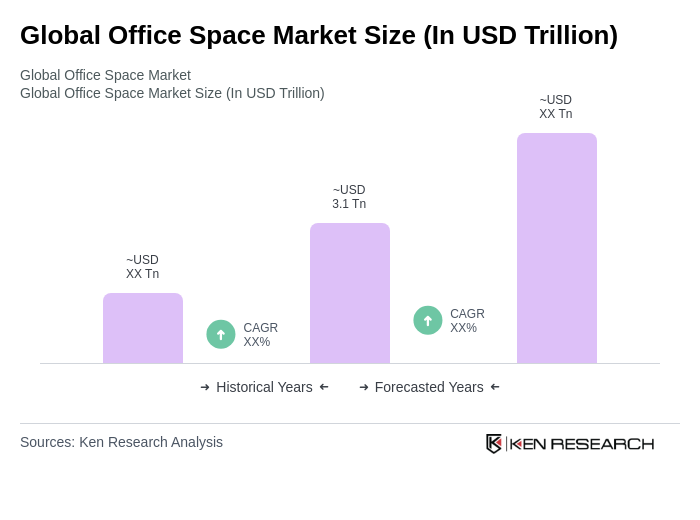
- The Global Office Space Market is valued at USD 3.1 trillion, based on a five-year historical analysis. This value reflects aggregated office real estate under management/stock and aligns with recent industry assessments placing the market near the low-three-trillion range. Key growth drivers include the increasing demand for flexible workspaces, urbanization in major metros, and hybrid/remote work reshaping occupier strategies, with flexible models gaining share within the broader office market .
- Key players in this market include major cities such as New York, London, and Tokyo, which dominate due to their status as global financial hubs and deep corporate ecosystems that attract multinational corporations and startups. These cities offer diverse office inventory (from Class A towers to flexible/coworking options), deep talent pools, and sophisticated transit and digital infrastructure that underpin investment and leasing activity .
- In 2023, the European Union advanced building decarbonization through updates to the Energy Performance of Buildings Directive, requiring all new buildings to be zero-emission by a specified horizon and introducing minimum energy performance standards for existing stock, steering office design and operations toward higher efficiency across member states .
Global Office Space Market Segmentation
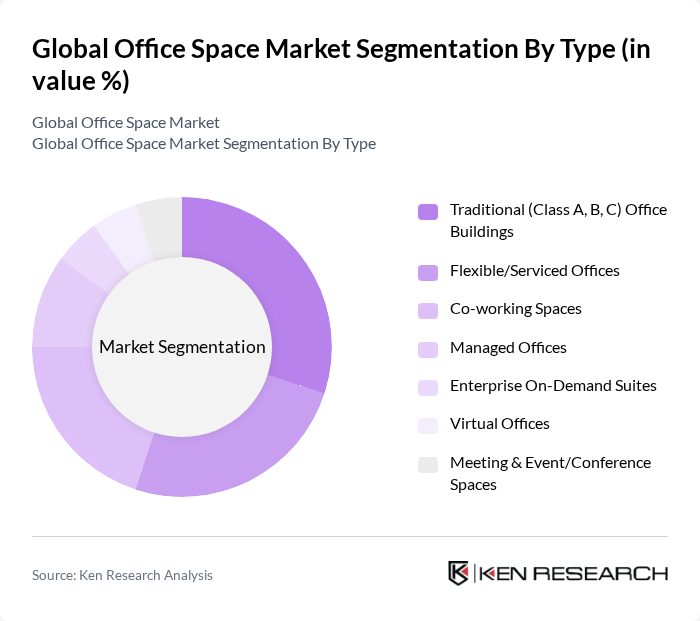
By Type:The office space market can be segmented into various types, including Traditional (Class A, B, C) Office Buildings, Flexible/Serviced Offices, Co-working Spaces, Managed Offices, Enterprise On-Demand Suites, Virtual Offices, and Meeting & Event/Conference Spaces. Each of these sub-segments caters to different business needs, with flexible and coworking formats expanding due to hybrid work adoption, cost optimization, and short-term commitments, while Class A assets continue to command a premium for amenity-rich, energy-efficient buildings .
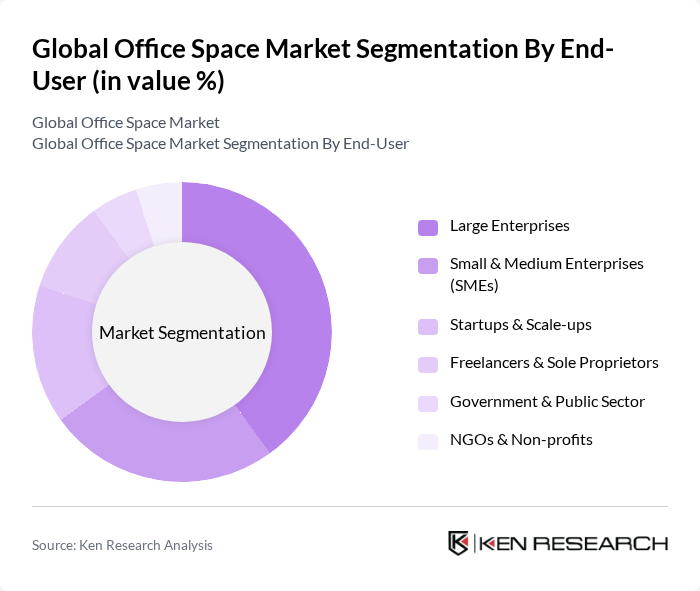
By End-User:The end-user segment of the office space market includes Large Enterprises, Small & Medium Enterprises (SMEs), Startups & Scale-ups, Freelancers & Sole Proprietors, Government & Public Sector, and NGOs & Non-profits. Large enterprises are consolidating footprints into higher-quality spaces and adopting flexible suites; SMEs and startups are driving demand for coworking and serviced models due to scalability and lower capex; and public/NGO occupiers are increasingly incorporating sustainability and wellness standards into procurement criteria .
Global Office Space Market Competitive Landscape
The Global Office Space Market is characterized by a dynamic mix of regional and international players. Leading participants such as CBRE Group, Inc., Jones Lang LaSalle Incorporated (JLL), IWG plc (Regus, Spaces), WeWork Inc., Cushman & Wakefield plc, Colliers International Group Inc., The Office Group (TOG) & Fora, Industrious National Management Company LLC, Servcorp Limited, Mindspace Ltd., Convene, Office Evolution (a United Franchise Group company), Ucommune International Ltd., Common Desk (an IWG company), The Instant Group contribute to innovation, geographic expansion, and service delivery in this space .
Global Office Space Market Industry Analysis
Growth Drivers
- Increasing Demand for Flexible Workspaces:The global flexible workspace market is projected to reach $300 billion in future, driven by the need for adaptable office solutions. Companies are increasingly adopting flexible workspaces to reduce overhead costs, with 70% of organizations planning to implement hybrid work models. This shift is supported by a 15% increase in demand for co-working spaces, reflecting a significant trend towards flexibility in office arrangements, particularly in urban areas.
- Rise of Remote Work Trends:The remote work trend has surged, with 30% of the global workforce expected to work remotely in future. This shift has led to a 25% increase in demand for office space that accommodates hybrid work environments. Companies are investing in technology to support remote collaboration, with an estimated $50 billion allocated to digital tools and platforms, enhancing productivity and employee satisfaction in flexible work settings.
- Urbanization and Population Growth:Urbanization continues to drive office space demand, with the UN projecting that 68% of the global population will live in urban areas by 2050. This urban influx is expected to increase office space requirements by 20% in major cities. Additionally, metropolitan areas are seeing a rise in population density, leading to a greater need for efficient office solutions that cater to a growing workforce, particularly in emerging markets.
Market Challenges
- Economic Uncertainty:Economic fluctuations pose significant challenges for the office space market, with global GDP growth projected at only 3% in future. This uncertainty affects corporate real estate decisions, leading to a cautious approach in leasing and investment. Companies are delaying expansion plans, resulting in a 10% decrease in new office space demand in economically volatile regions, impacting overall market stability.
- High Operational Costs:Rising operational costs, including utilities and maintenance, are straining office space profitability. In future, average operational costs are expected to increase by 5%, driven by inflation and rising energy prices. This trend forces companies to reassess their office space needs, leading to a potential reduction in leased space by 15% as businesses seek to optimize expenses and enhance operational efficiency.
Global Office Space Market Future Outlook
The future of the office space market is poised for transformation, driven by the integration of technology and evolving work patterns. As hybrid work models gain traction, companies will increasingly invest in smart office solutions, enhancing employee productivity and satisfaction. Additionally, the focus on sustainability will shape office design, with eco-friendly spaces becoming a priority. The market is expected to adapt to these trends, fostering innovation and collaboration in workspace design and management.
Market Opportunities
- Expansion into Emerging Markets:Emerging markets present significant growth opportunities, with an expected 40% increase in office space demand in future. Countries like India and Brazil are experiencing rapid urbanization, creating a need for modern office solutions. Companies that strategically enter these markets can capitalize on the growing workforce and rising disposable incomes, enhancing their market presence and profitability.
- Adoption of Smart Office Technologies:The adoption of smart office technologies is projected to grow by 30% in future, driven by the need for enhanced operational efficiency. Companies are increasingly investing in IoT devices and AI-driven management systems to optimize space utilization and reduce costs. This trend not only improves employee experience but also positions businesses as leaders in innovation and sustainability within the office space sector.
Scope of the Report
| Segment | Sub-Segments |
|---|---|
| By Type | Traditional (Class A, B, C) Office Buildings Flexible/Serviced Offices Co-working Spaces Managed Offices Enterprise On-Demand Suites Virtual Offices Meeting & Event/Conference Spaces |
| By End-User | Large Enterprises Small & Medium Enterprises (SMEs) Startups & Scale-ups Freelancers & Sole Proprietors Government & Public Sector NGOs & Non-profits |
| By Location | Central Business Districts (CBD) Secondary/Urban Fringe Suburban Tier 2/3 Cities Transit-Oriented & Mixed-Use Developments |
| By Lease Type | Long-Term Leases (5–10+ years) Mid-Term Leases (1–5 years) Short-Term & Flexible (Month-to-Month) Management Agreements & Revenue-Share |
| By Service Type | Fully Serviced/Managed Office Services Virtual Office & Mail Handling Meeting Rooms & Offsites Facility Management (FM), IT & Security Workplace Strategy & Fit-out |
| By Industry | Technology & Startups Banking, Financial Services & Insurance (BFSI) Professional Services (Legal, Consulting, Accounting) Healthcare & Life Sciences Media, Advertising & Creative Others |
| By Pricing Model | Fixed Rent (Gross/Net) All-Inclusive Memberships Desk/Room-Level Subscription (Hot desk, Dedicated desk, Private office) Usage-Based (Pay-per-Use for meeting rooms, day passes) |
Key Target Audience
Investors and Venture Capitalist Firms
Government and Regulatory Bodies (e.g.,
Real Estate Developers
Commercial Property Management Firms
Corporate Real Estate Departments
Facility Management Companies
Architectural and Design Firms
Construction Companies
Players Mentioned in the Report:
CBRE Group, Inc.
Jones Lang LaSalle Incorporated (JLL)
IWG plc (Regus, Spaces)
WeWork Inc.
Cushman & Wakefield plc
Colliers International Group Inc.
The Office Group (TOG) & Fora
Industrious National Management Company LLC
Servcorp Limited
Mindspace Ltd.
Convene
Office Evolution (a United Franchise Group company)
Ucommune International Ltd.
Common Desk (an IWG company)
The Instant Group
Table of Contents
Market Assessment Phase
1. Executive Summary and Approach
2. Global Office Space Market Overview
2.1 Key Insights and Strategic Recommendations
2.2 Global Office Space Market Overview
2.3 Definition and Scope
2.4 Evolution of Market Ecosystem
2.5 Timeline of Key Regulatory Milestones
2.6 Value Chain & Stakeholder Mapping
2.7 Business Cycle Analysis
2.8 Policy & Incentive Landscape
3. Global Office Space Market Analysis
3.1 Growth Drivers
3.1.1 Increasing Demand for Flexible Workspaces
3.1.2 Rise of Remote Work Trends
3.1.3 Urbanization and Population Growth
3.1.4 Technological Advancements in Office Solutions
3.2 Market Challenges
3.2.1 Economic Uncertainty
3.2.2 High Operational Costs
3.2.3 Regulatory Compliance Issues
3.2.4 Competition from Co-working Spaces
3.3 Market Opportunities
3.3.1 Expansion into Emerging Markets
3.3.2 Adoption of Smart Office Technologies
3.3.3 Sustainable Office Solutions
3.3.4 Partnerships with Tech Companies
3.4 Market Trends
3.4.1 Growth of Hybrid Work Models
3.4.2 Increased Focus on Employee Well-being
3.4.3 Integration of AI in Office Management
3.4.4 Shift Towards Eco-friendly Office Spaces
3.5 Government Regulation
3.5.1 Zoning Laws and Building Codes
3.5.2 Health and Safety Regulations
3.5.3 Tax Incentives for Green Buildings
3.5.4 Labor Laws Affecting Office Space Usage
4. SWOT Analysis
5. Stakeholder Analysis
6. Porter's Five Forces Analysis
7. Global Office Space Market Market Size, 2019-2024
7.1 By Value
7.2 By Volume
7.3 By Average Selling Price
8. Global Office Space Market Segmentation
8.1 By Type
8.1.1 Traditional (Class A, B, C) Office Buildings
8.1.2 Flexible/Serviced Offices
8.1.3 Co-working Spaces
8.1.4 Managed Offices
8.1.5 Enterprise On-Demand Suites
8.1.6 Virtual Offices
8.1.7 Meeting & Event/Conference Spaces
8.2 By End-User
8.2.1 Large Enterprises
8.2.2 Small & Medium Enterprises (SMEs)
8.2.3 Startups & Scale-ups
8.2.4 Freelancers & Sole Proprietors
8.2.5 Government & Public Sector
8.2.6 NGOs & Non-profits
8.3 By Location
8.3.1 Central Business Districts (CBD)
8.3.2 Secondary/Urban Fringe
8.3.3 Suburban
8.3.4 Tier 2/3 Cities
8.3.5 Transit-Oriented & Mixed-Use Developments
8.4 By Lease Type
8.4.1 Long-Term Leases (5–10+ years)
8.4.2 Mid-Term Leases (1–5 years)
8.4.3 Short-Term & Flexible (Month-to-Month)
8.4.4 Management Agreements & Revenue-Share
8.5 By Service Type
8.5.1 Fully Serviced/Managed Office Services
8.5.2 Virtual Office & Mail Handling
8.5.3 Meeting Rooms & Offsites
8.5.4 Facility Management (FM), IT & Security
8.5.5 Workplace Strategy & Fit-out
8.6 By Industry
8.6.1 Technology & Startups
8.6.2 Banking, Financial Services & Insurance (BFSI)
8.6.3 Professional Services (Legal, Consulting, Accounting)
8.6.4 Healthcare & Life Sciences
8.6.5 Media, Advertising & Creative
8.6.6 Others
8.7 By Pricing Model
8.7.1 Fixed Rent (Gross/Net)
8.7.2 All-Inclusive Memberships
8.7.3 Desk/Room-Level Subscription (Hot desk, Dedicated desk, Private office)
8.7.4 Usage-Based (Pay-per-Use for meeting rooms, day passes)
9. Global Office Space Market Competitive Analysis
9.1 Market Share of Key Players
9.2 Cross Comparison of Key Players
9.2.1 Company Name
9.2.2 Portfolio Scale (Total sq ft under management)
9.2.3 Occupancy Rate (%)
9.2.4 Revenue per Available Workspace (RevPAW)
9.2.5 Average Effective Rent ($/sq ft/month)
9.2.6 EBITDA Margin (%)
9.2.7 Geographic Footprint (Countries/Cities)
9.2.8 Average Lease Tenor (months)
9.2.9 Renewal/Retention Rate (%)
9.2.10 Net Promoter Score (NPS)
9.2.11 Same-Store Sales/Rev Growth (%)
9.2.12 Flex Mix (% of flexible/managed vs traditional)
9.3 SWOT Analysis of Top Players
9.4 Pricing Analysis
9.5 Detailed Profile of Major Companies
9.5.1 CBRE Group, Inc.
9.5.2 Jones Lang LaSalle Incorporated (JLL)
9.5.3 IWG plc (Regus, Spaces)
9.5.4 WeWork Inc.
9.5.5 Cushman & Wakefield plc
9.5.6 Colliers International Group Inc.
9.5.7 The Office Group (TOG) & Fora
9.5.8 Industrious National Management Company LLC
9.5.9 Servcorp Limited
9.5.10 Mindspace Ltd.
9.5.11 Convene
9.5.12 Office Evolution (a United Franchise Group company)
9.5.13 Ucommune International Ltd.
9.5.14 Common Desk (an IWG company)
9.5.15 The Instant Group
10. Global Office Space Market End-User Analysis
10.1 Procurement Behavior of Key Ministries
10.1.1 Budget Allocation Trends
10.1.2 Decision-Making Processes
10.1.3 Preferred Office Solutions
10.1.4 Contracting Practices
10.2 Corporate Spend on Infrastructure & Energy
10.2.1 Investment Trends
10.2.2 Cost Management Strategies
10.2.3 Sustainability Initiatives
10.3 Pain Point Analysis by End-User Category
10.3.1 Space Utilization Issues
10.3.2 Cost Constraints
10.3.3 Technology Integration Challenges
10.4 User Readiness for Adoption
10.4.1 Awareness of Flexible Solutions
10.4.2 Training and Support Needs
10.5 Post-Deployment ROI and Use Case Expansion
10.5.1 Performance Metrics
10.5.2 User Feedback Mechanisms
10.5.3 Future Expansion Plans
11. Global Office Space Market Future Size, 2025-2030
11.1 By Value
11.2 By Volume
11.3 By Average Selling Price
Go-To-Market Strategy Phase
1. Whitespace Analysis + Business Model Canvas
1.1 Market Gaps Identification
1.2 Value Proposition Development
1.3 Revenue Streams Analysis
1.4 Key Partnerships Exploration
1.5 Customer Segmentation
1.6 Cost Structure Assessment
1.7 Competitive Advantage Analysis
2. Marketing and Positioning Recommendations
2.1 Branding Strategies
2.2 Product USPs
3. Distribution Plan
3.1 Urban Retail vs Rural NGO Tie-ups
4. Channel & Pricing Gaps
4.1 Underserved Routes
4.2 Pricing Bands
5. Unmet Demand & Latent Needs
5.1 Category Gaps
5.2 Consumer Segments
6. Customer Relationship
6.1 Loyalty Programs
6.2 After-sales Service
7. Value Proposition
7.1 Sustainability
7.2 Integrated Supply Chains
8. Key Activities
8.1 Regulatory Compliance
8.2 Branding
8.3 Distribution Setup
9. Entry Strategy Evaluation
9.1 Domestic Market Entry Strategy
9.1.1 Product Mix
9.1.2 Pricing Band
9.1.3 Packaging
9.2 Export Entry Strategy
9.2.1 Target Countries
9.2.2 Compliance Roadmap
10. Entry Mode Assessment
10.1 JV
10.2 Greenfield
10.3 M&A
10.4 Distributor Model
11. Capital and Timeline Estimation
11.1 Capital Requirements
11.2 Timelines
12. Control vs Risk Trade-Off
12.1 Ownership vs Partnerships
13. Profitability Outlook
13.1 Breakeven Analysis
13.2 Long-term Sustainability
14. Potential Partner List
14.1 Distributors
14.2 JVs
14.3 Acquisition Targets
15. Execution Roadmap
15.1 Phased Plan for Market Entry
15.1.1 Market Setup
15.1.2 Market Entry
15.1.3 Growth Acceleration
15.1.4 Scale & Stabilize
15.2 Key Activities and Milestones
15.2.1 Activity Planning
15.2.2 Milestone Tracking
Research Methodology
Phase 1: Approach1
Desk Research
- Analysis of industry reports from real estate associations and market research firms
- Review of government publications on commercial real estate trends and regulations
- Examination of financial reports and press releases from leading office space providers
Primary Research
- Interviews with real estate brokers specializing in office space leasing
- Surveys with corporate real estate managers regarding space utilization trends
- Field interviews with facility managers to understand operational needs and preferences
Validation & Triangulation
- Cross-validation of findings through multiple data sources, including market surveys and expert opinions
- Triangulation of data from desk research, primary interviews, and industry benchmarks
- Sanity checks through expert panel discussions to ensure data reliability
Phase 2: Market Size Estimation1
Top-down Assessment
- Estimation of total addressable market based on national office space statistics
- Segmentation by geographic regions and types of office spaces (co-working, traditional, etc.)
- Incorporation of macroeconomic indicators such as GDP growth and employment rates
Bottom-up Modeling
- Data collection on average rental rates and occupancy levels from various office markets
- Estimation of total square footage available for lease across different regions
- Calculation of market size based on volume of leased space and average rental prices
Forecasting & Scenario Analysis
- Multi-factor regression analysis incorporating trends in remote work and urbanization
- Scenario modeling based on economic recovery rates and shifts in corporate real estate strategies
- Development of baseline, optimistic, and pessimistic forecasts through 2030
Phase 3: CATI Sample Composition1
| Scope Item/Segment | Sample Size | Target Respondent Profiles |
|---|---|---|
| Co-working Space Providers | 90 | Co-working Space Managers, Business Development Executives |
| Corporate Office Space Users | 120 | Corporate Real Estate Managers, Facilities Directors |
| Commercial Real Estate Brokers | 80 | Real Estate Agents, Market Analysts |
| Property Management Firms | 70 | Property Managers, Operations Managers |
| Investors in Office Real Estate | 60 | Real Estate Investors, Financial Analysts |
Frequently Asked Questions
What is the current value of the Global Office Space Market?
The Global Office Space Market is valued at approximately USD 3.1 trillion, reflecting a comprehensive analysis of office real estate under management and stock, driven by factors such as urbanization and the demand for flexible workspaces.
What are the key growth drivers in the Global Office Space Market?
Which cities dominate the Global Office Space Market?
How is the demand for flexible workspaces changing?
Other Regional/Country Reports
Indonesia Office Space Market
Malaysia Office Space Market
APAC Office Space Market
SEA Office Space Market
Why Buy From Us?

What makes us stand out is that our consultants follow Robust, Refine and Result (RRR) methodology. Robust for clear definitions, approaches and sanity checking, Refine for differentiating respondents' facts and opinions, and Result for presenting data with story.

We have set a benchmark in the industry by offering our clients with syndicated and customized market research reports featuring coverage of entire market as well as meticulous research and analyst insights.

While we don't replace traditional research, we flip the method upside down. Our dual approach of Top Bottom & Bottom Top ensures quality deliverable by not just verifying company fundamentals but also looking at the sector and macroeconomic factors.

With one step in the future, our research team constantly tries to show you the bigger picture. We help with some of the tough questions you may encounter along the way: How is the industry positioned? Best marketing channel? KPI's of competitors? By aligning every element, we help maximize success.

Our report gives you instant access to the answers and sources that other companies might choose to hide. We elaborate each steps of research methodology we have used and showcase you the sample size to earn your trust.

If you need any support, we are here! We pride ourselves on universe strength, data quality, and quick, friendly, and professional service.