About the Report
Base Year 2024Listen to the audio summary
Global Online Board Games Market Overview
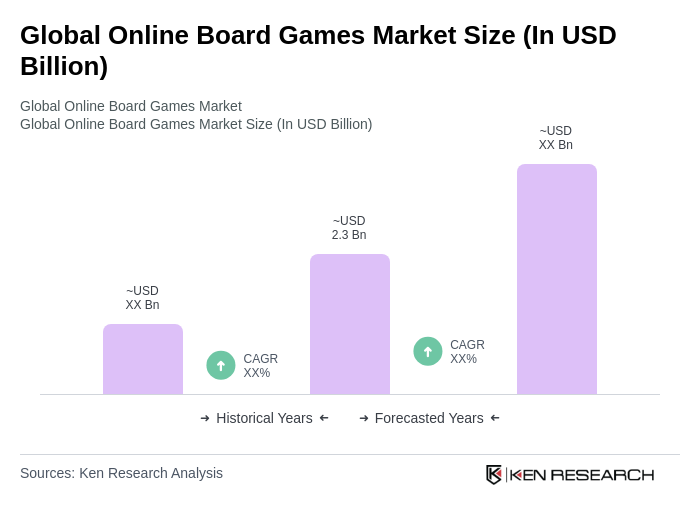
- The Global Online Board Games Market is valued at USD 2.3 billion, based on a five-year historical analysis. Recent industry reporting places the market around the low-two-billion range, reflecting steady uptake of digital adaptations of board and card titles and online platforms hosting them . This growth is primarily driven by the increasing popularity of digital gaming platforms, the rise of social gaming experiences, and broader high-speed internet access, with pandemic-era adoption creating a durable shift toward online multiplayer play and digital editions .
- Key players in this market include the United States, Germany, and the United Kingdom, supported by strong gaming cultures, advanced technology infrastructure, and high disposable incomes; North America and Europe are leading regions for board and card gaming (physical and digital), with large publisher ecosystems and active online communities that translate into robust demand for digital adaptations and platforms .
- In 2023, the European Union advanced consumer protection and platform governance measures applicable to online gaming and game-like services through frameworks such as the Digital Services Act and the Digital Markets Act, reinforcing requirements around transparency, moderation, and protections for minors; member-state implementation and guidance emphasize fair practices and child protection in digital environments, including games and game platforms .
Global Online Board Games Market Segmentation
By Type:The online board games market can be segmented into various types, including Strategy Board Games, Card & Deck-Building Games, Party & Social Deduction Games, Family & Casual Board Games, Educational & Edutainment Board Games, Co-op & Role-Playing Board Games, and Eurogames & Thematic/Ameritrash. Among these, Strategy Board Games and Card & Deck-Building Games are particularly popular due to their engaging gameplay and competitive nature, appealing to both casual and serious gamers .

By End-User:The end-user segmentation of the online board games market includes Casual Gamers, Competitive/Ranked Players, Families & Friends, and Schools & Educational Institutions. Casual Gamers represent the largest segment, driven by the accessibility of games on mobile platforms and the social aspect of gaming, which encourages group play among friends and family; mobile-accessible formats and cross-platform multiplayer help sustain casual uptake .

Global Online Board Games Market Competitive Landscape
The Global Online Board Games Market is characterized by a dynamic mix of regional and international players. Leading participants such as Asmodee Digital (Twin Sails Interactive), Board Game Arena (BGA), Tabletopia, Marmalade Game Studio, Nomad Games, Dire Wolf Digital, Temple Gates Games, CGE Digital (Czech Games Edition), GungHo Online Entertainment, Inc., Nintendo Co., Ltd., Tencent Holdings Limited, Zynga Inc. (Take-Two Interactive), Ravensburger AG (digital games and licenses), Hasbro, Inc. (digital licensing and partners), NetEase, Inc. (digital board and card adaptations) contribute to innovation, geographic expansion, and service delivery in this space.
Global Online Board Games Market Industry Analysis
Growth Drivers
- Increasing Popularity of Online Gaming:The online gaming sector has seen a remarkable surge, with over 3.2 billion gamers worldwide in future, according to Newzoo. This growth is driven by the increasing accessibility of high-speed internet, which reached 70% global penetration. Additionally, the global gaming market is projected to generate approximately $250 billion in revenue, indicating a robust demand for online board games as part of this expanding ecosystem.
- Rise in Mobile Gaming Accessibility:Mobile gaming has become a dominant force, with over 2 billion mobile gamers in future, as reported by Statista. The proliferation of smartphones, with over 5 billion units in use globally, has made gaming more accessible. This trend is further supported by the fact that mobile gaming revenue is expected to exceed $120 billion, creating a fertile ground for online board games to thrive in this expanding market.
- Expansion of Social Gaming Platforms:Social gaming platforms have gained traction, with platforms like Facebook Gaming reporting over 1 billion monthly active users in future. This growth is fueled by the increasing desire for social interaction through gaming, especially during the pandemic. The integration of social features in online board games enhances user engagement, leading to a projected increase in user retention rates by 35% as players seek community-driven experiences.
Market Challenges
- High Competition Among Game Developers:The online board games market is characterized by intense competition, with over 1,200 new games launched annually. This saturation makes it challenging for developers to differentiate their products. According to a report by App Annie, 75% of mobile games fail to recoup their development costs, highlighting the difficulty in achieving financial sustainability amidst fierce competition and market noise.
- User Retention and Engagement Issues:Retaining users in the online board games sector is increasingly difficult, with average retention rates dropping to 18% within the first month of gameplay. This trend is exacerbated by the rapid influx of new games, leading to a fragmented user base. Industry experts suggest that developers must invest in innovative features and community-building strategies to enhance engagement and improve retention rates significantly.
Global Online Board Games Market Future Outlook
The future of the online board games market appears promising, driven by technological advancements and evolving consumer preferences. The integration of artificial intelligence in game design is expected to enhance user experiences, while subscription-based models are gaining traction, with over 50% of gamers expressing interest in such services. Additionally, the focus on cross-platform compatibility will likely facilitate broader audience reach, ensuring sustained growth in this dynamic market landscape.
Market Opportunities
- Growth in E-Sports and Competitive Gaming:The e-sports industry is projected to reach $2.5 billion in revenue by future, creating opportunities for online board games to tap into competitive gaming. This growth can lead to increased visibility and engagement, as developers can create tournaments and leagues that attract a dedicated player base, enhancing the overall market appeal.
- Partnerships with Streaming Platforms:Collaborations with streaming platforms like Twitch and YouTube Gaming can significantly boost visibility for online board games. With over 20 million daily active users on Twitch, these partnerships can facilitate live gameplay sessions, attracting new players and fostering community engagement, ultimately driving revenue growth and brand loyalty.
Scope of the Report
| Segment | Sub-Segments |
|---|---|
| By Type | Strategy Board Games (e.g., chess, Go, digital adaptations) Card & Deck-Building Games (digital implementations) Party & Social Deduction Games Family & Casual Board Games Educational & Edutainment Board Games Co-op & Role-Playing Board Games (online-enabled) Eurogames & Thematic/Ameritrash |
| By End-User | Casual Gamers Competitive/Ranked Players Families & Friends Schools & Educational Institutions |
| By Platform | Mobile (iOS/Android) PC (Windows/macOS/Linux) Console (PlayStation/Xbox/Switch) Web-Based/Browser |
| By Distribution Channel | Direct-to-Consumer (publishers’ apps/websites) App Stores & Online Marketplaces Third-Party Platforms/Portals (e.g., Board Game Arena, Tabletopia) Subscription Services (e.g., platform passes, game bundles) |
| By Game Format & Monetization | Premium Purchase (one-time digital licenses) Free-to-Play with In-App Purchases (cosmetics/expansions) Season Passes/DLC & Expansions Cloud/Streaming Access |
| By User Demographics | Age Groups Gender Geographic Location |
| By Price Range | Free-to-Play Low-Cost (under $10) Mid-Tier ($10–$25) Premium ($25+) |
Key Target Audience
Investors and Venture Capitalist Firms
Government and Regulatory Bodies (e.g., Federal Trade Commission, European Commission)
Game Developers and Publishers
Online Gaming Platforms and Marketplaces
Marketing and Advertising Agencies
Content Creators and Influencers in Gaming
Retail Chains and E-commerce Platforms
Payment Processing Companies
Players Mentioned in the Report:
Asmodee Digital (Twin Sails Interactive)
Board Game Arena (BGA)
Tabletopia
Marmalade Game Studio
Nomad Games
Dire Wolf Digital
Temple Gates Games
CGE Digital (Czech Games Edition)
GungHo Online Entertainment, Inc.
Nintendo Co., Ltd.
Tencent Holdings Limited
Zynga Inc. (Take-Two Interactive)
Ravensburger AG (digital games and licenses)
Hasbro, Inc. (digital licensing and partners)
NetEase, Inc. (digital board and card adaptations)
Table of Contents
Market Assessment Phase
1. Executive Summary and Approach
2. Global Online Board Games Market Overview
2.1 Key Insights and Strategic Recommendations
2.2 Global Online Board Games Market Overview
2.3 Definition and Scope
2.4 Evolution of Market Ecosystem
2.5 Timeline of Key Regulatory Milestones
2.6 Value Chain & Stakeholder Mapping
2.7 Business Cycle Analysis
2.8 Policy & Incentive Landscape
3. Global Online Board Games Market Analysis
3.1 Growth Drivers
3.1.1 Increasing Popularity of Online Gaming
3.1.2 Rise in Mobile Gaming Accessibility
3.1.3 Expansion of Social Gaming Platforms
3.1.4 Innovative Game Designs and Formats
3.2 Market Challenges
3.2.1 High Competition Among Game Developers
3.2.2 User Retention and Engagement Issues
3.2.3 Regulatory Compliance and Licensing
3.2.4 Technological Barriers for New Entrants
3.3 Market Opportunities
3.3.1 Growth in E-Sports and Competitive Gaming
3.3.2 Partnerships with Streaming Platforms
3.3.3 Development of Augmented Reality Games
3.3.4 Expansion into Emerging Markets
3.4 Market Trends
3.4.1 Increasing Use of AI in Game Development
3.4.2 Rise of Subscription-Based Gaming Models
3.4.3 Focus on Cross-Platform Compatibility
3.4.4 Growing Community Engagement through User-Generated Content
3.5 Government Regulation
3.5.1 Data Protection and Privacy Regulations
3.5.2 Age Rating and Content Regulation
3.5.3 Taxation Policies on Digital Goods
3.5.4 Intellectual Property Rights Enforcement
4. SWOT Analysis
5. Stakeholder Analysis
6. Porter's Five Forces Analysis
7. Global Online Board Games Market Market Size, 2019-2024
7.1 By Value
7.2 By Volume
7.3 By Average Selling Price
8. Global Online Board Games Market Segmentation
8.1 By Type
8.1.1 Strategy Board Games (e.g., chess, Go, digital adaptations)
8.1.2 Card & Deck-Building Games (digital implementations)
8.1.3 Party & Social Deduction Games
8.1.4 Family & Casual Board Games
8.1.5 Educational & Edutainment Board Games
8.1.6 Co-op & Role-Playing Board Games (online-enabled)
8.1.7 Eurogames & Thematic/Ameritrash
8.2 By End-User
8.2.1 Casual Gamers
8.2.2 Competitive/Ranked Players
8.2.3 Families & Friends
8.2.4 Schools & Educational Institutions
8.3 By Platform
8.3.1 Mobile (iOS/Android)
8.3.2 PC (Windows/macOS/Linux)
8.3.3 Console (PlayStation/Xbox/Switch)
8.3.4 Web-Based/Browser
8.4 By Distribution Channel
8.4.1 Direct-to-Consumer (publishers’ apps/websites)
8.4.2 App Stores & Online Marketplaces
8.4.3 Third-Party Platforms/Portals (e.g., Board Game Arena, Tabletopia)
8.4.4 Subscription Services (e.g., platform passes, game bundles)
8.5 By Game Format & Monetization
8.5.1 Premium Purchase (one-time digital licenses)
8.5.2 Free-to-Play with In-App Purchases (cosmetics/expansions)
8.5.3 Season Passes/DLC & Expansions
8.5.4 Cloud/Streaming Access
8.6 By User Demographics
8.6.1 Age Groups
8.6.2 Gender
8.6.3 Geographic Location
8.7 By Price Range
8.7.1 Free-to-Play
8.7.2 Low-Cost (under $10)
8.7.3 Mid-Tier ($10–$25)
8.7.4 Premium ($25+)
9. Global Online Board Games Market Competitive Analysis
9.1 Market Share of Key Players
9.2 Cross Comparison of Key Players
9.2.1 Company Name
9.2.2 Group Size (Large, Medium, or Small as per industry convention)
9.2.3 Digital Board Games Revenue (latest FY)
9.2.4 Monthly Active Users (MAUs)
9.2.5 Daily Active Users (DAUs)
9.2.6 User Retention Rate (D30/D90)
9.2.7 Average Revenue Per User (ARPU)
9.2.8 Customer Acquisition Cost (CAC)
9.2.9 Conversion Rate (free-to-paying)
9.2.10 Churn Rate
9.2.11 Market Coverage (regions/languages supported)
9.2.12 Content Breadth (number of licensed titles)
9.2.13 Cross-Platform Availability (mobile/PC/console/web)
9.2.14 Monetization Mix (% IAP, subscriptions, premium)
9.2.15 Average Session Length
9.3 SWOT Analysis of Top Players
9.4 Pricing Analysis
9.5 Detailed Profile of Major Companies
9.5.1 Asmodee Digital (Twin Sails Interactive)
9.5.2 Board Game Arena (BGA)
9.5.3 Tabletopia
9.5.4 Marmalade Game Studio
9.5.5 Nomad Games
9.5.6 Dire Wolf Digital
9.5.7 Temple Gates Games
9.5.8 CGE Digital (Czech Games Edition)
9.5.9 GungHo Online Entertainment, Inc.
9.5.10 Nintendo Co., Ltd.
9.5.11 Tencent Holdings Limited
9.5.12 Zynga Inc. (Take-Two Interactive)
9.5.13 Ravensburger AG (digital games and licenses)
9.5.14 Hasbro, Inc. (digital licensing and partners)
9.5.15 NetEase, Inc. (digital board and card adaptations)
10. Global Online Board Games Market End-User Analysis
10.1 Procurement Behavior of Key Ministries
10.1.1 Government Interest in Educational Games
10.1.2 Funding for Digital Learning Initiatives
10.1.3 Partnerships with Game Developers
10.2 Corporate Spend on Infrastructure & Energy
10.2.1 Investment in Gaming Infrastructure
10.2.2 Budget Allocation for Employee Engagement
10.3 Pain Point Analysis by End-User Category
10.3.1 Accessibility Issues for Older Adults
10.3.2 Content Regulation Concerns
10.4 User Readiness for Adoption
10.4.1 Familiarity with Online Platforms
10.4.2 Willingness to Pay for Premium Content
10.5 Post-Deployment ROI and Use Case Expansion
10.5.1 Metrics for Measuring Engagement
10.5.2 Opportunities for Game Expansion
11. Global Online Board Games Market Future Size, 2025-2030
11.1 By Value
11.2 By Volume
11.3 By Average Selling Price
Go-To-Market Strategy Phase
1. Whitespace Analysis + Business Model Canvas
1.1 Market Gaps Identification
1.2 Value Proposition Development
1.3 Revenue Streams Analysis
1.4 Customer Segmentation
1.5 Key Partnerships
1.6 Cost Structure
1.7 Channels of Distribution
2. Marketing and Positioning Recommendations
2.1 Branding Strategies
2.2 Product USPs
3. Distribution Plan
3.1 Urban Retail vs Rural NGO Tie-ups
4. Channel & Pricing Gaps
4.1 Underserved Routes
4.2 Pricing Bands
5. Unmet Demand & Latent Needs
5.1 Category Gaps
5.2 Consumer Segments
6. Customer Relationship
6.1 Loyalty Programs
6.2 After-Sales Service
7. Value Proposition
7.1 Sustainability
7.2 Integrated Supply Chains
8. Key Activities
8.1 Regulatory Compliance
8.2 Branding
8.3 Distribution Setup
9. Entry Strategy Evaluation
9.1 Domestic Market Entry Strategy
9.1.1 Product Mix
9.1.2 Pricing Band
9.1.3 Packaging
9.2 Export Entry Strategy
9.2.1 Target Countries
9.2.2 Compliance Roadmap
10. Entry Mode Assessment
10.1 JV
10.2 Greenfield
10.3 M&A
10.4 Distributor Model
11. Capital and Timeline Estimation
11.1 Capital Requirements
11.2 Timelines
12. Control vs Risk Trade-Off
12.1 Ownership vs Partnerships
13. Profitability Outlook
13.1 Breakeven Analysis
13.2 Long-Term Sustainability
14. Potential Partner List
14.1 Distributors
14.2 JVs
14.3 Acquisition Targets
15. Execution Roadmap
15.1 Phased Plan for Market Entry
15.1.1 Market Setup
15.1.2 Market Entry
15.1.3 Growth Acceleration
15.1.4 Scale & Stabilize
15.2 Key Activities and Milestones
15.2.1 Milestone Planning
15.2.2 Activity Tracking
Research Methodology
Phase 1: Approach1
Desk Research
- Analysis of industry reports from gaming associations and market research firms
- Review of online board game sales data from e-commerce platforms and retail channels
- Examination of consumer behavior studies and trends in online gaming communities
Primary Research
- Interviews with game developers and publishers to understand market dynamics
- Surveys targeting online board game players to gather insights on preferences and spending
- Focus groups with industry experts to discuss emerging trends and challenges
Validation & Triangulation
- Cross-validation of findings through multiple data sources, including sales and user engagement metrics
- Triangulation of qualitative insights from interviews with quantitative data from surveys
- Sanity checks through expert panel reviews to ensure data accuracy and relevance
Phase 2: Market Size Estimation1
Top-down Assessment
- Estimation of total market size based on global tabletop gaming revenue and the online board games segment
- Segmentation by geographic regions and demographic profiles of players
- Incorporation of growth rates from related sectors, such as mobile gaming and e-sports
Bottom-up Modeling
- Collection of sales data from leading online board game platforms and publishers
- Estimation of average revenue per user (ARPU) based on subscription and purchase models
- Volume estimates based on user engagement metrics and game release schedules
Forecasting & Scenario Analysis
- Multi-factor regression analysis incorporating trends in digital gaming and consumer preferences
- Scenario modeling based on potential impacts of technological advancements and market disruptions
- Baseline, optimistic, and pessimistic forecasts through 2030, considering market volatility
Phase 3: CATI Sample Composition1
| Scope Item/Segment | Sample Size | Target Respondent Profiles |
|---|---|---|
| Casual Online Board Game Players | 150 | Regular Players, Hobbyists |
| Game Developers and Publishers | 100 | Product Managers, Marketing Directors |
| Online Gaming Community Leaders | 80 | Community Managers, Influencers |
| Retailers of Board Games | 70 | Store Owners, E-commerce Managers |
| Industry Experts and Analysts | 50 | Market Analysts, Research Directors |
Frequently Asked Questions
What is the current value of the Global Online Board Games Market?
The Global Online Board Games Market is valued at approximately USD 2.3 billion, reflecting steady growth driven by the increasing popularity of digital adaptations of board games and online platforms, particularly during and after the pandemic.
What factors are driving the growth of the online board games market?
Which regions are leading in the online board games market?
What types of games are included in the online board games market?
Other Regional/Country Reports
Indonesia Online Board Games Market
Malaysia Online Board Games Market
APAC Online Board Games Market
SEA Online Board Games Market
Why Buy From Us?

What makes us stand out is that our consultants follow Robust, Refine and Result (RRR) methodology. Robust for clear definitions, approaches and sanity checking, Refine for differentiating respondents' facts and opinions, and Result for presenting data with story.

We have set a benchmark in the industry by offering our clients with syndicated and customized market research reports featuring coverage of entire market as well as meticulous research and analyst insights.

While we don't replace traditional research, we flip the method upside down. Our dual approach of Top Bottom & Bottom Top ensures quality deliverable by not just verifying company fundamentals but also looking at the sector and macroeconomic factors.

With one step in the future, our research team constantly tries to show you the bigger picture. We help with some of the tough questions you may encounter along the way: How is the industry positioned? Best marketing channel? KPI's of competitors? By aligning every element, we help maximize success.

Our report gives you instant access to the answers and sources that other companies might choose to hide. We elaborate each steps of research methodology we have used and showcase you the sample size to earn your trust.

If you need any support, we are here! We pride ourselves on universe strength, data quality, and quick, friendly, and professional service.