About the Report
Base Year 2024Listen to the audio summary
Global Online Simulation Games Market Overview
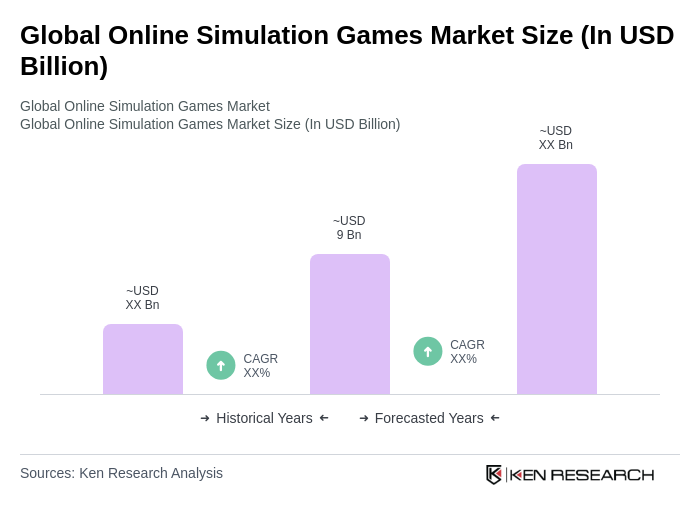
- The Global Online Simulation Games Market is valued at USD 9 billion, based on a five-year historical analysis. This growth is primarily driven by rising high-speed internet access, affordable gaming hardware, and demand for immersive, interactive entertainment, alongside the rise of eSports and streaming, which deepen engagement and broaden audiences.
- Key players in this market include the United States, China, and Japan, supported by robust gaming infrastructure, high internet and smartphone penetration, and large gamer populations; these countries also host major publishers, platforms, and development ecosystems that reinforce leadership.
- In 2023, the European Union advanced consumer protection around in-game monetization, with lawmakers and regulators pressing for transparency in loot boxes and spending controls; initiatives include requirements to disclose odds and provide spending limit tools in several EU markets, with the European Commission and national authorities coordinating enforcement on dark patterns and minors’ protection in games.
Global Online Simulation Games Market Segmentation
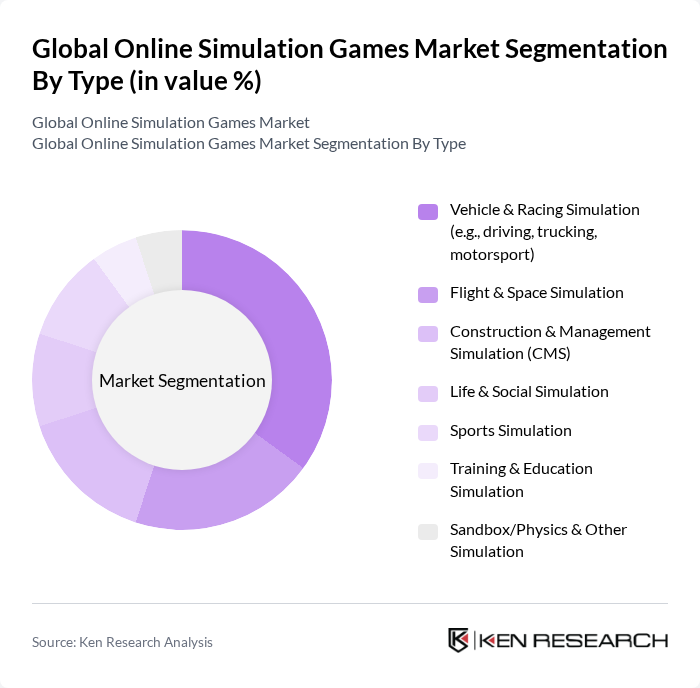
By Type:The online simulation games market is segmented into various types, including Vehicle & Racing Simulation, Flight & Space Simulation, Construction & Management Simulation (CMS), Life & Social Simulation, Sports Simulation, Training & Education Simulation, and Sandbox/Physics & Other Simulation. Vehicle & Racing Simulation has broad appeal from casual to enthusiast players and benefits from improved physics, force feedback, and graphics; VR support has further boosted realism. Flight & Space Simulation has gained renewed traction due to high-fidelity titles and VR integration enhancing immersion.
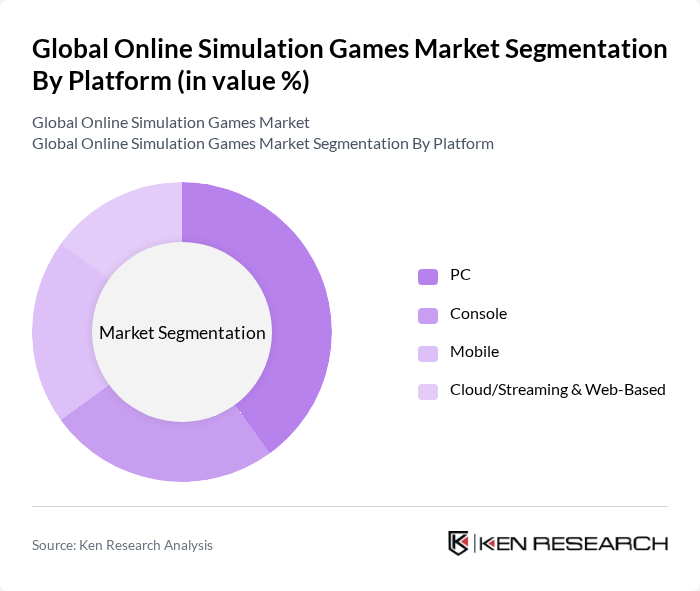
By Platform:The market is also segmented by platform, including PC, Console, Mobile, and Cloud/Streaming & Web-Based. The PC platform remains the most popular due to its superior graphics capabilities and extensive library of simulation games. However, the Mobile segment is rapidly growing, driven by the increasing accessibility of smartphones and the popularity of casual gaming. Cloud gaming is emerging as a significant player, allowing users to access high-quality games without the need for expensive hardware, thus broadening the market reach.
Global Online Simulation Games Market Competitive Landscape
The Global Online Simulation Games Market is characterized by a dynamic mix of regional and international players. Leading participants such as Electronic Arts Inc. (EA) — The Sims, EA Sports FC, Activision Blizzard, Inc. — Blizzard Entertainment (StarCraft II Arcade, Overwatch Workshop), Ubisoft Entertainment S.A. — Anno, The Crew (Ivory Tower), Take-Two Interactive Software, Inc. — Rockstar Games, Private Division (Kerbal Space Program), Paradox Interactive AB — Cities: Skylines, Stellaris, Frontier Developments plc — Elite Dangerous, Planet Coaster, Bohemia Interactive — Arma, DayZ (simulation/mod frameworks), SCS Software — Euro Truck Simulator, American Truck Simulator, KOEI TECMO GAMES CO., LTD. — Winning Post, Nobunaga’s Ambition, NCSOFT Corporation — AION Classic (simulation-adjacent systems), platform capabilities, Valve Corporation — Steam (distribution, mod/workshop ecosystem), Dota 2 workshop tools, Microsoft — Xbox Game Studios (Microsoft Flight Simulator by Asobo Studio), Asobo Studio — Microsoft Flight Simulator (development partner), NetEase Games — Eggy Party, LifeAfter (online systems; sim/social features), Tencent Games — Level Infinite (Arena Breakout; investments in sim studios) contribute to innovation, geographic expansion, and service delivery in this space.
Global Online Simulation Games Market Industry Analysis
Growth Drivers
- Increasing Popularity of E-Sports:The e-sports industry has seen exponential growth, with revenues reaching approximately $0.3 billion in future, driven by sponsorships, advertising, and media rights. This surge in interest has led to a greater demand for online simulation games that can be integrated into competitive formats. The global audience for e-sports is projected to exceed 600 million, creating a fertile ground for simulation games that cater to this expanding demographic, enhancing player engagement and participation.
- Advancements in Gaming Technology:Technological innovations, such as cloud gaming and high-performance graphics, are transforming the online simulation gaming landscape. In future, the global gaming hardware market is expected to surpass $30 billion, facilitating immersive experiences. Enhanced processing power and graphics capabilities allow developers to create more realistic simulations, attracting a broader audience. This technological evolution not only improves gameplay but also encourages the development of complex simulation environments, driving market growth significantly.
- Rise of Mobile Gaming:The mobile gaming sector is projected to generate over $80 billion in revenue in future, reflecting a significant shift in consumer preferences. With over 3.5 billion smartphone users globally, mobile platforms are becoming the primary medium for gaming. This trend is particularly beneficial for online simulation games, as they can be easily adapted for mobile devices, allowing for greater accessibility and engagement. The convenience of mobile gaming is driving user acquisition and retention, further propelling market growth.
Market Challenges
- High Development Costs:The development of high-quality online simulation games requires substantial investment, often exceeding $5 million per title. This financial burden can deter smaller developers from entering the market, limiting innovation and diversity. Additionally, the need for continuous updates and maintenance further escalates costs, making it challenging for companies to achieve profitability. As a result, many developers face significant financial risks, which can hinder overall market growth and sustainability.
- Intense Competition:The online simulation games market is characterized by fierce competition, with thousands of titles vying for consumer attention. In future, it is estimated that over 1,500 new games will be launched, making it increasingly difficult for developers to stand out. This saturation leads to market fragmentation, where only a few titles achieve significant success. Consequently, developers must invest heavily in marketing and user acquisition strategies, which can strain resources and impact profitability.
Global Online Simulation Games Market Future Outlook
The future of the online simulation games market appears promising, driven by technological advancements and evolving consumer preferences. As virtual reality and augmented reality technologies become more mainstream, developers are likely to create more immersive experiences that attract a wider audience. Additionally, the increasing integration of artificial intelligence in game design will enhance user engagement and personalization, further solidifying the market's growth trajectory. The focus on cross-platform compatibility will also facilitate broader access, ensuring sustained interest in simulation games.
Market Opportunities
- Growth in Virtual Reality Integration:The virtual reality market is projected to reach $30 billion by future, presenting significant opportunities for online simulation games. By incorporating VR technology, developers can create more engaging and realistic experiences, attracting both gamers and non-gamers. This integration can enhance user immersion, leading to increased player retention and satisfaction, ultimately driving revenue growth in the simulation gaming sector.
- Expansion into Emerging Markets:Emerging markets, particularly in Asia and Africa, are witnessing rapid internet penetration, with over 1 billion new users expected by future. This growth presents a lucrative opportunity for online simulation games, as developers can tap into these new audiences. By localizing content and adapting to regional preferences, companies can significantly increase their user base and revenue potential in these high-growth regions.
Scope of the Report
| Segment | Sub-Segments |
|---|---|
| By Type | Vehicle & Racing Simulation (e.g., driving, trucking, motorsport) Flight & Space Simulation Construction & Management Simulation (CMS) Life & Social Simulation Sports Simulation Training & Education Simulation Sandbox/Physics & Other Simulation |
| By Platform | PC Console Mobile Cloud/Streaming & Web-Based |
| By Revenue Model | In-App Purchases (F2P microtransactions) Subscription Advertising-Supported Paid/B2P (One-time purchase) |
| By Distribution Channel | Digital Stores/Launchers (e.g., Steam, Epic, PlayStation/Xbox stores) Direct Publisher/Developer Platforms Third-Party Marketplaces |
| By User Demographics | Children (Under 13) Teens (13–17) Adults (18–44) Mature Gamers (45+) |
| By Multiplayer Mode | Massively Multiplayer Online (MMO) Competitive/Ranked Multiplayer Co-op/Social Multiplayer Single-Player with Online Features |
| By Immersion Layer | Non-VR/Standard VR/AR-Enabled |
Key Target Audience
Investors and Venture Capitalist Firms
Government and Regulatory Bodies (e.g., Federal Trade Commission, National Telecommunications and Information Administration)
Game Developers and Publishers
Online Gaming Platforms and Distributors
Advertising Agencies and Marketing Firms
Content Creators and Influencers in Gaming
Telecommunications Companies
Market Analysts and Industry Experts
Players Mentioned in the Report:
Electronic Arts Inc. (EA) The Sims, EA Sports FC
Activision Blizzard, Inc. Blizzard Entertainment (StarCraft II Arcade, Overwatch Workshop)
Ubisoft Entertainment S.A. Anno, The Crew (Ivory Tower)
Take-Two Interactive Software, Inc. Rockstar Games, Private Division (Kerbal Space Program)
Paradox Interactive AB Cities: Skylines, Stellaris
Frontier Developments plc Elite Dangerous, Planet Coaster
Bohemia Interactive Arma, DayZ (simulation/mod frameworks)
SCS Software Euro Truck Simulator, American Truck Simulator
KOEI TECMO GAMES CO., LTD. Winning Post, Nobunagas Ambition
NCSOFT Corporation AION Classic (simulation-adjacent systems), platform capabilities
Valve Corporation Steam (distribution, mod/workshop ecosystem), Dota 2 workshop tools
Microsoft Xbox Game Studios (Microsoft Flight Simulator by Asobo Studio)
Asobo Studio Microsoft Flight Simulator (development partner)
NetEase Games Eggy Party, LifeAfter (online systems; sim/social features)
Tencent Games Level Infinite (Arena Breakout; investments in sim studios)
Table of Contents
Market Assessment Phase
1. Executive Summary and Approach
2. Global Online Simulation Games Market Overview
2.1 Key Insights and Strategic Recommendations
2.2 Global Online Simulation Games Market Overview
2.3 Definition and Scope
2.4 Evolution of Market Ecosystem
2.5 Timeline of Key Regulatory Milestones
2.6 Value Chain & Stakeholder Mapping
2.7 Business Cycle Analysis
2.8 Policy & Incentive Landscape
3. Global Online Simulation Games Market Analysis
3.1 Growth Drivers
3.1.1 Increasing Popularity of E-Sports
3.1.2 Advancements in Gaming Technology
3.1.3 Rise of Mobile Gaming
3.1.4 Expanding Global Internet Access
3.2 Market Challenges
3.2.1 High Development Costs
3.2.2 Intense Competition
3.2.3 Regulatory Compliance Issues
3.2.4 User Retention Difficulties
3.3 Market Opportunities
3.3.1 Growth in Virtual Reality Integration
3.3.2 Expansion into Emerging Markets
3.3.3 Development of Cross-Platform Games
3.3.4 Increasing Demand for Educational Simulation Games
3.4 Market Trends
3.4.1 Rise of Subscription-Based Models
3.4.2 Gamification in Non-Gaming Sectors
3.4.3 Focus on User-Generated Content
3.4.4 Integration of AI in Game Development
3.5 Government Regulation
3.5.1 Age Rating Regulations
3.5.2 Data Protection Laws
3.5.3 Online Gambling Regulations
3.5.4 Content Moderation Policies
4. SWOT Analysis
5. Stakeholder Analysis
6. Porter's Five Forces Analysis
7. Global Online Simulation Games Market Market Size, 2019-2024
7.1 By Value
7.2 By Volume
7.3 By Average Selling Price
8. Global Online Simulation Games Market Segmentation
8.1 By Type
8.1.1 Vehicle & Racing Simulation (e.g., driving, trucking, motorsport)
8.1.2 Flight & Space Simulation
8.1.3 Construction & Management Simulation (CMS)
8.1.4 Life & Social Simulation
8.1.5 Sports Simulation
8.1.6 Training & Education Simulation
8.1.7 Sandbox/Physics & Other Simulation
8.2 By Platform
8.2.1 PC
8.2.2 Console
8.2.3 Mobile
8.2.4 Cloud/Streaming & Web-Based
8.3 By Revenue Model
8.3.1 In-App Purchases (F2P microtransactions)
8.3.2 Subscription
8.3.3 Advertising-Supported
8.3.4 Paid/B2P (One-time purchase)
8.4 By Distribution Channel
8.4.1 Digital Stores/Launchers (e.g., Steam, Epic, PlayStation/Xbox stores)
8.4.2 Direct Publisher/Developer Platforms
8.4.3 Third-Party Marketplaces
8.5 By User Demographics
8.5.1 Children (Under 13)
8.5.2 Teens (13–17)
8.5.3 Adults (18–44)
8.5.4 Mature Gamers (45+)
8.6 By Multiplayer Mode
8.6.1 Massively Multiplayer Online (MMO)
8.6.2 Competitive/Ranked Multiplayer
8.6.3 Co-op/Social Multiplayer
8.6.4 Single-Player with Online Features
8.7 By Immersion Layer
8.7.1 Non-VR/Standard
8.7.2 VR/AR-Enabled
9. Global Online Simulation Games Market Competitive Analysis
9.1 Market Share of Key Players
9.2 Cross Comparison of Key Players
9.2.1 Company Name
9.2.2 Scale Tier (AAA publisher, AA/indie studio, platform)
9.2.3 Simulation Portfolio Breadth (number of active online sim titles)
9.2.4 MAU/DAU (monthly/daily active users)
9.2.5 Paying User Ratio and ARPDAU/ARPU
9.2.6 Regional User Mix (NA, EU, APAC share)
9.2.7 Growth KPIs (YoY bookings/revenue growth)
9.2.8 Monetization Mix (IAP %, subs %, ads %, paid %)
9.2.9 User Retention (D1/D7/D30)
9.2.10 CAC/Payback Period and LTV
9.2.11 Average Session Length and Engagement Time
9.2.12 Live Ops Cadence (update frequency, events/month)
9.2.13 Content Pipeline Velocity (DLC/expansions per year)
9.2.14 Cross-Platform Coverage (PC/console/mobile/VR)
9.2.15 Online Infrastructure (server uptime, concurrency peak)
9.3 SWOT Analysis of Top Players
9.4 Pricing Analysis
9.5 Detailed Profile of Major Companies
9.5.1 Electronic Arts Inc. (EA) — The Sims, EA Sports FC
9.5.2 Activision Blizzard, Inc. — Blizzard Entertainment (StarCraft II Arcade, Overwatch Workshop)
9.5.3 Ubisoft Entertainment S.A. — Anno, The Crew (Ivory Tower)
9.5.4 Take-Two Interactive Software, Inc. — Rockstar Games, Private Division (Kerbal Space Program)
9.5.5 Paradox Interactive AB — Cities: Skylines, Stellaris
9.5.6 Frontier Developments plc — Elite Dangerous, Planet Coaster
9.5.7 Bohemia Interactive — Arma, DayZ (simulation/mod frameworks)
9.5.8 SCS Software — Euro Truck Simulator, American Truck Simulator
9.5.9 KOEI TECMO GAMES CO., LTD. — Winning Post, Nobunaga’s Ambition
9.5.10 NCSOFT Corporation — AION Classic (simulation-adjacent systems), platform capabilities
9.5.11 Valve Corporation — Steam (distribution, mod/workshop ecosystem), Dota 2 workshop tools
9.5.12 Microsoft — Xbox Game Studios (Microsoft Flight Simulator by Asobo Studio)
9.5.13 Asobo Studio — Microsoft Flight Simulator (development partner)
9.5.14 NetEase Games — Eggy Party, LifeAfter (online systems; sim/social features)
9.5.15 Tencent Games — Level Infinite (Arena Breakout; investments in sim studios)
10. Global Online Simulation Games Market End-User Analysis
10.1 Procurement Behavior of Key Ministries
10.1.1 Government Interest in Educational Games
10.1.2 Funding for Simulation-Based Training
10.1.3 Partnerships with Game Developers
10.2 Corporate Spend on Infrastructure & Energy
10.2.1 Investment in Gaming Infrastructure
10.2.2 Budget Allocation for Game Development
10.2.3 Expenditure on Marketing and Promotion
10.3 Pain Point Analysis by End-User Category
10.3.1 Difficulty in Game Accessibility
10.3.2 Challenges in User Engagement
10.3.3 Issues with Game Performance
10.4 User Readiness for Adoption
10.4.1 Familiarity with Simulation Games
10.4.2 Willingness to Invest in Gaming
10.4.3 Interest in New Gaming Technologies
10.5 Post-Deployment ROI and Use Case Expansion
10.5.1 Evaluation of Game Performance Metrics
10.5.2 User Feedback and Improvement Plans
10.5.3 Expansion into New Game Genres
11. Global Online Simulation Games Market Future Size, 2025-2030
11.1 By Value
11.2 By Volume
11.3 By Average Selling Price
Go-To-Market Strategy Phase
1. Whitespace Analysis + Business Model Canvas
1.1 Market Gaps Identification
1.2 Business Model Development
2. Marketing and Positioning Recommendations
2.1 Branding Strategies
2.2 Product USPs
3. Distribution Plan
3.1 Urban Retail vs Rural NGO Tie-Ups
4. Channel & Pricing Gaps
4.1 Underserved Routes
4.2 Pricing Bands
5. Unmet Demand & Latent Needs
5.1 Category Gaps
5.2 Consumer Segments
6. Customer Relationship
6.1 Loyalty Programs
6.2 After-Sales Service
7. Value Proposition
7.1 Sustainability
7.2 Integrated Supply Chains
8. Key Activities
8.1 Regulatory Compliance
8.2 Branding
8.3 Distribution Setup
9. Entry Strategy Evaluation
9.1 Domestic Market Entry Strategy
9.1.1 Product Mix
9.1.2 Pricing Band
9.1.3 Packaging
9.2 Export Entry Strategy
9.2.1 Target Countries
9.2.2 Compliance Roadmap
10. Entry Mode Assessment
10.1 JV
10.2 Greenfield
10.3 M&A
10.4 Distributor Model
11. Capital and Timeline Estimation
11.1 Capital Requirements
11.2 Timelines
12. Control vs Risk Trade-Off
12.1 Ownership vs Partnerships
13. Profitability Outlook
13.1 Breakeven Analysis
13.2 Long-Term Sustainability
14. Potential Partner List
14.1 Distributors
14.2 JVs
14.3 Acquisition Targets
15. Execution Roadmap
15.1 Phased Plan for Market Entry
15.1.1 Market Setup
15.1.2 Market Entry
15.1.3 Growth Acceleration
15.1.4 Scale & Stabilize
15.2 Key Activities and Milestones
15.2.1 Activity Planning
15.2.2 Milestone Tracking
Research Methodology
Phase 1: Approach1
Desk Research
- Industry reports from market research firms focusing on online gaming trends
- Published articles and white papers from gaming associations and academic journals
- Statistical data from government and industry databases on internet usage and gaming demographics
Primary Research
- Interviews with game developers and publishers to understand market dynamics
- Surveys targeting gamers to gather insights on preferences and spending habits
- Focus groups with industry experts to discuss emerging trends and technologies
Validation & Triangulation
- Cross-validation of findings through multiple data sources, including sales data and user engagement metrics
- Triangulation of insights from primary interviews and secondary research findings
- Sanity checks conducted through expert panel reviews to ensure data accuracy
Phase 2: Market Size Estimation1
Top-down Assessment
- Analysis of global gaming revenue trends to estimate the online simulation games segment
- Segmentation of market size by geographic regions and user demographics
- Incorporation of growth rates from related sectors such as eSports and mobile gaming
Bottom-up Modeling
- Estimation of user base growth through subscription and purchase data from leading platforms
- Cost analysis based on average revenue per user (ARPU) across different game types
- Volume x cost calculations for in-game purchases and downloadable content (DLC)
Forecasting & Scenario Analysis
- Multi-factor regression analysis incorporating factors like technological advancements and consumer behavior shifts
- Scenario modeling based on potential regulatory changes and market disruptions
- Baseline, optimistic, and pessimistic forecasts through 2030 to capture market volatility
Phase 3: CATI Sample Composition1
| Scope Item/Segment | Sample Size | Target Respondent Profiles |
|---|---|---|
| Casual Gamers | 150 | Individuals aged 18-35, frequent mobile game users |
| Hardcore Gamers | 120 | Individuals aged 18-45, console and PC game enthusiasts |
| Game Developers | 80 | Professionals in game design and development roles |
| Industry Analysts | 60 | Market researchers and analysts specializing in gaming |
| Online Gaming Communities | 90 | Members of online forums and social media groups focused on gaming |
Frequently Asked Questions
What is the current value of the Global Online Simulation Games Market?
The Global Online Simulation Games Market is valued at approximately USD 9 billion, reflecting significant growth driven by factors such as increased internet access, affordable gaming hardware, and the rising popularity of immersive entertainment experiences.
Which countries are leading in the Online Simulation Games Market?
What are the main types of online simulation games?
How is the Online Simulation Games Market segmented by platform?
Other Regional/Country Reports
Indonesia Online Simulation Games Market
Malaysia Online Simulation Games Market
APAC Online Simulation Games Market
SEA Online Simulation Games Market
Why Buy From Us?

What makes us stand out is that our consultants follow Robust, Refine and Result (RRR) methodology. Robust for clear definitions, approaches and sanity checking, Refine for differentiating respondents' facts and opinions, and Result for presenting data with story.

We have set a benchmark in the industry by offering our clients with syndicated and customized market research reports featuring coverage of entire market as well as meticulous research and analyst insights.

While we don't replace traditional research, we flip the method upside down. Our dual approach of Top Bottom & Bottom Top ensures quality deliverable by not just verifying company fundamentals but also looking at the sector and macroeconomic factors.

With one step in the future, our research team constantly tries to show you the bigger picture. We help with some of the tough questions you may encounter along the way: How is the industry positioned? Best marketing channel? KPI's of competitors? By aligning every element, we help maximize success.

Our report gives you instant access to the answers and sources that other companies might choose to hide. We elaborate each steps of research methodology we have used and showcase you the sample size to earn your trust.

If you need any support, we are here! We pride ourselves on universe strength, data quality, and quick, friendly, and professional service.