About the Report
Base Year 2024Global Opioid Induced Constipation Market Overview
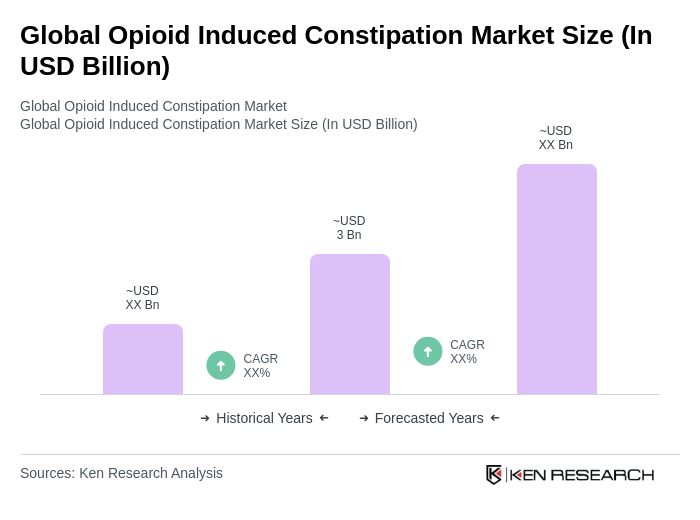
- The Global Opioid Induced Constipation Market is valued at USD 3 billion, based on a five-year historical analysis. This market is driven by widespread opioid prescribing for chronic pain and the consequent high prevalence of opioid-induced constipation (OIC), alongside broader awareness and uptake of targeted therapies such as peripherally acting mu-opioid receptor antagonists.
- Key players in this market include the United States, Germany, and Japan, which lead due to advanced healthcare systems, high opioid prescribing and utilization in pain management, and significant pharmaceutical R&D investment; North America holds the largest share given higher opioid use and established OIC therapeutics access, with Western Europe and Japan as additional mature markets.
- In 2023, the U.S. Food and Drug Administration did not issue new OIC-specific guidance; OIC medications continue to be evaluated under existing drug development and labeling standards (including class labeling and safety communications for PAMORAs where applicable). Recent market activity in the U.S. reflects continued reliance on established regulatory pathways for efficacy and safety, rather than the introduction of new OIC-focused guidance documents.
Global Opioid Induced Constipation Market Segmentation
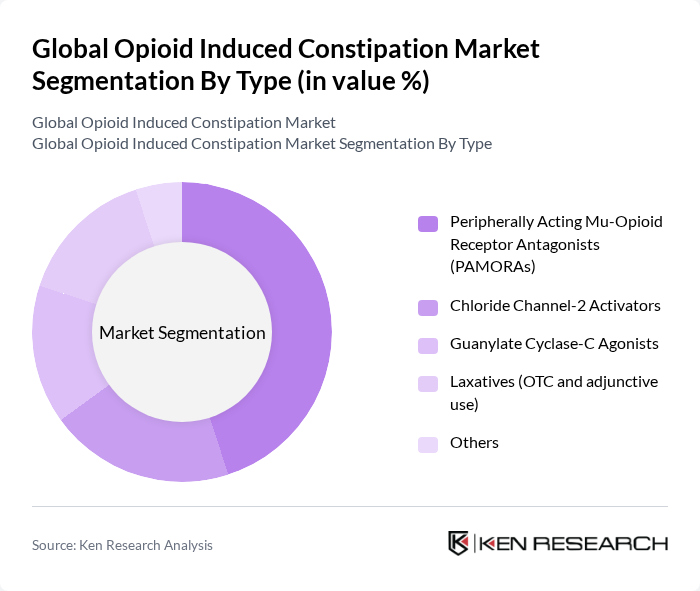
By Type:The market is segmented into various types of treatments for opioid-induced constipation, including Peripherally Acting Mu-Opioid Receptor Antagonists (PAMORAs), Chloride Channel-2 Activators, Guanylate Cyclase-C Agonists, Laxatives (OTC and adjunctive use), and Others. Among these, PAMORAs are currently the leading sub-segment due to their targeted action and effectiveness in alleviating constipation without affecting pain relief. The increasing adoption of these therapies in clinical settings is driving their dominance.
By End-User:The market is segmented by end-users, including Hospital Pharmacies, Retail Pharmacies, Online Pharmacies, and Specialty Clinics. Hospital Pharmacies dominate this segment due to their critical role in managing complex patient cases, particularly those involving chronic pain and opioid use. The increasing number of patients requiring specialized care in hospitals is driving the demand for effective OIC treatments.

Global Opioid Induced Constipation Market Competitive Landscape
The Global Opioid Induced Constipation Market is characterized by a dynamic mix of regional and international players. Leading participants such as Takeda Pharmaceutical Company Limited (Amitiza/linaclotide partnerships historically; OIC presence via lubiprostone legacy rights in some markets), Bausch Health Companies Inc. (Salix Pharmaceuticals) — Relistor (methylnaltrexone), AstraZeneca PLC — Movantik/Moventig (naloxegol), Kyowa Kirin Co., Ltd. — Moventig (select EU rights) and GI portfolio, Shionogi & Co., Ltd. — Symproic (naldemedine), Mallinckrodt Pharmaceuticals — Entereg (alvimopan; hospital-only in U.S.), Nektar Therapeutics — naloxegol originator technology licensing, Pfizer Inc. — GI collaborations and legacy OIC co-promotions in select markets, Ironwood Pharmaceuticals, Inc. — GI franchise participant (constipation therapeutics landscape), AbbVie Inc. (including Allergan legacy) — GI portfolio and distribution capabilities, Hikma Pharmaceuticals PLC — Generics and hospital channel presence relevant to OIC adjuncts, Lupin Limited — Generics in GI and pain adjunct categories, Sun Pharmaceutical Industries Ltd. — Generics/brands in GI and pain management, Zydus Lifesciences Limited, Viatris Inc. — Global generics distribution, including GI therapies contribute to innovation, geographic expansion, and service delivery in this space.
Global Opioid Induced Constipation Market Industry Analysis
Growth Drivers
- Increasing Prevalence of Opioid Prescriptions:The global opioid prescription rate has surged, with over 300 million prescriptions issued annually in the United States alone. This increase is driven by the rising incidence of chronic pain conditions, which affects approximately 20% of adults. As more patients receive opioid therapy, the incidence of opioid-induced constipation (OIC) is expected to rise, creating a significant demand for effective treatment options. This trend is further supported by the growing acceptance of opioids in pain management protocols.
- Rising Awareness About Opioid-Induced Constipation:Awareness campaigns and educational initiatives have led to a notable increase in the recognition of OIC among healthcare providers and patients. In future, approximately 60% of healthcare professionals reported discussing OIC with their patients, up from 40% previously. This heightened awareness is crucial as it encourages patients to seek treatment, thereby driving market growth. Furthermore, patient advocacy groups are actively promoting the importance of addressing OIC, further enhancing awareness and treatment uptake.
- Development of New Treatment Options:The pharmaceutical industry is witnessing a surge in the development of innovative therapies for OIC. In future, over 15 new drugs targeting OIC entered clinical trials, reflecting a robust pipeline. Notably, the introduction of peripherally acting mu-opioid receptor antagonists (PAMORAs) has revolutionized treatment options. These advancements are expected to significantly improve patient outcomes and adherence, thereby expanding the market. The ongoing research and development efforts are anticipated to yield more effective and safer alternatives in the coming years.
Market Challenges
- Regulatory Hurdles:The opioid market is heavily regulated, with stringent guidelines governing prescription practices. In future, the FDA implemented new regulations requiring enhanced labeling and risk evaluation for opioid medications. These regulations can delay the approval of new treatments for OIC, hindering market growth. Additionally, the complex approval process can deter pharmaceutical companies from investing in OIC therapies, limiting the availability of innovative solutions for patients suffering from this condition.
- High Treatment Costs:The cost of OIC treatments remains a significant barrier for many patients. In future, the average annual cost of prescription medications for OIC was approximately $4,500 per patient, which can be prohibitive, especially for those without insurance. This financial burden often leads to limited patient compliance and treatment discontinuation. As healthcare systems strive to manage costs, the high price of effective OIC therapies poses a challenge to market penetration and patient access.
Global Opioid Induced Constipation Market Future Outlook
The future of the opioid-induced constipation market appears promising, driven by ongoing innovations and a shift towards more patient-centric approaches. As healthcare providers increasingly recognize the importance of managing OIC, the integration of digital health solutions and personalized medicine is expected to enhance treatment adherence. Furthermore, the expansion of educational initiatives will empower patients to seek timely interventions, ultimately improving their quality of life. The market is poised for growth as stakeholders adapt to evolving patient needs and regulatory landscapes.
Market Opportunities
- Expansion into Emerging Markets:Emerging markets present significant growth opportunities for OIC treatments. With rising opioid prescriptions in regions like Asia and Latin America, the demand for effective OIC therapies is increasing. In future, these markets are projected to account for over 25% of global opioid prescriptions, highlighting the potential for pharmaceutical companies to introduce tailored solutions that address local healthcare needs and economic conditions.
- Innovations in Drug Formulations:The development of novel drug formulations, such as extended-release and combination therapies, offers substantial market potential. These innovations can enhance patient compliance and treatment efficacy. In future, it is anticipated that at least five new formulations will enter the market, providing healthcare providers with more options to effectively manage OIC, thereby driving overall market growth and improving patient outcomes.
Scope of the Report
| Segment | Sub-Segments |
|---|---|
| By Type | Peripherally Acting Mu-Opioid Receptor Antagonists (PAMORAs) Chloride Channel-2 Activators Guanylate Cyclase-C Agonists Laxatives (OTC and adjunctive use) Others |
| By End-User | Hospital Pharmacies Retail Pharmacies Online Pharmacies Specialty Clinics |
| By Distribution Channel | Hospital Pharmacies Retail Pharmacies Online Pharmacies Direct-to-Patient Programs |
| By Region | North America Europe Asia-Pacific Latin America Middle East & Africa |
| By Patient Demographics | Cancer-Pain Patients Non-Cancer Chronic-Pain Patients Geriatric Patients (65+) |
| By Treatment Duration | Short-term Treatment Long-term Maintenance |
| By Route of Administration | Oral Parenteral |
Key Target Audience
Investors and Venture Capitalist Firms
Government and Regulatory Bodies (e.g., U.S. Food and Drug Administration, European Medicines Agency)
Pharmaceutical Manufacturers
Biotechnology Companies
Healthcare Providers and Hospitals
Pharmacy Chains and Retail Pharmacies
Health Insurance Companies
Medical Device Manufacturers
Players Mentioned in the Report:
Takeda Pharmaceutical Company Limited (Amitiza/linaclotide partnerships historically; OIC presence via lubiprostone legacy rights in some markets)
Bausch Health Companies Inc. (Salix Pharmaceuticals) Relistor (methylnaltrexone)
AstraZeneca PLC Movantik/Moventig (naloxegol)
Kyowa Kirin Co., Ltd. Moventig (select EU rights) and GI portfolio
Shionogi & Co., Ltd. Symproic (naldemedine)
Mallinckrodt Pharmaceuticals Entereg (alvimopan; hospital-only in U.S.)
Nektar Therapeutics naloxegol originator technology licensing
Pfizer Inc. GI collaborations and legacy OIC co-promotions in select markets
Ironwood Pharmaceuticals, Inc. GI franchise participant (constipation therapeutics landscape)
AbbVie Inc. (including Allergan legacy) GI portfolio and distribution capabilities
Hikma Pharmaceuticals PLC Generics and hospital channel presence relevant to OIC adjuncts
Lupin Limited Generics in GI and pain adjunct categories
Sun Pharmaceutical Industries Ltd. Generics/brands in GI and pain management
Zydus Lifesciences Limited
Viatris Inc. Global generics distribution, including GI therapies
Table of Contents
Market Assessment Phase
1. Executive Summary and Approach
2. Global Opioid Induced Constipation Market Overview
2.1 Key Insights and Strategic Recommendations
2.2 Global Opioid Induced Constipation Market Overview
2.3 Definition and Scope
2.4 Evolution of Market Ecosystem
2.5 Timeline of Key Regulatory Milestones
2.6 Value Chain & Stakeholder Mapping
2.7 Business Cycle Analysis
2.8 Policy & Incentive Landscape
3. Global Opioid Induced Constipation Market Analysis
3.1 Growth Drivers
3.1.1 Increasing prevalence of opioid prescriptions
3.1.2 Rising awareness about opioid-induced constipation
3.1.3 Development of new treatment options
3.1.4 Growing geriatric population
3.2 Market Challenges
3.2.1 Regulatory hurdles
3.2.2 High treatment costs
3.2.3 Limited patient compliance
3.2.4 Stigma associated with opioid use
3.3 Market Opportunities
3.3.1 Expansion into emerging markets
3.3.2 Innovations in drug formulations
3.3.3 Collaborations with healthcare providers
3.3.4 Increased focus on patient education
3.4 Market Trends
3.4.1 Shift towards non-opioid alternatives
3.4.2 Integration of digital health solutions
3.4.3 Personalized medicine approaches
3.4.4 Increased investment in R&D
3.5 Government Regulation
3.5.1 Prescription monitoring programs
3.5.2 Guidelines for opioid prescribing
3.5.3 Restrictions on opioid formulations
3.5.4 Support for research on opioid alternatives
4. SWOT Analysis
5. Stakeholder Analysis
6. Porter's Five Forces Analysis
7. Global Opioid Induced Constipation Market Market Size, 2019-2024
7.1 By Value
7.2 By Volume
7.3 By Average Selling Price
8. Global Opioid Induced Constipation Market Segmentation
8.1 By Type
8.1.1 Peripherally Acting Mu-Opioid Receptor Antagonists (PAMORAs)
8.1.2 Chloride Channel-2 Activators
8.1.3 Guanylate Cyclase-C Agonists
8.1.4 Laxatives (OTC and adjunctive use)
8.1.5 Others
8.2 By End-User
8.2.1 Hospital Pharmacies
8.2.2 Retail Pharmacies
8.2.3 Online Pharmacies
8.2.4 Specialty Clinics
8.3 By Distribution Channel
8.3.1 Hospital Pharmacies
8.3.2 Retail Pharmacies
8.3.3 Online Pharmacies
8.3.4 Direct-to-Patient Programs
8.4 By Region
8.4.1 North America
8.4.2 Europe
8.4.3 Asia-Pacific
8.4.4 Latin America
8.4.5 Middle East & Africa
8.5 By Patient Demographics
8.5.1 Cancer-Pain Patients
8.5.2 Non-Cancer Chronic-Pain Patients
8.5.3 Geriatric Patients (65+)
8.6 By Treatment Duration
8.6.1 Short-term Treatment
8.6.2 Long-term Maintenance
8.7 By Route of Administration
8.7.1 Oral
8.7.2 Parenteral
9. Global Opioid Induced Constipation Market Competitive Analysis
9.1 Market Share of Key Players
9.2 Cross Comparison of Key Players
9.2.1 Company Name (e.g., Takeda; Bausch Health/Salix; AstraZeneca/Kyowa Kirin; Shionogi; Valeant legacy brands; Mallinckrodt; Ironwood; AbbVie/Allergan)
9.2.2 Group Size (Large, Medium, or Small as per industry convention)
9.2.3 OIC Portfolio Breadth (number of approved OIC SKUs/labels)
9.2.4 OIC Revenue (latest FY, USD)
9.2.5 Geographic Reach (number of countries with OIC product approvals)
9.2.6 Market Penetration in Target Populations (cancer vs. non-cancer patients)
9.2.7 R&D Investment Ratio in GI/Motility (%)
9.2.8 Time-to-Response/Efficacy Benchmarks (median time to first bowel movement)
9.2.9 Safety/Tolerability Profile (rate of GI adverse events)
9.2.10 Pricing and Reimbursement Access (formularies/tier placement and net price index)
9.3 SWOT Analysis of Top Players
9.4 Pricing Analysis
9.5 Detailed Profile of Major Companies
9.5.1 Takeda Pharmaceutical Company Limited (Amitiza/linaclotide partnerships historically; OIC presence via lubiprostone legacy rights in some markets)
9.5.2 Bausch Health Companies Inc. (Salix Pharmaceuticals) — Relistor (methylnaltrexone)
9.5.3 AstraZeneca PLC — Movantik/Moventig (naloxegol)
9.5.4 Kyowa Kirin Co., Ltd. — Moventig (select EU rights) and GI portfolio
9.5.5 Shionogi & Co., Ltd. — Symproic (naldemedine)
9.5.6 Mallinckrodt Pharmaceuticals — Entereg (alvimopan; hospital-only in U.S.)
9.5.7 Nektar Therapeutics — naloxegol originator technology licensing
9.5.8 Pfizer Inc. — GI collaborations and legacy OIC co-promotions in select markets
9.5.9 Ironwood Pharmaceuticals, Inc. — GI franchise participant (constipation therapeutics landscape)
9.5.10 AbbVie Inc. (including Allergan legacy) — GI portfolio and distribution capabilities
9.5.11 Hikma Pharmaceuticals PLC — Generics and hospital channel presence relevant to OIC adjuncts
9.5.12 Lupin Limited — Generics in GI and pain adjunct categories
9.5.13 Sun Pharmaceutical Industries Ltd. — Generics/brands in GI and pain management
9.5.14 Zydus Lifesciences Limited
9.5.15 Viatris Inc. — Global generics distribution, including GI therapies
10. Global Opioid Induced Constipation Market End-User Analysis
10.1 Procurement Behavior of Key Ministries
10.1.1 Budget Allocation Trends
10.1.2 Decision-Making Processes
10.1.3 Preferred Suppliers
10.2 Corporate Spend on Infrastructure & Energy
10.2.1 Investment in Healthcare Infrastructure
10.2.2 Spending on Research and Development
10.2.3 Budget for Patient Care Programs
10.3 Pain Point Analysis by End-User Category
10.3.1 Challenges Faced by Hospitals
10.3.2 Issues in Homecare Settings
10.3.3 Concerns of Long-term Care Facilities
10.4 User Readiness for Adoption
10.4.1 Awareness Levels
10.4.2 Training Needs
10.4.3 Technology Acceptance
10.5 Post-Deployment ROI and Use Case Expansion
10.5.1 Measurement of Treatment Efficacy
10.5.2 Cost Savings Analysis
10.5.3 Opportunities for Upselling
11. Global Opioid Induced Constipation Market Future Size, 2025-2030
11.1 By Value
11.2 By Volume
11.3 By Average Selling Price
Go-To-Market Strategy Phase
1. Whitespace Analysis + Business Model Canvas
1.1 Market Gaps Identification
1.2 Value Proposition Development
1.3 Revenue Streams Analysis
1.4 Key Partnerships Exploration
1.5 Customer Segmentation
1.6 Cost Structure Assessment
1.7 Competitive Advantage Analysis
2. Marketing and Positioning Recommendations
2.1 Branding Strategies
2.2 Product USPs
2.3 Target Audience Identification
2.4 Communication Channels
2.5 Promotional Tactics
2.6 Market Positioning
3. Distribution Plan
3.1 Urban Retail Strategies
3.2 Rural NGO Tie-ups
3.3 E-commerce Integration
3.4 Direct-to-Consumer Approaches
3.5 Distribution Partnerships
4. Channel & Pricing Gaps
4.1 Underserved Routes
4.2 Pricing Bands Analysis
4.3 Competitor Pricing Strategies
4.4 Customer Willingness to Pay
5. Unmet Demand & Latent Needs
5.1 Category Gaps Identification
5.2 Consumer Segments Analysis
5.3 Emerging Trends Exploration
5.4 Feedback Mechanisms
6. Customer Relationship
6.1 Loyalty Programs
6.2 After-sales Service
6.3 Customer Engagement Strategies
6.4 Feedback and Improvement Loops
7. Value Proposition
7.1 Sustainability Initiatives
7.2 Integrated Supply Chains
7.3 Customer-Centric Approaches
7.4 Innovation in Offerings
8. Key Activities
8.1 Regulatory Compliance
8.2 Branding Efforts
8.3 Distribution Setup
8.4 Training and Development
9. Entry Strategy Evaluation
9.1 Domestic Market Entry Strategy
9.1.1 Product Mix Considerations
9.1.2 Pricing Band Strategy
9.1.3 Packaging Innovations
9.2 Export Entry Strategy
9.2.1 Target Countries Identification
9.2.2 Compliance Roadmap Development
10. Entry Mode Assessment
10.1 Joint Ventures
10.2 Greenfield Investments
10.3 Mergers & Acquisitions
10.4 Distributor Model Evaluation
11. Capital and Timeline Estimation
11.1 Capital Requirements
11.2 Timelines for Implementation
12. Control vs Risk Trade-Off
12.1 Ownership vs Partnerships
13. Profitability Outlook
13.1 Breakeven Analysis
13.2 Long-term Sustainability
14. Potential Partner List
14.1 Distributors
14.2 Joint Ventures
14.3 Acquisition Targets
15. Execution Roadmap
15.1 Phased Plan for Market Entry
15.1.1 Market Setup
15.1.2 Market Entry
15.1.3 Growth Acceleration
15.1.4 Scale & Stabilize
15.2 Key Activities and Milestones
15.2.1 Milestone Planning
15.2.2 Activity Tracking
Research Methodology
Phase 1: Approach1
Desk Research
- Analysis of published market reports and white papers on opioid-induced constipation
- Review of academic journals and clinical studies related to opioid treatments and their side effects
- Examination of regulatory guidelines and policy documents from health authorities regarding opioid prescriptions
Primary Research
- Interviews with gastroenterologists and pain management specialists to understand treatment protocols
- Surveys with pharmacists to gather insights on prescription trends and patient feedback
- Focus groups with patients experiencing opioid-induced constipation to capture qualitative data
Validation & Triangulation
- Cross-validation of findings through multiple expert interviews and literature reviews
- Triangulation of data from clinical studies, market reports, and expert opinions
- Sanity checks through feedback from a panel of healthcare professionals
Phase 2: Market Size Estimation1
Top-down Assessment
- Estimation of the total addressable market based on opioid prescription volumes
- Segmentation of the market by geographic regions and healthcare settings (hospitals, outpatient clinics)
- Incorporation of demographic data to assess the prevalence of opioid-induced constipation
Bottom-up Modeling
- Collection of sales data from pharmaceutical companies producing laxatives and treatments for opioid-induced constipation
- Estimation of patient population based on opioid usage statistics and treatment adherence rates
- Calculation of market size based on average treatment costs and patient volume
Forecasting & Scenario Analysis
- Multi-factor regression analysis considering factors such as opioid prescription trends and healthcare policy changes
- Scenario modeling based on potential shifts in opioid regulations and alternative pain management therapies
- Development of baseline, optimistic, and pessimistic market forecasts through 2030
Phase 3: CATI Sample Composition1
| Scope Item/Segment | Sample Size | Target Respondent Profiles |
|---|---|---|
| Healthcare Providers (Gastroenterologists) | 90 | Gastroenterologists, Pain Management Specialists |
| Pharmacists | 80 | Community Pharmacists, Hospital Pharmacists |
| Patients with Opioid-Induced Constipation | 120 | Patients currently on opioid therapy |
| Healthcare Administrators | 70 | Hospital Administrators, Clinic Managers |
| Regulatory Experts | 50 | Health Policy Analysts, Regulatory Affairs Specialists |
Frequently Asked Questions
What is the current value of the Global Opioid Induced Constipation Market?
The Global Opioid Induced Constipation Market is valued at approximately USD 3 billion, reflecting a significant demand driven by the high prevalence of opioid prescriptions and the need for effective treatment options for opioid-induced constipation (OIC).
What factors are driving the growth of the Opioid Induced Constipation Market?
Which regions are leading in the Opioid Induced Constipation Market?
What are the main types of treatments available for opioid-induced constipation?
Other Regional/Country Reports
Indonesia Opioid Induced Constipation Market
Malaysia Opioid Induced Constipation Market
APAC Opioid Induced Constipation Market
Why Buy From Us?

What makes us stand out is that our consultants follow Robust, Refine and Result (RRR) methodology. Robust for clear definitions, approaches and sanity checking, Refine for differentiating respondents' facts and opinions, and Result for presenting data with story.

We have set a benchmark in the industry by offering our clients with syndicated and customized market research reports featuring coverage of entire market as well as meticulous research and analyst insights.

While we don't replace traditional research, we flip the method upside down. Our dual approach of Top Bottom & Bottom Top ensures quality deliverable by not just verifying company fundamentals but also looking at the sector and macroeconomic factors.

With one step in the future, our research team constantly tries to show you the bigger picture. We help with some of the tough questions you may encounter along the way: How is the industry positioned? Best marketing channel? KPI's of competitors? By aligning every element, we help maximize success.

Our report gives you instant access to the answers and sources that other companies might choose to hide. We elaborate each steps of research methodology we have used and showcase you the sample size to earn your trust.

If you need any support, we are here! We pride ourselves on universe strength, data quality, and quick, friendly, and professional service.