Global Osteoporosis Drugs Market

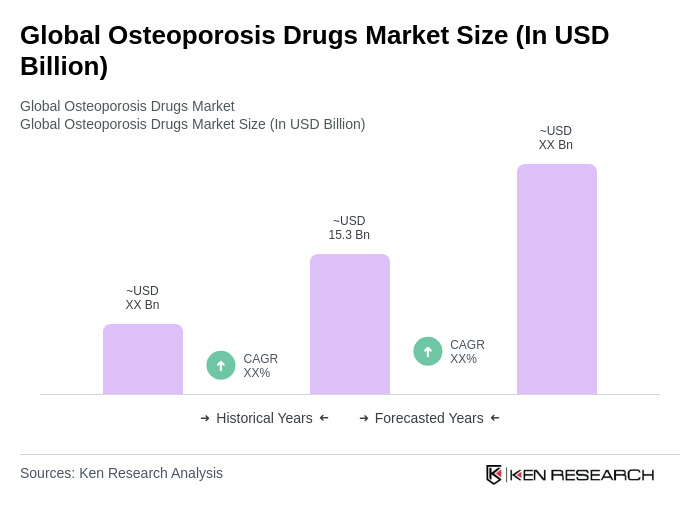
The Global Osteoporosis Drugs Market, valued at USD 15.3 billion, is poised for growth amid increasing osteoporosis cases, geriatric population rise, and biosimilar developments.

Region:Global

Author(s):Dev

Product Code:KRAA1542

Pages:97

Published On:August 2025
About the Report

Base Year 2024

Global Osteoporosis Drugs Market Overview

  • The Global Osteoporosis Drugs Market is valued at USD 15.3 billion, based on a five-year historical analysis. This value aligns with multiple industry datasets that place the market in the mid?teens billion range and reflects ongoing demand driven by pharmacologic management of fracture risk among postmenopausal women and older adults .
  • The United States, Europe, and Japan dominate the Global Osteoporosis Drugs Market due to advanced healthcare infrastructure, higher screening and treatment rates, and the presence of major companies. North America is frequently cited as the largest regional market, with Europe and developed Asia (including Japan) following, supported by high healthcare expenditure and established reimbursement pathways .
  • In 2023, the U.S. government implemented the "Osteoporosis Prevention and Treatment Act," aimed at increasing awareness and access to osteoporosis screening and treatment. This regulation mandates that healthcare providers offer osteoporosis screenings to women aged 65 and older, ensuring early detection and timely intervention for osteoporosis management.
Global Osteoporosis Drugs Market Size

Global Osteoporosis Drugs Market Segmentation

By Type:The market is segmented into various types of osteoporosis drugs, including Bisphosphonates, Selective Estrogen Receptor Modulators (SERMs), RANK Ligand Inhibitors, Parathyroid Hormone (PTH) Analogues, Sclerostin Inhibitors, Calcitonin, and Others. Among these, Bisphosphonates are the most widely used due to their proven efficacy in reducing fracture risk and their long-standing presence in the market. Authoritative market sources consistently report bisphosphonates as holding the largest share within product classes, supported by extensive clinical use and generic availability .
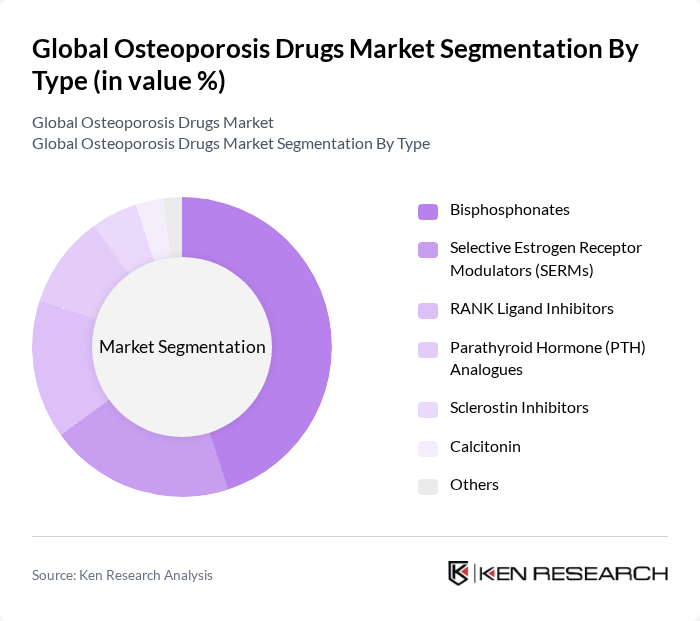
Global Osteoporosis Drugs Market segmentation by Type.

By End-User:The market is segmented by end-users, including Hospital Pharmacies, Retail Pharmacies, Online Pharmacies, and Specialty Clinics. Hospital Pharmacies dominate the market due to their ability to manage injectable biologics (e.g., denosumab) and oversee complex osteoporosis treatment regimens, with Retail and Online Pharmacies serving large volumes of oral bisphosphonates. Higher fracture-related admissions and coordinated post-fracture care pathways in hospitals further support higher dispensing through hospital channels .
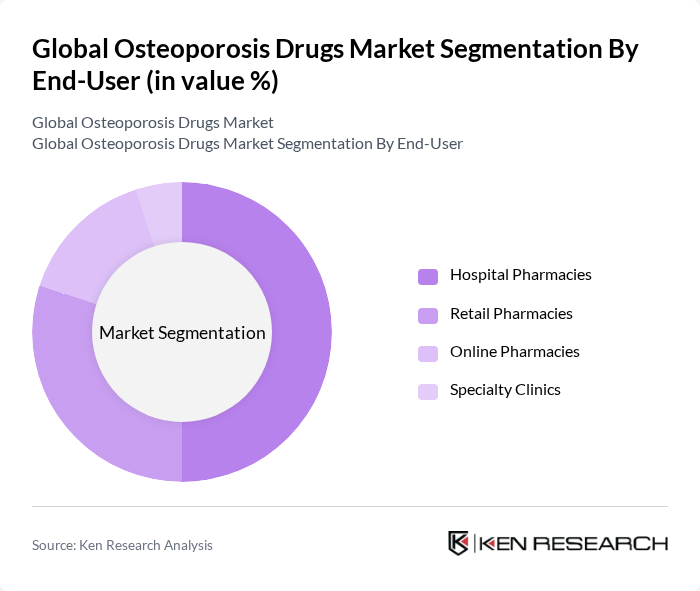
Global Osteoporosis Drugs Market segmentation by End-User.

Global Osteoporosis Drugs Market Competitive Landscape

The Global Osteoporosis Drugs Market is characterized by a dynamic mix of regional and international players. Leading participants such as Amgen Inc., Eli Lilly and Company, Merck & Co., Inc., Novartis AG, Pfizer Inc., Sanofi, Teva Pharmaceutical Industries Ltd., GSK plc, Takeda Pharmaceutical Company Limited, UCB S.A., Radius Health, Inc. (a Gurnet Point Capital company), Ipsen, Organon & Co., Viatris Inc., Dr. Reddy’s Laboratories Ltd. contribute to innovation, geographic expansion, and service delivery in this space. The therapeutic landscape spans antiresorptives (e.g., bisphosphonates, denosumab), anabolics (e.g., teriparatide, abaloparatide), and emerging mechanisms such as sclerostin inhibition, reflecting ongoing R&D investment and lifecycle management strategies across branded and generic portfolios .

Amgen Inc.

1980

Thousand Oaks, California, USA

Eli Lilly and Company

1876

Indianapolis, Indiana, USA

Merck & Co., Inc.

1891

Rahway, New Jersey, USA

Novartis AG

1996

Basel, Switzerland

Pfizer Inc.

1849

New York City, New York, USA

Company

Establishment Year

Headquarters

Revenue from Osteoporosis Portfolio (latest fiscal year, USD)

Geographic Coverage (countries/regions with active commercialization)

Pipeline Strength (number of phase II/III osteoporosis assets)

Market Share in Key Regions (North America, Europe, APAC)

Time-on-Market Advantage (years since first osteoporosis launch)

Pricing Strategy (branded vs. generic/biosimilar positioning)

Global Osteoporosis Drugs Market Industry Analysis

Growth Drivers

  • Increasing Prevalence of Osteoporosis:The global prevalence of osteoporosis is projected to reach approximately 300 million individuals in future, driven by factors such as aging populations and lifestyle changes. According to the World Health Organization, osteoporosis affects 1 in 3 women and 1 in 5 men over the age of 50. This rising incidence necessitates effective treatment options, thereby propelling the demand for osteoporosis drugs significantly in the None region.
  • Advancements in Drug Formulations:Recent innovations in drug formulations, including the development of long-acting injectable therapies, are enhancing treatment adherence and efficacy. For instance, the introduction of bisphosphonates and monoclonal antibodies has improved patient outcomes. The global market for osteoporosis drugs is expected to benefit from these advancements, with an estimated 20% increase in new drug approvals anticipated in future, according to the FDA.
  • Rising Geriatric Population:The geriatric population is expected to surpass 2 billion globally in future, with a significant proportion residing in the None region. This demographic shift is crucial, as older adults are at a higher risk for osteoporosis-related fractures. The increasing life expectancy, currently averaging 82 years, further emphasizes the need for effective osteoporosis management, driving market growth for osteoporosis drugs in the coming years.

Market Challenges

  • High Cost of Osteoporosis Drugs:The financial burden of osteoporosis medications remains a significant challenge, with annual treatment costs ranging from $2,000 to $4,000 per patient. This high cost can limit access for many individuals, particularly in lower-income demographics. As healthcare systems grapple with budget constraints, the affordability of these drugs poses a barrier to widespread adoption and treatment adherence in the None region.
  • Stringent Regulatory Approvals:The regulatory landscape for osteoporosis drugs is increasingly complex, with lengthy approval processes that can take several years. In future, the average time for drug approval is projected to be around 12 years, according to the FDA. This prolonged timeline can hinder the introduction of innovative therapies, limiting options for patients and slowing market growth in the None region.

Global Osteoporosis Drugs Market Future Outlook

The future of the osteoporosis drugs market appears promising, driven by ongoing advancements in drug development and a growing emphasis on personalized medicine. As healthcare providers increasingly adopt digital health solutions, patient engagement and monitoring will improve, enhancing treatment outcomes. Furthermore, the integration of telemedicine is expected to facilitate better management of osteoporosis, particularly in underserved areas, ensuring that more patients receive timely and effective care.

Market Opportunities

  • Development of Biosimilars:The emergence of biosimilars presents a significant opportunity for market expansion, as these alternatives can offer cost-effective treatment options. With the global biosimilars market projected to reach $70 billion in future, the introduction of biosimilar osteoporosis drugs could enhance accessibility and affordability for patients in the None region.
  • Expansion into Emerging Markets:Emerging markets are witnessing a rapid increase in osteoporosis cases, driven by urbanization and lifestyle changes. In future, these regions are expected to account for over 40% of the global osteoporosis drug market. Companies that strategically invest in these markets can tap into a growing patient base, enhancing their market presence and revenue potential.

Scope of the Report

SegmentSub-Segments
By Type

Bisphosphonates

Selective Estrogen Receptor Modulators (SERMs)

RANK Ligand Inhibitors

Parathyroid Hormone (PTH) Analogues

Sclerostin Inhibitors

Calcitonin

Others

By End-User

Hospital Pharmacies

Retail Pharmacies

Online Pharmacies

Specialty Clinics

By Route of Administration

Oral

Injectable (Subcutaneous/Intravenous)

Intranasal

By Distribution Channel

Hospital Pharmacies

Retail Pharmacies

Online Pharmacies

By Age Group

Adult (18–64 years)

Geriatric (65+ years)

By Drug Class

Anti-resorptive Agents (Bisphosphonates, SERMs, RANKL inhibitors, Calcitonin)

Anabolic Agents (PTH analogues, Sclerostin inhibitors)

Hormone Therapy

By Treatment Duration

Short-term

Long-term

Maintenance Therapy

Key Target Audience

Investors and Venture Capitalist Firms

Government and Regulatory Bodies (e.g., Food and Drug Administration, European Medicines Agency)

Pharmaceutical Manufacturers

Biotechnology Companies

Healthcare Providers and Hospitals

Pharmacy Benefit Managers

Health Insurance Companies

Clinical Research Organizations

Players Mentioned in the Report:

Amgen Inc.

Eli Lilly and Company

Merck & Co., Inc.

Novartis AG

Pfizer Inc.

Sanofi

Teva Pharmaceutical Industries Ltd.

GSK plc

Takeda Pharmaceutical Company Limited

UCB S.A.

Radius Health, Inc. (a Gurnet Point Capital company)

Ipsen

Organon & Co.

Viatris Inc.

Dr. Reddys Laboratories Ltd.

Table of Contents

Market Assessment Phase

1. Executive Summary and Approach


2. Global Osteoporosis Drugs Market Overview

2.1 Key Insights and Strategic Recommendations

2.2 Global Osteoporosis Drugs Market Overview

2.3 Definition and Scope

2.4 Evolution of Market Ecosystem

2.5 Timeline of Key Regulatory Milestones

2.6 Value Chain & Stakeholder Mapping

2.7 Business Cycle Analysis

2.8 Policy & Incentive Landscape


3. Global Osteoporosis Drugs Market Analysis

3.1 Growth Drivers

3.1.1 Increasing prevalence of osteoporosis
3.1.2 Advancements in drug formulations
3.1.3 Rising geriatric population
3.1.4 Growing awareness and education on bone health

3.2 Market Challenges

3.2.1 High cost of osteoporosis drugs
3.2.2 Stringent regulatory approvals
3.2.3 Side effects associated with treatments
3.2.4 Limited access in developing regions

3.3 Market Opportunities

3.3.1 Development of biosimilars
3.3.2 Expansion into emerging markets
3.3.3 Increased investment in R&D
3.3.4 Collaborations with healthcare providers

3.4 Market Trends

3.4.1 Shift towards personalized medicine
3.4.2 Integration of digital health solutions
3.4.3 Focus on preventive care
3.4.4 Rise in telemedicine for osteoporosis management

3.5 Government Regulation

3.5.1 Approval processes for new drugs
3.5.2 Pricing regulations
3.5.3 Guidelines for clinical trials
3.5.4 Policies promoting osteoporosis awareness

4. SWOT Analysis


5. Stakeholder Analysis


6. Porter's Five Forces Analysis


7. Global Osteoporosis Drugs Market Market Size, 2019-2024

7.1 By Value

7.2 By Volume

7.3 By Average Selling Price


8. Global Osteoporosis Drugs Market Segmentation

8.1 By Type

8.1.1 Bisphosphonates
8.1.2 Selective Estrogen Receptor Modulators (SERMs)
8.1.3 RANK Ligand Inhibitors
8.1.4 Parathyroid Hormone (PTH) Analogues
8.1.5 Sclerostin Inhibitors
8.1.6 Calcitonin
8.1.7 Others

8.2 By End-User

8.2.1 Hospital Pharmacies
8.2.2 Retail Pharmacies
8.2.3 Online Pharmacies
8.2.4 Specialty Clinics

8.3 By Route of Administration

8.3.1 Oral
8.3.2 Injectable (Subcutaneous/Intravenous)
8.3.3 Intranasal

8.4 By Distribution Channel

8.4.1 Hospital Pharmacies
8.4.2 Retail Pharmacies
8.4.3 Online Pharmacies

8.5 By Age Group

8.5.1 Adult (18–64 years)
8.5.2 Geriatric (65+ years)

8.6 By Drug Class

8.6.1 Anti-resorptive Agents (Bisphosphonates, SERMs, RANKL inhibitors, Calcitonin)
8.6.2 Anabolic Agents (PTH analogues, Sclerostin inhibitors)
8.6.3 Hormone Therapy

8.7 By Treatment Duration

8.7.1 Short-term
8.7.2 Long-term
8.7.3 Maintenance Therapy

9. Global Osteoporosis Drugs Market Competitive Analysis

9.1 Market Share of Key Players

9.2 Cross Comparison of Key Players

9.2.1 Portfolio Breadth (number of approved osteoporosis therapies)
9.2.2 Revenue from Osteoporosis Portfolio (latest fiscal year, USD)
9.2.3 Geographic Coverage (countries/regions with active commercialization)
9.2.4 Pipeline Strength (number of phase II/III osteoporosis assets)
9.2.5 Market Share in Key Regions (North America, Europe, APAC)
9.2.6 Time-on-Market Advantage (years since first osteoporosis launch)
9.2.7 Pricing Strategy (branded vs. generic/biosimilar positioning)
9.2.8 R&D Intensity (% of total revenue spent on R&D)
9.2.9 Sales Force Coverage (HCP reach in osteoporosis prescriber specialties)
9.2.10 Distribution Mix (hospital, retail, online share)
9.2.11 Patient Support Programs (access/adherence offerings)
9.2.12 Pharmacovigilance/Real-World Evidence Capabilities

9.3 SWOT Analysis of Top Players

9.4 Pricing Analysis

9.5 Detailed Profile of Major Companies

9.5.1 Amgen Inc.
9.5.2 Eli Lilly and Company
9.5.3 Merck & Co., Inc.
9.5.4 Novartis AG
9.5.5 Pfizer Inc.
9.5.6 Sanofi
9.5.7 Teva Pharmaceutical Industries Ltd.
9.5.8 GSK plc
9.5.9 Takeda Pharmaceutical Company Limited
9.5.10 UCB S.A.
9.5.11 Radius Health, Inc. (a Gurnet Point Capital company)
9.5.12 Ipsen
9.5.13 Organon & Co.
9.5.14 Viatris Inc.
9.5.15 Dr. Reddy’s Laboratories Ltd.

10. Global Osteoporosis Drugs Market End-User Analysis

10.1 Procurement Behavior of Key Ministries

10.1.1 Government health programs
10.1.2 Budget allocation for osteoporosis treatments
10.1.3 Collaboration with pharmaceutical companies

10.2 Corporate Spend on Infrastructure & Energy

10.2.1 Investment in healthcare facilities
10.2.2 Funding for osteoporosis research
10.2.3 Partnerships with healthcare providers

10.3 Pain Point Analysis by End-User Category

10.3.1 Accessibility of treatments
10.3.2 Affordability of medications
10.3.3 Awareness of osteoporosis

10.4 User Readiness for Adoption

10.4.1 Acceptance of new therapies
10.4.2 Training for healthcare professionals
10.4.3 Patient education initiatives

10.5 Post-Deployment ROI and Use Case Expansion

10.5.1 Long-term health outcomes
10.5.2 Cost savings from preventive care
10.5.3 Expansion into new patient demographics

11. Global Osteoporosis Drugs Market Future Size, 2025-2030

11.1 By Value

11.2 By Volume

11.3 By Average Selling Price


Go-To-Market Strategy Phase

1. Whitespace Analysis + Business Model Canvas

1.1 Market gaps identification

1.2 Value proposition development

1.3 Revenue model exploration

1.4 Customer segmentation analysis

1.5 Competitive landscape overview


2. Marketing and Positioning Recommendations

2.1 Branding strategies

2.2 Product USPs

2.3 Target audience identification

2.4 Communication strategies


3. Distribution Plan

3.1 Urban retail strategies

3.2 Rural NGO tie-ups

3.3 Online distribution channels


4. Channel & Pricing Gaps

4.1 Underserved routes

4.2 Pricing bands analysis

4.3 Competitor pricing comparison


5. Unmet Demand & Latent Needs

5.1 Category gaps

5.2 Consumer segments analysis

5.3 Emerging trends identification


6. Customer Relationship

6.1 Loyalty programs

6.2 After-sales service

6.3 Customer feedback mechanisms


7. Value Proposition

7.1 Sustainability initiatives

7.2 Integrated supply chains

7.3 Customer-centric approaches


8. Key Activities

8.1 Regulatory compliance

8.2 Branding efforts

8.3 Distribution setup


9. Entry Strategy Evaluation

9.1 Domestic Market Entry Strategy

9.1.1 Product mix considerations
9.1.2 Pricing band strategies
9.1.3 Packaging innovations

9.2 Export Entry Strategy

9.2.1 Target countries analysis
9.2.2 Compliance roadmap development

10. Entry Mode Assessment

10.1 Joint Ventures

10.2 Greenfield investments

10.3 Mergers & Acquisitions

10.4 Distributor Model


11. Capital and Timeline Estimation

11.1 Capital requirements

11.2 Timelines for market entry


12. Control vs Risk Trade-Off

12.1 Ownership considerations

12.2 Partnerships evaluation


13. Profitability Outlook

13.1 Breakeven analysis

13.2 Long-term sustainability strategies


14. Potential Partner List

14.1 Distributors

14.2 Joint Ventures

14.3 Acquisition targets


15. Execution Roadmap

15.1 Phased Plan for Market Entry

15.1.1 Market Setup
15.1.2 Market Entry
15.1.3 Growth Acceleration
15.1.4 Scale & Stabilize

15.2 Key Activities and Milestones

15.2.1 Activity timelines
15.2.2 Milestone tracking

Research Methodology

ApproachModellingSample

Phase 1: Approach1

Desk Research

  • Analysis of market reports from industry associations such as the International Osteoporosis Foundation
  • Review of published articles in peer-reviewed journals focusing on osteoporosis treatment advancements
  • Examination of regulatory documents and guidelines from health authorities like the FDA and EMA

Primary Research

  • Interviews with endocrinologists and rheumatologists specializing in osteoporosis management
  • Surveys conducted with pharmacists regarding prescription trends and patient demographics
  • Focus groups with patients to understand treatment experiences and medication adherence

Validation & Triangulation

  • Cross-validation of findings through multiple expert interviews to ensure consistency
  • Triangulation of data from clinical studies, market reports, and expert opinions
  • Sanity checks through feedback from a panel of healthcare professionals

Phase 2: Market Size Estimation1

Top-down Assessment

  • Estimation of total market size based on global healthcare expenditure on osteoporosis treatments
  • Segmentation of the market by drug class, including bisphosphonates, hormone therapy, and monoclonal antibodies
  • Incorporation of demographic data on osteoporosis prevalence among different age groups

Bottom-up Modeling

  • Collection of sales data from leading pharmaceutical companies producing osteoporosis drugs
  • Estimation of market share based on prescription volume and revenue from key products
  • Analysis of pricing strategies and reimbursement policies affecting drug accessibility

Forecasting & Scenario Analysis

  • Utilization of time-series analysis to project market growth based on historical data
  • Scenario modeling considering factors such as aging population and advancements in drug development
  • Development of best-case, worst-case, and most-likely scenarios through 2030

Phase 3: CATI Sample Composition1

Scope Item/SegmentSample SizeTarget Respondent Profiles
Endocrinologist Insights100Endocrinologists, Osteoporosis Specialists
Pharmacist Perspectives80Community Pharmacists, Hospital Pharmacists
Patient Experience Feedback150Osteoporosis Patients, Caregivers
Healthcare Provider Surveys120General Practitioners, Rheumatologists
Market Access Insights90Market Access Managers, Health Economists

Frequently Asked Questions

What is the current value of the Global Osteoporosis Drugs Market?

The Global Osteoporosis Drugs Market is valued at approximately USD 15.3 billion, reflecting a significant demand for pharmacologic management of fracture risk, particularly among postmenopausal women and older adults.

Which regions dominate the Global Osteoporosis Drugs Market?

What recent legislation has impacted osteoporosis treatment in the U.S.?

What are the main types of osteoporosis drugs available?

Other Regional/Country Reports

Indonesia Global Osteoporosis Drugs Market

Malaysia Global Osteoporosis Drugs Market

KSA Global Osteoporosis Drugs Market

APAC Global Osteoporosis Drugs Market

SEA Global Osteoporosis Drugs Market

Vietnam Global Osteoporosis Drugs Market

Why Buy From Us?

Refine Robust Result (RRR) Framework

What makes us stand out is that our consultants follow Robust, Refine and Result (RRR) methodology. Robust for clear definitions, approaches and sanity checking, Refine for differentiating respondents' facts and opinions, and Result for presenting data with story.

Our Reach Is Unmatched

We have set a benchmark in the industry by offering our clients with syndicated and customized market research reports featuring coverage of entire market as well as meticulous research and analyst insights.

Shifting the Research Paradigm

While we don't replace traditional research, we flip the method upside down. Our dual approach of Top Bottom & Bottom Top ensures quality deliverable by not just verifying company fundamentals but also looking at the sector and macroeconomic factors.

More Insights-Better Decisions

With one step in the future, our research team constantly tries to show you the bigger picture. We help with some of the tough questions you may encounter along the way: How is the industry positioned? Best marketing channel? KPI's of competitors? By aligning every element, we help maximize success.

Transparency and Trust

Our report gives you instant access to the answers and sources that other companies might choose to hide. We elaborate each steps of research methodology we have used and showcase you the sample size to earn your trust.

Round the Clock Support

If you need any support, we are here! We pride ourselves on universe strength, data quality, and quick, friendly, and professional service.

Why Clients Choose Us?

400000+
Reports in repository
150+
Consulting projects a year
100+
Analysts
8000+
Client Queries in 2022








