Global Oxygen Market

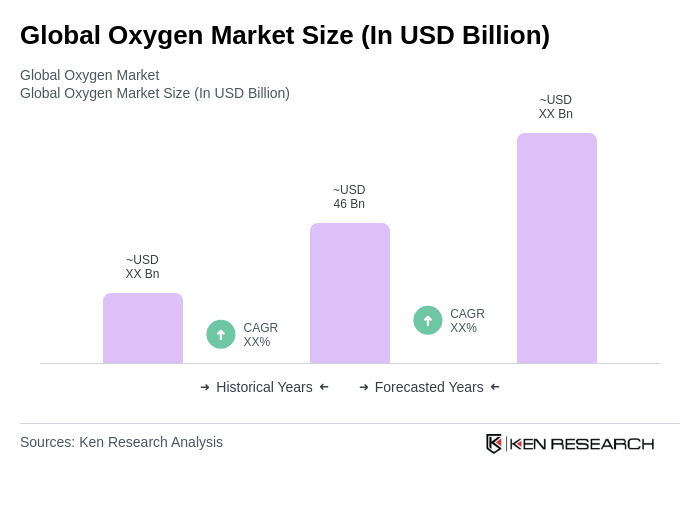
The Global Oxygen Market, valued at USD 46 billion, is driven by healthcare needs for respiratory care and industrial uses in steelmaking and chemicals, with key regions including US, Germany, and China.

Region:Global

Author(s):Shubham

Product Code:KRAC0575

Pages:86

Published On:August 2025
About the Report

Base Year 2024

Global Oxygen Market Overview

  • The Global Oxygen Market is valued at USD 46 billion, based on a five?year historical analysis. This valuation aligns with multiple industry sources that place recent market size in the mid?USD 40 billion range and reflect oxygen’s dual role across industrial and medical uses . The market is primarily driven by increasing demand from metals and mining/steelmaking, chemicals, and healthcare, alongside improvements in production technologies such as cryogenic air separation and pressure swing adsorption that enhance efficiency and lower delivered cost .
  • Key producers and consuming regions include the United States, Germany, and China, underpinned by large steel and chemicals bases and extensive healthcare infrastructure. Industrial demand remains the dominant share globally, with metals and mining accounting for roughly half of end?use in some industry assessments, while North America and Asia Pacific are leading regions for medical and industrial oxygen, respectively .
  • In the United States, medical oxygen is regulated as a prescription drug subject to FDA current good manufacturing practice (cGMP) requirements, labeling, and quality controls; FDA also issued pandemic?era guidances to strengthen supply reliability and purity oversight, and continues enforcement of drug?quality expectations for oxygen supplied to healthcare facilities .
Global Oxygen Market Size

Global Oxygen Market Segmentation

By Type:The oxygen market can be segmented into various types, including medical-grade oxygen, industrial oxygen, liquid oxygen (LOX), gaseous oxygen, compressed oxygen, on-site generated oxygen, and others. Each type serves distinct applications across healthcare and industrial sectors, with varying demand dynamics. Industrial oxygen and liquid oxygen are widely used in steelmaking and other high?temperature processes; medical-grade oxygen is produced and distributed under stringent quality standards; and on?site generated oxygen (PSA/VSA/VPSA) is increasingly adopted by hospitals and remote industrial sites to improve supply security and reduce logistics dependence .
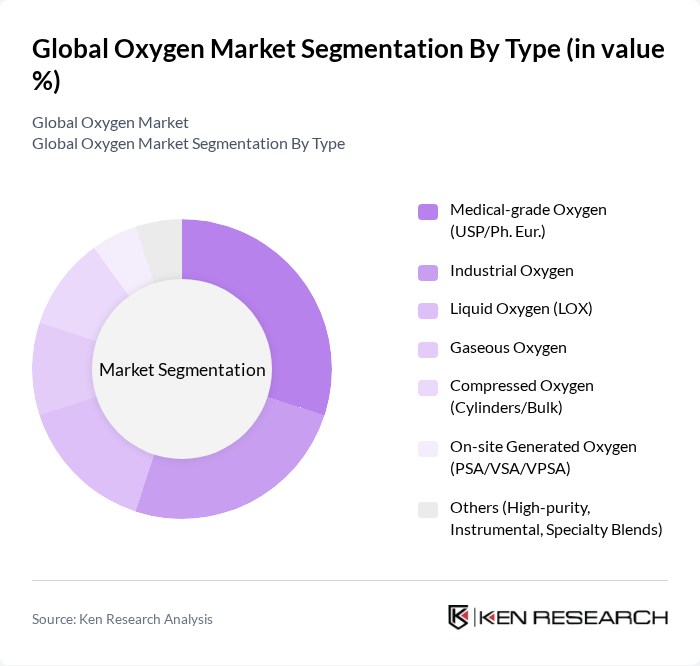
Global Oxygen Market segmentation by Type.

The medical-grade oxygen segment benefits from heightened respiratory care needs, with the oxygen therapy devices and services market itself sized in the mid?USD 30 billion range, reflecting sustained use in hospitals and homecare and ongoing investment after the pandemic period . Industrial oxygen remains the largest overall demand pool globally—driven by steel, chemicals, and refining—while healthcare demand continues to be structurally significant and resilient .

By End-User:The oxygen market can also be segmented by end-user applications, including healthcare providers, metals and metallurgy, chemicals and refining, electronics and semiconductors, food and beverage, pulp and paper, water and wastewater treatment, aerospace, and others. Each end-user segment has unique requirements and growth drivers. Metals and metallurgy rely on oxygen for basic oxygen furnaces and electric arc furnace enrichment; chemicals and refining use oxygen for oxidation processes; healthcare uses medical oxygen for acute and chronic respiratory care; electronics employs high?purity oxygen in fabrication; and water treatment utilizes oxygenation for biological processes .
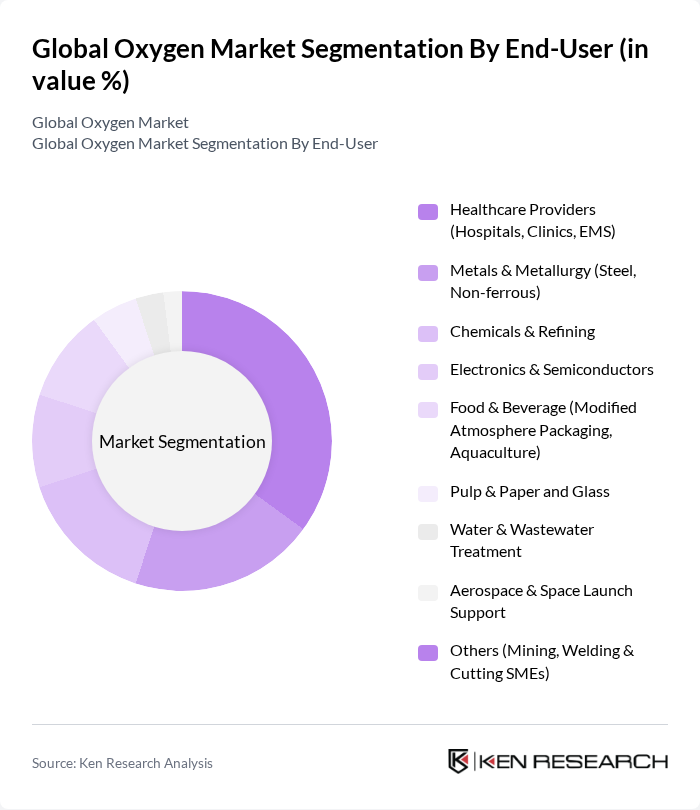
Global Oxygen Market segmentation by End-User.

The healthcare providers segment remains essential given the scale of oxygen therapy usage in inpatient and home settings, with suppliers and hospitals investing in bulk tanks, pipelines, and concentrators to improve resilience; concurrently, metals and metallurgy constitutes the largest industrial consumer, where oxygen boosts furnace efficiency and throughput .

Global Oxygen Market Competitive Landscape

The Global Oxygen Market is characterized by a dynamic mix of regional and international players. Leading participants such as Air Liquide S.A., Linde plc, Air Products and Chemicals, Inc., Messer Group GmbH, Taiyo Nippon Sanso Corporation, Matheson Tri-Gas, Inc. (MATHESON), Nippon Gases Europe, Airgas, Inc. (an Air Liquide company), Gulf Cryo, INOX Air Products Pvt. Ltd., Iwatani Corporation, Southern Industrial Gas Sdn. Bhd., Yingde Gases Group Company Limited, SOL Group (Società Ossigeno Liquido S.p.A.), PT Samator Indo Gas Tbk contribute to innovation, geographic expansion, and service delivery in this space.

Air Liquide S.A.

1902

Paris, France

Linde plc

1879

Woking, United Kingdom

Air Products and Chemicals, Inc.

1940

Allentown, Pennsylvania, USA

Messer Group GmbH

1898

Bad Soden am Taunus, Germany

Taiyo Nippon Sanso Corporation

1910

Tokyo, Japan

Company

Establishment Year

Headquarters

Segment Focus (Industrial, Medical, On-site, Homecare)

Oxygen Revenue and Growth (YoY/CAGR)

Installed Production Capacity (TPD/KT per year)

Geographic Footprint (Regions/Countries served)

Contract Backlog and Tonnage Pipeline Clients

Production Efficiency (Energy intensity kWh/Nm³; Plant uptime)

Global Oxygen Market Industry Analysis

Growth Drivers

  • Increasing Demand in Healthcare Sector:The healthcare sector's demand for oxygen is projected to reachin future, driven by the rising prevalence of respiratory diseases. According to the World Health Organization, approximatelypeople suffer from asthma globally, necessitating increased oxygen supply.Additionally, the aging population, which is expected to reachpeople aged 65 years or over, further fuels the need for medical oxygen, enhancing market growth in this segment.
  • Industrial Applications in Metal Fabrication:The metal fabrication industry is a significant consumer of oxygen, utilizing aroundannually for processes like cutting and welding.The global metal fabrication market is anticipated to grow toin future, with oxygen playing a crucial role in enhancing efficiency and quality. This growth is supported by increased infrastructure projects and manufacturing activities, particularly in emerging economies, driving demand for industrial oxygen.
  • Technological Advancements in Production:Innovations in oxygen production technologies, such as pressure swing adsorption (PSA) and cryogenic distillation, have improved efficiency and reduced costs. The global oxygen production technology market is expected to grow toin future. These advancements enable manufacturers to produce higher purity oxygen at lower operational costs, thus expanding the market's reach across various sectors, including healthcare and industrial applications.

Market Challenges

  • High Production Costs:The production of oxygen involves significant capital investment, with costs estimated atper ton for cryogenic plants. Fluctuations in energy prices, particularly natural gas, which accounts forof production costs, pose a challenge. In future, energy prices are projected to remain volatile, impacting overall profitability and hindering market expansion, especially for smaller producers.
  • Regulatory Compliance Issues:The oxygen market faces stringent regulatory requirements, particularly in healthcare applications. Compliance with safety standards, such as those set by the FDA and OSHA, can incur costs exceedingfor facilities. In future, increased scrutiny on environmental regulations may further complicate compliance, leading to potential fines and operational disruptions, which can deter new entrants into the market.

Global Oxygen Market Future Outlook

The future of the oxygen market appears promising, driven by the increasing integration of advanced technologies and a growing focus on sustainability. As healthcare demands rise, particularly in home care settings, the market is likely to see innovations in oxygen delivery systems. Additionally, the shift towards sustainable production methods will enhance operational efficiencies, making oxygen more accessible. The expansion into emerging markets will further bolster growth, creating a dynamic landscape for industry players.

Market Opportunities

  • Expansion in Emerging Markets:Emerging markets, particularly in Asia and Africa, are witnessing rapid urbanization and industrialization, leading to increased oxygen demand. By future, these regions are expected to account forof global oxygen consumption, presenting significant growth opportunities for suppliers looking to establish a foothold in these developing economies.
  • Innovations in Oxygen Delivery Systems:The development of portable and efficient oxygen delivery systems is gaining traction, particularly in home healthcare. The market for portable oxygen concentrators is projected to reachin future, driven by technological advancements and an aging population. This innovation presents a lucrative opportunity for companies to cater to the growing demand for at-home oxygen therapy solutions.

Scope of the Report

SegmentSub-Segments
By Type

Medical-grade Oxygen (USP/Ph. Eur.)

Industrial Oxygen

Liquid Oxygen (LOX)

Gaseous Oxygen

Compressed Oxygen (Cylinders/Bulk)

On-site Generated Oxygen (PSA/VSA/VPSA)

Others (High-purity, Instrumental, Specialty Blends)

By End-User

Healthcare Providers (Hospitals, Clinics, EMS)

Metals & Metallurgy (Steel, Non-ferrous)

Chemicals & Refining

Electronics & Semiconductors

Food & Beverage (Modified Atmosphere Packaging, Aquaculture)

Pulp & Paper and Glass

Water & Wastewater Treatment

Aerospace & Space Launch Support

Others (Mining, Welding & Cutting SMEs)

By Application

Respiratory Therapy & Anesthesia

Combustion Enhancement & Oxy-fuel Cutting/Welding

Steelmaking (BOF/EAF) and Direct Reduction

Chemical Synthesis & Oxidation

Environmental Applications (Ozone generation, Aeration)

Cryogenic Propellant Oxidizer (LOX for Aerospace)

R&D and Laboratory Use

Others

By Distribution Channel

On-site Pipeline Supply (Large tonnage)

Bulk Liquid Delivery (Tankers/ISO tanks)

Packaged Gas (Cylinders/Bundles)

Equipment & Homecare Providers (Concentrators/LOX systems)

Distributors/Dealers

E-commerce/Direct Ordering Portals

Others

By Region

North America

Europe

Asia-Pacific

Latin America

Middle East & Africa

Others

By Pricing Strategy

Contract/Tonnage Pricing (Pipeline/Bulk)

Cylinder/Packaged Gas Pricing

Value-based Pricing (Purity, Reliability, Service SLAs)

Dynamic/Fuel Surcharge-linked Pricing

Others

By Regulatory Compliance

ISO 7396, ISO 20486, ISO 8573, ISO 14175

FDA/EMA/Pharmacopoeia Standards for Medical Oxygen

Environmental Regulations (GHG, energy efficiency)

Occupational Safety Standards (OSHA, ATEX, ADR)

Others

Key Target Audience

Investors and Venture Capitalist Firms

Government and Regulatory Bodies (e.g., Environmental Protection Agency, Food and Drug Administration)

Manufacturers and Producers

Healthcare Providers and Hospitals

Industrial Gas Suppliers

Research and Development Organizations

Logistics and Supply Chain Companies

Pharmaceutical Companies

Players Mentioned in the Report:

Air Liquide S.A.

Linde plc

Air Products and Chemicals, Inc.

Messer Group GmbH

Taiyo Nippon Sanso Corporation

Matheson Tri-Gas, Inc. (MATHESON)

Nippon Gases Europe

Airgas, Inc. (an Air Liquide company)

Gulf Cryo

INOX Air Products Pvt. Ltd.

Iwatani Corporation

Southern Industrial Gas Sdn. Bhd.

Yingde Gases Group Company Limited

SOL Group (Societa Ossigeno Liquido S.p.A.)

PT Samator Indo Gas Tbk

Table of Contents

Market Assessment Phase

1. Executive Summary and Approach


2. Global Oxygen Market Overview

2.1 Key Insights and Strategic Recommendations

2.2 Global Oxygen Market Overview

2.3 Definition and Scope

2.4 Evolution of Market Ecosystem

2.5 Timeline of Key Regulatory Milestones

2.6 Value Chain & Stakeholder Mapping

2.7 Business Cycle Analysis

2.8 Policy & Incentive Landscape


3. Global Oxygen Market Analysis

3.1 Growth Drivers

3.1.1 Increasing Demand in Healthcare Sector
3.1.2 Industrial Applications in Metal Fabrication
3.1.3 Rising Awareness of Air Quality
3.1.4 Technological Advancements in Production

3.2 Market Challenges

3.2.1 High Production Costs
3.2.2 Regulatory Compliance Issues
3.2.3 Supply Chain Disruptions
3.2.4 Competition from Alternative Products

3.3 Market Opportunities

3.3.1 Expansion in Emerging Markets
3.3.2 Innovations in Oxygen Delivery Systems
3.3.3 Partnerships with Healthcare Providers
3.3.4 Increasing Use in Water Treatment

3.4 Market Trends

3.4.1 Shift Towards Sustainable Production Methods
3.4.2 Growth of Home Healthcare Services
3.4.3 Integration of IoT in Oxygen Monitoring
3.4.4 Rising Demand for Medical Oxygen Concentrators

3.5 Government Regulation

3.5.1 Emission Standards for Production Facilities
3.5.2 Safety Regulations for Medical Use
3.5.3 Incentives for Green Production Technologies
3.5.4 Import/Export Regulations on Oxygen Products

4. SWOT Analysis


5. Stakeholder Analysis


6. Porter's Five Forces Analysis


7. Global Oxygen Market Market Size, 2019-2024

7.1 By Value

7.2 By Volume

7.3 By Average Selling Price


8. Global Oxygen Market Segmentation

8.1 By Type

8.1.1 Medical-grade Oxygen (USP/Ph. Eur.)
8.1.2 Industrial Oxygen
8.1.3 Liquid Oxygen (LOX)
8.1.4 Gaseous Oxygen
8.1.5 Compressed Oxygen (Cylinders/Bulk)
8.1.6 On-site Generated Oxygen (PSA/VSA/VPSA)
8.1.7 Others (High-purity, Instrumental, Specialty Blends)

8.2 By End-User

8.2.1 Healthcare Providers (Hospitals, Clinics, EMS)
8.2.2 Metals & Metallurgy (Steel, Non-ferrous)
8.2.3 Chemicals & Refining
8.2.4 Electronics & Semiconductors
8.2.5 Food & Beverage (Modified Atmosphere Packaging, Aquaculture)
8.2.6 Pulp & Paper and Glass
8.2.7 Water & Wastewater Treatment
8.2.8 Aerospace & Space Launch Support
8.2.9 Others (Mining, Welding & Cutting SMEs)

8.3 By Application

8.3.1 Respiratory Therapy & Anesthesia
8.3.2 Combustion Enhancement & Oxy-fuel Cutting/Welding
8.3.3 Steelmaking (BOF/EAF) and Direct Reduction
8.3.4 Chemical Synthesis & Oxidation
8.3.5 Environmental Applications (Ozone generation, Aeration)
8.3.6 Cryogenic Propellant Oxidizer (LOX for Aerospace)
8.3.7 R&D and Laboratory Use
8.3.8 Others

8.4 By Distribution Channel

8.4.1 On-site Pipeline Supply (Large tonnage)
8.4.2 Bulk Liquid Delivery (Tankers/ISO tanks)
8.4.3 Packaged Gas (Cylinders/Bundles)
8.4.4 Equipment & Homecare Providers (Concentrators/LOX systems)
8.4.5 Distributors/Dealers
8.4.6 E-commerce/Direct Ordering Portals
8.4.7 Others

8.5 By Region

8.5.1 North America
8.5.2 Europe
8.5.3 Asia-Pacific
8.5.4 Latin America
8.5.5 Middle East & Africa
8.5.6 Others

8.6 By Pricing Strategy

8.6.1 Contract/Tonnage Pricing (Pipeline/Bulk)
8.6.2 Cylinder/Packaged Gas Pricing
8.6.3 Value-based Pricing (Purity, Reliability, Service SLAs)
8.6.4 Dynamic/Fuel Surcharge-linked Pricing
8.6.5 Others

8.7 By Regulatory Compliance

8.7.1 ISO 7396, ISO 20486, ISO 8573, ISO 14175
8.7.2 FDA/EMA/Pharmacopoeia Standards for Medical Oxygen
8.7.3 Environmental Regulations (GHG, energy efficiency)
8.7.4 Occupational Safety Standards (OSHA, ATEX, ADR)
8.7.5 Others

9. Global Oxygen Market Competitive Analysis

9.1 Market Share of Key Players

9.2 Cross Comparison of Key Players

9.2.1 Company Name
9.2.2 Segment Focus (Industrial, Medical, On-site, Homecare)
9.2.3 Oxygen Revenue and Growth (YoY/CAGR)
9.2.4 Installed Production Capacity (TPD/KT per year)
9.2.5 Geographic Footprint (Regions/Countries served)
9.2.6 Contract Backlog and Tonnage Pipeline Clients
9.2.7 Production Efficiency (Energy intensity kWh/Nm³; Plant uptime)
9.2.8 Distribution Network Strength (Bulk, cylinders, pipeline nodes)
9.2.9 Purity Range & Product Mix (LOX, GOX, high-purity)
9.2.10 Innovation & Capex Intensity (ASU builds, PSA/VSA deployments)
9.2.11 Safety and Quality KPIs (TRIR, compliance audits, recalls)
9.2.12 ESG Metrics (Scope 1/2 intensity, green power share)

9.3 SWOT Analysis of Top Players

9.4 Pricing Analysis

9.5 Detailed Profile of Major Companies

9.5.1 Air Liquide S.A.
9.5.2 Linde plc
9.5.3 Air Products and Chemicals, Inc.
9.5.4 Messer Group GmbH
9.5.5 Taiyo Nippon Sanso Corporation
9.5.6 Matheson Tri-Gas, Inc. (MATHESON)
9.5.7 Nippon Gases Europe
9.5.8 Airgas, Inc. (an Air Liquide company)
9.5.9 Gulf Cryo
9.5.10 INOX Air Products Pvt. Ltd.
9.5.11 Iwatani Corporation
9.5.12 Southern Industrial Gas Sdn. Bhd.
9.5.13 Yingde Gases Group Company Limited
9.5.14 SOL Group (Società Ossigeno Liquido S.p.A.)
9.5.15 PT Samator Indo Gas Tbk

10. Global Oxygen Market End-User Analysis

10.1 Procurement Behavior of Key Ministries

10.1.1 Government Procurement Policies
10.1.2 Budget Allocations for Healthcare
10.1.3 Regulatory Compliance in Procurement
10.1.4 Supplier Selection Criteria

10.2 Corporate Spend on Infrastructure & Energy

10.2.1 Investment in Healthcare Infrastructure
10.2.2 Spending on Industrial Applications
10.2.3 Budget for Environmental Projects

10.3 Pain Point Analysis by End-User Category

10.3.1 Healthcare Sector Challenges
10.3.2 Industrial Sector Pain Points
10.3.3 Regulatory Compliance Issues

10.4 User Readiness for Adoption

10.4.1 Awareness of Oxygen Products
10.4.2 Training and Support Needs
10.4.3 Financial Readiness for Investment

10.5 Post-Deployment ROI and Use Case Expansion

10.5.1 Measurement of ROI in Healthcare
10.5.2 Expansion Opportunities in Industrial Use
10.5.3 Long-term Sustainability Considerations

11. Global Oxygen Market Future Size, 2025-2030

11.1 By Value

11.2 By Volume

11.3 By Average Selling Price


Go-To-Market Strategy Phase

1. Whitespace Analysis + Business Model Canvas

1.1 Market Gaps Identification

1.2 Business Model Development


2. Marketing and Positioning Recommendations

2.1 Branding Strategies

2.2 Product USPs


3. Distribution Plan

3.1 Urban Retail Strategies

3.2 Rural NGO Tie-ups


4. Channel & Pricing Gaps

4.1 Underserved Routes

4.2 Pricing Bands Analysis


5. Unmet Demand & Latent Needs

5.1 Category Gaps

5.2 Consumer Segments


6. Customer Relationship

6.1 Loyalty Programs

6.2 After-sales Service


7. Value Proposition

7.1 Sustainability Initiatives

7.2 Integrated Supply Chains


8. Key Activities

8.1 Regulatory Compliance

8.2 Branding Efforts

8.3 Distribution Setup


9. Entry Strategy Evaluation

9.1 Domestic Market Entry Strategy

9.1.1 Product Mix Considerations
9.1.2 Pricing Band Strategy
9.1.3 Packaging Solutions

9.2 Export Entry Strategy

9.2.1 Target Countries Identification
9.2.2 Compliance Roadmap Development

10. Entry Mode Assessment

10.1 Joint Ventures

10.2 Greenfield Investments

10.3 Mergers & Acquisitions

10.4 Distributor Model Evaluation


11. Capital and Timeline Estimation

11.1 Capital Requirements

11.2 Timelines for Implementation


12. Control vs Risk Trade-Off

12.1 Ownership Considerations

12.2 Partnerships Evaluation


13. Profitability Outlook

13.1 Breakeven Analysis

13.2 Long-term Sustainability Strategies


14. Potential Partner List

14.1 Distributors

14.2 Joint Ventures

14.3 Acquisition Targets


15. Execution Roadmap

15.1 Phased Plan for Market Entry

15.1.1 Market Setup
15.1.2 Market Entry
15.1.3 Growth Acceleration
15.1.4 Scale & Stabilize

15.2 Key Activities and Milestones

15.2.1 Milestone Planning
15.2.2 Activity Tracking

Research Methodology

ApproachModellingSample

Phase 1: Approach1

Desk Research

  • Analysis of global oxygen production statistics from industry reports and market databases
  • Review of academic journals and publications on oxygen applications in various sectors
  • Examination of regulatory frameworks and environmental policies impacting the oxygen market

Primary Research

  • Interviews with executives from major oxygen production companies
  • Surveys targeting healthcare professionals regarding medical oxygen usage
  • Field interviews with industrial gas distributors and end-users in manufacturing

Validation & Triangulation

  • Cross-validation of findings through multiple industry reports and expert opinions
  • Triangulation of data from production, consumption, and pricing trends
  • Sanity checks conducted through expert panel discussions and feedback sessions

Phase 2: Market Size Estimation1

Top-down Assessment

  • Estimation of global oxygen market size based on GDP growth and industrial output
  • Segmentation by application areas such as healthcare, metallurgy, and water treatment
  • Incorporation of regional market dynamics and demand forecasts

Bottom-up Modeling

  • Collection of production data from leading oxygen manufacturers and suppliers
  • Estimation of market share based on sales volume and revenue figures
  • Analysis of pricing strategies and cost structures across different market segments

Forecasting & Scenario Analysis

  • Utilization of time-series analysis to project future demand trends
  • Scenario modeling based on technological advancements and regulatory changes
  • Development of baseline, optimistic, and pessimistic forecasts through 2030

Phase 3: CATI Sample Composition1

Scope Item/SegmentSample SizeTarget Respondent Profiles
Healthcare Oxygen Supply120Hospital Administrators, Medical Equipment Suppliers
Industrial Gas Applications100Manufacturing Managers, Process Engineers
Aquaculture Oxygen Usage80Aquaculture Farm Operators, Environmental Scientists
Metallurgical Oxygen Demand70Metallurgists, Production Supervisors
Research and Development in Oxygen Technologies60R&D Managers, Innovation Directors

Frequently Asked Questions

What is the current valuation of the Global Oxygen Market?

The Global Oxygen Market is valued at approximately USD 46 billion, reflecting its significant role in both industrial and medical applications. This valuation is supported by various industry analyses that indicate a consistent market size in the mid-USD 40 billion range.

What are the primary drivers of the Global Oxygen Market?

Which regions are the largest producers and consumers of oxygen?

How is medical oxygen regulated in the United States?

Other Regional/Country Reports

Indonesia Global Oxygen Market

Malaysia Global Oxygen Market

KSA Global Oxygen Market

APAC Global Oxygen Market

SEA Global Oxygen Market

Vietnam Global Oxygen Market

Why Buy From Us?

Refine Robust Result (RRR) Framework

What makes us stand out is that our consultants follow Robust, Refine and Result (RRR) methodology. Robust for clear definitions, approaches and sanity checking, Refine for differentiating respondents' facts and opinions, and Result for presenting data with story.

Our Reach Is Unmatched

We have set a benchmark in the industry by offering our clients with syndicated and customized market research reports featuring coverage of entire market as well as meticulous research and analyst insights.

Shifting the Research Paradigm

While we don't replace traditional research, we flip the method upside down. Our dual approach of Top Bottom & Bottom Top ensures quality deliverable by not just verifying company fundamentals but also looking at the sector and macroeconomic factors.

More Insights-Better Decisions

With one step in the future, our research team constantly tries to show you the bigger picture. We help with some of the tough questions you may encounter along the way: How is the industry positioned? Best marketing channel? KPI's of competitors? By aligning every element, we help maximize success.

Transparency and Trust

Our report gives you instant access to the answers and sources that other companies might choose to hide. We elaborate each steps of research methodology we have used and showcase you the sample size to earn your trust.

Round the Clock Support

If you need any support, we are here! We pride ourselves on universe strength, data quality, and quick, friendly, and professional service.

Why Clients Choose Us?

400000+
Reports in repository
150+
Consulting projects a year
100+
Analysts
8000+
Client Queries in 2022








