Ken Research Logo

Global Pad Mounted Transformer Market

Global Pad Mounted Transformer Market, valued at USD 11-12 billion, grows with demand for efficient transformers in utilities, commercial, and residential sectors amid renewable energy expansion.

Region:Global

Author(s):Dev

Product Code:KRAB0491

Pages:90

Published On:August 2025

About the Report

Base Year 2024

Global Pad Mounted Transformer Market Overview

  • The Global Pad Mounted Transformer Market is valued at approximately USD 11.0–12.0 billion, based on a five-year analysis. Demand reflects modernization of distribution networks, urban build-outs, and distributed energy integration across utilities, commercial sites, campuses, and residential developments .
  • Key players in this market include the United States, China, and Germany, driven by grid modernization programs, smart grid deployments, and high penetration of renewable generation and underground distribution in dense urban areas; these countries also host major OEM manufacturing and technology hubs that support pad-mounted product leadership .
  • In the United States, energy-efficiency requirements for distribution transformers are governed by the U.S. Department of Energy’s 2016 energy conservation standards (in effect since 2016) and updated 2023 final rule with a 2027 compliance date; while not limited only to new construction, these standards drive adoption of higher-efficiency transformers in new and replacement applications across the country .

Global Pad Mounted Transformer Market Segmentation

By Type:The market is segmented into various types of pad-mounted transformers, including single-phase and three-phase transformers, as well as oil-immersed, fluid-filled, and dry-type transformers. Each type serves specific applications and customer needs, with varying levels of efficiency and environmental impact. Utilities and commercial campuses typically deploy three-phase units for medium-voltage distribution and larger loads, while single-phase units are common for residential subdivisions; liquid-filled (mineral oil and natural/synthetic esters) dominate due to thermal performance and footprint advantages, with ester fluids gaining share for fire safety and environmental compliance; dry-type pad-mounted remains niche where fluid-free designs are specified .
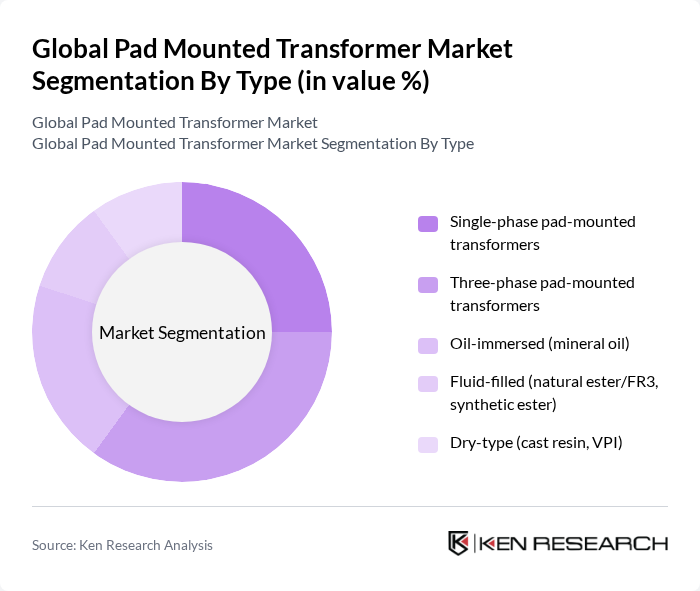
Global Pad Mounted Transformer Market segmentation by Type.

By End-User:The end-user segmentation includes residential and multi-dwelling units, commercial sectors such as retail and data centers, industrial applications, and utilities. Each segment has unique requirements and contributes differently to the overall market dynamics. Utilities drive base demand through grid expansions and replacements; commercial/data center campuses and EV-charging hubs increasingly specify pad-mounted designs for safety, aesthetics, and underground cabling; residential subdivisions and MDUs favor pad-mounted for tamper resistance and compact siting .
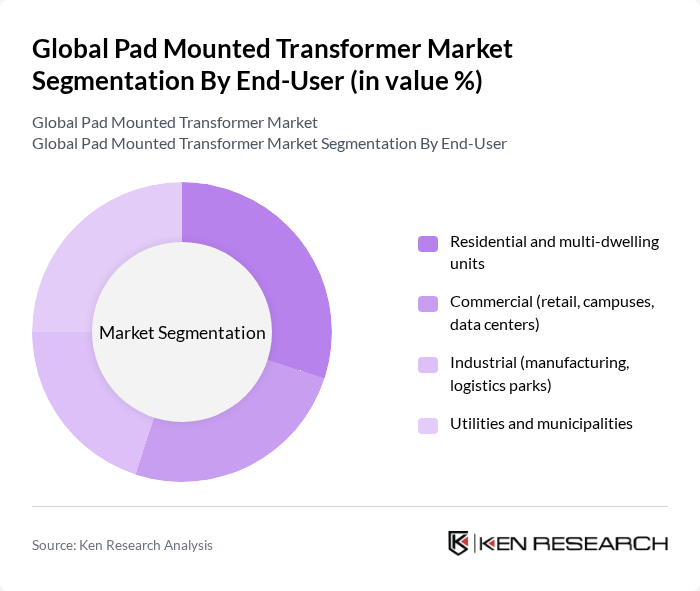
Global Pad Mounted Transformer Market segmentation by End-User.

Global Pad Mounted Transformer Market Competitive Landscape

The Global Pad Mounted Transformer Market is characterized by a dynamic mix of regional and international players. Leading participants such as Schneider Electric SE, Siemens Energy AG, ABB Ltd., Eaton Corporation plc, General Electric (GE Vernova, Grid Solutions), Mitsubishi Electric Corporation, Toshiba Energy Systems & Solutions Corporation, Hitachi Energy Ltd., SGB-SMIT Group, CG Power and Industrial Solutions Limited, Howard Industries, Inc., SPX Technologies, Inc. (SPX Transformer Solutions), Eaton’s Cooper Power Systems (Pad-mounted distribution), ERMCO, Inc. (a subsidiary of AECI), WEG S.A. contribute to innovation, geographic expansion, and service delivery in this space .

Schneider Electric SE

1836

Rueil-Malmaison, France

Siemens Energy AG

2020

Munich, Germany

ABB Ltd.

1988

Zurich, Switzerland

Eaton Corporation plc

1911

Dublin, Ireland

General Electric (GE Vernova, Grid Solutions)

1892

Boston, Massachusetts, USA

Company

Establishment Year

Headquarters

Group Size (Global diversified OEM, Regional OEM, Niche/specialist)

Pad-mounted transformer revenue (latest FY, USD)

CAGR of pad-mounted segment (3–5 years)

Regional footprint (No. of manufacturing sites/regions served)

Product portfolio breadth (phase, rating, fluids, smart features)

Certifications/compliance (DOE/CEC, IEC/IEEE, eco-fluids)

Global Pad Mounted Transformer Market Industry Analysis

Growth Drivers

  • Increasing Demand for Reliable Power Supply:The global demand for reliable power supply is projected to reach 27,000 TWh in the future, driven by industrial growth and urbanization. Countries like India and China are investing heavily in their power infrastructure, with India allocating $22 billion for power distribution improvements. This surge in energy consumption necessitates efficient transformers, propelling the pad mounted transformer market as utilities seek to enhance grid reliability and reduce outages.
  • Expansion of Renewable Energy Projects:The renewable energy sector is expected to attract $550 billion in investments globally in the future, with solar and wind projects leading the charge. As countries aim to meet their renewable energy targets, the integration of pad mounted transformers becomes crucial for connecting these energy sources to the grid. For instance, the U.S. plans to add 120 GW of solar capacity, necessitating robust transformer solutions to manage increased energy flow.
  • Technological Advancements in Transformer Design:Innovations in transformer technology, such as the development of more compact and efficient designs, are set to enhance market growth. The introduction of smart transformers, which can monitor and optimize performance, is expected to increase by 35% in the future. These advancements not only improve energy efficiency but also reduce operational costs, making pad mounted transformers more attractive to utilities and commercial users.

Market Challenges

  • High Initial Investment Costs:The initial capital required for pad mounted transformers can be substantial, often exceeding $55,000 per unit. This high upfront cost can deter smaller utilities and businesses from investing in necessary infrastructure upgrades. Additionally, the long payback period associated with these investments can further complicate financial planning, especially in regions with limited budgets for energy projects.
  • Regulatory Compliance Complexities:Navigating the regulatory landscape can be challenging for manufacturers and utilities. Compliance with various international standards, such as IEC 60076, can require significant resources and expertise. In the future, it is estimated that compliance costs could account for up to 18% of total project budgets, complicating the deployment of new transformer technologies and potentially delaying project timelines.

Global Pad Mounted Transformer Market Future Outlook

The future of the pad mounted transformer market appears promising, driven by the increasing integration of renewable energy sources and advancements in smart grid technologies. As utilities focus on enhancing grid resilience and efficiency, the demand for innovative transformer solutions is expected to rise. Furthermore, the ongoing urbanization and infrastructure development in emerging markets will create additional opportunities for growth, positioning the industry for significant advancements in the coming years.

Market Opportunities

  • Growth in Electric Vehicle Infrastructure:The electric vehicle (EV) market is projected to grow to 35 million units in the future, necessitating robust charging infrastructure. This growth presents a significant opportunity for pad mounted transformers, which are essential for managing the increased electrical load at charging stations, ensuring efficient energy distribution and reliability.
  • Smart Grid Technology Integration:The global smart grid market is expected to reach $120 billion in the future, driven by the need for improved energy management. The integration of pad mounted transformers into smart grid systems will enhance monitoring and control capabilities, allowing for better load management and energy efficiency, thus creating a lucrative opportunity for manufacturers.

Scope of the Report

SegmentSub-Segments
By Type

Single-phase pad-mounted transformers

Three-phase pad-mounted transformers

Oil-immersed (mineral oil)

Fluid-filled (natural ester/FR3, synthetic ester)

Dry-type (cast resin, VPI)

By End-User

Residential and multi-dwelling units

Commercial (retail, campuses, data centers)

Industrial (manufacturing, logistics parks)

Utilities and municipalities

By Application

Power distribution and secondary networks

Renewable interconnection (solar PV, wind collector systems)

Electric vehicle charging infrastructure

Underground distribution and urban networks

By Power Rating

?500 kVA

–2,500 kVA

,501–5,000 kVA

>5,000 kVA

By Insulation & Cooling

Mineral oil, ONAN

Natural ester (biodegradable), ONAN

Synthetic ester/FR fluids, KNAN

Dry-type, AN/AF

By Configuration

Loop feed

Radial feed

Compartmentalized tamper-proof

Pad-mounted switchgear-integrated

By Voltage Class

?15 kV

–25 kV

–35 kV

>35 kV (special applications)

Key Target Audience

Investors and Venture Capitalist Firms

Government and Regulatory Bodies (e.g., U.S. Department of Energy, International Energy Agency)

Manufacturers and Producers

Utility Companies

Energy Management Firms

Infrastructure Development Agencies

Environmental Protection Agencies

Power Generation Companies

Players Mentioned in the Report:

Schneider Electric SE

Siemens Energy AG

ABB Ltd.

Eaton Corporation plc

General Electric (GE Vernova, Grid Solutions)

Mitsubishi Electric Corporation

Toshiba Energy Systems & Solutions Corporation

Hitachi Energy Ltd.

SGB-SMIT Group

CG Power and Industrial Solutions Limited

Howard Industries, Inc.

SPX Technologies, Inc. (SPX Transformer Solutions)

Eatons Cooper Power Systems (Pad-mounted distribution)

ERMCO, Inc. (a subsidiary of AECI)

WEG S.A.

Table of Contents

Market Assessment Phase

1. Executive Summary and Approach


2. Global Pad Mounted Transformer Market Overview

2.1 Key Insights and Strategic Recommendations

2.2 Global Pad Mounted Transformer Market Overview

2.3 Definition and Scope

2.4 Evolution of Market Ecosystem

2.5 Timeline of Key Regulatory Milestones

2.6 Value Chain & Stakeholder Mapping

2.7 Business Cycle Analysis

2.8 Policy & Incentive Landscape


3. Global Pad Mounted Transformer Market Analysis

3.1 Growth Drivers

3.1.1 Increasing demand for reliable power supply
3.1.2 Expansion of renewable energy projects
3.1.3 Urbanization and infrastructure development
3.1.4 Technological advancements in transformer design

3.2 Market Challenges

3.2.1 High initial investment costs
3.2.2 Regulatory compliance complexities
3.2.3 Competition from alternative energy solutions
3.2.4 Supply chain disruptions

3.3 Market Opportunities

3.3.1 Growth in electric vehicle infrastructure
3.3.2 Smart grid technology integration
3.3.3 Expansion into emerging markets
3.3.4 Development of energy storage solutions

3.4 Market Trends

3.4.1 Increasing focus on energy efficiency
3.4.2 Adoption of IoT in transformer monitoring
3.4.3 Shift towards sustainable materials
3.4.4 Rise in demand for modular transformers

3.5 Government Regulation

3.5.1 Emission reduction targets
3.5.2 Energy efficiency standards
3.5.3 Renewable energy incentives
3.5.4 Safety and performance regulations

4. SWOT Analysis


5. Stakeholder Analysis


6. Porter's Five Forces Analysis


7. Global Pad Mounted Transformer Market Market Size, 2019-2024

7.1 By Value

7.2 By Volume

7.3 By Average Selling Price


8. Global Pad Mounted Transformer Market Segmentation

8.1 By Type

8.1.1 Single-phase pad-mounted transformers
8.1.2 Three-phase pad-mounted transformers
8.1.3 Oil-immersed (mineral oil)
8.1.4 Fluid-filled (natural ester/FR3, synthetic ester)
8.1.5 Dry-type (cast resin, VPI)

8.2 By End-User

8.2.1 Residential and multi-dwelling units
8.2.2 Commercial (retail, campuses, data centers)
8.2.3 Industrial (manufacturing, logistics parks)
8.2.4 Utilities and municipalities

8.3 By Application

8.3.1 Power distribution and secondary networks
8.3.2 Renewable interconnection (solar PV, wind collector systems)
8.3.3 Electric vehicle charging infrastructure
8.3.4 Underground distribution and urban networks

8.4 By Power Rating

8.4.1 ?500 kVA
8.4.2 501–2,500 kVA
8.4.3 2,501–5,000 kVA
8.4.4 >5,000 kVA

8.5 By Insulation & Cooling

8.5.1 Mineral oil, ONAN
8.5.2 Natural ester (biodegradable), ONAN
8.5.3 Synthetic ester/FR fluids, KNAN
8.5.4 Dry-type, AN/AF

8.6 By Configuration

8.6.1 Loop feed
8.6.2 Radial feed
8.6.3 Compartmentalized tamper-proof
8.6.4 Pad-mounted switchgear-integrated

8.7 By Voltage Class

8.7.1 ?15 kV
8.7.2 16–25 kV
8.7.3 26–35 kV
8.7.4 >35 kV (special applications)

9. Global Pad Mounted Transformer Market Competitive Analysis

9.1 Market Share of Key Players

9.2 Cross Comparison of Key Players

9.2.1 Company Name
9.2.2 Group Size (Global diversified OEM, Regional OEM, Niche/specialist)
9.2.3 Pad-mounted transformer revenue (latest FY, USD)
9.2.4 CAGR of pad-mounted segment (3–5 years)
9.2.5 Regional footprint (No. of manufacturing sites/regions served)
9.2.6 Product portfolio breadth (phase, rating, fluids, smart features)
9.2.7 Certifications/compliance (DOE/CEC, IEC/IEEE, eco-fluids)
9.2.8 Win rate in utility tenders (%)
9.2.9 Average lead time (weeks) and on-time delivery (%)
9.2.10 Gross margin (%) on distribution transformers
9.2.11 R&D intensity (% of revenue; digital monitoring/IoT)
9.2.12 Installed base and service coverage (O&M contracts)
9.2.13 Strategic partnerships (utilities, EPCs, EV charging, renewables)

9.3 SWOT Analysis of Top Players

9.4 Pricing Analysis

9.5 Detailed Profile of Major Companies

9.5.1 Schneider Electric SE
9.5.2 Siemens Energy AG
9.5.3 ABB Ltd.
9.5.4 Eaton Corporation plc
9.5.5 General Electric (GE Vernova, Grid Solutions)
9.5.6 Mitsubishi Electric Corporation
9.5.7 Toshiba Energy Systems & Solutions Corporation
9.5.8 Hitachi Energy Ltd.
9.5.9 SGB-SMIT Group
9.5.10 CG Power and Industrial Solutions Limited
9.5.11 Howard Industries, Inc.
9.5.12 SPX Technologies, Inc. (SPX Transformer Solutions)
9.5.13 Eaton’s Cooper Power Systems (Pad-mounted distribution)
9.5.14 ERMCO, Inc. (a subsidiary of AECI)
9.5.15 WEG S.A.

10. Global Pad Mounted Transformer Market End-User Analysis

10.1 Procurement Behavior of Key Ministries

10.1.1 Government procurement policies
10.1.2 Budget allocation trends
10.1.3 Decision-making processes

10.2 Corporate Spend on Infrastructure & Energy

10.2.1 Investment trends in energy infrastructure
10.2.2 Corporate sustainability initiatives
10.2.3 Energy efficiency investments

10.3 Pain Point Analysis by End-User Category

10.3.1 Reliability of power supply
10.3.2 Cost of energy
10.3.3 Maintenance challenges

10.4 User Readiness for Adoption

10.4.1 Awareness of technology benefits
10.4.2 Financial readiness
10.4.3 Training and support needs

10.5 Post-Deployment ROI and Use Case Expansion

10.5.1 Performance metrics tracking
10.5.2 Expansion into new applications
10.5.3 Long-term cost savings

11. Global Pad Mounted Transformer Market Future Size, 2025-2030

11.1 By Value

11.2 By Volume

11.3 By Average Selling Price


Go-To-Market Strategy Phase

1. Whitespace Analysis + Business Model Canvas

1.1 Market gaps identification

1.2 Value proposition development

1.3 Revenue model exploration

1.4 Key partnerships

1.5 Customer segments

1.6 Cost structure analysis

1.7 Channels of distribution


2. Marketing and Positioning Recommendations

2.1 Branding strategies

2.2 Product USPs

2.3 Target market identification

2.4 Communication strategies

2.5 Digital marketing initiatives


3. Distribution Plan

3.1 Urban retail strategies

3.2 Rural NGO tie-ups

3.3 Online distribution channels

3.4 Direct sales approach


4. Channel & Pricing Gaps

4.1 Underserved routes

4.2 Pricing bands analysis

4.3 Competitor pricing strategies


5. Unmet Demand & Latent Needs

5.1 Category gaps

5.2 Consumer segments analysis

5.3 Emerging trends identification


6. Customer Relationship

6.1 Loyalty programs

6.2 After-sales service

6.3 Customer feedback mechanisms


7. Value Proposition

7.1 Sustainability initiatives

7.2 Integrated supply chains

7.3 Competitive advantages


8. Key Activities

8.1 Regulatory compliance

8.2 Branding efforts

8.3 Distribution setup


9. Entry Strategy Evaluation

9.1 Domestic Market Entry Strategy

9.1.1 Product mix considerations
9.1.2 Pricing band analysis
9.1.3 Packaging strategies

9.2 Export Entry Strategy

9.2.1 Target countries identification
9.2.2 Compliance roadmap development

10. Entry Mode Assessment

10.1 Joint Ventures

10.2 Greenfield investments

10.3 Mergers & Acquisitions

10.4 Distributor Model


11. Capital and Timeline Estimation

11.1 Capital requirements

11.2 Timelines for market entry


12. Control vs Risk Trade-Off

12.1 Ownership considerations

12.2 Partnerships evaluation


13. Profitability Outlook

13.1 Breakeven analysis

13.2 Long-term sustainability strategies


14. Potential Partner List

14.1 Distributors

14.2 Joint Ventures

14.3 Acquisition targets


15. Execution Roadmap

15.1 Phased Plan for Market Entry

15.1.1 Market Setup
15.1.2 Market Entry
15.1.3 Growth Acceleration
15.1.4 Scale & Stabilize

15.2 Key Activities and Milestones

15.2.1 Milestone tracking
15.2.2 Activity scheduling

Research Methodology

ApproachModellingSample

Phase 1: Approach1

Desk Research

  • Industry reports from global energy and electrical equipment associations
  • Market analysis publications from leading research firms focusing on electrical infrastructure
  • Government publications and energy sector regulations impacting transformer usage

Primary Research

  • Interviews with electrical engineers and project managers in utility companies
  • Surveys with procurement specialists from manufacturing firms utilizing pad mounted transformers
  • Field interviews with installation and maintenance teams in the electrical distribution sector

Validation & Triangulation

  • Cross-validation of data through multiple industry sources and expert opinions
  • Triangulation of market size estimates from sales data and installation statistics
  • Sanity checks conducted through expert panel reviews and feedback loops

Phase 2: Market Size Estimation1

Top-down Assessment

  • Analysis of global energy consumption trends and their impact on transformer demand
  • Segmentation of the market by geographical regions and application sectors
  • Incorporation of renewable energy initiatives and their influence on transformer technology

Bottom-up Modeling

  • Volume estimates based on historical sales data from leading transformer manufacturers
  • Cost analysis derived from component pricing and manufacturing expenses
  • Estimation of market share based on regional sales performance and distribution channels

Forecasting & Scenario Analysis

  • Multi-variable regression analysis incorporating economic indicators and energy policies
  • Scenario modeling based on technological advancements and market disruptions
  • Development of baseline, optimistic, and pessimistic forecasts through 2030

Phase 3: CATI Sample Composition1

Scope Item/SegmentSample SizeTarget Respondent Profiles
Utility Companies120Electrical Engineers, Operations Managers
Manufacturing Sector80Procurement Managers, Facility Managers
Renewable Energy Projects60Project Managers, Sustainability Officers
Electrical Distribution Networks90Network Planners, Maintenance Supervisors
Research Institutions40Research Analysts, Academic Professionals

Frequently Asked Questions

What is the current value of the Global Pad Mounted Transformer Market?

The Global Pad Mounted Transformer Market is valued at approximately USD 11.012.0 billion, reflecting the demand for modernization of distribution networks and integration of distributed energy across various sectors, including utilities and residential developments.

What are the main types of pad-mounted transformers?

Who are the key players in the pad-mounted transformer market?

What factors are driving the growth of the pad-mounted transformer market?

Other Regional/Country Reports

Indonesia Global Pad Mounted Transformer Market

Malaysia Global Pad Mounted Transformer Market

KSA Global Pad Mounted Transformer Market

APAC Global Pad Mounted Transformer Market

SEA Global Pad Mounted Transformer Market

Vietnam Global Pad Mounted Transformer Market

Why Buy From Us?

Refine Robust Result (RRR) Framework

What makes us stand out is that our consultants follow Robust, Refine and Result (RRR) methodology. Robust for clear definitions, approaches and sanity checking, Refine for differentiating respondents' facts and opinions, and Result for presenting data with story.

Our Reach Is Unmatched

We have set a benchmark in the industry by offering our clients with syndicated and customized market research reports featuring coverage of entire market as well as meticulous research and analyst insights.

Shifting the Research Paradigm

While we don't replace traditional research, we flip the method upside down. Our dual approach of Top Bottom & Bottom Top ensures quality deliverable by not just verifying company fundamentals but also looking at the sector and macroeconomic factors.

More Insights-Better Decisions

With one step in the future, our research team constantly tries to show you the bigger picture. We help with some of the tough questions you may encounter along the way: How is the industry positioned? Best marketing channel? KPI's of competitors? By aligning every element, we help maximize success.

Transparency and Trust

Our report gives you instant access to the answers and sources that other companies might choose to hide. We elaborate each steps of research methodology we have used and showcase you the sample size to earn your trust.

Round the Clock Support

If you need any support, we are here! We pride ourselves on universe strength, data quality, and quick, friendly, and professional service.

Why Clients Choose Us?

400000+
Reports in repository
150+
Consulting projects a year
100+
Analysts
8000+
Client Queries in 2022








