About the Report
Base Year 2024Global Parachute Market Overview
- The Global Parachute Market is valued at USD 980 million, based on a five-year historical analysis, reflecting published estimates that place the market in the high hundreds of millions range in the most recent year available.
- This growth is primarily driven by increasing demand from military applications, recreational skydiving, and advancements in parachute technology, including lighter, more durable materials and improved deployment systems.
- The market has seen a surge in interest due to the rising popularity of extreme sports and the need for reliable airdrop systems in defense operations.
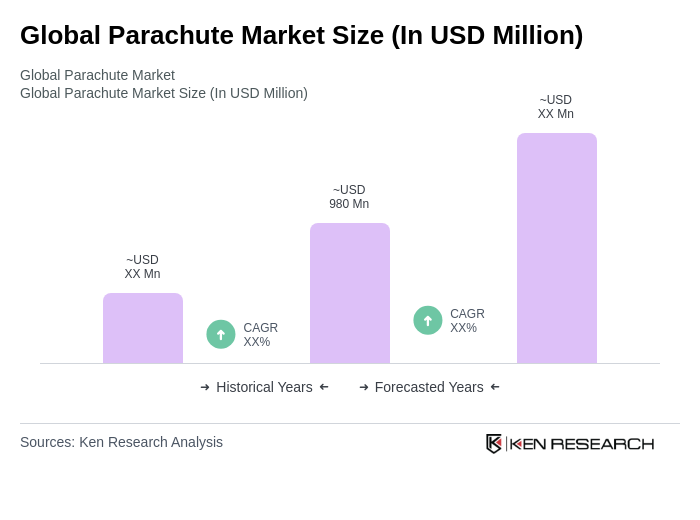
- Key players in this market include the United States, Germany, and the United Kingdom, which dominate due to their strong military presence and investment in defense technologies; North America leads the market with significant defense demand, while Europe hosts major military and industrial suppliers.
- Additionally, countries with a robust recreational skydiving culture, such as Australia and Canada, contribute to market growth via tourism and adventure sports participation and infrastructure (drop zones, training, tandem operations).
- In 2023, the U.S. government implemented new regulations mandating enhanced safety standards for parachute manufacturing. This regulation requires all parachute systems to undergo rigorous testing and certification processes, ensuring that they meet the latest safety protocols, thereby increasing consumer confidence and market demand.
Global Parachute Market Segmentation
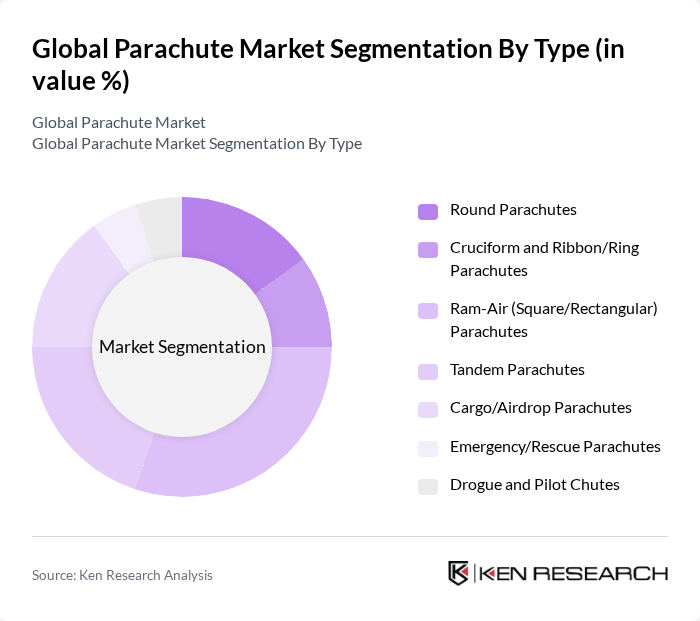
By Type:The market is segmented into various types of parachutes, each serving distinct purposes and applications. The primary types include Round Parachutes, Cruciform and Ribbon/Ring Parachutes, Ram-Air (Square/Rectangular) Parachutes, Tandem Parachutes, Cargo/Airdrop Parachutes, Emergency/Rescue Parachutes, and Drogue and Pilot Chutes. Each type has unique characteristics that cater to specific operational needs.
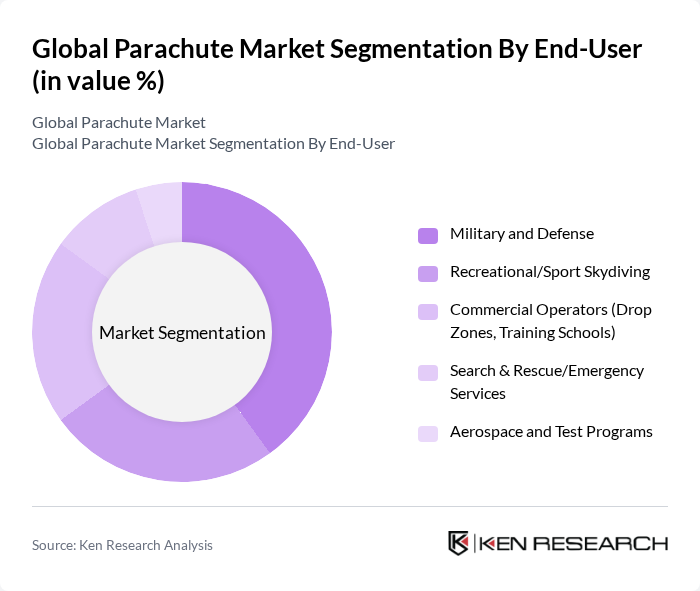
By End-User:The market is categorized based on end-users, which include Military and Defense, Recreational/Sport Skydiving, Commercial Operators (Drop Zones, Training Schools), Search & Rescue/Emergency Services, and Aerospace and Test Programs. Each end-user segment has distinct requirements and contributes differently to the overall market dynamics, with military applications generally accounting for the largest share and North America leading by end-use demand.
Global Parachute Market Competitive Landscape
The Global Parachute Market is characterized by a dynamic mix of regional and international players. Leading participants such as Airborne Systems Group (UK/US), Performance Designs, Inc. (US), NZ Aerosports Ltd (New Zealand), Aerodyne Research, LLC (US/South Africa), United Parachute Technologies (UPT) (US), Sun Path Products, Inc. (US), Mirage Systems, Inc. (US), Parachute Systems (South Africa), Strong Enterprises (US), National Parachute Industries, Inc. (US), Butler Parachute Systems, Inc. (US), Atair Aerospace, Inc. (US), Mills Manufacturing Corporation (US), FXC Corporation / Guardian Parachute (US), Spekon GmbH (Germany) contribute to innovation, geographic expansion, and service delivery in this space.
Global Parachute Market Industry Analysis
Growth Drivers
- Increasing Demand for Recreational Parachuting:The recreational parachuting segment has seen a significant rise, with over3 millionjumps recorded annually in the U.S. alone. This surge is driven by a growing interest in adventure sports, particularly among millennials and Gen Z, who prioritize unique experiences. The global adventure tourism market, valued at approximatelyUSD 1 trillion, is projected to grow, further fueling demand for parachuting activities and related equipment in theregion.
- Advancements in Parachute Technology:Technological innovations have led to the development of more reliable and efficient parachute systems. For instance, the introduction of automated deployment systems has reduced the risk of human error, enhancing safety. In the future, the global investment in aerospace technology is expected to reachUSD 1.5 trillion, with a notable portion allocated to parachute advancements. This trend is expected to continue, driving growth in the parachute market as safety and performance improve.
- Rising Military Expenditure on Parachute Systems:Military budgets worldwide are increasing, with global defense spending reachingUSD 2.44 trillion. This rise includes significant investments in advanced parachute systems for troop deployment and cargo delivery. Theregion, with its strategic military interests, is likely to see a boost in demand for specialized parachute systems, contributing to overall market growth as governments prioritize modernization and operational readiness.
Market Challenges
- Stringent Safety Regulations:The parachute industry faces rigorous safety regulations imposed by aviation authorities, which can hinder market entry for new players. Compliance with international safety standards, such as those set by the Federal Aviation Administration (FAA) and the European Union Aviation Safety Agency (EASA), requires substantial investment in testing and certification. In the future, the cost of compliance for manufacturers was estimated atUSD 600,000per product line, posing a significant barrier to entry.
- High Initial Investment Costs:The initial costs associated with parachute manufacturing and technology development are substantial. For instance, setting up a production facility can exceedUSD 1.5 million, not including R&D expenses. This financial burden can deter new entrants and limit competition. Additionally, the need for specialized materials and skilled labor further escalates costs, making it challenging for smaller companies to thrive in the market.
Global Parachute Market Future Outlook
The future of the parachute market in theregion appears promising, driven by technological advancements and a growing interest in adventure sports. As safety technologies continue to evolve, the market is likely to attract more participants, including those from emerging economies. Additionally, the integration of eco-friendly materials in parachute manufacturing is expected to resonate with environmentally conscious consumers, further enhancing market appeal and sustainability in the coming years.
Market Opportunities
- Expansion into Emerging Markets:Emerging markets, particularly in Asia and Africa, present significant growth opportunities for parachute manufacturers. With rising disposable incomes and increasing interest in adventure tourism, these regions are poised for market expansion. The global adventure tourism market is expected to grow byUSD 1.5 trillion, indicating a ripe opportunity for parachute companies to establish a presence and cater to new customers.
- Development of Smart Parachute Systems:The advent of smart technology in parachuting, such as GPS tracking and automated deployment systems, offers a lucrative opportunity for innovation. As consumer demand for enhanced safety and performance grows, companies that invest in smart parachute systems can differentiate themselves. The global smart textiles market, valued atUSD 3 billion, indicates a strong potential for integrating smart technologies into parachute designs.
Scope of the Report
| Segment | Sub-Segments |
|---|---|
| By Type | Round Parachutes Cruciform and Ribbon/Ring Parachutes Ram-Air (Square/Rectangular) Parachutes Tandem Parachutes Cargo/Airdrop Parachutes Emergency/Rescue Parachutes Drogue and Pilot Chutes |
| By End-User | Military and Defense Recreational/Sport Skydiving Commercial Operators (Drop Zones, Training Schools) Search & Rescue/Emergency Services Aerospace and Test Programs |
| By Application | Personnel Airborne Operations Cargo and Equipment Airdrop Skydiving and Tandem Jumps Search and Rescue/Recovery UAV/Spacecraft Recovery and Testing |
| By Distribution Channel | Direct Government/Defense Procurement OEM Direct Sales Authorized Distributors/Dealers Specialty Retailers and E-commerce Training Schools and DZ Partnerships |
| By Region | North America Europe Asia-Pacific Latin America Middle East & Africa Rest of World |
| By Price Range | Budget Mid-Range Premium |
| By Payload Capacity | Light Payload (?120 kg) Medium Payload (121–500 kg) Heavy Payload (>500 kg) Ultra-Heavy/Special Mission |
Key Target Audience
Investors and Venture Capitalist Firms
Government and Regulatory Bodies (e.g., Federal Aviation Administration, European Union Aviation Safety Agency)
Manufacturers and Producers
Distributors and Retailers
Military and Defense Organizations
Aerospace and Aviation Companies
Adventure Sports Organizations
Insurance Companies
Players Mentioned in the Report:
Airborne Systems Group (UK/US)
Performance Designs, Inc. (US)
NZ Aerosports Ltd (New Zealand)
Aerodyne Research, LLC (US/South Africa)
United Parachute Technologies (UPT) (US)
Sun Path Products, Inc. (US)
Mirage Systems, Inc. (US)
Parachute Systems (South Africa)
Strong Enterprises (US)
National Parachute Industries, Inc. (US)
Butler Parachute Systems, Inc. (US)
Atair Aerospace, Inc. (US)
Mills Manufacturing Corporation (US)
FXC Corporation / Guardian Parachute (US)
Spekon GmbH (Germany)
Table of Contents
Market Assessment Phase
1. Executive Summary and Approach
2. Global Parachute Market Overview
2.1 Key Insights and Strategic Recommendations
2.2 Global Parachute Market Overview
2.3 Definition and Scope
2.4 Evolution of Market Ecosystem
2.5 Timeline of Key Regulatory Milestones
2.6 Value Chain & Stakeholder Mapping
2.7 Business Cycle Analysis
2.8 Policy & Incentive Landscape
3. Global Parachute Market Analysis
3.1 Growth Drivers
3.1.1 Increasing Demand for Recreational Parachuting
3.1.2 Advancements in Parachute Technology
3.1.3 Rising Military Expenditure on Parachute Systems
3.1.4 Growth in Adventure Tourism
3.2 Market Challenges
3.2.1 Stringent Safety Regulations
3.2.2 High Initial Investment Costs
3.2.3 Competition from Alternative Aerial Activities
3.2.4 Seasonal Demand Fluctuations
3.3 Market Opportunities
3.3.1 Expansion into Emerging Markets
3.3.2 Development of Smart Parachute Systems
3.3.3 Partnerships with Adventure Sports Companies
3.3.4 Increasing Popularity of Skydiving Schools
3.4 Market Trends
3.4.1 Growing Popularity of Indoor Skydiving
3.4.2 Customization of Parachute Designs
3.4.3 Integration of Safety Technologies
3.4.4 Eco-friendly Parachute Materials
3.5 Government Regulation
3.5.1 Compliance with International Safety Standards
3.5.2 Licensing Requirements for Parachute Instructors
3.5.3 Regulations on Parachute Manufacturing
3.5.4 Airspace Management Policies
4. SWOT Analysis
5. Stakeholder Analysis
6. Porter's Five Forces Analysis
7. Global Parachute Market Market Size, 2019-2024
7.1 By Value
7.2 By Volume
7.3 By Average Selling Price
8. Global Parachute Market Segmentation
8.1 By Type
8.1.1 Round Parachutes
8.1.2 Cruciform and Ribbon/Ring Parachutes
8.1.3 Ram-Air (Square/Rectangular) Parachutes
8.1.4 Tandem Parachutes
8.1.5 Cargo/Airdrop Parachutes
8.1.6 Emergency/Rescue Parachutes
8.1.7 Drogue and Pilot Chutes
8.2 By End-User
8.2.1 Military and Defense
8.2.2 Recreational/Sport Skydiving
8.2.3 Commercial Operators (Drop Zones, Training Schools)
8.2.4 Search & Rescue/Emergency Services
8.2.5 Aerospace and Test Programs
8.3 By Application
8.3.1 Personnel Airborne Operations
8.3.2 Cargo and Equipment Airdrop
8.3.3 Skydiving and Tandem Jumps
8.3.4 Search and Rescue/Recovery
8.3.5 UAV/Spacecraft Recovery and Testing
8.4 By Distribution Channel
8.4.1 Direct Government/Defense Procurement
8.4.2 OEM Direct Sales
8.4.3 Authorized Distributors/Dealers
8.4.4 Specialty Retailers and E-commerce
8.4.5 Training Schools and DZ Partnerships
8.5 By Region
8.5.1 North America
8.5.2 Europe
8.5.3 Asia-Pacific
8.5.4 Latin America
8.5.5 Middle East & Africa
8.5.6 Rest of World
8.6 By Price Range
8.6.1 Budget
8.6.2 Mid-Range
8.6.3 Premium
8.7 By Payload Capacity
8.7.1 Light Payload (?120 kg)
8.7.2 Medium Payload (121–500 kg)
8.7.3 Heavy Payload (>500 kg)
8.7.4 Ultra-Heavy/Special Mission
9. Global Parachute Market Competitive Analysis
9.1 Market Share of Key Players
9.2 Cross Comparison of Key Players
9.2.1 Company Name
9.2.2 Segment Focus (Military, Cargo, Sport/Tandem, Emergency)
9.2.3 Revenue (Latest FY) and 3-year CAGR
9.2.4 Contract Backlog/Defense Program Wins
9.2.5 Global Footprint (Manufacturing Sites/Regions Served)
9.2.6 Certification Portfolio (e.g., TSO-C23f, MIL-STD, NATO AQAP)
9.2.7 Product Innovation Rate (New Models/Upgrades per Year)
9.2.8 On-time Delivery and Lead Time (Days)
9.2.9 Failure Rate/Field Safety Incidents (per 10,000 deployments)
9.2.10 Average Selling Price Band by Product Type
9.2.11 Aftermarket Mix (Canopy Relines, Reserve Repack %, AAD Integration)
9.2.12 Partnerships and Distribution Coverage (Dealers/DZs)
9.3 SWOT Analysis of Top Players
9.4 Pricing Analysis
9.5 Detailed Profile of Major Companies
9.5.1 Airborne Systems Group (UK/US)
9.5.2 Performance Designs, Inc. (US)
9.5.3 NZ Aerosports Ltd (New Zealand)
9.5.4 Aerodyne Research, LLC (US/South Africa)
9.5.5 United Parachute Technologies (UPT) (US)
9.5.6 Sun Path Products, Inc. (US)
9.5.7 Mirage Systems, Inc. (US)
9.5.8 Parachute Systems (South Africa)
9.5.9 Strong Enterprises (US)
9.5.10 National Parachute Industries, Inc. (US)
9.5.11 Butler Parachute Systems, Inc. (US)
9.5.12 Atair Aerospace, Inc. (US)
9.5.13 Mills Manufacturing Corporation (US)
9.5.14 FXC Corporation / Guardian Parachute (US)
9.5.15 Spekon GmbH (Germany)
10. Global Parachute Market End-User Analysis
10.1 Procurement Behavior of Key Ministries
10.1.1 Military Procurement Trends
10.1.2 Emergency Services Equipment Acquisition
10.1.3 Recreational Parachuting Regulations
10.2 Corporate Spend on Infrastructure & Energy
10.2.1 Investment in Training Facilities
10.2.2 Budget Allocation for Safety Equipment
10.2.3 Funding for Adventure Sports Initiatives
10.3 Pain Point Analysis by End-User Category
10.3.1 Military Challenges in Equipment Standardization
10.3.2 Recreational User Safety Concerns
10.3.3 Commercial Operator Cost Management
10.4 User Readiness for Adoption
10.4.1 Training and Certification Requirements
10.4.2 Awareness of Safety Protocols
10.4.3 Accessibility of Parachuting Facilities
10.5 Post-Deployment ROI and Use Case Expansion
10.5.1 Evaluation of Training Program Effectiveness
10.5.2 Analysis of Customer Feedback for Improvement
10.5.3 Expansion into New Markets
11. Global Parachute Market Future Size, 2025-2030
11.1 By Value
11.2 By Volume
11.3 By Average Selling Price
Go-To-Market Strategy Phase
1. Whitespace Analysis + Business Model Canvas
1.1 Market Gaps Identification
1.2 Value Proposition Development
1.3 Revenue Streams Analysis
1.4 Key Partnerships Exploration
1.5 Customer Segmentation
1.6 Cost Structure Assessment
1.7 Competitive Advantage Analysis
2. Marketing and Positioning Recommendations
2.1 Branding Strategies
2.2 Product USPs
2.3 Target Audience Identification
2.4 Marketing Channels Selection
2.5 Messaging and Communication Strategy
3. Distribution Plan
3.1 Urban Retail Strategies
3.2 Rural NGO Tie-ups
3.3 Online Distribution Channels
3.4 Partnerships with Adventure Sports Outlets
4. Channel & Pricing Gaps
4.1 Underserved Routes Analysis
4.2 Pricing Bands Evaluation
4.3 Competitor Pricing Comparison
5. Unmet Demand & Latent Needs
5.1 Category Gaps Identification
5.2 Consumer Segments Analysis
5.3 Emerging Trends Exploration
6. Customer Relationship
6.1 Loyalty Programs Development
6.2 After-sales Service Improvement
6.3 Customer Feedback Mechanisms
7. Value Proposition
7.1 Sustainability Initiatives
7.2 Integrated Supply Chains
7.3 Unique Selling Points
8. Key Activities
8.1 Regulatory Compliance
8.2 Branding Initiatives
8.3 Distribution Setup
9. Entry Strategy Evaluation
9.1 Domestic Market Entry Strategy
9.1.1 Product Mix Considerations
9.1.2 Pricing Band Strategy
9.1.3 Packaging Innovations
9.2 Export Entry Strategy
9.2.1 Target Countries Identification
9.2.2 Compliance Roadmap Development
10. Entry Mode Assessment
10.1 Joint Ventures
10.2 Greenfield Investments
10.3 Mergers & Acquisitions
10.4 Distributor Model Evaluation
11. Capital and Timeline Estimation
11.1 Capital Requirements Analysis
11.2 Timelines for Market Entry
12. Control vs Risk Trade-Off
12.1 Ownership vs Partnerships
13. Profitability Outlook
13.1 Breakeven Analysis
13.2 Long-term Sustainability Assessment
14. Potential Partner List
14.1 Distributors Identification
14.2 Joint Ventures Opportunities
14.3 Acquisition Targets
15. Execution Roadmap
15.1 Phased Plan for Market Entry
15.1.1 Market Setup
15.1.2 Market Entry
15.1.3 Growth Acceleration
15.1.4 Scale & Stabilize
15.2 Key Activities and Milestones
15.2.1 Activity Planning
15.2.2 Milestone Tracking
Research Methodology
Phase 1: Approach1
Desk Research
- Industry reports from global parachute manufacturers and suppliers
- Market analysis from aviation and aerospace regulatory bodies
- Published articles and white papers on parachute technology advancements
Primary Research
- Interviews with product managers at leading parachute manufacturing companies
- Surveys with skydiving instructors and safety officers
- Field interviews with military procurement officers and defense contractors
Validation & Triangulation
- Cross-validation using historical sales data and market growth rates
- Triangulation of insights from primary interviews and secondary data sources
- Sanity check through expert panel reviews from the aerospace sector
Phase 2: Market Size Estimation1
Top-down Assessment
- Global market size derived from military and recreational parachute spending
- Segmentation by application: military, recreational, and emergency services
- Incorporation of trends in adventure sports and military modernization
Bottom-up Modeling
- Volume estimates based on production data from major parachute manufacturers
- Cost analysis of parachute materials and manufacturing processes
- Sales projections based on historical growth rates and market demand
Forecasting & Scenario Analysis
- Multi-factor regression analysis considering economic indicators and consumer trends
- Scenario planning based on military budget allocations and recreational market growth
- Baseline, optimistic, and pessimistic forecasts through 2030
Phase 3: CATI Sample Composition1
| Scope Item/Segment | Sample Size | Target Respondent Profiles |
|---|---|---|
| Military Parachute Procurement | 100 | Defense Procurement Officers, Military Equipment Managers |
| Recreational Skydiving Equipment | 120 | Skydiving Instructors, Equipment Retailers |
| Emergency Services Parachute Use | 80 | Fire Department Coordinators, Emergency Response Managers |
| Parachute Manufacturing Insights | 70 | Production Managers, Quality Assurance Specialists |
| Parachute Technology Development | 60 | R&D Engineers, Aerospace Technology Experts |
Frequently Asked Questions
What is the current value of the Global Parachute Market?
The Global Parachute Market is valued at approximately USD 980 million, reflecting a significant growth trend driven by military applications, recreational skydiving, and advancements in parachute technology.
What factors are driving the growth of the Global Parachute Market?
Which regions dominate the Global Parachute Market?
What types of parachutes are available in the market?
Other Regional/Country Reports
Indonesia Parachute Market
Malaysia Parachute Market
APAC Parachute Market
SEA Parachute Market
Why Buy From Us?

What makes us stand out is that our consultants follow Robust, Refine and Result (RRR) methodology. Robust for clear definitions, approaches and sanity checking, Refine for differentiating respondents' facts and opinions, and Result for presenting data with story.

We have set a benchmark in the industry by offering our clients with syndicated and customized market research reports featuring coverage of entire market as well as meticulous research and analyst insights.

While we don't replace traditional research, we flip the method upside down. Our dual approach of Top Bottom & Bottom Top ensures quality deliverable by not just verifying company fundamentals but also looking at the sector and macroeconomic factors.

With one step in the future, our research team constantly tries to show you the bigger picture. We help with some of the tough questions you may encounter along the way: How is the industry positioned? Best marketing channel? KPI's of competitors? By aligning every element, we help maximize success.

Our report gives you instant access to the answers and sources that other companies might choose to hide. We elaborate each steps of research methodology we have used and showcase you the sample size to earn your trust.

If you need any support, we are here! We pride ourselves on universe strength, data quality, and quick, friendly, and professional service.